IR SPECTRAL FEATURES OF
SOME ORGANIC COMPOUNDS
Features of an IR Spectrum
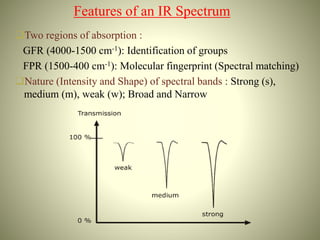
Two regions of absorption :
GFR (4000-1500 cm-1): Identification of groups
FPR (1500-400 cm-1): Molecular fingerprint (Spectral matching)
Nature (Intensity and Shape) of spectral bands : Strong (s),
medium (m), weak (w); Broad and Narrow
HYDROCARBONS:
1.ALKANES:
They yield four stretching and bending vibration of C-H and C-C
bonds.
1 .C - C BENDING VIBRATION :
2. C - H STRETCHING VIBRATION
3. CH3 BENDING VIBRATIONS:
4. CH2 BENDING VIBRATION :
Example
Decane , cyclohexane
#
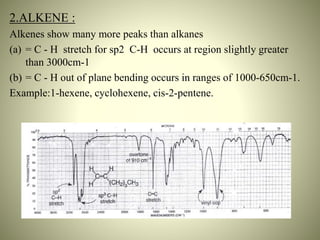
2.ALKENE :
Alkenes show many more peaks than alkanes
(a) = C - H stretch for sp2 C-H occurs at region slightly greater
than 3000cm-1
(b) = C - H out of plane bending occurs in ranges of 1000-650cm-1.
Example:1-hexene, cyclohexene, cis-2-pentene.
3.ALKYNES:
Terminal alkyne show prominent peak at about 3300cm-1 for
SP hybridized C-H.
≡C – H stretching vibration occurs at 3300cm-1
C≡C stretch occurs near 2150cm-1 this is only for terminal
alkynes (absent or very weak for non terminal alkynes)
Example:1-hexyne,1-octyne,4-octyne
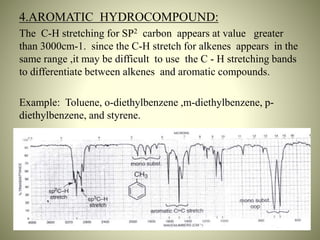
4.AROMATIC HYDROCOMPOUND:
The C-H stretching for SP2 carbon appears at value greater
than 3000cm-1. since the C-H stretch for alkenes appears in the
same range ,it may be difficult to use the C - H stretching bands
to differentiate between alkenes and aromatic compounds.
Example: Toluene, o-diethylbenzene ,m-diethylbenzene, p-
diethylbenzene, and styrene.
*For aromatic compounds, the most characteristic C=C stretching
bands are at 1600cm-1, 1580cm-1, 1500cm-1 and 1450cm-1.
* If there is no absorption in this region, it is a fair proof that the
compound is not aromatic.
5.ALCOHOL AND PHENOL:
Alcohol and phenol show strong and broad hydrogen bonded O-H
stretching bands between 3400cm-1 and 3300cm-1. In solution it
will also be possible to observe a free O-H stretching band at
3600cm-1.
Example: 1-hexanol,2-butanol,para cresol.
6.ETHERS:
Ether show prominent C-O stretching band at 1300 to 1000cm-1.
Absence of C=O and O-H is required to ensure that C-O stretch is
not due to an ester and phenol .phenyl alkyl ether gives two strong
bands at 1250cm-1 and 1040cm-1.
Example: dibutylether, anisole
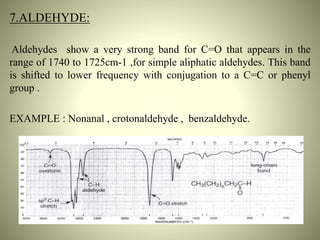
7.ALDEHYDE:
Aldehydes show a very strong band for C=O that appears in the
range of 1740 to 1725cm-1 ,for simple aliphatic aldehydes. This band
is shifted to lower frequency with conjugation to a C=C or phenyl
group .
EXAMPLE : Nonanal , crotonaldehyde , benzaldehyde.
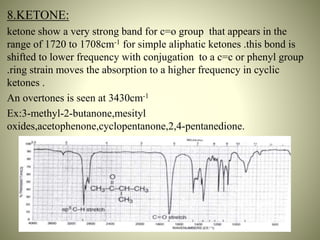
8.KETONE:
ketone show a very strong band for c=o group that appears in the
range of 1720 to 1708cm-1 for simple aliphatic ketones .this bond is
shifted to lower frequency with conjugation to a c=c or phenyl group
.ring strain moves the absorption to a higher frequency in cyclic
ketones .
An overtones is seen at 3430cm-1
Ex:3-methyl-2-butanone,mesityl
oxides,acetophenone,cyclopentanone,2,4-pentanedione.
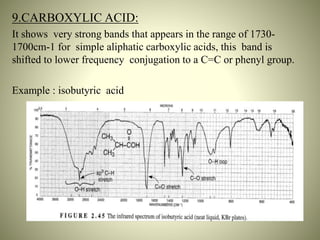
9.CARBOXYLIC ACID:
It shows very strong bands that appears in the range of 1730-
1700cm-1 for simple aliphatic carboxylic acids, this band is
shifted to lower frequency conjugation to a C=C or phenyl group.
Example : isobutyric acid
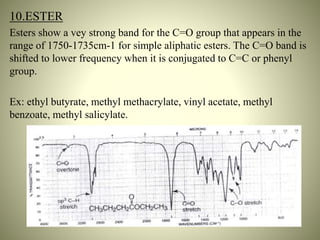
10.ESTER
Esters show a vey strong band for the C=O group that appears in the
range of 1750-1735cm-1 for simple aliphatic esters. The C=O band is
shifted to lower frequency when it is conjugated to C=C or phenyl
group.
Ex: ethyl butyrate, methyl methacrylate, vinyl acetate, methyl
benzoate, methyl salicylate.
11.AMIDES
Amides show a very strong band for the C=O group that appears in
the range of 1680 to 1630cm-1.
N-H stretch in primary amides (-NH2) gives two bands near
3350cm-1 (asymmetric), and 3180cm-1 (symmetric) secondary
amides (-NH) have one band at 3300cm-1. Tertiary amides will not
show an N-H stretch because they do not contain N-H.
EX: Propionamide, N-Methylacetamide
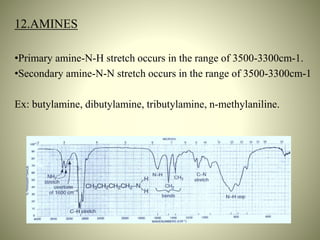
12.AMINES
•Primary amine-N-H stretch occurs in the range of 3500-3300cm-1.
•Secondary amine-N-N stretch occurs in the range of 3500-3300cm-1
Ex: butylamine, dibutylamine, tributylamine, n-methylaniline.
CONCLUSION
• Infra-red spectrum of a compound provides more information than
is normally available from the electronic spectra.
• The position of the peek or the band not only tells the presence of a
particular group but also reveals a good deal about the environments
affecting the group.
• Further study of the spectrum reveals whether it is aldehydic,
ketonic, esters, amide etc.
• Due to the different positions of absorptions, it is also possible to
know the axial and the equatorial positions of certain groups in a
cyclic structure.
REFERENCE:
1.Pharmaceutical drug analysis Ashutoshkar , New age international
publishers page 330-335.
2.Introduction to spectroscopy .Donald L. Pavia, Gray
M.Lampman, George S. Kritz. 3rd edition ,page 13-82.
3. Spectroscopy .B.K Sharma, Goel Publishing house, page 193-
333.
4. Elementary organic spectroscopy .Y.R Sharma.S.Chand and
company Ltd,page 90.
5.Spectrometric identification of organic compound.Robert
M.Silverstein ,Francis X.Webster,David J.Kiemle. 7th edition page
72-125
Thank you

Ir interpretation

  • 1.
    IR SPECTRAL FEATURESOF SOME ORGANIC COMPOUNDS
  • 2.
    Features of anIR Spectrum Two regions of absorption : GFR (4000-1500 cm-1): Identification of groups FPR (1500-400 cm-1): Molecular fingerprint (Spectral matching) Nature (Intensity and Shape) of spectral bands : Strong (s), medium (m), weak (w); Broad and Narrow
  • 3.
    HYDROCARBONS: 1.ALKANES: They yield fourstretching and bending vibration of C-H and C-C bonds. 1 .C - C BENDING VIBRATION : 2. C - H STRETCHING VIBRATION 3. CH3 BENDING VIBRATIONS: 4. CH2 BENDING VIBRATION : Example Decane , cyclohexane
  • 4.
  • 5.
    2.ALKENE : Alkenes showmany more peaks than alkanes (a) = C - H stretch for sp2 C-H occurs at region slightly greater than 3000cm-1 (b) = C - H out of plane bending occurs in ranges of 1000-650cm-1. Example:1-hexene, cyclohexene, cis-2-pentene.
  • 6.
    3.ALKYNES: Terminal alkyne showprominent peak at about 3300cm-1 for SP hybridized C-H. ≡C – H stretching vibration occurs at 3300cm-1 C≡C stretch occurs near 2150cm-1 this is only for terminal alkynes (absent or very weak for non terminal alkynes) Example:1-hexyne,1-octyne,4-octyne
  • 7.
    4.AROMATIC HYDROCOMPOUND: The C-Hstretching for SP2 carbon appears at value greater than 3000cm-1. since the C-H stretch for alkenes appears in the same range ,it may be difficult to use the C - H stretching bands to differentiate between alkenes and aromatic compounds. Example: Toluene, o-diethylbenzene ,m-diethylbenzene, p- diethylbenzene, and styrene.
  • 8.
    *For aromatic compounds,the most characteristic C=C stretching bands are at 1600cm-1, 1580cm-1, 1500cm-1 and 1450cm-1. * If there is no absorption in this region, it is a fair proof that the compound is not aromatic.
  • 9.
    5.ALCOHOL AND PHENOL: Alcoholand phenol show strong and broad hydrogen bonded O-H stretching bands between 3400cm-1 and 3300cm-1. In solution it will also be possible to observe a free O-H stretching band at 3600cm-1. Example: 1-hexanol,2-butanol,para cresol.
  • 11.
    6.ETHERS: Ether show prominentC-O stretching band at 1300 to 1000cm-1. Absence of C=O and O-H is required to ensure that C-O stretch is not due to an ester and phenol .phenyl alkyl ether gives two strong bands at 1250cm-1 and 1040cm-1. Example: dibutylether, anisole
  • 12.
    7.ALDEHYDE: Aldehydes show avery strong band for C=O that appears in the range of 1740 to 1725cm-1 ,for simple aliphatic aldehydes. This band is shifted to lower frequency with conjugation to a C=C or phenyl group . EXAMPLE : Nonanal , crotonaldehyde , benzaldehyde.
  • 13.
    8.KETONE: ketone show avery strong band for c=o group that appears in the range of 1720 to 1708cm-1 for simple aliphatic ketones .this bond is shifted to lower frequency with conjugation to a c=c or phenyl group .ring strain moves the absorption to a higher frequency in cyclic ketones . An overtones is seen at 3430cm-1 Ex:3-methyl-2-butanone,mesityl oxides,acetophenone,cyclopentanone,2,4-pentanedione.
  • 14.
    9.CARBOXYLIC ACID: It showsvery strong bands that appears in the range of 1730- 1700cm-1 for simple aliphatic carboxylic acids, this band is shifted to lower frequency conjugation to a C=C or phenyl group. Example : isobutyric acid
  • 15.
    10.ESTER Esters show avey strong band for the C=O group that appears in the range of 1750-1735cm-1 for simple aliphatic esters. The C=O band is shifted to lower frequency when it is conjugated to C=C or phenyl group. Ex: ethyl butyrate, methyl methacrylate, vinyl acetate, methyl benzoate, methyl salicylate.
  • 16.
    11.AMIDES Amides show avery strong band for the C=O group that appears in the range of 1680 to 1630cm-1. N-H stretch in primary amides (-NH2) gives two bands near 3350cm-1 (asymmetric), and 3180cm-1 (symmetric) secondary amides (-NH) have one band at 3300cm-1. Tertiary amides will not show an N-H stretch because they do not contain N-H. EX: Propionamide, N-Methylacetamide
  • 17.
    12.AMINES •Primary amine-N-H stretchoccurs in the range of 3500-3300cm-1. •Secondary amine-N-N stretch occurs in the range of 3500-3300cm-1 Ex: butylamine, dibutylamine, tributylamine, n-methylaniline.
  • 18.
    CONCLUSION • Infra-red spectrumof a compound provides more information than is normally available from the electronic spectra. • The position of the peek or the band not only tells the presence of a particular group but also reveals a good deal about the environments affecting the group. • Further study of the spectrum reveals whether it is aldehydic, ketonic, esters, amide etc. • Due to the different positions of absorptions, it is also possible to know the axial and the equatorial positions of certain groups in a cyclic structure.
  • 19.
    REFERENCE: 1.Pharmaceutical drug analysisAshutoshkar , New age international publishers page 330-335. 2.Introduction to spectroscopy .Donald L. Pavia, Gray M.Lampman, George S. Kritz. 3rd edition ,page 13-82. 3. Spectroscopy .B.K Sharma, Goel Publishing house, page 193- 333. 4. Elementary organic spectroscopy .Y.R Sharma.S.Chand and company Ltd,page 90. 5.Spectrometric identification of organic compound.Robert M.Silverstein ,Francis X.Webster,David J.Kiemle. 7th edition page 72-125
  • 20.