Infrared Spectroscopy 
By-Saurav K. Rawat 
(Rawat DA Greatt)
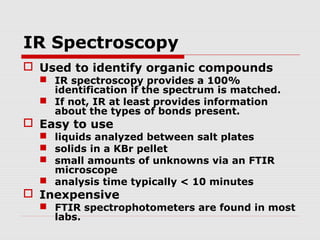
IR Spectroscopy 
 Used to identify organic compounds 
 IR spectroscopy provides a 100% 
identification if the spectrum is matched. 
 If not, IR at least provides information 
about the types of bonds present. 
 Easy to use 
 liquids analyzed between salt plates 
 solids in a KBr pellet 
 small amounts of unknowns via an FTIR 
microscope 
 analysis time typically < 10 minutes 
 Inexpensive 
 FTIR spectrophotometers are found in most 
labs.
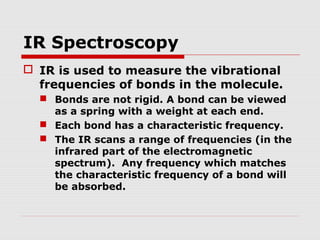
IR Spectroscopy 
 IR is used to measure the vibrational 
frequencies of bonds in the molecule. 
 Bonds are not rigid. A bond can be viewed 
as a spring with a weight at each end. 
 Each bond has a characteristic frequency. 
 The IR scans a range of frequencies (in the 
infrared part of the electromagnetic 
spectrum). Any frequency which matches 
the characteristic frequency of a bond will 
be absorbed.
IR Spectrophotometers 
 In the old days, the frequencies 
were stepped through, one at a 
time, and the absorption 
measured. 
 This means of data collection was very 
slow. 
 Laser technology and computers 
have made available a much 
faster means of data collection.
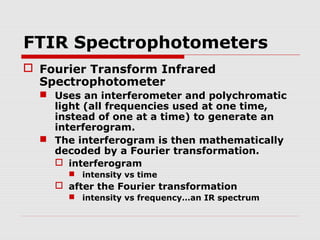
FTIR Spectrophotometers 
 Fourier Transform Infrared 
Spectrophotometer 
 Uses an interferometer and polychromatic 
light (all frequencies used at one time, 
instead of one at a time) to generate an 
interferogram. 
 The interferogram is then mathematically 
decoded by a Fourier transformation. 
 interferogram 
 intensity vs time 
 after the Fourier transformation 
 intensity vs frequency…an IR spectrum
FTIR Spectrophotometers 
 http://www.chemistry.oregonstate.edu/ FTIR spectrophotometers collect 
data very quickly and, of course, 
the spectra can be stored and 
reviewed electronically.
An IR Spectrum 
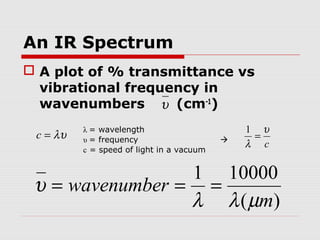
 A plot of % transmittance vs 
vibrational frequency in 
wavenumbers (cm-1) 
u 
c 
c = lu 1 = 
l 
1 10000 
m 
( ) 
wavenumber 
u = = = 
l l m 
u 
λ = wavelength 
υ = frequency  
c = speed of light in a vacuum
Wavenumbers 
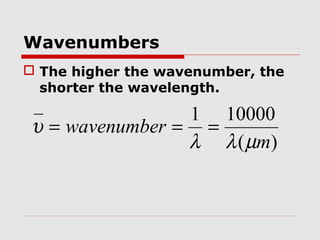
 The higher the wavenumber, the 
shorter the wavelength. 
1 10000 
m 
( ) 
wavenumber 
u = = = 
l l m
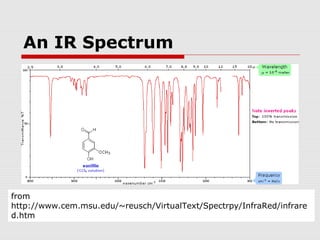
An IR Spectrum 
from 
http://www.cem.msu.edu/~reusch/VirtualText/Spectrpy/InfraRed/infrare 
d.htm
An IR Spectrum 
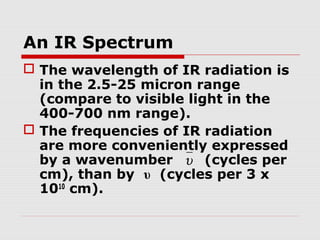
 The wavelength of IR radiation is 
in the 2.5-25 micron range 
(compare to visible light in the 
400-700 nm range). 
 The frequencies of IR radiation 
are more conveniently expressed 
by a wavenumber u 
(cycles per 
cm), than by υ (cycles per 3 x 
1010 cm).
Characteristic Vibrational 
Frequencies of Bonds 
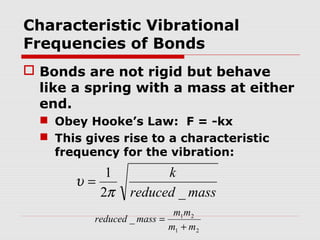
 Bonds are not rigid but behave 
like a spring with a mass at either 
end. 
 Obey Hooke’s Law: F = -kx 
 This gives rise to a characteristic 
frequency for the vibration: 
k 
reduced mass 
1 
p 
2 _ 
u = 
reduced mass m m 
_ 1 2 
m + 
m 
1 2 
=
Characteristic Vibrational 
Frequencies of Bonds 
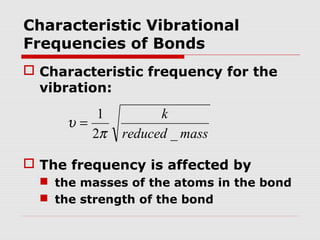
 Characteristic frequency for the 
vibration: 
k 
reduced mass 
1 
p 
2 _ 
u = 
 The frequency is affected by 
 the masses of the atoms in the bond 
 the strength of the bond
Characteristic Vibrational 
Frequencies of Bonds 
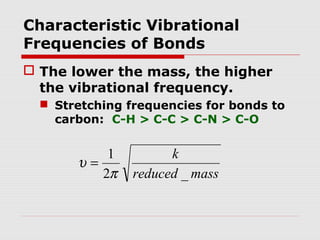
 The lower the mass, the higher 
the vibrational frequency. 
 Stretching frequencies for bonds to 
carbon: C-H > C-C > C-N > C-O 
k 
reduced mass 
1 
p 
2 _ 
u =
Characteristic Vibrational 
Frequencies of Bonds 
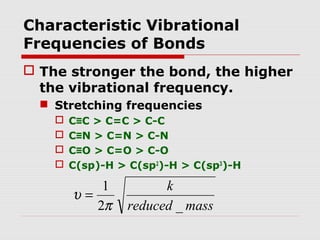
 The stronger the bond, the higher 
the vibrational frequency. 
 Stretching frequencies 
 C≡C > C=C > C-C 
 C≡N > C=N > C-N 
 C≡O > C=O > C-O 
 C(sp)-H > C(sp2)-H > C(sp3)-H 
k 
reduced mass 
1 
p 
2 _ 
u =
Number of Vibrational 
Frequencies in a Molecule 
 There are 3n-6 possible 
vibrational modes in a nonlinear 
molecule with no symmetry 
 Symmetry reduces the number of 
possible vibrational modes. 
 Water has 3 possible vibrational 
modes. 
 Formaldehyde has 6.
The Fingerprint Region is 
Unique to the Molecule 
 In addition, the vibration of a 
particular bond in a molecule 
affects the whole molecule. 
 The various harmonics of a bond 
vibration can combine and lead to a 
number of combinational bands. 
 The intensity of these bands is usually 
1/100 the intensity of the main 
vibrational absorptions. 
 These make up the “fingerprint 
region.” (occur at <1250 cm-1)
Intensity of IR Absorptions 
 In order for a vibration mode to absorb 
in the infrared, the vibrational motion 
must cause a change in the dipole 
moment of the bond. 
 The intensity of the IR “peaks” is 
proportional to the change in dipole 
moment that a bond undergoes during 
a vibration. 
 C=O bonds absorb strongly. 
 C=C bonds generally absorb much less.
How to Analyze an IR Spectrum 
 Pay the most attention to the 
strongest absorptions: 
 -C=O 
 -OH 
 -NH2 
 -C≡N 
 -NO2 
 Pay more attention to the peaks to the 
left of the fingerprint region (>1250 
cm-1).
How to Analyze an IR Spectrum 
 Pay the most attention to the 
strongest absorptions. 
 Pay more attention to the peaks 
to the left of the fingerprint 
region (>1250 cm-1). 
 Note the absence of certain 
peaks. 
 Be wary of O-H peaks, water is a 
common contaminant.
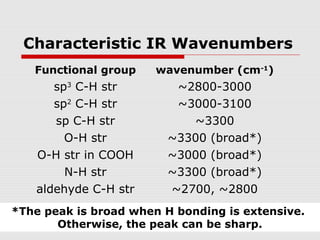
Characteristic IR Wavenumbers 
Functional group wavenumber (cm-1) 
sp3 C-H str ~2800-3000 
sp2 C-H str ~3000-3100 
sp C-H str ~3300 
O-H str ~3300 (broad*) 
O-H str in COOH ~3000 (broad*) 
N-H str ~3300 (broad*) 
aldehyde C-H str ~2700, ~2800 
*The peak is broad when H bonding is extensive. 
Otherwise, the peak can be sharp.
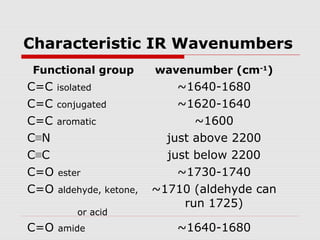
Characteristic IR Wavenumbers 
Functional group wavenumber (cm-1) 
C=C isolated ~1640-1680 
C=C conjugated ~1620-1640 
C=C aromatic ~1600 
C≡N just above 2200 
C≡C just below 2200 
C=O ester ~1730-1740 
C=O aldehyde, ketone, 
or acid 
~1710 (aldehyde can 
run 1725) 
C=O amide ~1640-1680
How to Analyze an IR Spectrum 
 Look for what’s there and what’s not there. 
 C-H absorption 
 The wavenumber will tell you sp3(C-C), 
sp2(C=C), sp (C≡C) and perhaps aldehyde. 
 Carbonyl (C=O) absorption 
 Its presence means the compound is an 
aldehyde, ketone, carboxylic acid, ester, 
amide, anhydride or acyl halide. 
 Its absence means the compound cannot be 
any of the carbonyl-containing compounds.
How to Analyze an IR Spectrum 
 O-H or N-H absorption 
 This indicates either an alcohol, N-H 
containing amine or amide, or carboxylic 
acid. 
 C≡C and C≡N absorptions 
 Be careful: internal triple bonds often do 
not show up in IR spectra. 
 C=C absorption 
 Can indicate whether compound is 
alkene or aromatic.
How to Analyze an IR Spectrum 
 N-O of NO2 absorption 
 This is a distinctive, strong doublet that 
it pays to know (1515-1560 & 1345- 
1385 cm-1). 
 Read the scale for the value of 
the wavenumbers (be able to 
interpolate), or 
 Read the wavenumbers in the 
table provided.
IR Spectra - Examples 
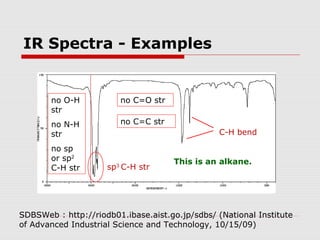
no C=O str 
no C=C str 
sp3 C-H str 
no O-H 
str 
no N-H 
str 
no sp 
or sp2 
C-H str 
C-H bend 
This is an alkane. 
SDBSWeb : http://riodb01.ibase.aist.go.jp/sdbs/ (National Institute 
of Advanced Industrial Science and Technology, 10/15/09)
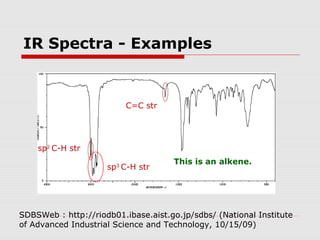
IR Spectra - Examples 
C=C str 
sp3 C-H str 
sp2 C-H str 
This is an alkene. 
SDBSWeb : http://riodb01.ibase.aist.go.jp/sdbs/ (National Institute 
of Advanced Industrial Science and Technology, 10/15/09)
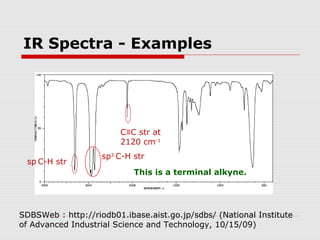
IR Spectra - Examples 
C≡C str at 
2120 cm-1 
sp3 C-H str 
This is a terminal alkyne. 
sp C-H str 
SDBSWeb : http://riodb01.ibase.aist.go.jp/sdbs/ (National Institute 
of Advanced Industrial Science and Technology, 10/15/09)
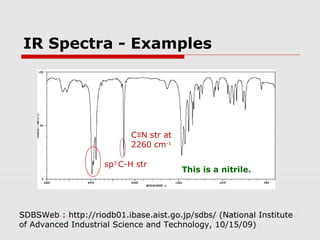
IR Spectra - Examples 
C≡N str at 
2260 cm-1 
sp3 C-H str 
This is a nitrile. 
SDBSWeb : http://riodb01.ibase.aist.go.jp/sdbs/ (National Institute 
of Advanced Industrial Science and Technology, 10/15/09)
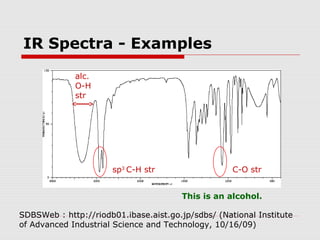
IR Spectra - Examples 
sp3 C-H str 
alc. 
O-H 
str 
C-O str 
This is an alcohol. 
SDBSWeb : http://riodb01.ibase.aist.go.jp/sdbs/ (National Institute 
of Advanced Industrial Science and Technology, 10/16/09)
How to Analyze an IR Spectrum 
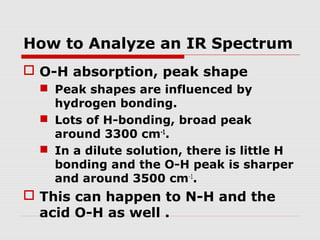
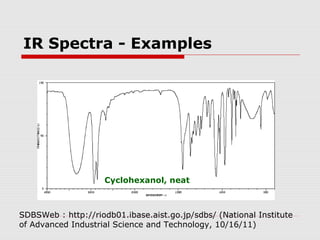
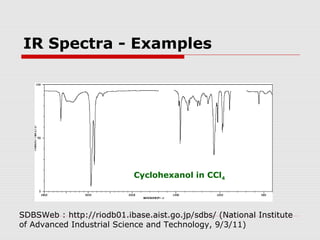
 O-H absorption, peak shape 
 Peak shapes are influenced by 
hydrogen bonding. 
 Lots of H-bonding, broad peak 
around 3300 cm-1. 
 In a dilute solution, there is little H 
bonding and the O-H peak is sharper 
and around 3500 cm-1. 
 This can happen to N-H and the 
acid O-H as well .
IR Spectra - Examples 
Cyclohexanol, neat 
SDBSWeb : http://riodb01.ibase.aist.go.jp/sdbs/ (National Institute 
of Advanced Industrial Science and Technology, 10/16/11)
IR Spectra - Examples 
Cyclohexanol in CCl4 
SDBSWeb : http://riodb01.ibase.aist.go.jp/sdbs/ (National Institute 
of Advanced Industrial Science and Technology, 9/3/11)
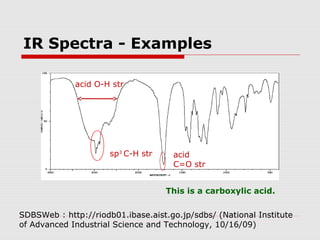
IR Spectra - Examples 
acid O-H str 
sp3 C-H str acid 
C=O str 
This is a carboxylic acid. 
SDBSWeb : http://riodb01.ibase.aist.go.jp/sdbs/ (National Institute 
of Advanced Industrial Science and Technology, 10/16/09)
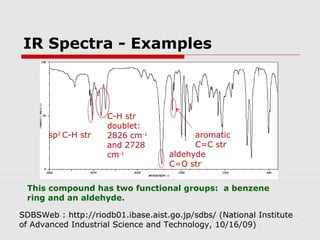
IR Spectra - Examples 
sp2 C-H str aromatic 
C=C str 
aldehyde 
C=O str 
C-H str 
doublet: 
2826 cm-1 
and 2728 
cm-1 
This compound has two functional groups: a benzene 
ring and an aldehyde. 
SDBSWeb : http://riodb01.ibase.aist.go.jp/sdbs/ (National Institute 
of Advanced Industrial Science and Technology, 10/16/09)
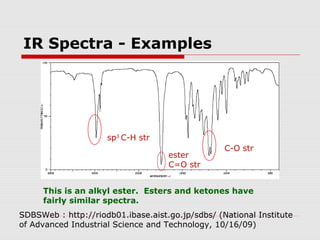
IR Spectra - Examples 
sp3 C-H str 
C-O str 
ester 
C=O str 
This is an alkyl ester. Esters and ketones have 
fairly similar spectra. 
SDBSWeb : http://riodb01.ibase.aist.go.jp/sdbs/ (National Institute 
of Advanced Industrial Science and Technology, 10/16/09)
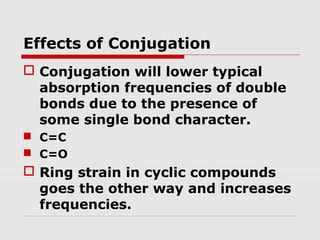
Effects of Conjugation 
 Conjugation will lower typical 
absorption frequencies of double 
bonds due to the presence of 
some single bond character. 
 C=C 
 C=O 
 Ring strain in cyclic compounds 
goes the other way and increases 
frequencies.
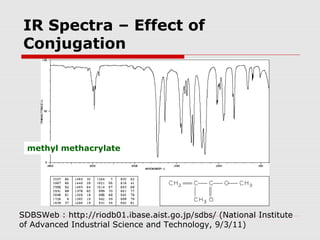
IR Spectra – Effect of 
Conjugation 
methyl methacrylate 
SDBSWeb : http://riodb01.ibase.aist.go.jp/sdbs/ (National Institute 
of Advanced Industrial Science and Technology, 9/3/11)
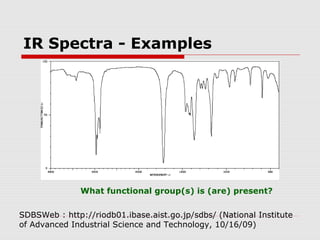
IR Spectra - Examples 
What functional group(s) is (are) present? 
SDBSWeb : http://riodb01.ibase.aist.go.jp/sdbs/ (National Institute 
of Advanced Industrial Science and Technology, 10/16/09)
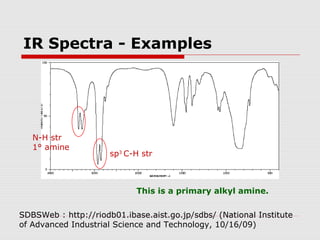
IR Spectra - Examples 
sp3 C-H str 
N-H str 
1° amine 
This is a primary alkyl amine. 
SDBSWeb : http://riodb01.ibase.aist.go.jp/sdbs/ (National Institute 
of Advanced Industrial Science and Technology, 10/16/09)
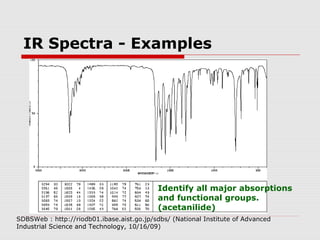
IR Spectra - Examples 
Identify all major absorptions 
and functional groups. 
(acetanilide) 
SDBSWeb : http://riodb01.ibase.aist.go.jp/sdbs/ (National Institute of Advanced 
Industrial Science and Technology, 10/16/09)
How to Analyze an IR Spectrum 
 http://www.cem.msu.edu/~reusch/VirtualText/ Nothing takes the place of sitting 
down with actual spectra and 
studying them.
Rawat’s Creation-rwtdgreat@ 
gmail.com 
rwtdgreat@yahoo.co.uk 
RawatDAgreatt/LinkedIn 
www.slideshare.net/ 
RawatDAgreatt 
Google+/blogger/Facebook 
/ 
Twitter-@RawatDAgreatt 
+919808050301 
+919958249693

Infrared spectroscopy

  • 1.
    Infrared Spectroscopy By-SauravK. Rawat (Rawat DA Greatt)
  • 2.
    IR Spectroscopy Used to identify organic compounds  IR spectroscopy provides a 100% identification if the spectrum is matched.  If not, IR at least provides information about the types of bonds present.  Easy to use  liquids analyzed between salt plates  solids in a KBr pellet  small amounts of unknowns via an FTIR microscope  analysis time typically < 10 minutes  Inexpensive  FTIR spectrophotometers are found in most labs.
  • 3.
    IR Spectroscopy IR is used to measure the vibrational frequencies of bonds in the molecule.  Bonds are not rigid. A bond can be viewed as a spring with a weight at each end.  Each bond has a characteristic frequency.  The IR scans a range of frequencies (in the infrared part of the electromagnetic spectrum). Any frequency which matches the characteristic frequency of a bond will be absorbed.
  • 4.
    IR Spectrophotometers In the old days, the frequencies were stepped through, one at a time, and the absorption measured.  This means of data collection was very slow.  Laser technology and computers have made available a much faster means of data collection.
  • 5.
    FTIR Spectrophotometers Fourier Transform Infrared Spectrophotometer  Uses an interferometer and polychromatic light (all frequencies used at one time, instead of one at a time) to generate an interferogram.  The interferogram is then mathematically decoded by a Fourier transformation.  interferogram  intensity vs time  after the Fourier transformation  intensity vs frequency…an IR spectrum
  • 6.
    FTIR Spectrophotometers http://www.chemistry.oregonstate.edu/ FTIR spectrophotometers collect data very quickly and, of course, the spectra can be stored and reviewed electronically.
  • 7.
    An IR Spectrum  A plot of % transmittance vs vibrational frequency in wavenumbers (cm-1) u c c = lu 1 = l 1 10000 m ( ) wavenumber u = = = l l m u λ = wavelength υ = frequency  c = speed of light in a vacuum
  • 8.
    Wavenumbers  Thehigher the wavenumber, the shorter the wavelength. 1 10000 m ( ) wavenumber u = = = l l m
  • 9.
    An IR Spectrum from http://www.cem.msu.edu/~reusch/VirtualText/Spectrpy/InfraRed/infrare d.htm
  • 10.
    An IR Spectrum  The wavelength of IR radiation is in the 2.5-25 micron range (compare to visible light in the 400-700 nm range).  The frequencies of IR radiation are more conveniently expressed by a wavenumber u (cycles per cm), than by υ (cycles per 3 x 1010 cm).
  • 11.
    Characteristic Vibrational Frequenciesof Bonds  Bonds are not rigid but behave like a spring with a mass at either end.  Obey Hooke’s Law: F = -kx  This gives rise to a characteristic frequency for the vibration: k reduced mass 1 p 2 _ u = reduced mass m m _ 1 2 m + m 1 2 =
  • 12.
    Characteristic Vibrational Frequenciesof Bonds  Characteristic frequency for the vibration: k reduced mass 1 p 2 _ u =  The frequency is affected by  the masses of the atoms in the bond  the strength of the bond
  • 13.
    Characteristic Vibrational Frequenciesof Bonds  The lower the mass, the higher the vibrational frequency.  Stretching frequencies for bonds to carbon: C-H > C-C > C-N > C-O k reduced mass 1 p 2 _ u =
  • 14.
    Characteristic Vibrational Frequenciesof Bonds  The stronger the bond, the higher the vibrational frequency.  Stretching frequencies  C≡C > C=C > C-C  C≡N > C=N > C-N  C≡O > C=O > C-O  C(sp)-H > C(sp2)-H > C(sp3)-H k reduced mass 1 p 2 _ u =
  • 15.
    Number of Vibrational Frequencies in a Molecule  There are 3n-6 possible vibrational modes in a nonlinear molecule with no symmetry  Symmetry reduces the number of possible vibrational modes.  Water has 3 possible vibrational modes.  Formaldehyde has 6.
  • 16.
    The Fingerprint Regionis Unique to the Molecule  In addition, the vibration of a particular bond in a molecule affects the whole molecule.  The various harmonics of a bond vibration can combine and lead to a number of combinational bands.  The intensity of these bands is usually 1/100 the intensity of the main vibrational absorptions.  These make up the “fingerprint region.” (occur at <1250 cm-1)
  • 17.
    Intensity of IRAbsorptions  In order for a vibration mode to absorb in the infrared, the vibrational motion must cause a change in the dipole moment of the bond.  The intensity of the IR “peaks” is proportional to the change in dipole moment that a bond undergoes during a vibration.  C=O bonds absorb strongly.  C=C bonds generally absorb much less.
  • 18.
    How to Analyzean IR Spectrum  Pay the most attention to the strongest absorptions:  -C=O  -OH  -NH2  -C≡N  -NO2  Pay more attention to the peaks to the left of the fingerprint region (>1250 cm-1).
  • 19.
    How to Analyzean IR Spectrum  Pay the most attention to the strongest absorptions.  Pay more attention to the peaks to the left of the fingerprint region (>1250 cm-1).  Note the absence of certain peaks.  Be wary of O-H peaks, water is a common contaminant.
  • 20.
    Characteristic IR Wavenumbers Functional group wavenumber (cm-1) sp3 C-H str ~2800-3000 sp2 C-H str ~3000-3100 sp C-H str ~3300 O-H str ~3300 (broad*) O-H str in COOH ~3000 (broad*) N-H str ~3300 (broad*) aldehyde C-H str ~2700, ~2800 *The peak is broad when H bonding is extensive. Otherwise, the peak can be sharp.
  • 21.
    Characteristic IR Wavenumbers Functional group wavenumber (cm-1) C=C isolated ~1640-1680 C=C conjugated ~1620-1640 C=C aromatic ~1600 C≡N just above 2200 C≡C just below 2200 C=O ester ~1730-1740 C=O aldehyde, ketone, or acid ~1710 (aldehyde can run 1725) C=O amide ~1640-1680
  • 22.
    How to Analyzean IR Spectrum  Look for what’s there and what’s not there.  C-H absorption  The wavenumber will tell you sp3(C-C), sp2(C=C), sp (C≡C) and perhaps aldehyde.  Carbonyl (C=O) absorption  Its presence means the compound is an aldehyde, ketone, carboxylic acid, ester, amide, anhydride or acyl halide.  Its absence means the compound cannot be any of the carbonyl-containing compounds.
  • 23.
    How to Analyzean IR Spectrum  O-H or N-H absorption  This indicates either an alcohol, N-H containing amine or amide, or carboxylic acid.  C≡C and C≡N absorptions  Be careful: internal triple bonds often do not show up in IR spectra.  C=C absorption  Can indicate whether compound is alkene or aromatic.
  • 24.
    How to Analyzean IR Spectrum  N-O of NO2 absorption  This is a distinctive, strong doublet that it pays to know (1515-1560 & 1345- 1385 cm-1).  Read the scale for the value of the wavenumbers (be able to interpolate), or  Read the wavenumbers in the table provided.
  • 25.
    IR Spectra -Examples no C=O str no C=C str sp3 C-H str no O-H str no N-H str no sp or sp2 C-H str C-H bend This is an alkane. SDBSWeb : http://riodb01.ibase.aist.go.jp/sdbs/ (National Institute of Advanced Industrial Science and Technology, 10/15/09)
  • 26.
    IR Spectra -Examples C=C str sp3 C-H str sp2 C-H str This is an alkene. SDBSWeb : http://riodb01.ibase.aist.go.jp/sdbs/ (National Institute of Advanced Industrial Science and Technology, 10/15/09)
  • 27.
    IR Spectra -Examples C≡C str at 2120 cm-1 sp3 C-H str This is a terminal alkyne. sp C-H str SDBSWeb : http://riodb01.ibase.aist.go.jp/sdbs/ (National Institute of Advanced Industrial Science and Technology, 10/15/09)
  • 28.
    IR Spectra -Examples C≡N str at 2260 cm-1 sp3 C-H str This is a nitrile. SDBSWeb : http://riodb01.ibase.aist.go.jp/sdbs/ (National Institute of Advanced Industrial Science and Technology, 10/15/09)
  • 29.
    IR Spectra -Examples sp3 C-H str alc. O-H str C-O str This is an alcohol. SDBSWeb : http://riodb01.ibase.aist.go.jp/sdbs/ (National Institute of Advanced Industrial Science and Technology, 10/16/09)
  • 30.
    How to Analyzean IR Spectrum  O-H absorption, peak shape  Peak shapes are influenced by hydrogen bonding.  Lots of H-bonding, broad peak around 3300 cm-1.  In a dilute solution, there is little H bonding and the O-H peak is sharper and around 3500 cm-1.  This can happen to N-H and the acid O-H as well .
  • 31.
    IR Spectra -Examples Cyclohexanol, neat SDBSWeb : http://riodb01.ibase.aist.go.jp/sdbs/ (National Institute of Advanced Industrial Science and Technology, 10/16/11)
  • 32.
    IR Spectra -Examples Cyclohexanol in CCl4 SDBSWeb : http://riodb01.ibase.aist.go.jp/sdbs/ (National Institute of Advanced Industrial Science and Technology, 9/3/11)
  • 33.
    IR Spectra -Examples acid O-H str sp3 C-H str acid C=O str This is a carboxylic acid. SDBSWeb : http://riodb01.ibase.aist.go.jp/sdbs/ (National Institute of Advanced Industrial Science and Technology, 10/16/09)
  • 34.
    IR Spectra -Examples sp2 C-H str aromatic C=C str aldehyde C=O str C-H str doublet: 2826 cm-1 and 2728 cm-1 This compound has two functional groups: a benzene ring and an aldehyde. SDBSWeb : http://riodb01.ibase.aist.go.jp/sdbs/ (National Institute of Advanced Industrial Science and Technology, 10/16/09)
  • 35.
    IR Spectra -Examples sp3 C-H str C-O str ester C=O str This is an alkyl ester. Esters and ketones have fairly similar spectra. SDBSWeb : http://riodb01.ibase.aist.go.jp/sdbs/ (National Institute of Advanced Industrial Science and Technology, 10/16/09)
  • 36.
    Effects of Conjugation  Conjugation will lower typical absorption frequencies of double bonds due to the presence of some single bond character.  C=C  C=O  Ring strain in cyclic compounds goes the other way and increases frequencies.
  • 37.
    IR Spectra –Effect of Conjugation methyl methacrylate SDBSWeb : http://riodb01.ibase.aist.go.jp/sdbs/ (National Institute of Advanced Industrial Science and Technology, 9/3/11)
  • 38.
    IR Spectra -Examples What functional group(s) is (are) present? SDBSWeb : http://riodb01.ibase.aist.go.jp/sdbs/ (National Institute of Advanced Industrial Science and Technology, 10/16/09)
  • 39.
    IR Spectra -Examples sp3 C-H str N-H str 1° amine This is a primary alkyl amine. SDBSWeb : http://riodb01.ibase.aist.go.jp/sdbs/ (National Institute of Advanced Industrial Science and Technology, 10/16/09)
  • 40.
    IR Spectra -Examples Identify all major absorptions and functional groups. (acetanilide) SDBSWeb : http://riodb01.ibase.aist.go.jp/sdbs/ (National Institute of Advanced Industrial Science and Technology, 10/16/09)
  • 41.
    How to Analyzean IR Spectrum  http://www.cem.msu.edu/~reusch/VirtualText/ Nothing takes the place of sitting down with actual spectra and studying them.
  • 42.
    Rawat’s Creation-rwtdgreat@ gmail.com rwtdgreat@yahoo.co.uk RawatDAgreatt/LinkedIn www.slideshare.net/ RawatDAgreatt Google+/blogger/Facebook / Twitter-@RawatDAgreatt +919808050301 +919958249693