

IPSec VPN
INTERNET PROTOCOL SECURITY
VIRTUAL PRIVATE NETWORK
June 2014
- Tilak Upadhyay
THE PING BOX .NET CCIE Security 4.0
1 | P a g e
IPSec VPN with RSA using NTP & CA Servers
CONFIGURATION:
STEP I: Configure NTP Server on R4 and NTP Client on R1 & R2
NTP SERVER (ROUTER R4)
To set clock, write on privilege mode,
CA_Server# clock set 12:10:08 26 july 2014
ntp authentication-key 1 md5 ciscoNTP
ntp authenticate
ntp trusted-key 1
ntp master 2
VERIFICATION:
CA_Server# sh ntp status
CA_Server# sh ntp associations
THE PING BOX .NET CCIE Security 4.0
2 | P a g e
NTP CLIENTS (ROUTER R1 & R2)
ntp authentication-key 1 md5 ciscoNTP
ntp authenticate
ntp trusted-key 1
ntp server 40.0.0.4 key 1
VERIFICATION:
R1# sh ntp status
R1# sh ntp associations
STEP II: Configure CA Server on R4 and CA Client on Router R1 & R2
CA SERVER (ROUTER R4)
ip http server
crypto pki server IOS_CA
database archive pem password cisco123
grant auto
lifetime certificate 300
lifetime ca-certificate 500
no shutdown
exit
VERIFICATION:
CA_Server# sh crypto pki server
CA CLIENTS (ROUTER R1 & R2)
ip domain name Mabison.com
crypto key generate rsa (To generate RSA key)
THE PING BOX .NET CCIE Security 4.0
3 | P a g e
crypto pki trustpoint IOS_CA
usage ike
enrollment url http://40.0.0.4
subject-name CN=R1 C=IN
exit
crypto ca authenticate IOS_CA (To get authenticate or to get signature certificate from CA)
crypto ca enroll IOS_CA (For getting enrol router in CA Server)
STEP III: Create IPSec VPN between Router R1 & R2 using “rsa-sig”
ROUTER R1
crypto isakmp policy 10
encr 3des
hash md5
group 2
auth rsa-sig
exit
access-list 101 permit ip host 1.1.1.1 host 2.2.2.2
crypto ipsec transform-set tset esp-3des esp-md5-hmac
exit
crypto map RSA_ENCRYPT 10 ipsec-isakmp
set peer 20.0.0.2
set transform-set tset
match address 101
THE PING BOX .NET CCIE Security 4.0
4 | P a g e
exit
interface FastEthernet0/0
crypto map RSA_ENCRYPT
exit
ROUTER R2
crypto isakmp policy 10
encr 3des
hash md5
group 2
auth rsa-sig
exit
access-list 101 permit ip host 2.2.2.2 host 1.1.1.1
crypto ipsec transform-set tset esp-3des esp-md5-hmac
exit
crypto map RSA_ENCRYPT 10 ipsec-isakmp
set peer 10.0.0.1
set transform-set tset
match address 101
exit
interface FastEthernet0/0
crypto map RSA_ENCRYPT
exit
VERIFICATION:
THE PING BOX .NET CCIE Security 4.0
5 | P a g e
R1# sh crypto isakmp sa
R1# sh crypto ipsec sa
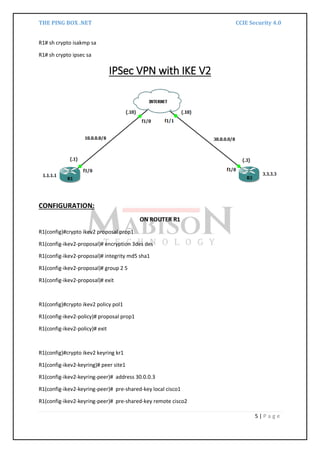
IPSec VPN with IKE V2
CONFIGURATION:
ON ROUTER R1
R1(config)#crypto ikev2 proposal prop1
R1(config-ikev2-proposal)# encryption 3des des
R1(config-ikev2-proposal)# integrity md5 sha1
R1(config-ikev2-proposal)# group 2 5
R1(config-ikev2-proposal)# exit
R1(config)#crypto ikev2 policy pol1
R1(config-ikev2-policy)# proposal prop1
R1(config-ikev2-policy)# exit
R1(config)#crypto ikev2 keyring kr1
R1(config-ikev2-keyring)# peer site1
R1(config-ikev2-keyring-peer)# address 30.0.0.3
R1(config-ikev2-keyring-peer)# pre-shared-key local cisco1
R1(config-ikev2-keyring-peer)# pre-shared-key remote cisco2
THE PING BOX .NET CCIE Security 4.0
6 | P a g e
R1(config-ikev2-keyring-peer)# exit
R1(config-ikev2-keyring)# exit
R1(config)#crypto ikev2 profile prof1
R1(config-ikev2-profile)# match identity remote address 30.0.0.3 255.255.255.255
R1(config-ikev2-profile)# authentication remote pre-share
R1(config-ikev2-profile)# authentication local pre-share
R1(config-ikev2-profile)# keyring local kr1
R1(config-ikev2-profile)# exit
R1(config)#crypto ipsec transform-set tset esp-3des esp-md5-hmac
R1(cfg-crypto-trans)#exit
R1(config)#access-list 101 permit ip host 1.1.1.1 host 3.3.3.3
R1(config)#crypto map abc 10 ipsec-isakmp
R1(config-crypto-map)# set peer 30.0.0.3
R1(config-crypto-map)# set transform-set tset
R1(config-crypto-map)# set ikev2-profile prof1
R1(config-crypto-map)# match address 101
R1(config-crypto-map)# exit
R1(config)#int fa 1/0
R1(config-if)#crypto map abc
R1(config-if)#exit
ON ROUTER R3
R3(config)#crypto ikev2 proposal prop1
R3(config-ikev2-proposal)# encryption 3des des
R3(config-ikev2-proposal)# integrity md5 sha1
R3(config-ikev2-proposal)# group 2 5
R3(config-ikev2-proposal)# exit
THE PING BOX .NET CCIE Security 4.0
7 | P a g e
R3(config)#crypto ikev2 policy pol1
R3(config-ikev2-policy)# proposal prop1
R3(config-ikev2-policy)# exit
R3(config)#crypto ikev2 keyring kr1
R3(config-ikev2-keyring)# peer site1
R3(config-ikev2-keyring-peer)# address 10.0.0.1
R3(config-ikev2-keyring-peer)# pre-shared-key local cisco2
R3(config-ikev2-keyring-peer)# pre-shared-key remote cisco1
R3(config-ikev2-keyring-peer)# exit
R3(config-ikev2-keyring)# exit
R3(config)#crypto ikev2 profile prof1
R3(config-ikev2-profile)#$tity remote address 10.0.0.1 255.255.255.255
R3(config-ikev2-profile)# authentication remote pre-share
R3(config-ikev2-profile)# authentication local pre-share
R3(config-ikev2-profile)# keyring local kr1
R3(config-ikev2-profile)# exit
R3(config)#crypto ipsec transform-set tset esp-3des esp-md5-hmac
R3(cfg-crypto-trans)#exit
R3(config)#access-list 101 permit ip host 3.3.3.3 host 1.1.1.1
R3(config)#crypto map abc 10 ipsec-isakmp
R3(config-crypto-map)# set peer 10.0.0.1
R3(config-crypto-map)# set transform-set tset
R3(config-crypto-map)# set ikev2-profile prof1
R3(config-crypto-map)# match address 101
THE PING BOX .NET CCIE Security 4.0
8 | P a g e
R3(config-crypto-map)# exit
R3(config)#int fa 1/0
R3(config-if)#crypto map abc
R3(config-if)#exit
RESULT:
ON ROUTER R1
R1#sh crypto ikev2 sa
IPv4 Crypto IKEv2 SA
Tunnel-id Local Remote fvrf/ivrf Status
1 10.0.0.1/500 30.0.0.3/500 none/none READY
Encr: 3DES, Hash: MD596, DH Grp:2, Auth sign: PSK, Auth verify: PSK
Life/Active Time: 86400/164 sec
IPv6 Crypto IKEv2 SA
ON ROUTER R3
R3#sh crypto ikev2 sa
IPv4 Crypto IKEv2 SA
Tunnel-id Local Remote fvrf/ivrf Status
1 30.0.0.3/500 10.0.0.1/500 none/none READY
Encr: 3DES, Hash: MD596, DH Grp:2, Auth sign: PSK, Auth verify: PSK
Life/Active Time: 86400/36 sec
IPv6 Crypto IKEv2 SA

IPSec VPN

  • 1.
    IPSec VPN INTERNET PROTOCOLSECURITY VIRTUAL PRIVATE NETWORK June 2014 - Tilak Upadhyay
  • 2.
    THE PING BOX.NET CCIE Security 4.0 1 | P a g e IPSec VPN with RSA using NTP & CA Servers CONFIGURATION: STEP I: Configure NTP Server on R4 and NTP Client on R1 & R2 NTP SERVER (ROUTER R4) To set clock, write on privilege mode, CA_Server# clock set 12:10:08 26 july 2014 ntp authentication-key 1 md5 ciscoNTP ntp authenticate ntp trusted-key 1 ntp master 2 VERIFICATION: CA_Server# sh ntp status CA_Server# sh ntp associations
  • 3.
    THE PING BOX.NET CCIE Security 4.0 2 | P a g e NTP CLIENTS (ROUTER R1 & R2) ntp authentication-key 1 md5 ciscoNTP ntp authenticate ntp trusted-key 1 ntp server 40.0.0.4 key 1 VERIFICATION: R1# sh ntp status R1# sh ntp associations STEP II: Configure CA Server on R4 and CA Client on Router R1 & R2 CA SERVER (ROUTER R4) ip http server crypto pki server IOS_CA database archive pem password cisco123 grant auto lifetime certificate 300 lifetime ca-certificate 500 no shutdown exit VERIFICATION: CA_Server# sh crypto pki server CA CLIENTS (ROUTER R1 & R2) ip domain name Mabison.com crypto key generate rsa (To generate RSA key)
  • 4.
    THE PING BOX.NET CCIE Security 4.0 3 | P a g e crypto pki trustpoint IOS_CA usage ike enrollment url http://40.0.0.4 subject-name CN=R1 C=IN exit crypto ca authenticate IOS_CA (To get authenticate or to get signature certificate from CA) crypto ca enroll IOS_CA (For getting enrol router in CA Server) STEP III: Create IPSec VPN between Router R1 & R2 using “rsa-sig” ROUTER R1 crypto isakmp policy 10 encr 3des hash md5 group 2 auth rsa-sig exit access-list 101 permit ip host 1.1.1.1 host 2.2.2.2 crypto ipsec transform-set tset esp-3des esp-md5-hmac exit crypto map RSA_ENCRYPT 10 ipsec-isakmp set peer 20.0.0.2 set transform-set tset match address 101
  • 5.
    THE PING BOX.NET CCIE Security 4.0 4 | P a g e exit interface FastEthernet0/0 crypto map RSA_ENCRYPT exit ROUTER R2 crypto isakmp policy 10 encr 3des hash md5 group 2 auth rsa-sig exit access-list 101 permit ip host 2.2.2.2 host 1.1.1.1 crypto ipsec transform-set tset esp-3des esp-md5-hmac exit crypto map RSA_ENCRYPT 10 ipsec-isakmp set peer 10.0.0.1 set transform-set tset match address 101 exit interface FastEthernet0/0 crypto map RSA_ENCRYPT exit VERIFICATION:
  • 6.
    THE PING BOX.NET CCIE Security 4.0 5 | P a g e R1# sh crypto isakmp sa R1# sh crypto ipsec sa IPSec VPN with IKE V2 CONFIGURATION: ON ROUTER R1 R1(config)#crypto ikev2 proposal prop1 R1(config-ikev2-proposal)# encryption 3des des R1(config-ikev2-proposal)# integrity md5 sha1 R1(config-ikev2-proposal)# group 2 5 R1(config-ikev2-proposal)# exit R1(config)#crypto ikev2 policy pol1 R1(config-ikev2-policy)# proposal prop1 R1(config-ikev2-policy)# exit R1(config)#crypto ikev2 keyring kr1 R1(config-ikev2-keyring)# peer site1 R1(config-ikev2-keyring-peer)# address 30.0.0.3 R1(config-ikev2-keyring-peer)# pre-shared-key local cisco1 R1(config-ikev2-keyring-peer)# pre-shared-key remote cisco2
  • 7.
    THE PING BOX.NET CCIE Security 4.0 6 | P a g e R1(config-ikev2-keyring-peer)# exit R1(config-ikev2-keyring)# exit R1(config)#crypto ikev2 profile prof1 R1(config-ikev2-profile)# match identity remote address 30.0.0.3 255.255.255.255 R1(config-ikev2-profile)# authentication remote pre-share R1(config-ikev2-profile)# authentication local pre-share R1(config-ikev2-profile)# keyring local kr1 R1(config-ikev2-profile)# exit R1(config)#crypto ipsec transform-set tset esp-3des esp-md5-hmac R1(cfg-crypto-trans)#exit R1(config)#access-list 101 permit ip host 1.1.1.1 host 3.3.3.3 R1(config)#crypto map abc 10 ipsec-isakmp R1(config-crypto-map)# set peer 30.0.0.3 R1(config-crypto-map)# set transform-set tset R1(config-crypto-map)# set ikev2-profile prof1 R1(config-crypto-map)# match address 101 R1(config-crypto-map)# exit R1(config)#int fa 1/0 R1(config-if)#crypto map abc R1(config-if)#exit ON ROUTER R3 R3(config)#crypto ikev2 proposal prop1 R3(config-ikev2-proposal)# encryption 3des des R3(config-ikev2-proposal)# integrity md5 sha1 R3(config-ikev2-proposal)# group 2 5 R3(config-ikev2-proposal)# exit
  • 8.
    THE PING BOX.NET CCIE Security 4.0 7 | P a g e R3(config)#crypto ikev2 policy pol1 R3(config-ikev2-policy)# proposal prop1 R3(config-ikev2-policy)# exit R3(config)#crypto ikev2 keyring kr1 R3(config-ikev2-keyring)# peer site1 R3(config-ikev2-keyring-peer)# address 10.0.0.1 R3(config-ikev2-keyring-peer)# pre-shared-key local cisco2 R3(config-ikev2-keyring-peer)# pre-shared-key remote cisco1 R3(config-ikev2-keyring-peer)# exit R3(config-ikev2-keyring)# exit R3(config)#crypto ikev2 profile prof1 R3(config-ikev2-profile)#$tity remote address 10.0.0.1 255.255.255.255 R3(config-ikev2-profile)# authentication remote pre-share R3(config-ikev2-profile)# authentication local pre-share R3(config-ikev2-profile)# keyring local kr1 R3(config-ikev2-profile)# exit R3(config)#crypto ipsec transform-set tset esp-3des esp-md5-hmac R3(cfg-crypto-trans)#exit R3(config)#access-list 101 permit ip host 3.3.3.3 host 1.1.1.1 R3(config)#crypto map abc 10 ipsec-isakmp R3(config-crypto-map)# set peer 10.0.0.1 R3(config-crypto-map)# set transform-set tset R3(config-crypto-map)# set ikev2-profile prof1 R3(config-crypto-map)# match address 101
  • 9.
    THE PING BOX.NET CCIE Security 4.0 8 | P a g e R3(config-crypto-map)# exit R3(config)#int fa 1/0 R3(config-if)#crypto map abc R3(config-if)#exit RESULT: ON ROUTER R1 R1#sh crypto ikev2 sa IPv4 Crypto IKEv2 SA Tunnel-id Local Remote fvrf/ivrf Status 1 10.0.0.1/500 30.0.0.3/500 none/none READY Encr: 3DES, Hash: MD596, DH Grp:2, Auth sign: PSK, Auth verify: PSK Life/Active Time: 86400/164 sec IPv6 Crypto IKEv2 SA ON ROUTER R3 R3#sh crypto ikev2 sa IPv4 Crypto IKEv2 SA Tunnel-id Local Remote fvrf/ivrf Status 1 30.0.0.3/500 10.0.0.1/500 none/none READY Encr: 3DES, Hash: MD596, DH Grp:2, Auth sign: PSK, Auth verify: PSK Life/Active Time: 86400/36 sec IPv6 Crypto IKEv2 SA