Deploying and Managing Enterprise IPsec VPNs Ken Kaminski Cisco Systems Consulting Systems Engineer – Security/VPN Northeast [email_address]
Security Enforcement, Firewall, IDS Network Topology Routing (OSPF, EIGRP) design High Availability  Performance QoS Path MTU Discovery Network Management ............. IPsec -  more than just crypto !
IPsec Design Options IPsec Design Issues IPsec Management Agenda
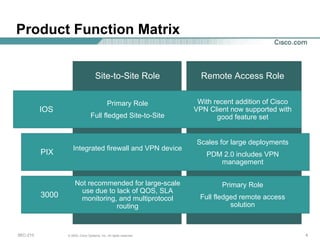
Product Function Matrix Site-to-Site Role Remote Access Role IOS PIX 3000 Scales for large deployments PDM 2.0 includes VPN management Primary Role Full fledged remote access solution With recent addition of Cisco VPN Client now supported with good feature set Not recommended for large-scale use due to lack of QOS, SLA monitoring, and multiprotocol routing Integrated firewall and VPN device Primary Role Full fledged Site-to-Site
Agenda IPsec Design Options IPsec IPsec Remote Access (EzVPN) IPsec/GRE IPsec Design Issues IPsec Management
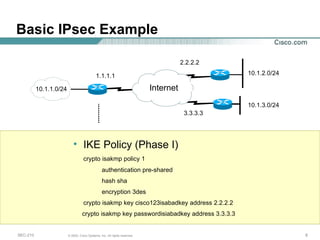
Basic IPsec Example Internet 10.1.1.0/24 10.1.2.0/24 IKE Policy (Phase I) crypto isakmp policy 1 authentication pre-shared hash sha encryption 3des crypto isakmp key cisco123isabadkey address 2.2.2.2 crypto isakmp key passwordisiabadkey address 3.3.3.3  1.1.1.1 2.2.2.2 10.1.3.0/24 3.3.3.3
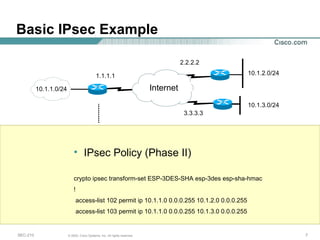
Basic IPsec Example IPsec Policy (Phase II) crypto ipsec transform-set ESP-3DES-SHA esp-3des esp-sha-hmac ! access-list 102 permit ip 10.1.1.0 0.0.0.255 10.1.2.0 0.0.0.255 access-list 103 permit ip 10.1.1.0 0.0.0.255 10.1.3.0 0.0.0.255 Internet 10.1.1.0/24 10.1.2.0/24 1.1.1.1 2.2.2.2 10.1.3.0/24 3.3.3.3
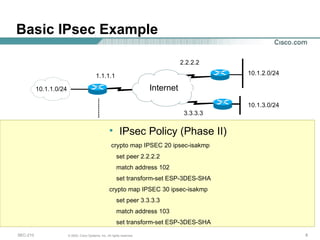
Basic IPsec Example IPsec Policy (Phase II) crypto map IPSEC 20 ipsec-isakmp set peer 2.2.2.2 match address 102 set transform-set ESP-3DES-SHA crypto map IPSEC 30 ipsec-isakmp set peer 3.3.3.3 match address 103 set transform-set ESP-3DES-SHA Internet 10.1.1.0/24 10.1.2.0/24 1.1.1.1 2.2.2.2 10.1.3.0/24 3.3.3.3
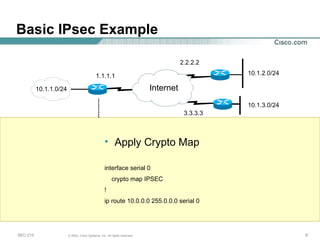
Basic IPsec Example Apply Crypto Map interface serial 0 crypto map IPSEC ! ip route 10.0.0.0 255.0.0.0 serial 0 Internet 10.1.1.0/24 10.1.2.0/24 1.1.1.1 2.2.2.2 10.1.3.0/24 3.3.3.3
Basic IPsec Summary Supported by IOS, Pix, VPN 3000 and several other vendors Either side can initiate tunnel No support for routing protocol, multicast
Agenda IPsec Design Options IPsec IPsec Remote Access (EzVPN) IPsec/GRE IPsec Design Issues IPsec Management
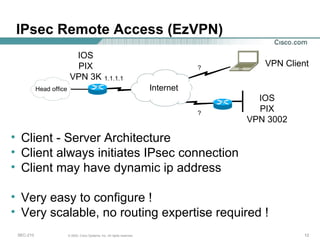
IPsec Remote Access (EzVPN)  Internet Head office 1.1.1.1 ? ? Client - Server Architecture Client always initiates IPsec connection Client may have dynamic ip address Very easy to configure ! Very scalable, no routing expertise required ! IOS PIX VPN 3K VPN Client IOS PIX VPN 3002
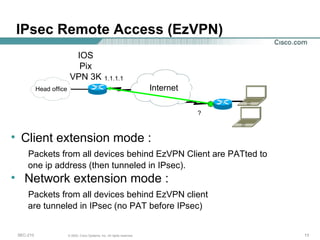
IPsec Remote Access (EzVPN)  Internet Head office 1.1.1.1 ? Client extension mode :  Packets from all devices behind EzVPN Client are PATted to one ip address (then tunneled in IPsec). Network extension mode : Packets from all devices behind EzVPN client are tunneled in IPsec (no PAT before IPsec) IOS Pix VPN 3K
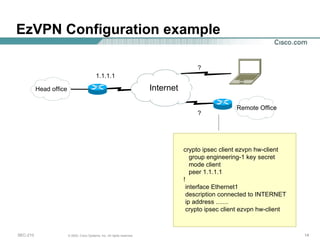
EzVPN Configuration example Internet Head office 1.1.1.1 ? ? Remote Office crypto ipsec client ezvpn hw-client group engineering-1 key secret mode client peer 1.1.1.1 ! interface Ethernet1 description connected to INTERNET ip address ....... crypto ipsec client ezvpn hw-client
Agenda IPsec Design Options IPsec IPsec Remote Access (EzVPN) IPsec/GRE IPsec Design Issues IPsec Management
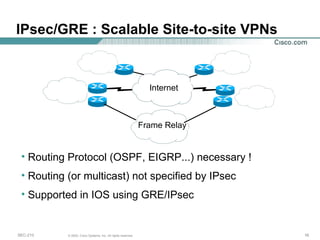
IPsec/GRE : Scalable Site-to-site VPNs Internet Frame Relay Routing Protocol (OSPF, EIGRP...) necessary ! Routing (or multicast) not specified by IPsec Supported in IOS using GRE/IPsec
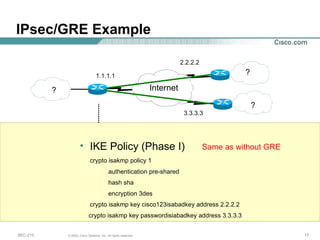
IPsec/GRE Example Internet ? IKE Policy (Phase I) crypto isakmp policy 1 authentication pre-shared hash sha encryption 3des crypto isakmp key cisco123isabadkey address 2.2.2.2 crypto isakmp key passwordisiabadkey address 3.3.3.3  1.1.1.1 2.2.2.2 3.3.3.3 ? ? Same as without GRE
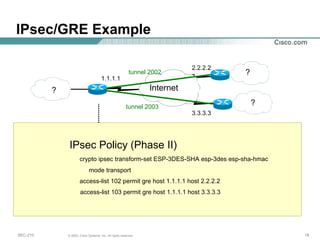
IPsec/GRE Example IPsec Policy (Phase II) crypto ipsec transform-set ESP-3DES-SHA esp-3des esp-sha-hmac mode transport access-list 102 permit gre host 1.1.1.1 host 2.2.2.2 access-list 103 permit gre host 1.1.1.1 host 3.3.3.3 Internet ? 1.1.1.1 2.2.2.2 3.3.3.3 ? ? tunnel 2003 tunnel 2002
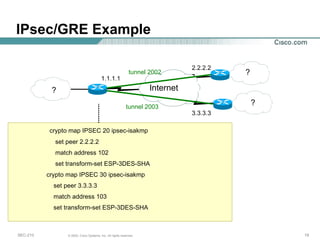
IPsec/GRE Example crypto map IPSEC 20 ipsec-isakmp set peer 2.2.2.2 match address 102 set transform-set ESP-3DES-SHA crypto map IPSEC 30 ipsec-isakmp set peer 3.3.3.3 match address 103 set transform-set ESP-3DES-SHA Internet ? 1.1.1.1 2.2.2.2 3.3.3.3 ? ? tunnel 2003 tunnel 2002
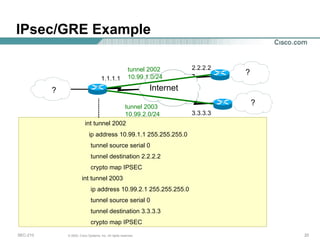
IPsec/GRE Example Internet ? int tunnel 2002 ip address 10.99.1.1 255.255.255.0 tunnel source serial 0 tunnel destination 2.2.2.2 crypto map IPSEC int tunnel 2003 ip address 10.99.2.1 255.255.255.0 tunnel source serial 0 tunnel destination 3.3.3.3 crypto map IPSEC 1.1.1.1 2.2.2.2 3.3.3.3 ? ? tunnel 2003 10.99.2.0/24 tunnel 2002 10.99.1.0/24
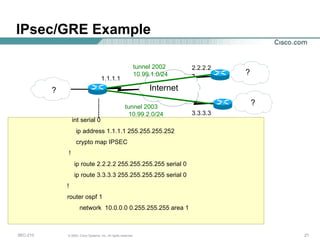
IPsec/GRE Example int serial 0 ip address 1.1.1.1 255.255.255.252 crypto map IPSEC ! ip route 2.2.2.2 255.255.255.255 serial 0 ip route 3.3.3.3 255.255.255.255 serial 0 !  router ospf 1 network  10.0.0.0 0.255.255.255 area 1 Internet ? 1.1.1.1 2.2.2.2 3.3.3.3 ? ? tunnel 2003 10.99.2.0/24 tunnel 2002 10.99.1.0/24
IPsec/GRE Summary IOS only (not Pix, VPN 3000) Enables Routing over IPsec protected Tunnels Enables IPsec protected multicast Enables Multi-Protocol (IPX...) Easy to configure thanks to trivial ACLs Reduces the number of SAs Uses standards : RFC 240x (IPsec), RFC 2784 (GRE) IPinIP (RFC 2003) is an alternative to GRE
Agenda IPsec Design Options IPsec Design Issues Topologies High Availability Split Tunneling Device Placement IPsec Management
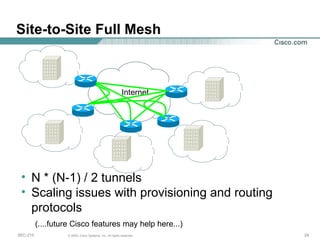
Site-to-Site Full Mesh Internet  N * (N-1) / 2 tunnels Scaling issues with provisioning and routing protocols (....future Cisco features may help here...)
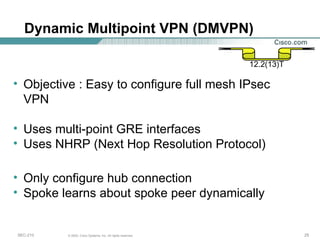
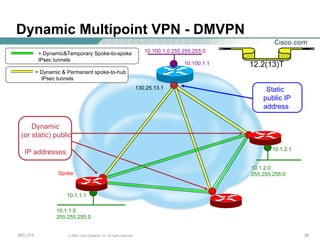
Dynamic Multipoint VPN (DMVPN) 12.2(13)T Objective : Easy to configure full mesh IPsec VPN  Uses multi-point GRE interfaces Uses NHRP (Next Hop Resolution Protocol) Only configure hub connection Spoke learns about spoke peer dynamically
Dynamic Multipoint VPN - DMVPN Spoke Dynamic (or static) public  IP addresses 10.100.1.0 255.255.255.0 10.1.1.0 255.255.255.0 10.1.1.1 10.100.1.1 = Dynamic & Permanent spoke-to-hub IPsec tunnels Static   public IP address 10.1.2.0 255.255.255.0 10.1.2.1 130.25.13.1   12.2(13)T = Dynamic&Temporary Spoke-to-spoke IPsec tunnels
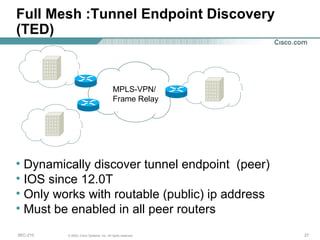
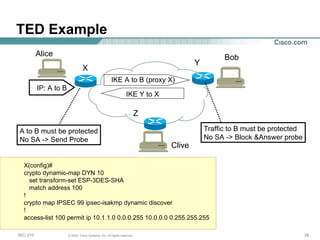
Full Mesh :Tunnel Endpoint Discovery (TED) MPLS-VPN/ Frame Relay Dynamically discover tunnel endpoint  (peer) IOS since 12.0T Only works with routable (public) ip address Must be enabled in all peer routers
TED Example Alice Bob IP: A to B X Y Z Clive X(config)# crypto dynamic-map DYN 10 set transform-set ESP-3DES-SHA match address 100 ! crypto map IPSEC 99 ipsec-isakmp dynamic discover ! access-list 100 permit ip 10.1.1.0 0.0.0.255 10.0.0.0 0.255.255.255 A to B must be protected No SA -> Send Probe IKE A to B (proxy X) IKE Y to X Traffic to B must be protected No SA -> Block &Answer probe
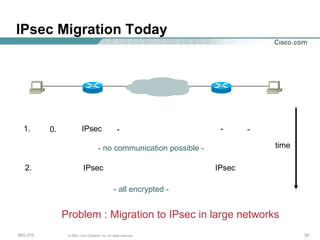
IPsec  Migration  Today 1.  IPsec  - t ime 0.  -  - - no communication possible - 2.  IPsec  IPsec - all encrypted - Problem : Migration to IPsec in large networks
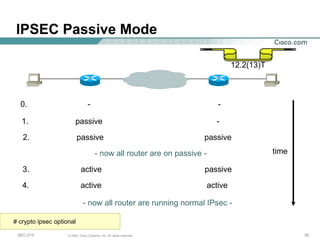
IPSEC  Passive  M ode 1.  passive  - 2.  passive  passive 3.  active  passive 4.  active  active t ime 0.  -  - - now all router are on passive - - now all router are running normal IPsec - 12.2(13)T # crypto ipsec optional
Agenda IPsec Design Options IPsec Design Issues Topologies High Availability Split Tunneling Device Placement IPsec Management
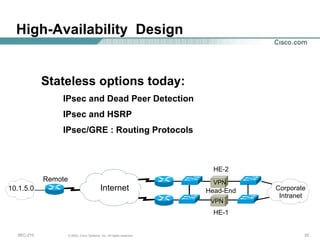
High-Availability  Design Stateless options today: IPsec and Dead Peer Detection  IPsec and HSRP  IPsec/GRE : Routing Protocols Head-End Remote HE-2 HE-1 Internet Corporate Intranet 10.1.5.0 VPN VPN
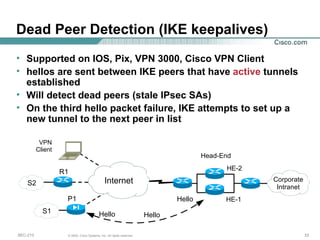
Dead Peer Detection (IKE keepalives) Supported on IOS, Pix, VPN 3000, Cisco VPN Client hellos are sent between IKE peers that have  active  tunnels established  Will detect dead peers (stale IPsec SAs) On the third hello packet failure, IKE attempts to set up a new tunnel to the next peer in list S1 Head-End R1 HE-2 HE-1 Internet Corporate Intranet S2 P1 VPN Client Hello Hello Hello
DPD is an optimization to IKE keepalives : "I don't  bother to check peer by sending keepalive,  if I am receiving data  from peer" DPD compatibility : IOS 12.2(8)T and later Pix 6.0 and later VPN 3000 3.0 and later Dead Peer Detection vs IKE keepalives
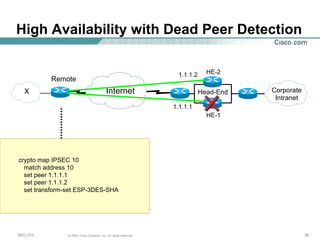
High Availability with Dead Peer Detection  Head-End Remote HE-2 HE-1 Internet Corporate Intranet X crypto map IPSEC 10 match address 10 set peer 1.1.1.1 set peer 1.1.1.2 set transform-set ESP-3DES-SHA 1.1.1.1 1.1.1.2
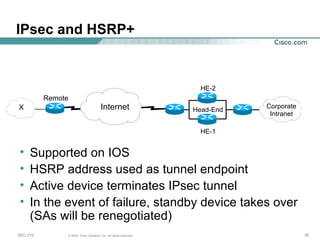
IPsec and HSRP+  Supported on IOS HSRP address used as tunnel endpoint Active device terminates IPsec tunnel In the event of failure, standby device takes over (SAs will be renegotiated) Head-End Remote HE-2 HE-1 Internet Corporate Intranet X
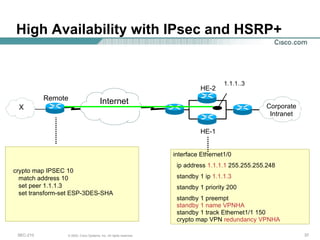
High Availability with IPsec and HSRP+  Remote HE-2 HE-1 Internet Corporate Intranet X 1.1.1..3 crypto map IPSEC 10 match address 10 set peer 1.1.1.3 set transform-set ESP-3DES-SHA interface Ethernet1/0  ip address  1.1.1.1  255.255.255.248  standby 1 ip  1.1.1.3 standby 1 priority 200  standby 1 preempt  standby 1 name VPNHA   standby 1 track Ethernet1/1 150  crypto map VPN  redundancy VPNHA
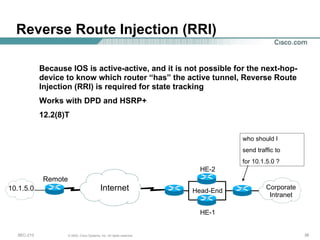
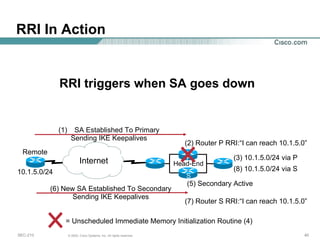
Reverse Route Injection (RRI)  Because IOS is active-active, and it is not possible for the next-hop-device to know which router “has” the active tunnel, Reverse Route Injection (RRI) is required for state tracking Works with DPD and HSRP+ 12.2(8)T Head-End Remote HE-2 HE-1 Internet Corporate Intranet 10.1.5.0 who should I send traffic to for 10.1.5.0 ?
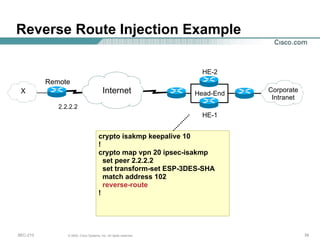
Reverse Route Injection Example  crypto isakmp keepalive 10  ! crypto map vpn 20 ipsec-isakmp  set peer 2.2.2.2  set transform-set ESP-3DES-SHA match address 102  reverse-route   !  Head-End Remote HE-2 HE-1 Internet Corporate Intranet X 2.2.2.2
RRI In Action RRI triggers when SA goes down Head-End Remote Internet 10.1.5.0/24 P S SA Established To Primary Sending IKE Keepalives (2) Router P RRI:“I can reach 10.1.5.0” (3) 10.1.5.0/24 via P (8) 10.1.5.0/24 via S (5) Secondary Active (6) New SA Established To Secondary Sending IKE Keepalives (7) Router S RRI:“I can reach 10.1.5.0” = Unscheduled Immediate Memory Initialization Routine (4)
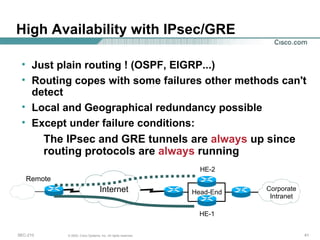
High Availability with IPsec/GRE Just plain routing ! (OSPF, EIGRP...) Routing copes with some failures other methods can't detect Local and Geographical redundancy possible Except under failure conditions: The IPsec and GRE tunnels are  always  up since routing protocols are  always  running Head-End Remote HE-2 HE-1 Internet Corporate Intranet
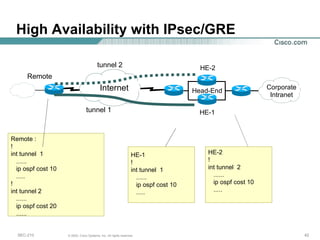
High Availability with IPsec/GRE Head-End Remote HE-2 HE-1 Internet Corporate Intranet Remote : ! int tunnel  1 ...... ip ospf cost 10 ..... ! int tunnel 2 ...... ip ospf cost 20 ...... tunnel 1 tunnel 2 HE-1 ! int tunnel  1 ...... ip ospf cost 10 ..... HE-2 ! int tunnel  2 ...... ip ospf cost 10 .....
Local/Geographical Failover/Load-Balancing The Cisco VPN Client supports the notion of backup servers for high availability PIX, 3000, and IOS compatible The 3000 Concentrator also supports local clustering Supports local load sharing (not geographical) DNS resolution based load balancing could also be used as the client resolves the FQDN of the head-end device (geographical)
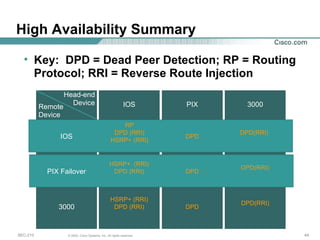
Key:  DPD = Dead Peer Detection; RP = Routing Protocol; RRI = Reverse Route Injection High Availability Summary Remote Device Head-end Device IOS PIX 3000 IOS PIX Failover 3000 RP DPD (RRI) HSRP+ (RRI) DPD DPD(RRI)  DPD DPD DPD(RRI) DPD(RRI) HSRP+  (RRI) DPD (RRI) HSRP+ (RRI) DPD (RRI)
Agenda IPsec Design Options IPsec Design Issues Topologies High Availability Split Tunneling Device Placement IPsec Management
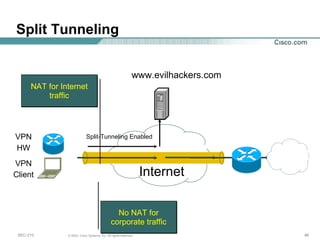
Split Tunneling Internet Split-Tunneling Enabled VPN Client www.evilhackers.com VPN HW No NAT for corporate traffic NAT for Internet traffic
Split Tunneling  Should it be allowed ?  Policy Decision ! If allowed, firewall is needed at remote end Cisco VPN Client - $0 firewall Default stops incoming connections; allows outgoing connections Firewall active even when VPN client is not connected Firewall policies can be pushed from VPN 3000 concentrator
Agenda IPsec Design Options IPsec Design Issues Topologies High Availability Split Tunneling Device Placement IPsec Management
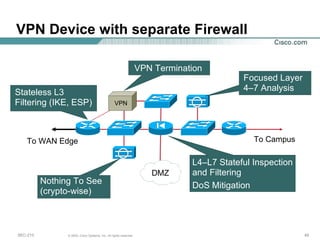
VPN Device with separate Firewall To WAN Edge To Campus VPN Termination L4–L7 Stateful Inspection and Filtering DoS Mitigation Focused Layer 4–7 Analysis Nothing To See (crypto-wise) Stateless L3 Filtering (IKE, ESP) VPN DMZ
Agenda IPsec Design Options IPsec Design Issues IPsec Management
VPN Management Nothing dramatically new - configuration management - performance management - fault management - sw updates Many of the same tools apply :  SNMP, TFTP, SSH Management traffic should be encrypted    ( IPsec vs SSH)
VPN Management Applications Device Managers (on the box) PDM—PIX Device Manager VDM—VPN Device Manager for IOS and 3000 VPN/Security Management Solution (VMS) 2.1 IOS, IDS, PIX Multiple Device Centers VPN Solution Center (VPNSC) Primary focus :  Service Providers
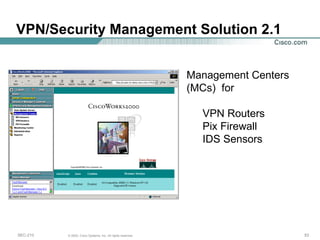
VPN/Security Management Solution 2.1 Management Centers (MCs)  for VPN Routers Pix Firewall IDS Sensors
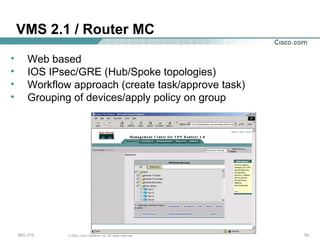
VMS 2.1 / Router MC Web based IOS IPsec/GRE (Hub/Spoke topologies) Workflow approach (create task/approve task) Grouping of devices/apply policy on group
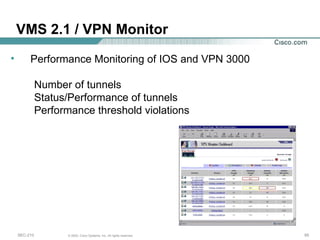
VMS 2.1 / VPN Monitor Performance Monitoring of IOS and VPN 3000 Number of tunnels Status/Performance of tunnels Performance threshold violations

Vpn(4)

  • 1.
    Deploying and ManagingEnterprise IPsec VPNs Ken Kaminski Cisco Systems Consulting Systems Engineer – Security/VPN Northeast [email_address]
  • 2.
    Security Enforcement, Firewall,IDS Network Topology Routing (OSPF, EIGRP) design High Availability Performance QoS Path MTU Discovery Network Management ............. IPsec - more than just crypto !
  • 3.
    IPsec Design OptionsIPsec Design Issues IPsec Management Agenda
  • 4.
    Product Function MatrixSite-to-Site Role Remote Access Role IOS PIX 3000 Scales for large deployments PDM 2.0 includes VPN management Primary Role Full fledged remote access solution With recent addition of Cisco VPN Client now supported with good feature set Not recommended for large-scale use due to lack of QOS, SLA monitoring, and multiprotocol routing Integrated firewall and VPN device Primary Role Full fledged Site-to-Site
  • 5.
    Agenda IPsec DesignOptions IPsec IPsec Remote Access (EzVPN) IPsec/GRE IPsec Design Issues IPsec Management
  • 6.
    Basic IPsec ExampleInternet 10.1.1.0/24 10.1.2.0/24 IKE Policy (Phase I) crypto isakmp policy 1 authentication pre-shared hash sha encryption 3des crypto isakmp key cisco123isabadkey address 2.2.2.2 crypto isakmp key passwordisiabadkey address 3.3.3.3 1.1.1.1 2.2.2.2 10.1.3.0/24 3.3.3.3
  • 7.
    Basic IPsec ExampleIPsec Policy (Phase II) crypto ipsec transform-set ESP-3DES-SHA esp-3des esp-sha-hmac ! access-list 102 permit ip 10.1.1.0 0.0.0.255 10.1.2.0 0.0.0.255 access-list 103 permit ip 10.1.1.0 0.0.0.255 10.1.3.0 0.0.0.255 Internet 10.1.1.0/24 10.1.2.0/24 1.1.1.1 2.2.2.2 10.1.3.0/24 3.3.3.3
  • 8.
    Basic IPsec ExampleIPsec Policy (Phase II) crypto map IPSEC 20 ipsec-isakmp set peer 2.2.2.2 match address 102 set transform-set ESP-3DES-SHA crypto map IPSEC 30 ipsec-isakmp set peer 3.3.3.3 match address 103 set transform-set ESP-3DES-SHA Internet 10.1.1.0/24 10.1.2.0/24 1.1.1.1 2.2.2.2 10.1.3.0/24 3.3.3.3
  • 9.
    Basic IPsec ExampleApply Crypto Map interface serial 0 crypto map IPSEC ! ip route 10.0.0.0 255.0.0.0 serial 0 Internet 10.1.1.0/24 10.1.2.0/24 1.1.1.1 2.2.2.2 10.1.3.0/24 3.3.3.3
  • 10.
    Basic IPsec SummarySupported by IOS, Pix, VPN 3000 and several other vendors Either side can initiate tunnel No support for routing protocol, multicast
  • 11.
    Agenda IPsec DesignOptions IPsec IPsec Remote Access (EzVPN) IPsec/GRE IPsec Design Issues IPsec Management
  • 12.
    IPsec Remote Access(EzVPN) Internet Head office 1.1.1.1 ? ? Client - Server Architecture Client always initiates IPsec connection Client may have dynamic ip address Very easy to configure ! Very scalable, no routing expertise required ! IOS PIX VPN 3K VPN Client IOS PIX VPN 3002
  • 13.
    IPsec Remote Access(EzVPN) Internet Head office 1.1.1.1 ? Client extension mode : Packets from all devices behind EzVPN Client are PATted to one ip address (then tunneled in IPsec). Network extension mode : Packets from all devices behind EzVPN client are tunneled in IPsec (no PAT before IPsec) IOS Pix VPN 3K
  • 14.
    EzVPN Configuration exampleInternet Head office 1.1.1.1 ? ? Remote Office crypto ipsec client ezvpn hw-client group engineering-1 key secret mode client peer 1.1.1.1 ! interface Ethernet1 description connected to INTERNET ip address ....... crypto ipsec client ezvpn hw-client
  • 15.
    Agenda IPsec DesignOptions IPsec IPsec Remote Access (EzVPN) IPsec/GRE IPsec Design Issues IPsec Management
  • 16.
    IPsec/GRE : ScalableSite-to-site VPNs Internet Frame Relay Routing Protocol (OSPF, EIGRP...) necessary ! Routing (or multicast) not specified by IPsec Supported in IOS using GRE/IPsec
  • 17.
    IPsec/GRE Example Internet? IKE Policy (Phase I) crypto isakmp policy 1 authentication pre-shared hash sha encryption 3des crypto isakmp key cisco123isabadkey address 2.2.2.2 crypto isakmp key passwordisiabadkey address 3.3.3.3 1.1.1.1 2.2.2.2 3.3.3.3 ? ? Same as without GRE
  • 18.
    IPsec/GRE Example IPsecPolicy (Phase II) crypto ipsec transform-set ESP-3DES-SHA esp-3des esp-sha-hmac mode transport access-list 102 permit gre host 1.1.1.1 host 2.2.2.2 access-list 103 permit gre host 1.1.1.1 host 3.3.3.3 Internet ? 1.1.1.1 2.2.2.2 3.3.3.3 ? ? tunnel 2003 tunnel 2002
  • 19.
    IPsec/GRE Example cryptomap IPSEC 20 ipsec-isakmp set peer 2.2.2.2 match address 102 set transform-set ESP-3DES-SHA crypto map IPSEC 30 ipsec-isakmp set peer 3.3.3.3 match address 103 set transform-set ESP-3DES-SHA Internet ? 1.1.1.1 2.2.2.2 3.3.3.3 ? ? tunnel 2003 tunnel 2002
  • 20.
    IPsec/GRE Example Internet? int tunnel 2002 ip address 10.99.1.1 255.255.255.0 tunnel source serial 0 tunnel destination 2.2.2.2 crypto map IPSEC int tunnel 2003 ip address 10.99.2.1 255.255.255.0 tunnel source serial 0 tunnel destination 3.3.3.3 crypto map IPSEC 1.1.1.1 2.2.2.2 3.3.3.3 ? ? tunnel 2003 10.99.2.0/24 tunnel 2002 10.99.1.0/24
  • 21.
    IPsec/GRE Example intserial 0 ip address 1.1.1.1 255.255.255.252 crypto map IPSEC ! ip route 2.2.2.2 255.255.255.255 serial 0 ip route 3.3.3.3 255.255.255.255 serial 0 ! router ospf 1 network 10.0.0.0 0.255.255.255 area 1 Internet ? 1.1.1.1 2.2.2.2 3.3.3.3 ? ? tunnel 2003 10.99.2.0/24 tunnel 2002 10.99.1.0/24
  • 22.
    IPsec/GRE Summary IOSonly (not Pix, VPN 3000) Enables Routing over IPsec protected Tunnels Enables IPsec protected multicast Enables Multi-Protocol (IPX...) Easy to configure thanks to trivial ACLs Reduces the number of SAs Uses standards : RFC 240x (IPsec), RFC 2784 (GRE) IPinIP (RFC 2003) is an alternative to GRE
  • 23.
    Agenda IPsec DesignOptions IPsec Design Issues Topologies High Availability Split Tunneling Device Placement IPsec Management
  • 24.
    Site-to-Site Full MeshInternet N * (N-1) / 2 tunnels Scaling issues with provisioning and routing protocols (....future Cisco features may help here...)
  • 25.
    Dynamic Multipoint VPN(DMVPN) 12.2(13)T Objective : Easy to configure full mesh IPsec VPN Uses multi-point GRE interfaces Uses NHRP (Next Hop Resolution Protocol) Only configure hub connection Spoke learns about spoke peer dynamically
  • 26.
    Dynamic Multipoint VPN- DMVPN Spoke Dynamic (or static) public IP addresses 10.100.1.0 255.255.255.0 10.1.1.0 255.255.255.0 10.1.1.1 10.100.1.1 = Dynamic & Permanent spoke-to-hub IPsec tunnels Static public IP address 10.1.2.0 255.255.255.0 10.1.2.1 130.25.13.1 12.2(13)T = Dynamic&Temporary Spoke-to-spoke IPsec tunnels
  • 27.
    Full Mesh :TunnelEndpoint Discovery (TED) MPLS-VPN/ Frame Relay Dynamically discover tunnel endpoint (peer) IOS since 12.0T Only works with routable (public) ip address Must be enabled in all peer routers
  • 28.
    TED Example AliceBob IP: A to B X Y Z Clive X(config)# crypto dynamic-map DYN 10 set transform-set ESP-3DES-SHA match address 100 ! crypto map IPSEC 99 ipsec-isakmp dynamic discover ! access-list 100 permit ip 10.1.1.0 0.0.0.255 10.0.0.0 0.255.255.255 A to B must be protected No SA -> Send Probe IKE A to B (proxy X) IKE Y to X Traffic to B must be protected No SA -> Block &Answer probe
  • 29.
    IPsec Migration Today 1. IPsec - t ime 0. - - - no communication possible - 2. IPsec IPsec - all encrypted - Problem : Migration to IPsec in large networks
  • 30.
    IPSEC Passive M ode 1. passive - 2. passive passive 3. active passive 4. active active t ime 0. - - - now all router are on passive - - now all router are running normal IPsec - 12.2(13)T # crypto ipsec optional
  • 31.
    Agenda IPsec DesignOptions IPsec Design Issues Topologies High Availability Split Tunneling Device Placement IPsec Management
  • 32.
    High-Availability DesignStateless options today: IPsec and Dead Peer Detection IPsec and HSRP IPsec/GRE : Routing Protocols Head-End Remote HE-2 HE-1 Internet Corporate Intranet 10.1.5.0 VPN VPN
  • 33.
    Dead Peer Detection(IKE keepalives) Supported on IOS, Pix, VPN 3000, Cisco VPN Client hellos are sent between IKE peers that have active tunnels established Will detect dead peers (stale IPsec SAs) On the third hello packet failure, IKE attempts to set up a new tunnel to the next peer in list S1 Head-End R1 HE-2 HE-1 Internet Corporate Intranet S2 P1 VPN Client Hello Hello Hello
  • 34.
    DPD is anoptimization to IKE keepalives : "I don't bother to check peer by sending keepalive, if I am receiving data from peer" DPD compatibility : IOS 12.2(8)T and later Pix 6.0 and later VPN 3000 3.0 and later Dead Peer Detection vs IKE keepalives
  • 35.
    High Availability withDead Peer Detection Head-End Remote HE-2 HE-1 Internet Corporate Intranet X crypto map IPSEC 10 match address 10 set peer 1.1.1.1 set peer 1.1.1.2 set transform-set ESP-3DES-SHA 1.1.1.1 1.1.1.2
  • 36.
    IPsec and HSRP+ Supported on IOS HSRP address used as tunnel endpoint Active device terminates IPsec tunnel In the event of failure, standby device takes over (SAs will be renegotiated) Head-End Remote HE-2 HE-1 Internet Corporate Intranet X
  • 37.
    High Availability withIPsec and HSRP+ Remote HE-2 HE-1 Internet Corporate Intranet X 1.1.1..3 crypto map IPSEC 10 match address 10 set peer 1.1.1.3 set transform-set ESP-3DES-SHA interface Ethernet1/0 ip address 1.1.1.1 255.255.255.248 standby 1 ip 1.1.1.3 standby 1 priority 200 standby 1 preempt standby 1 name VPNHA standby 1 track Ethernet1/1 150 crypto map VPN redundancy VPNHA
  • 38.
    Reverse Route Injection(RRI) Because IOS is active-active, and it is not possible for the next-hop-device to know which router “has” the active tunnel, Reverse Route Injection (RRI) is required for state tracking Works with DPD and HSRP+ 12.2(8)T Head-End Remote HE-2 HE-1 Internet Corporate Intranet 10.1.5.0 who should I send traffic to for 10.1.5.0 ?
  • 39.
    Reverse Route InjectionExample crypto isakmp keepalive 10 ! crypto map vpn 20 ipsec-isakmp set peer 2.2.2.2 set transform-set ESP-3DES-SHA match address 102 reverse-route ! Head-End Remote HE-2 HE-1 Internet Corporate Intranet X 2.2.2.2
  • 40.
    RRI In ActionRRI triggers when SA goes down Head-End Remote Internet 10.1.5.0/24 P S SA Established To Primary Sending IKE Keepalives (2) Router P RRI:“I can reach 10.1.5.0” (3) 10.1.5.0/24 via P (8) 10.1.5.0/24 via S (5) Secondary Active (6) New SA Established To Secondary Sending IKE Keepalives (7) Router S RRI:“I can reach 10.1.5.0” = Unscheduled Immediate Memory Initialization Routine (4)
  • 41.
    High Availability withIPsec/GRE Just plain routing ! (OSPF, EIGRP...) Routing copes with some failures other methods can't detect Local and Geographical redundancy possible Except under failure conditions: The IPsec and GRE tunnels are always up since routing protocols are always running Head-End Remote HE-2 HE-1 Internet Corporate Intranet
  • 42.
    High Availability withIPsec/GRE Head-End Remote HE-2 HE-1 Internet Corporate Intranet Remote : ! int tunnel 1 ...... ip ospf cost 10 ..... ! int tunnel 2 ...... ip ospf cost 20 ...... tunnel 1 tunnel 2 HE-1 ! int tunnel 1 ...... ip ospf cost 10 ..... HE-2 ! int tunnel 2 ...... ip ospf cost 10 .....
  • 43.
    Local/Geographical Failover/Load-Balancing TheCisco VPN Client supports the notion of backup servers for high availability PIX, 3000, and IOS compatible The 3000 Concentrator also supports local clustering Supports local load sharing (not geographical) DNS resolution based load balancing could also be used as the client resolves the FQDN of the head-end device (geographical)
  • 44.
    Key: DPD= Dead Peer Detection; RP = Routing Protocol; RRI = Reverse Route Injection High Availability Summary Remote Device Head-end Device IOS PIX 3000 IOS PIX Failover 3000 RP DPD (RRI) HSRP+ (RRI) DPD DPD(RRI) DPD DPD DPD(RRI) DPD(RRI) HSRP+ (RRI) DPD (RRI) HSRP+ (RRI) DPD (RRI)
  • 45.
    Agenda IPsec DesignOptions IPsec Design Issues Topologies High Availability Split Tunneling Device Placement IPsec Management
  • 46.
    Split Tunneling InternetSplit-Tunneling Enabled VPN Client www.evilhackers.com VPN HW No NAT for corporate traffic NAT for Internet traffic
  • 47.
    Split Tunneling Should it be allowed ? Policy Decision ! If allowed, firewall is needed at remote end Cisco VPN Client - $0 firewall Default stops incoming connections; allows outgoing connections Firewall active even when VPN client is not connected Firewall policies can be pushed from VPN 3000 concentrator
  • 48.
    Agenda IPsec DesignOptions IPsec Design Issues Topologies High Availability Split Tunneling Device Placement IPsec Management
  • 49.
    VPN Device withseparate Firewall To WAN Edge To Campus VPN Termination L4–L7 Stateful Inspection and Filtering DoS Mitigation Focused Layer 4–7 Analysis Nothing To See (crypto-wise) Stateless L3 Filtering (IKE, ESP) VPN DMZ
  • 50.
    Agenda IPsec DesignOptions IPsec Design Issues IPsec Management
  • 51.
    VPN Management Nothingdramatically new - configuration management - performance management - fault management - sw updates Many of the same tools apply : SNMP, TFTP, SSH Management traffic should be encrypted ( IPsec vs SSH)
  • 52.
    VPN Management ApplicationsDevice Managers (on the box) PDM—PIX Device Manager VDM—VPN Device Manager for IOS and 3000 VPN/Security Management Solution (VMS) 2.1 IOS, IDS, PIX Multiple Device Centers VPN Solution Center (VPNSC) Primary focus : Service Providers
  • 53.
    VPN/Security Management Solution2.1 Management Centers (MCs) for VPN Routers Pix Firewall IDS Sensors
  • 54.
    VMS 2.1 /Router MC Web based IOS IPsec/GRE (Hub/Spoke topologies) Workflow approach (create task/approve task) Grouping of devices/apply policy on group
  • 55.
    VMS 2.1 /VPN Monitor Performance Monitoring of IOS and VPN 3000 Number of tunnels Status/Performance of tunnels Performance threshold violations