Needs Assessment
Chapter 3
6th Edition
Raymond A. Noe
McGraw-Hill/Irwin

Copyright © 2013 by The McGraw-Hill Companies, Inc. All rights reserved.
Objectives
ď‚— Discuss the role of organization analysis, person

analysis, and task analysis in needs assessment
ď‚— Identify different methods used in needs
assessment and identify the advantages and
disadvantages of each method
ď‚— Discuss the concerns of upper- and mid-level
managers and trainers in needs assessment
ď‚— Explain how personal characteristics, input,
output, consequences, and feedback influence
performance and learning
3-2
Objectives
ď‚— Create conditions to ensure that employees are

receptive to training
ď‚— Discuss the steps involved in conducting a task
analysis
ď‚— Analyze task analysis data to determine the
tasks for which people need to be trained
ď‚— Explain competency models and the process
used to develop them

3-3
Introduction
ď‚— The design process begins with a needs

assessment
ď‚— Subsequent steps in the process include
ď‚— Ensuring that employees have the motivation and

basic skills necessary to learn
ď‚— Creating a positive learning environment
ď‚— Making sure that trainees use learned skills on the
job
ď‚— Choosing the training method and evaluating the
results
ď‚— Needs assessment: Process used to determine

whether training is necessary

3-4
Introduction
ď‚— Involves
ď‚— Organizational analysis: Determines the

appropriateness of training, given the company’s
business strategy and resources
ď‚— Person analysis: Determines
ď‚— Whether performance deficiencies result from a lack of

knowledge, skill, or ability
ď‚— Who needs training
ď‚— Employee readiness for training

3-5
Introduction
ď‚— Task analysis: Identifies the important tasks and

knowledge, skills, and behaviors that need to be
emphasized in training for employees to
complete their tasks

3-6
Why is Needs Assessment
Necessary?
ď‚— Training may be incorrectly used as a solution to

a performance problem
ď‚— Training programs may have the wrong content,
objectives, or methods
ď‚— Trainees may be sent to training programs for
which they do not have the basic skills,
prerequisite skills, or confidence needed to learn

3-7
Why is Needs Assessment
Necessary?
ď‚— Training will not deliver the expected learning,

behavior change, or financial results that the
company expects
ď‚— Money will be spent on training programs that
are unnecessary because they are unrelated to
the company’s business strategy

3-8
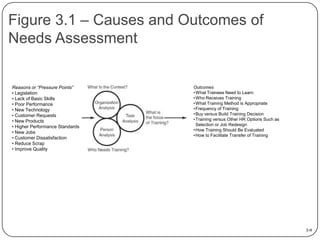
Figure 3.1 – Causes and Outcomes of
Needs Assessment

Reasons or “Pressure Points”
• Legislation
• Lack of Basic Skills
• Poor Performance
• New Technology
• Customer Requests
• New Products
• Higher Performance Standards
• New Jobs
• Customer Dissatisfaction
• Reduce Scrap
• Improve Quality

Outcomes
• What Trainees Need to Learn
• Who Receives Training
• What Training Method is Appropriate
• Frequency of Training
• Buy versus Build Training Decision
• Training versus Other HR Options Such as
Selection or Job Redesign
• How Training Should Be Evaluated
• How to Facilitate Transfer of Training

3-9
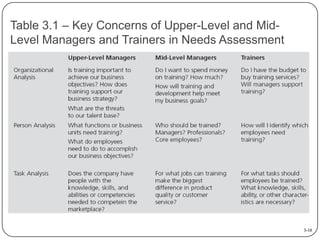
Table 3.1 – Key Concerns of Upper-Level and MidLevel Managers and Trainers in Needs Assessment

3-10
Who Should Participate in Needs
Assessment
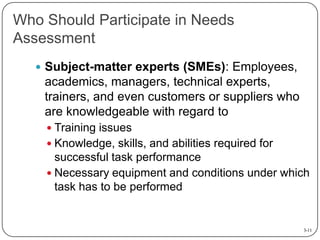
ď‚— Subject-matter experts (SMEs): Employees,

academics, managers, technical experts,
trainers, and even customers or suppliers who
are knowledgeable with regard to
ď‚— Training issues
ď‚— Knowledge, skills, and abilities required for

successful task performance
ď‚— Necessary equipment and conditions under which
task has to be performed

3-11
Who Should Participate in Needs
Assessment
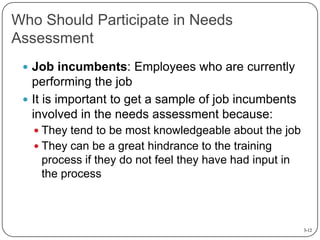
ď‚— Job incumbents: Employees who are currently

performing the job
ď‚— It is important to get a sample of job incumbents
involved in the needs assessment because:
ď‚— They tend to be most knowledgeable about the job
ď‚— They can be a great hindrance to the training

process if they do not feel they have had input in
the process

3-12
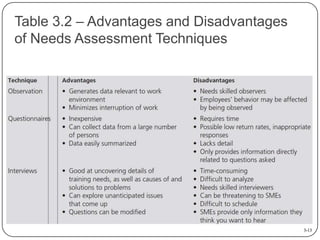
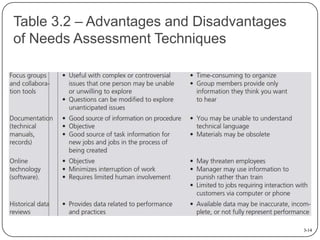
Table 3.2 – Advantages and Disadvantages
of Needs Assessment Techniques

3-13
Table 3.2 – Advantages and Disadvantages
of Needs Assessment Techniques

3-14
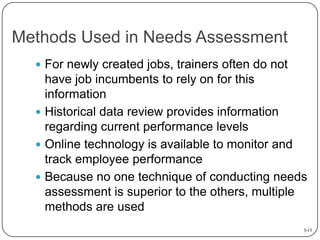
Methods Used in Needs Assessment
ď‚— For newly created jobs, trainers often do not

have job incumbents to rely on for this
information
ď‚— Historical data review provides information
regarding current performance levels
ď‚— Online technology is available to monitor and
track employee performance
ď‚— Because no one technique of conducting needs
assessment is superior to the others, multiple
methods are used
3-15
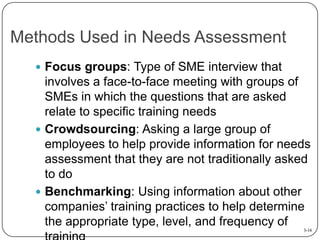
Methods Used in Needs Assessment
ď‚— Focus groups: Type of SME interview that

involves a face-to-face meeting with groups of
SMEs in which the questions that are asked
relate to specific training needs
ď‚— Crowdsourcing: Asking a large group of
employees to help provide information for needs
assessment that they are not traditionally asked
to do
ď‚— Benchmarking: Using information about other
companies’ training practices to help determine
the appropriate type, level, and frequency of
3-16
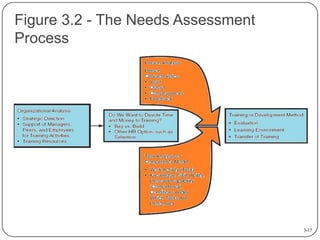
Figure 3.2 - The Needs Assessment
Process

3-17
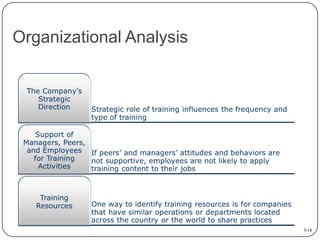
Organizational Analysis

3-18
Person Analysis
ď‚— Helps to identify employees who need training
ď‚— The need for training may result from the

pressure points
ď‚— Readiness for training: Refers to whether:
ď‚— Employees have the personal characteristics

necessary to learn program content and apply it on
the job
ď‚— The work environment will facilitate learning and
not interfere with performance

3-19
Person Analysis
ď‚— This process includes evaluating person

characteristics, input, output, consequences, and
feedback
ď‚— A major pressure point for training is substandard
or poor performance
ď‚— Another potential indicator of the need for
training is if the job changes such that current
levels of performance need to be improved or
employees must be able to complete new tasks
3-20
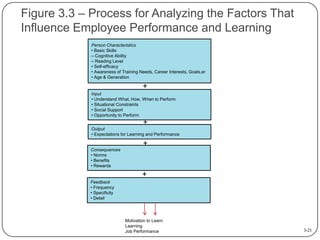
Figure 3.3 – Process for Analyzing the Factors That
Influence Employee Performance and Learning
Person Characteristics
• Basic Skills
– Cognitive Ability
– Reading Level
• Self-efficacy
• Awareness of Training Needs, Career Interests, Goals,er
• Age & Generation

+
Input
• Understand What, How, When to Perform
• Situational Constraints
• Social Support
• Opportunity to Perform

+
Output
• Expectations for Learning and Performance

+
Consequences
• Norms
• Benefits
• Rewards

+
Feedback
• Frequency
• Specificity
• Detail

Motivation to Learn
Learning
Job Performance

3-21
Person Analysis
ď‚— Consequences: Type of incentives that

employees receive for performing well
ď‚— Feedback: Information that employees receive
while they are performing
 Motivation to learn: Trainees’ desire to learn the
content of training programs
ď‚— Personal characteristics include basic skills,
cognitive ability, language skills, and other traits
that employees need to perform their jobs or
learn in training and development programs
effectively

3-22
Basic Skills
ď‚— Skills that are necessary for employees to

perform on the job and learn the content of
training programs successfully
ď‚— Cognitive ability
ď‚— Reading skills
ď‚— Writing skills

3-23
Cognitive Ability
ď‚— Includes three dimensions:
ď‚— Verbal comprehension, quantitative ability, and

reasoning ability
 Trainees’ level of cognitive ability also can

influence how well they can learn in training
programs
ď‚— To identify employees without the cognitive ability
to succeed on the job, companies use paperand-pencil cognitive ability tests
3-24
Reading Ability
ď‚— Readability: Difficulty level of written materials
ď‚— Readability assessment usually involves analysis

of sentence length and word difficulty
 If trainees’ reading level does not match the level
needed for the training materials, four options
are available
ď‚— Trainers can determine whether it is feasible to

lower the reading level of training materials or onthe-job training

3-25
Reading Ability
ď‚— Employees without the necessary reading level

could be identified through reading tests and
reassigned to other positions more congruent with
their skill levels
ď‚— Using reading tests, trainers can identify
employees who lack the necessary reading skills
and provide them with remedial training
ď‚— Alternative training methods need to be
considered, or managers can elect a nontraining
option
ď‚— To develop basic skills or close the skills gap,

many companies are engaging in skills

3-26
Self-Efficacy
 Employees’ belief that they can perform their job

or learn the content of the training program
successfully
 Employees’ self-efficacy level can be increased
by:
ď‚— Letting employees know the purpose of training
ď‚— Providing as much information as possible about

the training program and the purpose of training
prior to the actual training

3-27
Self-Efficacy
ď‚— Showing employees the training success of their

peers who are now in similar jobs
ď‚— Providing employees with feedback that learning is
under their control and they have the ability and
the responsibility to overcome any learning
difficulties they experience in the program

3-28
Awareness of Training Needs, Career
Interests, and Goals
ď‚— Managers should communicate the link between

training and improvement of skill weaknesses or
knowledge deficiencies
ď‚— Employees need to be given a choice of what
programs to attend and must understand how
actual training assignments are made to
maximize motivation to learn

3-29
Awareness of Training Needs, Career
Interests, and Goals
ď‚— To ensure that the work environment enhances

trainees’ motivation to learn:
ď‚— Provide materials, time, job-related information,

and other work aids necessary for employees to
use new skills or behavior before participating in
training programs
 Speak positively about the company’s training
programs to employees

3-30
Age and Generation
ď‚— Millenniums and Generation Y (born after 1980):

Optimistic, willing to work and learn, and
technology-literate
ď‚— Gen Xers (1965 to 1980): Need feedback and
flexibility; they dislike close supervision
ď‚— Baby boomers (1946 and 1964): Competitive,
hardworking, and concerned that all employees
be fairly treated

3-31
Age and Generation
ď‚— Traditionalists (1925 and 1945): Patriotic and

loyal; great deal of knowledge of the history of
organizations and work life

3-32
Input
ď‚— Situational constraints: Include lack of proper

tools and equipment, materials and supplies,
budgetary support, and time
 Social support: Managers’ and peers’
willingness to provide feedback and
reinforcement

3-33
Output, Consequences, and
Feedback
ď‚— Trainees need to understand what specifically

they are expected to learn in the training
program
ď‚— Norms: Accepted standards of behavior for
workgroup members
ď‚— For employees to perform to standard, feedback
needs to be given frequently, not just during a
yearly performance evaluation

3-34
Determining Whether Training is the Best
Solution
ď‚— If employees lack the knowledge and skill to

perform a job and the other factors are
satisfactory, training is needed
ď‚— If employees have the knowledge and skill to
perform but input, output, consequences, or
feedback is inadequate, training may not be the
best solution

3-35
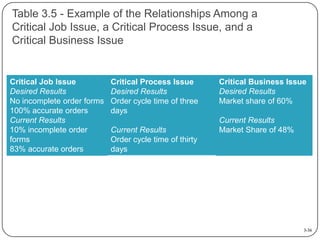
Table 3.5 - Example of the Relationships Among a
Critical Job Issue, a Critical Process Issue, and a
Critical Business Issue

Critical Job Issue
Desired Results
No incomplete order forms
100% accurate orders
Current Results
10% incomplete order
forms
83% accurate orders

Critical Process Issue
Desired Results
Order cycle time of three
days
Current Results
Order cycle time of thirty
days

Critical Business Issue
Desired Results
Market share of 60%

Current Results
Market Share of 48%

3-36
Task Analysis
ď‚— Job: Specific position requiring the completion of

certain tasks
 Task: Employee’s work activity in a specific job

3-37
The Needs Assessment Process
(cont.)
 Knowledge – Includes facts or procedures
 Skill – Indicates competency in performing a

task
 Ability – Includes the physical and mental
capacities to perform a task

3-38
Task Analysis
ď‚— Steps involved in a task analysis
ď‚— Select the job or jobs to be analyzed

ď‚— Develop a preliminary list of tasks performed on

the job by:
ď‚— Interviewing and observing expert employees and their

managers
ď‚— Talking with others who have performed a task analysis

ď‚— Validate or confirm the preliminary list of tasks
ď‚— Once the tasks have been identified, it is important

to identify the knowledge, skills, or abilities
necessary to successfully perform each task
3-39
Competency Models
ď‚— Identifies the competencies necessary for each

job
ď‚— Competency models provide descriptions of
competencies that are common for an entire
occupation or organization
ď‚— They can be used for:
ď‚— Performance management
ď‚— Identifying the best employees to fill open positions

3-40
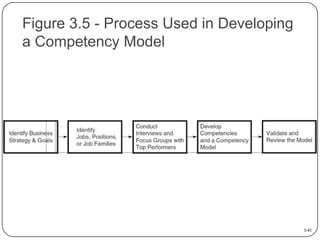
Figure 3.5 - Process Used in Developing
a Competency Model

3-41
Competency Models
ď‚— Competency models are useful for training and

development in several ways
ď‚— Identify behaviors needed for effective job

performance
 Evaluate the relationship between the company’s
current training programs and present needs

3-42
Competency Models
ď‚— Provide a framework for ongoing coaching and

feedback to develop employees for current and
future roles
ď‚— Help in succession planning
 Help integrate and align the company’s HR
systems and practices

3-43
Scope of Needs Assessment
ď‚— Rapid needs assessment: Needs assessment

that is done quickly and accurately, but without
sacrificing the quality of the process or the
outcomes
ď‚— There are several ways to conduct a rapid needs
assessment
ď‚— Scope of needs assessment depends on the size

of the potential pressure point

3-44
Scope of Needs Assessment
ď‚— Consider using already available data collected for

other purposes
ď‚— If business problems, technological developments,
and other issues facing the organization are
attuned to, training needs can be anticipated

3-45
Needs Assessment in Practice
ď‚— The manufacturing operations of the Owens-

Corning insulation business were interested in
increasing the productivity, product quality, and
safety performance of the business
ď‚— Training was viewed as critical for helping the

company meet its strategic objectives

3-46
Needs Assessment in Practice
ď‚— Person analysis consisted of a survey of

supervisor skills
ď‚— Training programs were developed to improve the
identified skill deficiencies through methods that
were congruent with the plant environment and
culture

3-47

MBA760 Chapter 03

  • 1.
    Needs Assessment Chapter 3 6thEdition Raymond A. Noe McGraw-Hill/Irwin Copyright © 2013 by The McGraw-Hill Companies, Inc. All rights reserved.
  • 2.
    Objectives ď‚— Discuss therole of organization analysis, person analysis, and task analysis in needs assessment ď‚— Identify different methods used in needs assessment and identify the advantages and disadvantages of each method ď‚— Discuss the concerns of upper- and mid-level managers and trainers in needs assessment ď‚— Explain how personal characteristics, input, output, consequences, and feedback influence performance and learning 3-2
  • 3.
    Objectives ď‚— Create conditionsto ensure that employees are receptive to training ď‚— Discuss the steps involved in conducting a task analysis ď‚— Analyze task analysis data to determine the tasks for which people need to be trained ď‚— Explain competency models and the process used to develop them 3-3
  • 4.
    Introduction ď‚— The designprocess begins with a needs assessment ď‚— Subsequent steps in the process include ď‚— Ensuring that employees have the motivation and basic skills necessary to learn ď‚— Creating a positive learning environment ď‚— Making sure that trainees use learned skills on the job ď‚— Choosing the training method and evaluating the results ď‚— Needs assessment: Process used to determine whether training is necessary 3-4
  • 5.
    Introduction  Involves  Organizationalanalysis: Determines the appropriateness of training, given the company’s business strategy and resources  Person analysis: Determines  Whether performance deficiencies result from a lack of knowledge, skill, or ability  Who needs training  Employee readiness for training 3-5
  • 6.
    Introduction ď‚— Task analysis:Identifies the important tasks and knowledge, skills, and behaviors that need to be emphasized in training for employees to complete their tasks 3-6
  • 7.
    Why is NeedsAssessment Necessary? ď‚— Training may be incorrectly used as a solution to a performance problem ď‚— Training programs may have the wrong content, objectives, or methods ď‚— Trainees may be sent to training programs for which they do not have the basic skills, prerequisite skills, or confidence needed to learn 3-7
  • 8.
    Why is NeedsAssessment Necessary?  Training will not deliver the expected learning, behavior change, or financial results that the company expects  Money will be spent on training programs that are unnecessary because they are unrelated to the company’s business strategy 3-8
  • 9.
    Figure 3.1 –Causes and Outcomes of Needs Assessment Reasons or “Pressure Points” • Legislation • Lack of Basic Skills • Poor Performance • New Technology • Customer Requests • New Products • Higher Performance Standards • New Jobs • Customer Dissatisfaction • Reduce Scrap • Improve Quality Outcomes • What Trainees Need to Learn • Who Receives Training • What Training Method is Appropriate • Frequency of Training • Buy versus Build Training Decision • Training versus Other HR Options Such as Selection or Job Redesign • How Training Should Be Evaluated • How to Facilitate Transfer of Training 3-9
  • 10.
    Table 3.1 –Key Concerns of Upper-Level and MidLevel Managers and Trainers in Needs Assessment 3-10
  • 11.
    Who Should Participatein Needs Assessment ď‚— Subject-matter experts (SMEs): Employees, academics, managers, technical experts, trainers, and even customers or suppliers who are knowledgeable with regard to ď‚— Training issues ď‚— Knowledge, skills, and abilities required for successful task performance ď‚— Necessary equipment and conditions under which task has to be performed 3-11
  • 12.
    Who Should Participatein Needs Assessment ď‚— Job incumbents: Employees who are currently performing the job ď‚— It is important to get a sample of job incumbents involved in the needs assessment because: ď‚— They tend to be most knowledgeable about the job ď‚— They can be a great hindrance to the training process if they do not feel they have had input in the process 3-12
  • 13.
    Table 3.2 –Advantages and Disadvantages of Needs Assessment Techniques 3-13
  • 14.
    Table 3.2 –Advantages and Disadvantages of Needs Assessment Techniques 3-14
  • 15.
    Methods Used inNeeds Assessment ď‚— For newly created jobs, trainers often do not have job incumbents to rely on for this information ď‚— Historical data review provides information regarding current performance levels ď‚— Online technology is available to monitor and track employee performance ď‚— Because no one technique of conducting needs assessment is superior to the others, multiple methods are used 3-15
  • 16.
    Methods Used inNeeds Assessment  Focus groups: Type of SME interview that involves a face-to-face meeting with groups of SMEs in which the questions that are asked relate to specific training needs  Crowdsourcing: Asking a large group of employees to help provide information for needs assessment that they are not traditionally asked to do  Benchmarking: Using information about other companies’ training practices to help determine the appropriate type, level, and frequency of 3-16
  • 17.
    Figure 3.2 -The Needs Assessment Process 3-17
  • 18.
  • 19.
    Person Analysis ď‚— Helpsto identify employees who need training ď‚— The need for training may result from the pressure points ď‚— Readiness for training: Refers to whether: ď‚— Employees have the personal characteristics necessary to learn program content and apply it on the job ď‚— The work environment will facilitate learning and not interfere with performance 3-19
  • 20.
    Person Analysis ď‚— Thisprocess includes evaluating person characteristics, input, output, consequences, and feedback ď‚— A major pressure point for training is substandard or poor performance ď‚— Another potential indicator of the need for training is if the job changes such that current levels of performance need to be improved or employees must be able to complete new tasks 3-20
  • 21.
    Figure 3.3 –Process for Analyzing the Factors That Influence Employee Performance and Learning Person Characteristics • Basic Skills – Cognitive Ability – Reading Level • Self-efficacy • Awareness of Training Needs, Career Interests, Goals,er • Age & Generation + Input • Understand What, How, When to Perform • Situational Constraints • Social Support • Opportunity to Perform + Output • Expectations for Learning and Performance + Consequences • Norms • Benefits • Rewards + Feedback • Frequency • Specificity • Detail Motivation to Learn Learning Job Performance 3-21
  • 22.
    Person Analysis  Consequences:Type of incentives that employees receive for performing well  Feedback: Information that employees receive while they are performing  Motivation to learn: Trainees’ desire to learn the content of training programs  Personal characteristics include basic skills, cognitive ability, language skills, and other traits that employees need to perform their jobs or learn in training and development programs effectively 3-22
  • 23.
    Basic Skills ď‚— Skillsthat are necessary for employees to perform on the job and learn the content of training programs successfully ď‚— Cognitive ability ď‚— Reading skills ď‚— Writing skills 3-23
  • 24.
    Cognitive Ability  Includesthree dimensions:  Verbal comprehension, quantitative ability, and reasoning ability  Trainees’ level of cognitive ability also can influence how well they can learn in training programs  To identify employees without the cognitive ability to succeed on the job, companies use paperand-pencil cognitive ability tests 3-24
  • 25.
    Reading Ability  Readability:Difficulty level of written materials  Readability assessment usually involves analysis of sentence length and word difficulty  If trainees’ reading level does not match the level needed for the training materials, four options are available  Trainers can determine whether it is feasible to lower the reading level of training materials or onthe-job training 3-25
  • 26.
    Reading Ability ď‚— Employeeswithout the necessary reading level could be identified through reading tests and reassigned to other positions more congruent with their skill levels ď‚— Using reading tests, trainers can identify employees who lack the necessary reading skills and provide them with remedial training ď‚— Alternative training methods need to be considered, or managers can elect a nontraining option ď‚— To develop basic skills or close the skills gap, many companies are engaging in skills 3-26
  • 27.
    Self-Efficacy  Employees’ beliefthat they can perform their job or learn the content of the training program successfully  Employees’ self-efficacy level can be increased by:  Letting employees know the purpose of training  Providing as much information as possible about the training program and the purpose of training prior to the actual training 3-27
  • 28.
    Self-Efficacy ď‚— Showing employeesthe training success of their peers who are now in similar jobs ď‚— Providing employees with feedback that learning is under their control and they have the ability and the responsibility to overcome any learning difficulties they experience in the program 3-28
  • 29.
    Awareness of TrainingNeeds, Career Interests, and Goals ď‚— Managers should communicate the link between training and improvement of skill weaknesses or knowledge deficiencies ď‚— Employees need to be given a choice of what programs to attend and must understand how actual training assignments are made to maximize motivation to learn 3-29
  • 30.
    Awareness of TrainingNeeds, Career Interests, and Goals  To ensure that the work environment enhances trainees’ motivation to learn:  Provide materials, time, job-related information, and other work aids necessary for employees to use new skills or behavior before participating in training programs  Speak positively about the company’s training programs to employees 3-30
  • 31.
    Age and Generation ď‚—Millenniums and Generation Y (born after 1980): Optimistic, willing to work and learn, and technology-literate ď‚— Gen Xers (1965 to 1980): Need feedback and flexibility; they dislike close supervision ď‚— Baby boomers (1946 and 1964): Competitive, hardworking, and concerned that all employees be fairly treated 3-31
  • 32.
    Age and Generation ď‚—Traditionalists (1925 and 1945): Patriotic and loyal; great deal of knowledge of the history of organizations and work life 3-32
  • 33.
    Input  Situational constraints:Include lack of proper tools and equipment, materials and supplies, budgetary support, and time  Social support: Managers’ and peers’ willingness to provide feedback and reinforcement 3-33
  • 34.
    Output, Consequences, and Feedback ď‚—Trainees need to understand what specifically they are expected to learn in the training program ď‚— Norms: Accepted standards of behavior for workgroup members ď‚— For employees to perform to standard, feedback needs to be given frequently, not just during a yearly performance evaluation 3-34
  • 35.
    Determining Whether Trainingis the Best Solution ď‚— If employees lack the knowledge and skill to perform a job and the other factors are satisfactory, training is needed ď‚— If employees have the knowledge and skill to perform but input, output, consequences, or feedback is inadequate, training may not be the best solution 3-35
  • 36.
    Table 3.5 -Example of the Relationships Among a Critical Job Issue, a Critical Process Issue, and a Critical Business Issue Critical Job Issue Desired Results No incomplete order forms 100% accurate orders Current Results 10% incomplete order forms 83% accurate orders Critical Process Issue Desired Results Order cycle time of three days Current Results Order cycle time of thirty days Critical Business Issue Desired Results Market share of 60% Current Results Market Share of 48% 3-36
  • 37.
    Task Analysis  Job:Specific position requiring the completion of certain tasks  Task: Employee’s work activity in a specific job 3-37
  • 38.
    The Needs AssessmentProcess (cont.)  Knowledge – Includes facts or procedures  Skill – Indicates competency in performing a task  Ability – Includes the physical and mental capacities to perform a task 3-38
  • 39.
    Task Analysis ď‚— Stepsinvolved in a task analysis ď‚— Select the job or jobs to be analyzed ď‚— Develop a preliminary list of tasks performed on the job by: ď‚— Interviewing and observing expert employees and their managers ď‚— Talking with others who have performed a task analysis ď‚— Validate or confirm the preliminary list of tasks ď‚— Once the tasks have been identified, it is important to identify the knowledge, skills, or abilities necessary to successfully perform each task 3-39
  • 40.
    Competency Models ď‚— Identifiesthe competencies necessary for each job ď‚— Competency models provide descriptions of competencies that are common for an entire occupation or organization ď‚— They can be used for: ď‚— Performance management ď‚— Identifying the best employees to fill open positions 3-40
  • 41.
    Figure 3.5 -Process Used in Developing a Competency Model 3-41
  • 42.
    Competency Models  Competencymodels are useful for training and development in several ways  Identify behaviors needed for effective job performance  Evaluate the relationship between the company’s current training programs and present needs 3-42
  • 43.
    Competency Models  Providea framework for ongoing coaching and feedback to develop employees for current and future roles  Help in succession planning  Help integrate and align the company’s HR systems and practices 3-43
  • 44.
    Scope of NeedsAssessment ď‚— Rapid needs assessment: Needs assessment that is done quickly and accurately, but without sacrificing the quality of the process or the outcomes ď‚— There are several ways to conduct a rapid needs assessment ď‚— Scope of needs assessment depends on the size of the potential pressure point 3-44
  • 45.
    Scope of NeedsAssessment ď‚— Consider using already available data collected for other purposes ď‚— If business problems, technological developments, and other issues facing the organization are attuned to, training needs can be anticipated 3-45
  • 46.
    Needs Assessment inPractice ď‚— The manufacturing operations of the Owens- Corning insulation business were interested in increasing the productivity, product quality, and safety performance of the business ď‚— Training was viewed as critical for helping the company meet its strategic objectives 3-46
  • 47.
    Needs Assessment inPractice ď‚— Person analysis consisted of a survey of supervisor skills ď‚— Training programs were developed to improve the identified skill deficiencies through methods that were congruent with the plant environment and culture 3-47