Chapter 7
Individual Income Tax Computation
and Tax Credits
© 2014 by McGraw-Hill Education. This is proprietary material solely for authorized instructor use. Not authorized for sale or distribution in any manner. This
document may not be copied, scanned, duplicated, forwarded, distributed, or posted on a website, in whole or part.
Learning Objectives
1. Determine a taxpayer’s regular tax liability and
identify tax issues associated with the process.
2. Compute a taxpayer’s alternative minimum tax
liability and describe the tax characteristics of
taxpayers most likely to owe the alternative
minimum tax.
3. Calculate a taxpayer’s employment and self-
employment taxes payable and explain tax
considerations relating to whether a taxpayer is
considered to be an employee or a self-employed
independent contractor.
7-2
Learning Objectives (cont’d)
4. Describe the different general types of tax credits,
identify specific tax credits, and compute a
taxpayer’s allowable child tax credit, child and
dependent care credit, earned income credit,
American opportunity credit, lifetime learning
credit, and earned income credit.
5. Explain taxpayer filing and tax payment
requirements and describe in general terms how to
compute a taxpayer’s underpayment, late filing,
and late payment penalties.
7-3
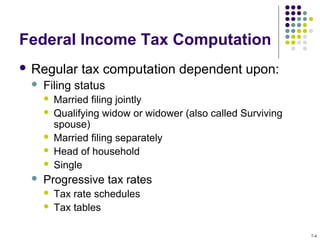
Federal Income Tax Computation
 Regular tax computation dependent upon:
 Filing status
 Married filing jointly
 Qualifying widow or widower (also called Surviving
spouse)
 Married filing separately
 Head of household
 Single
 Progressive tax rates
 Tax rate schedules
 Tax tables
7-4
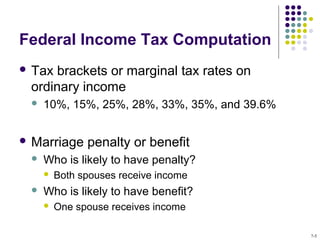
Federal Income Tax Computation
 Tax brackets or marginal tax rates on
ordinary income
 10%, 15%, 25%, 28%, 33%, 35%, and 39.6%
 Marriage penalty or benefit
 Who is likely to have penalty?
 Both spouses receive income
 Who is likely to have benefit?
 One spouse receives income
7-5
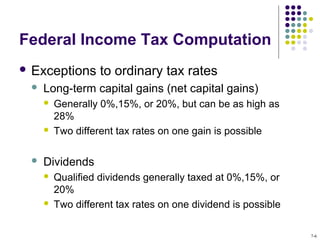
Federal Income Tax Computation
 Exceptions to ordinary tax rates
 Long-term capital gains (net capital gains)
 Generally 0%,15%, or 20%, but can be as high as
28%
 Two different tax rates on one gain is possible
 Dividends
 Qualified dividends generally taxed at 0%,15%, or
20%
 Two different tax rates on one dividend is possible
7-6
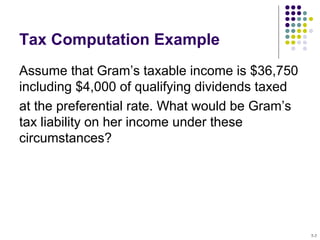
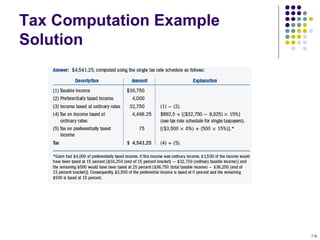
Tax Computation Example
Assume that Gram’s taxable income is $36,750
including $4,000 of qualifying dividends taxed
at the preferential rate. What would be Gram’s
tax liability on her income under these
circumstances?
7-7
Tax Computation Example
Solution
7-8
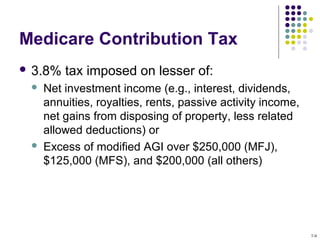
Medicare Contribution Tax
 3.8% tax imposed on lesser of:
 Net investment income (e.g., interest, dividends,
annuities, royalties, rents, passive activity income,
net gains from disposing of property, less related
allowed deductions) or
 Excess of modified AGI over $250,000 (MFJ),
$125,000 (MFS), and $200,000 (all others)
7-9
Federal Income Tax Computation
 Kiddie tax
 Net unearned income taxed at parents’ marginal rate
 Net unearned income = unearned income in excess of
$2,000
 Parents can elect to actually include this income on their
tax return.
 Applies if
 Child is under age 18 at year end,
 Child is 18 at year end but earned income not greater than
half of child’s support, or
 Child is over age 18 but under age 24, is a full-time student,
and child’s earned income not greater than half of child’s
support.
7-10
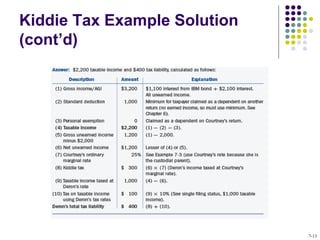
Kiddie Tax Example
Suppose that during 2013, Deron received
$1,100 in interest from an IBM bond, and he
received another $2,100 in interest income
from a money market account that his parents
have been contributing to over the years. What
is Deron’s taxable income and corresponding
tax liability? (Deron’s mother Courtney is
subject to a 25% marginal tax rate.)
7-11
Kiddie Tax Example Solution
Because Deron is younger than 18 years of
age at the end of the year and his net unearned
income exceeds $2,000, he is potentially
subject to the kiddie tax.
7-12
Kiddie Tax Example Solution
(cont’d)
7-13
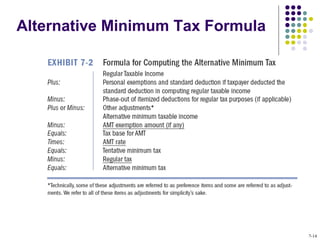
Alternative Minimum Tax Formula
7-14
Alternative Minimum Tax
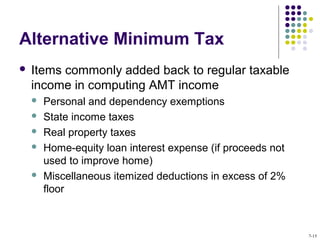
 Items commonly added back to regular taxable
income in computing AMT income
 Personal and dependency exemptions
 State income taxes
 Real property taxes
 Home-equity loan interest expense (if proceeds not
used to improve home)
 Miscellaneous itemized deductions in excess of 2%
floor
7-15
Alternative Minimum Tax
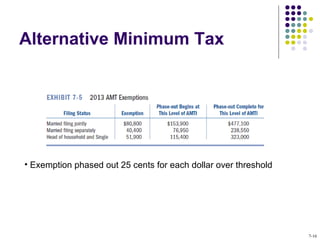
• Exemption phased out 25 cents for each dollar over threshold
7-16
Alternative Minimum Tax
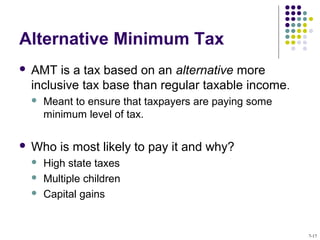
 AMT is a tax based on an alternative more
inclusive tax base than regular taxable income.
 Meant to ensure that taxpayers are paying some
minimum level of tax.
 Who is most likely to pay it and why?
 High state taxes
 Multiple children
 Capital gains
7-17
Alternative Minimum Tax
 Why is it becoming so prevalent?
 Exemption phase-out threshold not indexed for
inflation
 Individual tax rates have decreased since AMT
enacted
 AMT rates 26% or 28% vs. individual ordinary
rates 10%, 15%, 25%, 28%, 33%, 35%, 39.6%
7-18
Employment FICA Taxes
 Employee
 Must pay FICA taxes on compensation from employer
(6.2 % Social Security tax rate; 1.45% to 2.35%
Medicare tax rate)
 $113,700 limit applies to Social Security portion
 Multiple employers during year
 Employer
 Pays FICA tax on employee’s compensation (6.2%
Social Security tax rate; 1.45% Medicare tax rate)
 & withholds FICA tax from employee’s pay check
7-19
Employment and Self-
Employment Taxes
 Self-employed taxpayers
 Responsible for entire FICA tax (employee and
employer share)
 Tax base is net earnings from self-employment
(net Schedule C income (generally) and multiply
by .9235)
 Same $113,700 limit applies to Social Security
portion
7-20
Employment and Self-
Employment Taxes
 If net earnings from self-employment < $400,
no SE tax.
 How does $113,700 Social Security earnings
limit apply when have both wages and SE
earnings in the same year?
 Wages use up limit first– taxpayer favorable or
unfavorable? Why?
7-21
Employment and Self-
Employment Taxes Example
Assume that Courtney received $100,000 of
taxable compensation from EWD in 2013, and
she received $180,000 in self-employment
income from her weekend consulting activities.
What amount of self-employment taxes is
Courtney required to pay on her $180,000 of
business income?
7-22
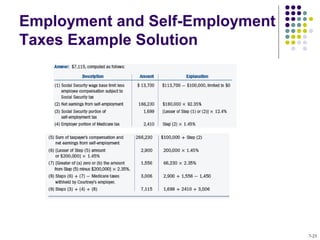
Employment and Self-Employment
Taxes Example Solution
7-23
Employee vs. Independent
Contractor
 Determining whether taxpayer is employee or
independent contractor
 Primary question: who has control over how, when,
where work is performed?
 Tax differences
 Amount of FICA or SE taxes payable
 Deductibility of expenses
 For AGI
 From AGI
 Employer portion of self-employment taxes
7-24
Tax Credits
 Reduce tax liability dollar for dollar
 Consist of three categories
 Nonrefundable personal
 Refundable personal
 Business
7-25
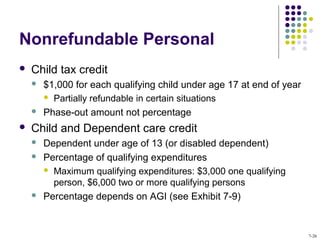
Nonrefundable Personal
 Child tax credit
 $1,000 for each qualifying child under age 17 at end of year
 Partially refundable in certain situations
 Phase-out amount not percentage
 Child and Dependent care credit
 Dependent under age of 13 (or disabled dependent)
 Percentage of qualifying expenditures
 Maximum qualifying expenditures: $3,000 one qualifying
person, $6,000 two or more qualifying persons
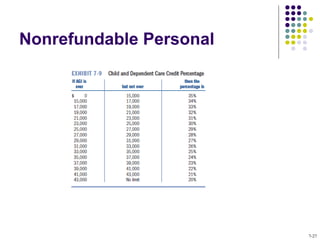
 Percentage depends on AGI (see Exhibit 7-9)
7-26
Nonrefundable Personal
7-27
Nonrefundable Personal
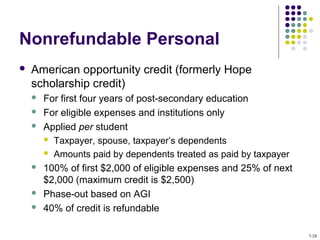
 American opportunity credit (formerly Hope
scholarship credit)
 For first four years of post-secondary education
 For eligible expenses and institutions only
 Applied per student
 Taxpayer, spouse, taxpayer’s dependents
 Amounts paid by dependents treated as paid by taxpayer
 100% of first $2,000 of eligible expenses and 25% of next
$2,000 (maximum credit is $2,500)
 Phase-out based on AGI
 40% of credit is refundable
7-28
American Opportunity Credit
Example
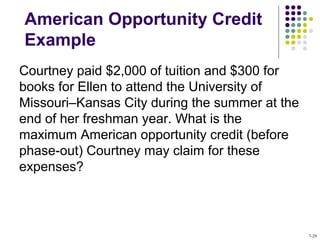
Courtney paid $2,000 of tuition and $300 for
books for Ellen to attend the University of
Missouri–Kansas City during the summer at the
end of her freshman year. What is the
maximum American opportunity credit (before
phase-out) Courtney may claim for these
expenses?
7-29
American Opportunity Credit
Example Solution
Answer: $2,075.
Because the cost of tuition and books are
eligible expenses, Courtney may claim a
maximum American opportunity credit before
phase-out of $2,075 [($2,000 × 100%) +
($2,300 - $2,000) × 25%].
7-30
American Opportunity Credit
Example
Assuming Courtney qualifies for a $2,075
American opportunity credit, she is married
filing jointly, and her AGI is $162,000, what
amount of American opportunity credit would
she be allowed to claim after phase-out?
7-31
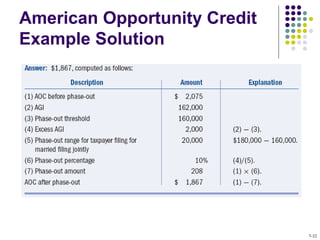
American Opportunity Credit
Example Solution
7-32
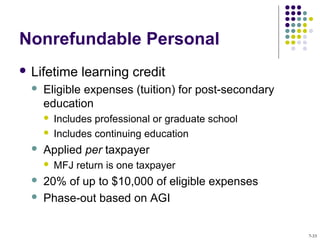
Nonrefundable Personal
 Lifetime learning credit
 Eligible expenses (tuition) for post-secondary
education
 Includes professional or graduate school
 Includes continuing education
 Applied per taxpayer
 MFJ return is one taxpayer
 20% of up to $10,000 of eligible expenses
 Phase-out based on AGI
7-33
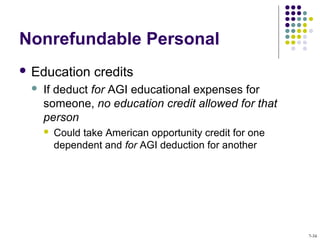
Nonrefundable Personal
 Education credits
 If deduct for AGI educational expenses for
someone, no education credit allowed for that
person
 Could take American opportunity credit for one
dependent and for AGI deduction for another
7-34
Refundable Personal
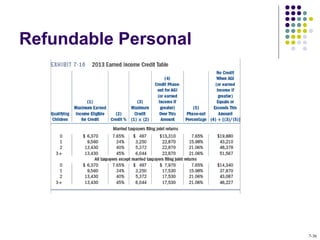
 Earned income credit
 Negative income tax
 Must have earned income
 Must have at least one qualifying child or must be
at least 25 years old and less than 65 and not a
dependent of another
 See Exhibit 7-10
7-35
Refundable Personal
7-36
Tax Credits
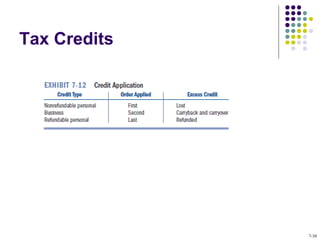
 Business credits
 Promote certain behaviors
 If credit exceeds tax, carry back one year and
carry forward 20 years
 Foreign tax credit
 Hybrid business and personal – nonrefundable; carry
back one year and carry forward 10 years
7-37
Tax Credits
7-38
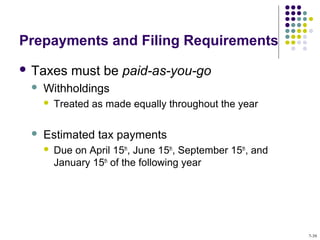
Prepayments and Filing Requirements
 Taxes must be paid-as-you-go
 Withholdings
 Treated as made equally throughout the year
 Estimated tax payments
 Due on April 15th
, June 15th
, September 15th
, and
January 15th
of the following year
7-39
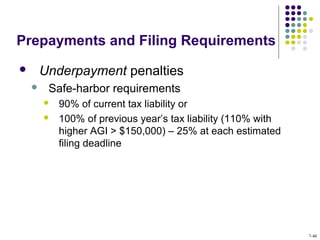
Prepayments and Filing Requirements
 Underpayment penalties
 Safe-harbor requirements
 90% of current tax liability or
 100% of previous year’s tax liability (110% with
higher AGI > $150,000) – 25% at each estimated
filing deadline
7-40
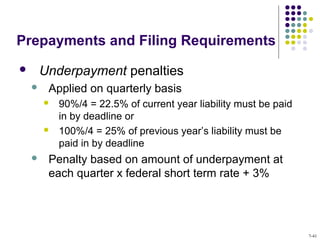
Prepayments and Filing Requirements
 Underpayment penalties
 Applied on quarterly basis
 90%/4 = 22.5% of current year liability must be paid
in by deadline or
 100%/4 = 25% of previous year’s liability must be
paid in by deadline
 Penalty based on amount of underpayment at
each quarter x federal short term rate + 3%
7-41
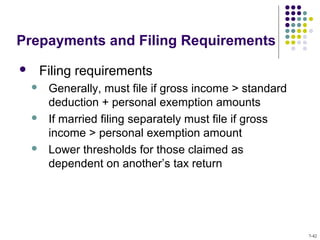
Prepayments and Filing Requirements
 Filing requirements
 Generally, must file if gross income > standard
deduction + personal exemption amounts
 If married filing separately must file if gross
income > personal exemption amount
 Lower thresholds for those claimed as
dependent on another’s tax return
7-42
Prepayments and Filing Requirements
 Due dates
 April 15th
 Extend filing up to six months
 May not extend due date for paying taxes
7-43
Prepayments and Filing Requirements
 Late filing penalty
 5% of tax owed per month up to 25% if not fraudulent; 15%
of tax owed per month up to 75% if fraudulent
 No penalty if no tax is due
 Late payment penalty
 If don’t pay entire tax owed by due date of return
 .5% of amount due up to 25% maximum if not fraudulent
 15% of amount due per month up to 75% if fraudulent
 Combined late filing and late payment penalties may
not exceed maximum amounts for either one
7-44
Late Filing and Late Payment Penalty
Example
Assume Courtney filed her tax return on April
10 and included a check with the return for
$2,896 made payable to the United States
Treasury. The $2,896 consisted of her
underpaid tax liability of $2,866 and her $30
underpayment penalty. If Courtney had waited
until May 1 to file her return and pay her taxes,
what late filing and late payment penalties
would she owe?
7-45
Late Filing and Late Payment Penalty
Example Solution
Answer: Her combined late filing penalty and
late payment penalty would be $143 ($2,866
late payment × 5 percent × 1 month or portion
thereof). Note that the combined late filing and
late payment penalty is limited to 5 percent per
month.
7-46

ACCT321 Chapter 07

  • 1.
    Chapter 7 Individual IncomeTax Computation and Tax Credits © 2014 by McGraw-Hill Education. This is proprietary material solely for authorized instructor use. Not authorized for sale or distribution in any manner. This document may not be copied, scanned, duplicated, forwarded, distributed, or posted on a website, in whole or part.
  • 2.
    Learning Objectives 1. Determinea taxpayer’s regular tax liability and identify tax issues associated with the process. 2. Compute a taxpayer’s alternative minimum tax liability and describe the tax characteristics of taxpayers most likely to owe the alternative minimum tax. 3. Calculate a taxpayer’s employment and self- employment taxes payable and explain tax considerations relating to whether a taxpayer is considered to be an employee or a self-employed independent contractor. 7-2
  • 3.
    Learning Objectives (cont’d) 4.Describe the different general types of tax credits, identify specific tax credits, and compute a taxpayer’s allowable child tax credit, child and dependent care credit, earned income credit, American opportunity credit, lifetime learning credit, and earned income credit. 5. Explain taxpayer filing and tax payment requirements and describe in general terms how to compute a taxpayer’s underpayment, late filing, and late payment penalties. 7-3
  • 4.
    Federal Income TaxComputation  Regular tax computation dependent upon:  Filing status  Married filing jointly  Qualifying widow or widower (also called Surviving spouse)  Married filing separately  Head of household  Single  Progressive tax rates  Tax rate schedules  Tax tables 7-4
  • 5.
    Federal Income TaxComputation  Tax brackets or marginal tax rates on ordinary income  10%, 15%, 25%, 28%, 33%, 35%, and 39.6%  Marriage penalty or benefit  Who is likely to have penalty?  Both spouses receive income  Who is likely to have benefit?  One spouse receives income 7-5
  • 6.
    Federal Income TaxComputation  Exceptions to ordinary tax rates  Long-term capital gains (net capital gains)  Generally 0%,15%, or 20%, but can be as high as 28%  Two different tax rates on one gain is possible  Dividends  Qualified dividends generally taxed at 0%,15%, or 20%  Two different tax rates on one dividend is possible 7-6
  • 7.
    Tax Computation Example Assumethat Gram’s taxable income is $36,750 including $4,000 of qualifying dividends taxed at the preferential rate. What would be Gram’s tax liability on her income under these circumstances? 7-7
  • 8.
  • 9.
    Medicare Contribution Tax 3.8% tax imposed on lesser of:  Net investment income (e.g., interest, dividends, annuities, royalties, rents, passive activity income, net gains from disposing of property, less related allowed deductions) or  Excess of modified AGI over $250,000 (MFJ), $125,000 (MFS), and $200,000 (all others) 7-9
  • 10.
    Federal Income TaxComputation  Kiddie tax  Net unearned income taxed at parents’ marginal rate  Net unearned income = unearned income in excess of $2,000  Parents can elect to actually include this income on their tax return.  Applies if  Child is under age 18 at year end,  Child is 18 at year end but earned income not greater than half of child’s support, or  Child is over age 18 but under age 24, is a full-time student, and child’s earned income not greater than half of child’s support. 7-10
  • 11.
    Kiddie Tax Example Supposethat during 2013, Deron received $1,100 in interest from an IBM bond, and he received another $2,100 in interest income from a money market account that his parents have been contributing to over the years. What is Deron’s taxable income and corresponding tax liability? (Deron’s mother Courtney is subject to a 25% marginal tax rate.) 7-11
  • 12.
    Kiddie Tax ExampleSolution Because Deron is younger than 18 years of age at the end of the year and his net unearned income exceeds $2,000, he is potentially subject to the kiddie tax. 7-12
  • 13.
    Kiddie Tax ExampleSolution (cont’d) 7-13
  • 14.
  • 15.
    Alternative Minimum Tax Items commonly added back to regular taxable income in computing AMT income  Personal and dependency exemptions  State income taxes  Real property taxes  Home-equity loan interest expense (if proceeds not used to improve home)  Miscellaneous itemized deductions in excess of 2% floor 7-15
  • 16.
    Alternative Minimum Tax •Exemption phased out 25 cents for each dollar over threshold 7-16
  • 17.
    Alternative Minimum Tax AMT is a tax based on an alternative more inclusive tax base than regular taxable income.  Meant to ensure that taxpayers are paying some minimum level of tax.  Who is most likely to pay it and why?  High state taxes  Multiple children  Capital gains 7-17
  • 18.
    Alternative Minimum Tax Why is it becoming so prevalent?  Exemption phase-out threshold not indexed for inflation  Individual tax rates have decreased since AMT enacted  AMT rates 26% or 28% vs. individual ordinary rates 10%, 15%, 25%, 28%, 33%, 35%, 39.6% 7-18
  • 19.
    Employment FICA Taxes Employee  Must pay FICA taxes on compensation from employer (6.2 % Social Security tax rate; 1.45% to 2.35% Medicare tax rate)  $113,700 limit applies to Social Security portion  Multiple employers during year  Employer  Pays FICA tax on employee’s compensation (6.2% Social Security tax rate; 1.45% Medicare tax rate)  & withholds FICA tax from employee’s pay check 7-19
  • 20.
    Employment and Self- EmploymentTaxes  Self-employed taxpayers  Responsible for entire FICA tax (employee and employer share)  Tax base is net earnings from self-employment (net Schedule C income (generally) and multiply by .9235)  Same $113,700 limit applies to Social Security portion 7-20
  • 21.
    Employment and Self- EmploymentTaxes  If net earnings from self-employment < $400, no SE tax.  How does $113,700 Social Security earnings limit apply when have both wages and SE earnings in the same year?  Wages use up limit first– taxpayer favorable or unfavorable? Why? 7-21
  • 22.
    Employment and Self- EmploymentTaxes Example Assume that Courtney received $100,000 of taxable compensation from EWD in 2013, and she received $180,000 in self-employment income from her weekend consulting activities. What amount of self-employment taxes is Courtney required to pay on her $180,000 of business income? 7-22
  • 23.
  • 24.
    Employee vs. Independent Contractor Determining whether taxpayer is employee or independent contractor  Primary question: who has control over how, when, where work is performed?  Tax differences  Amount of FICA or SE taxes payable  Deductibility of expenses  For AGI  From AGI  Employer portion of self-employment taxes 7-24
  • 25.
    Tax Credits  Reducetax liability dollar for dollar  Consist of three categories  Nonrefundable personal  Refundable personal  Business 7-25
  • 26.
    Nonrefundable Personal  Childtax credit  $1,000 for each qualifying child under age 17 at end of year  Partially refundable in certain situations  Phase-out amount not percentage  Child and Dependent care credit  Dependent under age of 13 (or disabled dependent)  Percentage of qualifying expenditures  Maximum qualifying expenditures: $3,000 one qualifying person, $6,000 two or more qualifying persons  Percentage depends on AGI (see Exhibit 7-9) 7-26
  • 27.
  • 28.
    Nonrefundable Personal  Americanopportunity credit (formerly Hope scholarship credit)  For first four years of post-secondary education  For eligible expenses and institutions only  Applied per student  Taxpayer, spouse, taxpayer’s dependents  Amounts paid by dependents treated as paid by taxpayer  100% of first $2,000 of eligible expenses and 25% of next $2,000 (maximum credit is $2,500)  Phase-out based on AGI  40% of credit is refundable 7-28
  • 29.
    American Opportunity Credit Example Courtneypaid $2,000 of tuition and $300 for books for Ellen to attend the University of Missouri–Kansas City during the summer at the end of her freshman year. What is the maximum American opportunity credit (before phase-out) Courtney may claim for these expenses? 7-29
  • 30.
    American Opportunity Credit ExampleSolution Answer: $2,075. Because the cost of tuition and books are eligible expenses, Courtney may claim a maximum American opportunity credit before phase-out of $2,075 [($2,000 × 100%) + ($2,300 - $2,000) × 25%]. 7-30
  • 31.
    American Opportunity Credit Example AssumingCourtney qualifies for a $2,075 American opportunity credit, she is married filing jointly, and her AGI is $162,000, what amount of American opportunity credit would she be allowed to claim after phase-out? 7-31
  • 32.
  • 33.
    Nonrefundable Personal  Lifetimelearning credit  Eligible expenses (tuition) for post-secondary education  Includes professional or graduate school  Includes continuing education  Applied per taxpayer  MFJ return is one taxpayer  20% of up to $10,000 of eligible expenses  Phase-out based on AGI 7-33
  • 34.
    Nonrefundable Personal  Educationcredits  If deduct for AGI educational expenses for someone, no education credit allowed for that person  Could take American opportunity credit for one dependent and for AGI deduction for another 7-34
  • 35.
    Refundable Personal  Earnedincome credit  Negative income tax  Must have earned income  Must have at least one qualifying child or must be at least 25 years old and less than 65 and not a dependent of another  See Exhibit 7-10 7-35
  • 36.
  • 37.
    Tax Credits  Businesscredits  Promote certain behaviors  If credit exceeds tax, carry back one year and carry forward 20 years  Foreign tax credit  Hybrid business and personal – nonrefundable; carry back one year and carry forward 10 years 7-37
  • 38.
  • 39.
    Prepayments and FilingRequirements  Taxes must be paid-as-you-go  Withholdings  Treated as made equally throughout the year  Estimated tax payments  Due on April 15th , June 15th , September 15th , and January 15th of the following year 7-39
  • 40.
    Prepayments and FilingRequirements  Underpayment penalties  Safe-harbor requirements  90% of current tax liability or  100% of previous year’s tax liability (110% with higher AGI > $150,000) – 25% at each estimated filing deadline 7-40
  • 41.
    Prepayments and FilingRequirements  Underpayment penalties  Applied on quarterly basis  90%/4 = 22.5% of current year liability must be paid in by deadline or  100%/4 = 25% of previous year’s liability must be paid in by deadline  Penalty based on amount of underpayment at each quarter x federal short term rate + 3% 7-41
  • 42.
    Prepayments and FilingRequirements  Filing requirements  Generally, must file if gross income > standard deduction + personal exemption amounts  If married filing separately must file if gross income > personal exemption amount  Lower thresholds for those claimed as dependent on another’s tax return 7-42
  • 43.
    Prepayments and FilingRequirements  Due dates  April 15th  Extend filing up to six months  May not extend due date for paying taxes 7-43
  • 44.
    Prepayments and FilingRequirements  Late filing penalty  5% of tax owed per month up to 25% if not fraudulent; 15% of tax owed per month up to 75% if fraudulent  No penalty if no tax is due  Late payment penalty  If don’t pay entire tax owed by due date of return  .5% of amount due up to 25% maximum if not fraudulent  15% of amount due per month up to 75% if fraudulent  Combined late filing and late payment penalties may not exceed maximum amounts for either one 7-44
  • 45.
    Late Filing andLate Payment Penalty Example Assume Courtney filed her tax return on April 10 and included a check with the return for $2,896 made payable to the United States Treasury. The $2,896 consisted of her underpaid tax liability of $2,866 and her $30 underpayment penalty. If Courtney had waited until May 1 to file her return and pay her taxes, what late filing and late payment penalties would she owe? 7-45
  • 46.
    Late Filing andLate Payment Penalty Example Solution Answer: Her combined late filing penalty and late payment penalty would be $143 ($2,866 late payment × 5 percent × 1 month or portion thereof). Note that the combined late filing and late payment penalty is limited to 5 percent per month. 7-46