CHAPTERTHREE:
NEEDS
ASSESSMENT
Objectives
1. Discuss the role of organization analysis and task analysis in needs assessment.
2. Identify different methods used in needs assessment and identify the
advantage and disadvantage of each methods.
3. Discuss the concern of upper- and mid-level manager and trainers in need
assessment.
4. Explain how personal characteristic, input, output, consequences, and feedback
influence performance and learning
5. Create condition to ensure that employees are receptive to training
6. Discuss the step involved conducting a task analysis
7. Analyze task for which people need to be trained
8. Explain competency model and the process used to develop them
Introduction
Needs Assessment refers to the process used to determine whether training is
necessary typically involves organizational analysis, and task analysis
DesigningTraining
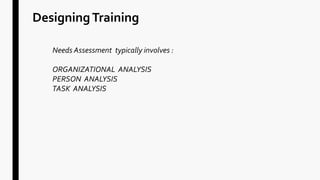
Needs Assessment typically involves :
ORGANIZATIONAL ANALYSIS
PERSON ANALYSIS
TASK ANALYSIS
WHY IS NEEDS ASSESSMENT NECESSARY?
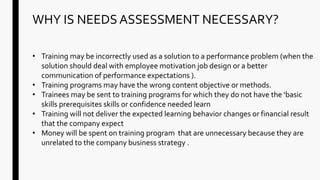
• Training may be incorrectly used as a solution to a performance problem (when the
solution should deal with employee motivation job design or a better
communication of performance expectations ).
• Training programs may have the wrong content objective or methods.
• Trainees may be sent to training programs for which they do not have the ‘basic
skills prerequisites skills or confidence needed learn
• Training will not deliver the expected learning behavior changes or financial result
that the company expect
• Money will be spent on training program that are unnecessary because they are
unrelated to the company business strategy .
WHO SHOULD PARTICIPATE IN NEEDS
ASSESSMENT?
Stakeholders include person in the organization who have an interesting in training
and development and their support is important for determining its success (or
failure)
METHODS USED IN NEEDS ASSESSMENT
Several methods are used to conducts needs assessment including observing employees
performing the job using online technology reading technical manuals and others
documentation interviewing SME’s and asking SME’s to complete survey designed to
identify the task and knowledge skill abilities and other characteristic required
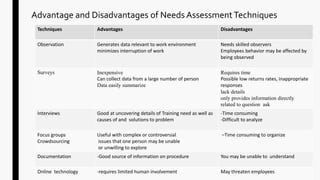
Advantage and Disadvantages of Needs AssessmentTechniques
Techniques Advantages Disadvantages
Observation Generates data relevant to work environment
minimizes interruption of work
Needs skilled observers
Employees behavior may be affected by
being observed
Surveys Inexpensive
Can collect data from a large number of person
Data easily summarize
Requires time
Possible low returns rates, inappropriate
responses
lack details
only provides information directly
related to question ask
Interviews Good at uncovering details of Training need as well as
causes of and solutions to problem
-Time consuming
-Difficult to analyze
Focus groups
Crowdsourcing
Useful with complex or controversial
issues that one person may be unable
or unwilling to explore
–Time consuming to organize
Documentation -Good source of information on procedure You may be unable to understand
Online technology -requires limited human involvement May threaten employees
THE NEEDS ASSESSMENT PROCESS
This section examines the three elements of needs assessment:
Organizational
Analysis
Person
Analysis
Task Analysis
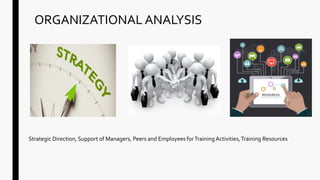
ORGANIZATIONAL ANALYSIS
Strategic Direction, Support of Managers, Peers and Employees forTraining Activities,Training Resources
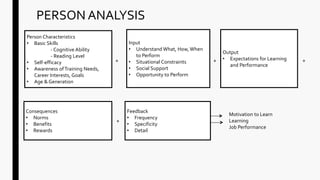
PERSON ANALYSIS
Person Characteristics
• Basic Skills
- Cognitive Ability
- Reading Level
• Self-efficacy
• Awareness ofTraining Needs,
Career Interests, Goals
• Age & Generation
+
Input
• Understand What, How,When
to Perform
• Situational Constraints
• Social Support
• Opportunity to Perform
+
Output
• Expectations for Learning
and Performance
+
Consequences
• Norms
• Benefits
• Rewards
+
Feedback
• Frequency
• Specificity
• Detail
Motivation to Learn
Learning
Job Performance
Reading Ability
■ Readability refers to the difficulty level of written materials. Lack of the appropriate
reading level can impede performance and learning in training programs. Material
used in training should be evaluated to ensure that its reading level does not exceed
that required by the job. A readability assessment usually involves analysis of sentence
length and word difficulty.
Self-Efficacy
■ Self-efficacy is employees' belief that they can perform their job or learn the content
of the training program successfully.The job environment can be threatening to too
many employees who may not have been successful performers in the past.
Research has demonstrated that self-efficacy is
related to performance in training programs.
Employees' self-efficacy level can be increased by
1. Letting employees know that the purpose of training is to try
to improve performance rather than to identify areas in which
employees incompetent.
2. Providing as much information as possible about the training
program and the purpose of training prior to the actual
training.
3. Showing employees training success of their peers who are
now in similar jobs.
4. Providing employees with feedback that learning is under their
control and they have the ability and the responsibility to overcome
any learning difficulties they experience in the program.
Awareness ofTraining Needs, Career Interest,
and Goals
■ To be motivated to learn in training programs, employees must be aware of their skill
strengths and weaknesses and of the link between the training program and
improvement of their weaknesses.
Age and Generation
■ There is biological evidence that certain mental capacities decrease from age twenty
to age seventy. Short-term memory and the speed at which people process
information decline as we age.
Input
Employees' perceptions of two characteristics of the work environment---
situational constraints and social support--- are determinants of
performance and motivation to learn Situational contraints include lack
of proper tools and equipment, materials and supplies, budgetary
support, and time. Social support refers to managers' and peers'
willingness to provide feedback and reinforcement.
To ensure the work environment 'enhances
trainees' motivation to learn, managers
should take the following steps:
1. Provide materials, time, job-related information, and other work
aids necessary for employees to use skills or behavior before
participating in training programs.
2. Speak positively about the company's training programs to
employees.
3. Let employees know they are doing a good job when they are using
training content in their work
4. Encourage work-group members to involves each other in trying to
use new skills on the job by soliciting feedback and sharing training
experiences and situations in which training content has been helpful.
5. Provide employees with time and opportunities to practice and apply
new skills or behaviors to their work.
Output
Poor substandard performance can occur on the job because employees do not know at
what level they are expected to perform.
Consequence
If employees do not believe that rewards or incentives for performance are adequate, they
will be unlikely to meet performance standards even if they have the necessary
knowledge, behavior, skill, or attitudes.
Feedback
Performance problems can result when employees do not receive feedback regarding the
extent to which they are meeting performance standards.
DeterminingWhetherTraining Is
The Best Solution
To determine whether training is needed to solve a performance
problem, managers need to analyze characteristics of the performer,
input, output, consequences, and feedback. How might this be done?
Managers should asses the following:
1. Is the performance problem important? Does it have the potential to
cost the company a significant amount of money from lost productivity or
customer?
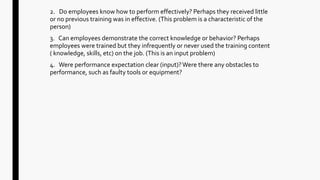
2. Do employees know how to perform effectively? Perhaps they received little
or no previous training was in effective. (This problem is a characteristic of the
person)
3. Can employees demonstrate the correct knowledge or behavior? Perhaps
employees were trained but they infrequently or never used the training content
( knowledge, skills, etc) on the job. (This is an input problem)
4. Were performance expectation clear (input)?Were there any obstacles to
performance, such as faulty tools or equipment?
5. Were positive consequences offered for good performance?Was good
performance not rewarded? (This involves cobsequences)
6. Did employees receive timely, relevant, accurate, constructive, and
specific feedback about their performance (a feedback issue)?
7. Were other solutions----such as job redesign or transferring employees to
other jobs---too expensive or unrealistic.
Figure 3.4 Identifying How to solve Performance Issues
Task Analysis
■ Task analysis results in a deacription of work activities, including task performed by
the employee and the knowledge, skills, and abilities required to complete the task. A
job is a specific position requiring the completion of a certain task.
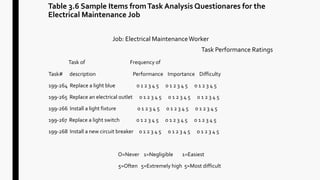
Table 3.6 Sample Items fromTask Analysis Questionares for the
Electrical Maintenance Job
Job: Electrical MaintenanceWorker
Task Performance Ratings
Task of Frequency of
Task# description Performance Importance Difficulty
199-264 Replace a light blue 0 1 2 3 4 5 0 1 2 3 4 5 0 1 2 3 4 5
199-265 Replace an electrical outlet 0 1 2 3 4 5 0 1 2 3 4 5 0 1 2 3 4 5
199-266 Install a light fixture 0 1 2 3 4 5 0 1 2 3 4 5 0 1 2 3 4 5
199-267 Replace a light switch 0 1 2 3 4 5 0 1 2 3 4 5 0 1 2 3 4 5
199-268 Install a new circuit breaker 0 1 2 3 4 5 0 1 2 3 4 5 0 1 2 3 4 5
O=Never 1=Negligible 1=Easiest
5=Often 5=Extremely high 5=Most difficult
Step in aTask Analysis
1. Select the job or jobs to be analyzed.
2. Develop a preliminary list of tasks performed on the job by (1)
interviewing and observing expert emloyees and their managers and (2)
taking with others who have performed a task analysis.
3. Validate or confirm the preliminary list of tasks.This step involves
having a group of SMEs (job incumbents, managers and etc.) answer in a
meeting or on a written survey several questipn regarding the task.
4. Once the task have been identified, it is important to identify the
knowledge, skills, or tasks that are difficult to learn or prone to errors
such as decision making or problem solving task.
Example ofTask Analysis
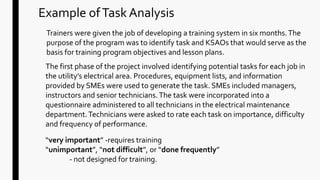
Trainers were given the job of developing a training system in six months.The
purpose of the program was to identify task and KSAOs that would serve as the
basis for training program objectives and lesson plans.
The first phase of the project involved identifying potential tasks for each job in
the utility’s electrical area. Procedures, equipment lists, and information
provided by SMEs were used to generate the task. SMEs included managers,
instructors and senior technicians.The task were incorporated into a
questionnaire administered to all technicians in the electrical maintenance
department.Technicians were asked to rate each task on importance, difficulty
and frequency of performance.
“very important” -requires training
“unimportant”, “not difficult”, or “done frequently”
- not designed for training.
REMEMBER!!
 A task analysis should identify both employees are actually doing and what
they should be doing on the job.
 Task analysis begins from breaking the job into duties and tasks.
 Use more than two methods for collecting task information to increase the
validity of the analysis
COMPETENCY MODEL
Identifies competencies necessary for each job. Competency models provide
description of competencies that are common for an entire occupation, organization,
job family, or specific job.
It can be used for performance management.
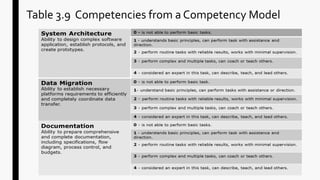
Table 3.9 Competencies from a Competency Model
One way to understand competency model is to compare them to job analysis.
Job analysis is more work- and task-focused, whereas competency modeling is worker-
focused.
The competencies generated by competency modeling and more general and believed
to have greater application to a wider variety of purposes.
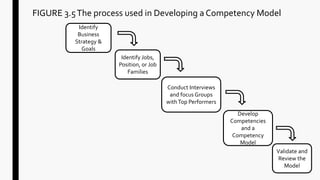
FIGURE 3.5The process used in Developing a Competency Model
Identify
Business
Strategy &
Goals
Develop
Competencies
and a
Competency
Model
Conduct Interviews
and focus Groups
withTop Performers
Identify Jobs,
Position, or Job
Families
Validate and
Review the
Model
SCOPE OF NEEDS ASSESSMENT
Rapid NeedsAssessment refers to a need assessment that is done quickly and
accurately but without sacrificing the quality of the process or the outcomes.
Ways to conduct a rapid needs assessment:
1.The scope of needs of assessment depends on the size of the potential pressure
point.
2. Consider using already available data collected for other purposes.
3. If you are attuned to the business problems, technological methods, and other
issues facing the organization, you will be able to anticipate training needs.
Thank you!!

NEEDS ASSESSMENT

  • 1.
  • 2.
    Objectives 1. Discuss therole of organization analysis and task analysis in needs assessment. 2. Identify different methods used in needs assessment and identify the advantage and disadvantage of each methods. 3. Discuss the concern of upper- and mid-level manager and trainers in need assessment. 4. Explain how personal characteristic, input, output, consequences, and feedback influence performance and learning 5. Create condition to ensure that employees are receptive to training 6. Discuss the step involved conducting a task analysis 7. Analyze task for which people need to be trained 8. Explain competency model and the process used to develop them
  • 3.
    Introduction Needs Assessment refersto the process used to determine whether training is necessary typically involves organizational analysis, and task analysis
  • 4.
    DesigningTraining Needs Assessment typicallyinvolves : ORGANIZATIONAL ANALYSIS PERSON ANALYSIS TASK ANALYSIS
  • 5.
    WHY IS NEEDSASSESSMENT NECESSARY? • Training may be incorrectly used as a solution to a performance problem (when the solution should deal with employee motivation job design or a better communication of performance expectations ). • Training programs may have the wrong content objective or methods. • Trainees may be sent to training programs for which they do not have the ‘basic skills prerequisites skills or confidence needed learn • Training will not deliver the expected learning behavior changes or financial result that the company expect • Money will be spent on training program that are unnecessary because they are unrelated to the company business strategy .
  • 6.
    WHO SHOULD PARTICIPATEIN NEEDS ASSESSMENT? Stakeholders include person in the organization who have an interesting in training and development and their support is important for determining its success (or failure)
  • 7.
    METHODS USED INNEEDS ASSESSMENT Several methods are used to conducts needs assessment including observing employees performing the job using online technology reading technical manuals and others documentation interviewing SME’s and asking SME’s to complete survey designed to identify the task and knowledge skill abilities and other characteristic required
  • 8.
    Advantage and Disadvantagesof Needs AssessmentTechniques Techniques Advantages Disadvantages Observation Generates data relevant to work environment minimizes interruption of work Needs skilled observers Employees behavior may be affected by being observed Surveys Inexpensive Can collect data from a large number of person Data easily summarize Requires time Possible low returns rates, inappropriate responses lack details only provides information directly related to question ask Interviews Good at uncovering details of Training need as well as causes of and solutions to problem -Time consuming -Difficult to analyze Focus groups Crowdsourcing Useful with complex or controversial issues that one person may be unable or unwilling to explore –Time consuming to organize Documentation -Good source of information on procedure You may be unable to understand Online technology -requires limited human involvement May threaten employees
  • 9.
    THE NEEDS ASSESSMENTPROCESS This section examines the three elements of needs assessment: Organizational Analysis Person Analysis Task Analysis
  • 10.
    ORGANIZATIONAL ANALYSIS Strategic Direction,Support of Managers, Peers and Employees forTraining Activities,Training Resources
  • 11.
    PERSON ANALYSIS Person Characteristics •Basic Skills - Cognitive Ability - Reading Level • Self-efficacy • Awareness ofTraining Needs, Career Interests, Goals • Age & Generation + Input • Understand What, How,When to Perform • Situational Constraints • Social Support • Opportunity to Perform + Output • Expectations for Learning and Performance + Consequences • Norms • Benefits • Rewards + Feedback • Frequency • Specificity • Detail Motivation to Learn Learning Job Performance
  • 12.
    Reading Ability ■ Readabilityrefers to the difficulty level of written materials. Lack of the appropriate reading level can impede performance and learning in training programs. Material used in training should be evaluated to ensure that its reading level does not exceed that required by the job. A readability assessment usually involves analysis of sentence length and word difficulty.
  • 13.
    Self-Efficacy ■ Self-efficacy isemployees' belief that they can perform their job or learn the content of the training program successfully.The job environment can be threatening to too many employees who may not have been successful performers in the past.
  • 14.
    Research has demonstratedthat self-efficacy is related to performance in training programs. Employees' self-efficacy level can be increased by 1. Letting employees know that the purpose of training is to try to improve performance rather than to identify areas in which employees incompetent. 2. Providing as much information as possible about the training program and the purpose of training prior to the actual training.
  • 15.
    3. Showing employeestraining success of their peers who are now in similar jobs. 4. Providing employees with feedback that learning is under their control and they have the ability and the responsibility to overcome any learning difficulties they experience in the program.
  • 16.
    Awareness ofTraining Needs,Career Interest, and Goals ■ To be motivated to learn in training programs, employees must be aware of their skill strengths and weaknesses and of the link between the training program and improvement of their weaknesses.
  • 17.
    Age and Generation ■There is biological evidence that certain mental capacities decrease from age twenty to age seventy. Short-term memory and the speed at which people process information decline as we age.
  • 18.
    Input Employees' perceptions oftwo characteristics of the work environment--- situational constraints and social support--- are determinants of performance and motivation to learn Situational contraints include lack of proper tools and equipment, materials and supplies, budgetary support, and time. Social support refers to managers' and peers' willingness to provide feedback and reinforcement.
  • 19.
    To ensure thework environment 'enhances trainees' motivation to learn, managers should take the following steps: 1. Provide materials, time, job-related information, and other work aids necessary for employees to use skills or behavior before participating in training programs. 2. Speak positively about the company's training programs to employees. 3. Let employees know they are doing a good job when they are using training content in their work
  • 20.
    4. Encourage work-groupmembers to involves each other in trying to use new skills on the job by soliciting feedback and sharing training experiences and situations in which training content has been helpful. 5. Provide employees with time and opportunities to practice and apply new skills or behaviors to their work.
  • 21.
    Output Poor substandard performancecan occur on the job because employees do not know at what level they are expected to perform.
  • 22.
    Consequence If employees donot believe that rewards or incentives for performance are adequate, they will be unlikely to meet performance standards even if they have the necessary knowledge, behavior, skill, or attitudes.
  • 23.
    Feedback Performance problems canresult when employees do not receive feedback regarding the extent to which they are meeting performance standards.
  • 24.
    DeterminingWhetherTraining Is The BestSolution To determine whether training is needed to solve a performance problem, managers need to analyze characteristics of the performer, input, output, consequences, and feedback. How might this be done? Managers should asses the following: 1. Is the performance problem important? Does it have the potential to cost the company a significant amount of money from lost productivity or customer?
  • 25.
    2. Do employeesknow how to perform effectively? Perhaps they received little or no previous training was in effective. (This problem is a characteristic of the person) 3. Can employees demonstrate the correct knowledge or behavior? Perhaps employees were trained but they infrequently or never used the training content ( knowledge, skills, etc) on the job. (This is an input problem) 4. Were performance expectation clear (input)?Were there any obstacles to performance, such as faulty tools or equipment?
  • 26.
    5. Were positiveconsequences offered for good performance?Was good performance not rewarded? (This involves cobsequences) 6. Did employees receive timely, relevant, accurate, constructive, and specific feedback about their performance (a feedback issue)? 7. Were other solutions----such as job redesign or transferring employees to other jobs---too expensive or unrealistic.
  • 27.
    Figure 3.4 IdentifyingHow to solve Performance Issues
  • 28.
    Task Analysis ■ Taskanalysis results in a deacription of work activities, including task performed by the employee and the knowledge, skills, and abilities required to complete the task. A job is a specific position requiring the completion of a certain task.
  • 29.
    Table 3.6 SampleItems fromTask Analysis Questionares for the Electrical Maintenance Job Job: Electrical MaintenanceWorker Task Performance Ratings Task of Frequency of Task# description Performance Importance Difficulty 199-264 Replace a light blue 0 1 2 3 4 5 0 1 2 3 4 5 0 1 2 3 4 5 199-265 Replace an electrical outlet 0 1 2 3 4 5 0 1 2 3 4 5 0 1 2 3 4 5 199-266 Install a light fixture 0 1 2 3 4 5 0 1 2 3 4 5 0 1 2 3 4 5 199-267 Replace a light switch 0 1 2 3 4 5 0 1 2 3 4 5 0 1 2 3 4 5 199-268 Install a new circuit breaker 0 1 2 3 4 5 0 1 2 3 4 5 0 1 2 3 4 5 O=Never 1=Negligible 1=Easiest 5=Often 5=Extremely high 5=Most difficult
  • 30.
    Step in aTaskAnalysis 1. Select the job or jobs to be analyzed. 2. Develop a preliminary list of tasks performed on the job by (1) interviewing and observing expert emloyees and their managers and (2) taking with others who have performed a task analysis. 3. Validate or confirm the preliminary list of tasks.This step involves having a group of SMEs (job incumbents, managers and etc.) answer in a meeting or on a written survey several questipn regarding the task.
  • 31.
    4. Once thetask have been identified, it is important to identify the knowledge, skills, or tasks that are difficult to learn or prone to errors such as decision making or problem solving task.
  • 32.
    Example ofTask Analysis Trainerswere given the job of developing a training system in six months.The purpose of the program was to identify task and KSAOs that would serve as the basis for training program objectives and lesson plans. The first phase of the project involved identifying potential tasks for each job in the utility’s electrical area. Procedures, equipment lists, and information provided by SMEs were used to generate the task. SMEs included managers, instructors and senior technicians.The task were incorporated into a questionnaire administered to all technicians in the electrical maintenance department.Technicians were asked to rate each task on importance, difficulty and frequency of performance. “very important” -requires training “unimportant”, “not difficult”, or “done frequently” - not designed for training.
  • 33.
    REMEMBER!!  A taskanalysis should identify both employees are actually doing and what they should be doing on the job.  Task analysis begins from breaking the job into duties and tasks.  Use more than two methods for collecting task information to increase the validity of the analysis
  • 34.
    COMPETENCY MODEL Identifies competenciesnecessary for each job. Competency models provide description of competencies that are common for an entire occupation, organization, job family, or specific job. It can be used for performance management.
  • 35.
    Table 3.9 Competenciesfrom a Competency Model
  • 36.
    One way tounderstand competency model is to compare them to job analysis. Job analysis is more work- and task-focused, whereas competency modeling is worker- focused. The competencies generated by competency modeling and more general and believed to have greater application to a wider variety of purposes.
  • 37.
    FIGURE 3.5The processused in Developing a Competency Model Identify Business Strategy & Goals Develop Competencies and a Competency Model Conduct Interviews and focus Groups withTop Performers Identify Jobs, Position, or Job Families Validate and Review the Model
  • 38.
    SCOPE OF NEEDSASSESSMENT Rapid NeedsAssessment refers to a need assessment that is done quickly and accurately but without sacrificing the quality of the process or the outcomes.
  • 39.
    Ways to conducta rapid needs assessment: 1.The scope of needs of assessment depends on the size of the potential pressure point. 2. Consider using already available data collected for other purposes. 3. If you are attuned to the business problems, technological methods, and other issues facing the organization, you will be able to anticipate training needs.
  • 40.