Introduction to Employee
Training and Development
Chapter 1
6th Edition
Raymond A. Noe
McGraw-Hill/Irwin

Copyright © 2013 by The McGraw-Hill Companies, Inc. All rights reserved.
Learning Objectives
• Discuss the forces influencing the workplace and
learning, and explain how training can help
companies deal with these forces
• Draw a figure or diagram and explain how training,
development, informal learning, and knowledge
management contribute to business success
• Discuss various aspects of the training design
process

1-2
Learning Objectives





Describe the amount and types of training occurring
in U.S. companies
Discuss the key roles for training professionals
Identify appropriate resources (e.g., journals,
websites) for learning about training research and
practice

1-3
Introduction
 Competitiveness: Ability to maintain and gain

market share in an industry
 Human resource management: Policies,
practices, and systems that influence employees’
behaviour, attitudes, and performance
 Stakeholders: All parties that have an interest in
seeing that the company succeeds

1-4
Training and Development: Key
Components of Learning
 Learning: Acquiring knowledge, skills,

competencies, attitudes, or behaviors
 Human capital: Refers to:
 Knowledge (know what)
 Advanced skills (know how)
 System understanding and creativity (know why)
 Motivation to deliver high-quality products and

services (care why)

1-5
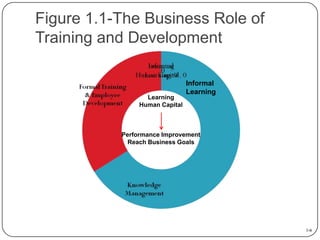
Figure 1.1-The Business Role of
Training and Development

Learning
Human Capital

Informal
Learning

Performance Improvement
Reach Business Goals

1-6
Training and Development: Key
Components of Learning
 Training: Facilitates learning job-related

competencies, knowledge, skills or behavior
 Development
 Future focused
 Includes:
 Formal education, job experiences, relationship
 Assessments of personality, skills, and abilities

 Formal training and development
 Programs, courses, and events that are developed

and organized by the company
1-7
Training and Development: Key
Components of Learning
 Informal learning
 Learner initiated

 Occurs without a trainer or instructor
 Motivated by an intent to develop
 Does not occur in a formal learning setting
 Breadth, depth, and timing is controlled by the

employee
 Explicit knowledge
 Well documented, easily articulated, and easily

transferred from person-to-person
1-8
Training and Development: Key
Components of Learning
 Primary focus of formal training and development

 Tacit knowledge
 Personal knowledge based on individual

experiences that is difficult to codify
 Result of informal learning
 Knowledge management
 Process of enhancing company performance by

designing and implementing:
 Tools, processes, systems, structures, and cultures to

improve the creation, sharing, and use of knowledge
1-9
Designing Effective Training
 Training design process
 Systematic approach for developing training

programs
 Based on the principles of Instructional System
Design (ISD)
 ADDIE model- Analysis, design, development,
implementation, and evaluation
 Should be systematic yet flexible to adapt to
business needs

1-10
Figure 1.2 - Training Design Process
1. Conducting Needs
Assessment
Organizational Analysis’
Personal Analysis
Task Analysis

5. Developing an Evaluation
Plan
Identify Learning Outcomes
Choose Evaluation Design
Plan Cost-Benefit Analysis

6. Selecting Training Method
Traditional
E-Learning

2. Ensuring Employees’
Readiness for Training
Attitudes and Motivation
Basic Skills

3. Creating a Learning
Environment
Learning Objectives
Meaningful Material
Practice
Feedback
Community of Learning
Modeling
Program Administration

4. Ensuring Transfer of
Training
Self-Management
Peer and Manger Support

7. Monitoring and Evaluating the
Program
Conduct Evaluation
Make Changes to Improve the
Program

1-11
Designing Effective Training
 Flaws of the ISD model
 Step by-step approach is rarely followed in real life

organizations
 Necessary requirement of trainers adds time and
cost to developing a training program
 Implies an end point: evaluation
 May lead to assumption that training is the best
solution

1-12
Table 1.1 - Forces Influencing
Working and Learning
Economic cycles
Globalization
Increased value placed on intangible assets and
human capital
Focus on link to business strategy
Changing demographics and diversity of the
workforce
Talent management
Customer service and quality emphasis
New technology
High-performance work systems
1-13
Globalization
 Offshoring: Process of moving jobs from the

United States to other locations in the world
 Advantage- Lower labor costs
 Disadvantage
 Low standards of health and safety
 Lack of necessary skills to perform the job

1-14
Assets
Human Capital
• Tacit knowledge
• Education
• Work-related know-how
• Work-related competence
Customer Capital
• Customer relationships
• Brands
• Customer loyalty
• Distribution channels
Social Capital
• Corporate culture
• Management philosophy
• Management practices
• Informal networking systems
• Coaching/mentoring relationships
Intellectual Capital
• Patents
• Copyrights
• Trade secrets
• Intellectual property

1-15
Increased Value Placed on
Intangible Assets and Human
Capital
 Human capital: Refers to employees’
 Attributes

 Life experiences
 Knowledge
 Inventiveness
 Energy and enthusiasm

 Intellectual capital: Codified knowledge that

exists in a company
 Social capital: Relationships in the company
1-16
Increased Value Placed on Intangible
Assets and Human Capital
 Customer capital: Value of relationships with

persons or other organizations
 Implications of intangible assets and human
capital
 Focus on knowledge worker
 Employees who contribute to the company not through
specialized body of knowledge
 Employee engagement
 Degree to which employees are fully involved in their work
 Strength of employee engagement
 Attitude or opinion surveys measure level of engagement
1-17
Increased Value Placed on Intangible
Assets and Human Capital
– Change and continuous learning
• Change: Adoption of a new idea or behavior by a company
• Learning organization
– Culture of lifelong learning
– Enables all employees to continually acquire and share knowledge
– Requires financial, time, and content resources

1-18
Changing Demographics and
Diversity of the Work Force
 Increase in racial and ethnic diversity
 Ethnically and racially diverse labor force

 Increased participation of minorities in the work

force
 Aging labor force
 Increased work-force participation of individuals 55

years or greater
 Generational differences

1-19
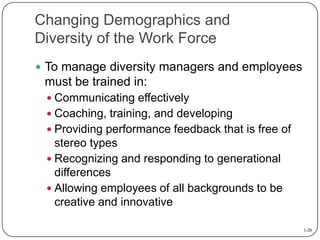
Changing Demographics and
Diversity of the Work Force
 To manage diversity managers and employees

must be trained in:
 Communicating effectively
 Coaching, training, and developing
 Providing performance feedback that is free of

stereo types
 Recognizing and responding to generational
differences
 Allowing employees of all backgrounds to be
creative and innovative
1-20
Talent Management
 Systematic, planned, and strategic effort by a

company
 To attract, retain, develop, and motivate highly

skilled employees and managers
 Involves
 acquiring and assessing employees
 learning and development
 performance management, and compensation

1-21
Talent Management
 Is important due to:
 Changes in demand for certain occupations and

jobs
 Skill requirement
 Anticipated retirement of baby boomer generation
 Requirement to develop managerial talent

1-22
Customer Service and Quality
Emphasis
 Total Quality Management (TQM)
 Companywide effort to continuously improve the

ways people, machines, and systems accomplish
work
 Core values of TQM
 Methods and processes designed to meet the

needs of internal and external customers
 Every employee receives training in quality
 Errors are prevented from occurring rather than
being detected and corrected
1-23
Customer Service and Quality
Emphasis
 Promotes cooperation with vendors, suppliers, and

customers
 Measures progress with feedback based on data
 Quality standards
 Malcolm Baldrige National Quality Award
 ISO 9000
 Family of standards related to quality
 Address what the company does to meet regulatory
requirements

1-24
Customer Service and Quality
Emphasis
 Six Sigma process
 Measuring, analyzing, improving, and then

controlling processes once:
 They have been brought within the narrow six sigma

quality tolerances or standards

 Training helps by
 Teaching employees statistical process control
 Engaging in “lean” processes

1-25
Customer Service and Quality
Emphasis
 Lean thinking
 Doing more with less effort, equipment, space, and

time, but satisfying consumer needs and wants
 ISO 10015
 Ensures that training is linked to company needs

and performance

1-26
New Technology
 Influence on training
 Makes training more realistic

 Allows flexibility of time and any place
 Reduces travel costs
 Provides greater accessibility and consistency
 Increased ability to access experts and share

learning with others
 Creates a learning environment that provides
feedback, self-pacing, and practice exercises
 Allows greater use of alternative work
arrangements
1-27
High performance models of work
systems
 Work teams
 Employees with various skills interact to assemble

a product or provide a service
 Cross training
 Training employees in a wide range of skills to fill

any of the roles needed to be performed

1-28
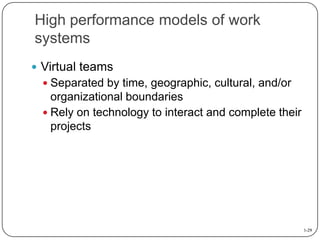
High performance models of work
systems
 Virtual teams
 Separated by time, geographic, cultural, and/or

organizational boundaries
 Rely on technology to interact and complete their
projects

1-29
Snapshot of Training Practices
 Key trends in learning initiative investments:
 Direct expenditures, has remained stable over the

last several years
 Increased demand for specialized learning that
 Use of technology-based learning delivery
increased from 11%in 2001 to 29 %in 2010
 Self-paced online learning is the most popular
technology-based learning

1-30
Snapshot of Training Practices
 Technology-based learning
 Has improved learning efficiency
 Has resulted in a larger employee–learning staff member
ratio
 Percentage of services distributed by external

providers dropped from 29 % in 2004 to 23 % in
2010.

1-31
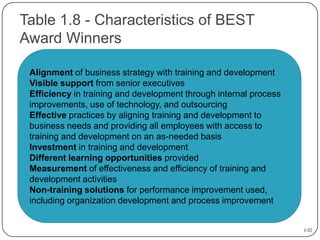
Table 1.8 - Characteristics of BEST
Award Winners
Alignment of business strategy with training and development
Visible support from senior executives
Efficiency in training and development through internal process
improvements, use of technology, and outsourcing
Effective practices by aligning training and development to
business needs and providing all employees with access to
training and development on an as-needed basis
Investment in training and development
Different learning opportunities provided
Measurement of effectiveness and efficiency of training and
development activities
Non-training solutions for performance improvement used,
including organization development and process improvement

1-32
Figure 1.5 - The 2011 ASTD Competency Model
Learning
Strategist

Business

WORKPLACE
partner
LEARNING &
PERFORMAN
Project
CE ROLES
manage
Professional
COACHING
Specialist

DELIVERING TRAINING

DESIGNING LEARNING

FACILITATING ORGANIZATIONAL CHANGE

IMPROVING HUMAN PERFORMANCE

MANAGING ORGANIZATIONAL KNOWLEDGE/SOCIAL LEARNING

MANAGING THE LEARNING FUNCTION

MEASURING & EVALUATING

INTERPERSONAL
BUSINESS/MANAGEMENT
PERSONAL
AREAS OF EXPERTISE
>Building Trust
>Analyzing Needs and Proposing Solutions
>Demonstrating Adaptability
>Communicating Effectively >Applying Business Acumen
>Modeling
Personal Development
>Influencing Stakeholders
>Driving Results
>Leveraging Diversity FOUNDATION COMPETENCIES
>Planning and Implementing Assignments
>Networking & Partnering
>Thinking Strategically

ASTD COMPETENCY MODEL
Delivering learning and performance competencies with global, business, ad
technological perspectives.

1-33
Snapshot of Training Practices
 Who provides training
 Trainers, managers, in-house consultants, and

employee experts
 Outsourcing: Training and development activities
provided by individuals outside the company

1-34
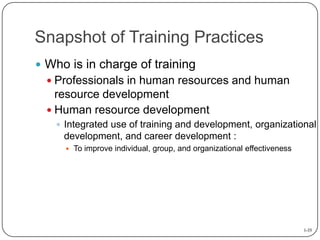
Snapshot of Training Practices
 Who is in charge of training
 Professionals in human resources and human

resource development
 Human resource development
 Integrated use of training and development, organizational

development, and career development :


To improve individual, group, and organizational effectiveness

1-35

MBA760 Chapter 01

  • 1.
    Introduction to Employee Trainingand Development Chapter 1 6th Edition Raymond A. Noe McGraw-Hill/Irwin Copyright © 2013 by The McGraw-Hill Companies, Inc. All rights reserved.
  • 2.
    Learning Objectives • Discussthe forces influencing the workplace and learning, and explain how training can help companies deal with these forces • Draw a figure or diagram and explain how training, development, informal learning, and knowledge management contribute to business success • Discuss various aspects of the training design process 1-2
  • 3.
    Learning Objectives    Describe theamount and types of training occurring in U.S. companies Discuss the key roles for training professionals Identify appropriate resources (e.g., journals, websites) for learning about training research and practice 1-3
  • 4.
    Introduction  Competitiveness: Abilityto maintain and gain market share in an industry  Human resource management: Policies, practices, and systems that influence employees’ behaviour, attitudes, and performance  Stakeholders: All parties that have an interest in seeing that the company succeeds 1-4
  • 5.
    Training and Development:Key Components of Learning  Learning: Acquiring knowledge, skills, competencies, attitudes, or behaviors  Human capital: Refers to:  Knowledge (know what)  Advanced skills (know how)  System understanding and creativity (know why)  Motivation to deliver high-quality products and services (care why) 1-5
  • 6.
    Figure 1.1-The BusinessRole of Training and Development Learning Human Capital Informal Learning Performance Improvement Reach Business Goals 1-6
  • 7.
    Training and Development:Key Components of Learning  Training: Facilitates learning job-related competencies, knowledge, skills or behavior  Development  Future focused  Includes:  Formal education, job experiences, relationship  Assessments of personality, skills, and abilities  Formal training and development  Programs, courses, and events that are developed and organized by the company 1-7
  • 8.
    Training and Development:Key Components of Learning  Informal learning  Learner initiated  Occurs without a trainer or instructor  Motivated by an intent to develop  Does not occur in a formal learning setting  Breadth, depth, and timing is controlled by the employee  Explicit knowledge  Well documented, easily articulated, and easily transferred from person-to-person 1-8
  • 9.
    Training and Development:Key Components of Learning  Primary focus of formal training and development  Tacit knowledge  Personal knowledge based on individual experiences that is difficult to codify  Result of informal learning  Knowledge management  Process of enhancing company performance by designing and implementing:  Tools, processes, systems, structures, and cultures to improve the creation, sharing, and use of knowledge 1-9
  • 10.
    Designing Effective Training Training design process  Systematic approach for developing training programs  Based on the principles of Instructional System Design (ISD)  ADDIE model- Analysis, design, development, implementation, and evaluation  Should be systematic yet flexible to adapt to business needs 1-10
  • 11.
    Figure 1.2 -Training Design Process 1. Conducting Needs Assessment Organizational Analysis’ Personal Analysis Task Analysis 5. Developing an Evaluation Plan Identify Learning Outcomes Choose Evaluation Design Plan Cost-Benefit Analysis 6. Selecting Training Method Traditional E-Learning 2. Ensuring Employees’ Readiness for Training Attitudes and Motivation Basic Skills 3. Creating a Learning Environment Learning Objectives Meaningful Material Practice Feedback Community of Learning Modeling Program Administration 4. Ensuring Transfer of Training Self-Management Peer and Manger Support 7. Monitoring and Evaluating the Program Conduct Evaluation Make Changes to Improve the Program 1-11
  • 12.
    Designing Effective Training Flaws of the ISD model  Step by-step approach is rarely followed in real life organizations  Necessary requirement of trainers adds time and cost to developing a training program  Implies an end point: evaluation  May lead to assumption that training is the best solution 1-12
  • 13.
    Table 1.1 -Forces Influencing Working and Learning Economic cycles Globalization Increased value placed on intangible assets and human capital Focus on link to business strategy Changing demographics and diversity of the workforce Talent management Customer service and quality emphasis New technology High-performance work systems 1-13
  • 14.
    Globalization  Offshoring: Processof moving jobs from the United States to other locations in the world  Advantage- Lower labor costs  Disadvantage  Low standards of health and safety  Lack of necessary skills to perform the job 1-14
  • 15.
    Assets Human Capital • Tacitknowledge • Education • Work-related know-how • Work-related competence Customer Capital • Customer relationships • Brands • Customer loyalty • Distribution channels Social Capital • Corporate culture • Management philosophy • Management practices • Informal networking systems • Coaching/mentoring relationships Intellectual Capital • Patents • Copyrights • Trade secrets • Intellectual property 1-15
  • 16.
    Increased Value Placedon Intangible Assets and Human Capital  Human capital: Refers to employees’  Attributes  Life experiences  Knowledge  Inventiveness  Energy and enthusiasm  Intellectual capital: Codified knowledge that exists in a company  Social capital: Relationships in the company 1-16
  • 17.
    Increased Value Placedon Intangible Assets and Human Capital  Customer capital: Value of relationships with persons or other organizations  Implications of intangible assets and human capital  Focus on knowledge worker  Employees who contribute to the company not through specialized body of knowledge  Employee engagement  Degree to which employees are fully involved in their work  Strength of employee engagement  Attitude or opinion surveys measure level of engagement 1-17
  • 18.
    Increased Value Placedon Intangible Assets and Human Capital – Change and continuous learning • Change: Adoption of a new idea or behavior by a company • Learning organization – Culture of lifelong learning – Enables all employees to continually acquire and share knowledge – Requires financial, time, and content resources 1-18
  • 19.
    Changing Demographics and Diversityof the Work Force  Increase in racial and ethnic diversity  Ethnically and racially diverse labor force  Increased participation of minorities in the work force  Aging labor force  Increased work-force participation of individuals 55 years or greater  Generational differences 1-19
  • 20.
    Changing Demographics and Diversityof the Work Force  To manage diversity managers and employees must be trained in:  Communicating effectively  Coaching, training, and developing  Providing performance feedback that is free of stereo types  Recognizing and responding to generational differences  Allowing employees of all backgrounds to be creative and innovative 1-20
  • 21.
    Talent Management  Systematic,planned, and strategic effort by a company  To attract, retain, develop, and motivate highly skilled employees and managers  Involves  acquiring and assessing employees  learning and development  performance management, and compensation 1-21
  • 22.
    Talent Management  Isimportant due to:  Changes in demand for certain occupations and jobs  Skill requirement  Anticipated retirement of baby boomer generation  Requirement to develop managerial talent 1-22
  • 23.
    Customer Service andQuality Emphasis  Total Quality Management (TQM)  Companywide effort to continuously improve the ways people, machines, and systems accomplish work  Core values of TQM  Methods and processes designed to meet the needs of internal and external customers  Every employee receives training in quality  Errors are prevented from occurring rather than being detected and corrected 1-23
  • 24.
    Customer Service andQuality Emphasis  Promotes cooperation with vendors, suppliers, and customers  Measures progress with feedback based on data  Quality standards  Malcolm Baldrige National Quality Award  ISO 9000  Family of standards related to quality  Address what the company does to meet regulatory requirements 1-24
  • 25.
    Customer Service andQuality Emphasis  Six Sigma process  Measuring, analyzing, improving, and then controlling processes once:  They have been brought within the narrow six sigma quality tolerances or standards  Training helps by  Teaching employees statistical process control  Engaging in “lean” processes 1-25
  • 26.
    Customer Service andQuality Emphasis  Lean thinking  Doing more with less effort, equipment, space, and time, but satisfying consumer needs and wants  ISO 10015  Ensures that training is linked to company needs and performance 1-26
  • 27.
    New Technology  Influenceon training  Makes training more realistic  Allows flexibility of time and any place  Reduces travel costs  Provides greater accessibility and consistency  Increased ability to access experts and share learning with others  Creates a learning environment that provides feedback, self-pacing, and practice exercises  Allows greater use of alternative work arrangements 1-27
  • 28.
    High performance modelsof work systems  Work teams  Employees with various skills interact to assemble a product or provide a service  Cross training  Training employees in a wide range of skills to fill any of the roles needed to be performed 1-28
  • 29.
    High performance modelsof work systems  Virtual teams  Separated by time, geographic, cultural, and/or organizational boundaries  Rely on technology to interact and complete their projects 1-29
  • 30.
    Snapshot of TrainingPractices  Key trends in learning initiative investments:  Direct expenditures, has remained stable over the last several years  Increased demand for specialized learning that  Use of technology-based learning delivery increased from 11%in 2001 to 29 %in 2010  Self-paced online learning is the most popular technology-based learning 1-30
  • 31.
    Snapshot of TrainingPractices  Technology-based learning  Has improved learning efficiency  Has resulted in a larger employee–learning staff member ratio  Percentage of services distributed by external providers dropped from 29 % in 2004 to 23 % in 2010. 1-31
  • 32.
    Table 1.8 -Characteristics of BEST Award Winners Alignment of business strategy with training and development Visible support from senior executives Efficiency in training and development through internal process improvements, use of technology, and outsourcing Effective practices by aligning training and development to business needs and providing all employees with access to training and development on an as-needed basis Investment in training and development Different learning opportunities provided Measurement of effectiveness and efficiency of training and development activities Non-training solutions for performance improvement used, including organization development and process improvement 1-32
  • 33.
    Figure 1.5 -The 2011 ASTD Competency Model Learning Strategist Business WORKPLACE partner LEARNING & PERFORMAN Project CE ROLES manage Professional COACHING Specialist DELIVERING TRAINING DESIGNING LEARNING FACILITATING ORGANIZATIONAL CHANGE IMPROVING HUMAN PERFORMANCE MANAGING ORGANIZATIONAL KNOWLEDGE/SOCIAL LEARNING MANAGING THE LEARNING FUNCTION MEASURING & EVALUATING INTERPERSONAL BUSINESS/MANAGEMENT PERSONAL AREAS OF EXPERTISE >Building Trust >Analyzing Needs and Proposing Solutions >Demonstrating Adaptability >Communicating Effectively >Applying Business Acumen >Modeling Personal Development >Influencing Stakeholders >Driving Results >Leveraging Diversity FOUNDATION COMPETENCIES >Planning and Implementing Assignments >Networking & Partnering >Thinking Strategically ASTD COMPETENCY MODEL Delivering learning and performance competencies with global, business, ad technological perspectives. 1-33
  • 34.
    Snapshot of TrainingPractices  Who provides training  Trainers, managers, in-house consultants, and employee experts  Outsourcing: Training and development activities provided by individuals outside the company 1-34
  • 35.
    Snapshot of TrainingPractices  Who is in charge of training  Professionals in human resources and human resource development  Human resource development  Integrated use of training and development, organizational development, and career development :  To improve individual, group, and organizational effectiveness 1-35