THE THREE MUSKETEERS
SECETION:C
MINAL SETHIA 13BSP0411
AKHASH PATEL 13BSP1345
M.V.SAIMAHESH 13BSP1569
AGENDA
 Overview of strategic planning process
 History of the word strategy
 Meaning of strategic
 Hierarchy of strategy
 Difference between training and strategic training
 Questions to ask to develop strategic training and
development initiatives
 Training needs in different strategies
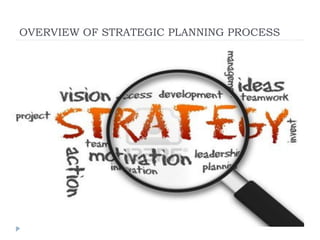
OVERVIEW OF STRATEGIC PLANNING PROCESS
HISTORY OF STRATEGY
 The word 'strategy', deriving from the Greek noun
strategus, meaning 'commander in chief', was first used in
the English language in 1656. which was used in army.
 In a management context, the word 'strategy' has now
replaced the more traditional term - 'long-term planning' -
to denote a specific pattern of decisions and actions
undertaken by the upper echelon of the organization in
order to accomplish performance goals.
MEANING OF STRATEGIC
 Wheelen and Hunger (1995) define strategic management.
as 'that set of managerial decisions and actions that
determines the long-run performance of a corporation'.
 Hill and Jones (2001) take a similar view when they
define strategy as 'an action a company takes to attain
superior performance'
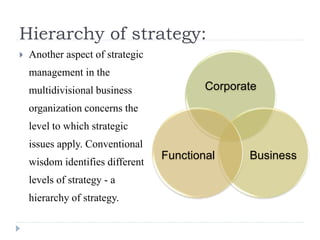
Hierarchy of strategy:
 Another aspect of strategic
management in the
multidivisional business
organization concerns the
level to which strategic
issues apply. Conventional
wisdom identifies different
levels of strategy - a
hierarchy of strategy.
Corporate
BusinessFunctional
Corporate level strategy
 Corporate-level strategy describes a corporation's overall
direction in terms of its general philosophy towards the
growth and the management of its various business
units. Such strategies determine the types of business a
corporation wants to be involved in and what business
units should be acquired, modified or sold. This strategy
addresses the question, 'What business are we in'?'
Business level strategy
 Business-level strategy deals with decisions and actions
pertaining to each business unit, the main objective of a
business-level strategy being to make the unit more
competitive in its marketplace.
 This level of strategy addresses the question, 'How do we
compete'?' Although business-level strategy is guided by
'upstream', corporate-level strategy, business unit management
must craft a strategy that is appropriate for its own operating
situation.
Functional-level strategy
 Functional-level strategy pertains to the major functional
operations within the business unit, including research and
development, marketing, manufacturing, finance and HR.
 This strategy level is typically primarily concerned with
maximizing resource productivity and addresses the question,
'How do we support the business-level competitive
strategy?' Consistent with this, at the functional level, HRM
policies and practices support the business strategy goals.
TRAINING
 Training represents a significant expenditure for most
employers. But it is too often viewed tactically rather than
strategically, which means that training is seen as a short
term activity rather than one that has longer-term effects
on organizational success
STRATEGIC TRAINING
 Training is used strategically to help the organization
accomplish its goals.
 Strategic training can have numerous organizational
benefits. It requires HR and training professionals to get
intimately involved with the business and to partner with
operating managers to help solve their problems, thus
making significant contributions to organizational results.
Questions to ask to develop strategic
training and development initiatives
 1. What is the vision and mission of the organization? Identify
the strategic drivers of the business strategy.
 2. What capabilities does the organization need as result of the
business strategy and business environment challenges?
 3. What types of training and development will best attract,
retain and develop the talent needed for success?
 4. Which competencies are critical for organization success and
the business strategy?
 5. Does the organization have a plan for making the link
between training and development and the business
strategy understood by executives, managers and
employees or customers?
 6. Will the senior management team publicly support and
champion training and development?
 7. Does the organization provide opportunities for training
and developing not only individuals but also teams?
TRAINING NEEDS IN DIFFERENT
STRATEGIES
 There are four business strategies
1) concentration
2) internal growth
3) external growth and
4) disinvestment
Concentration strategy
 A concentration strategy focuses on increasing market share,
reducing costs or creating and maintaining a market niche
for products and services.
EXAMPLE:
Tiger Airways in Australia has a concentration strategy. It
focuses on providing short-haul, low-fare, high-frequency air
transport. It has a limited aircraft fleet and serves a restricted
range of food and drinks.
Internal growth strategy
 An internal growth strategy focuses on new market and
product development, innovation and joint ventures.
For example,
the merger between two publishing organizations, McGraw-Hill
and Richard D Irwin, created one organization with strengths in
the US and the international university textbook markets.
Medical technology company Massimo, in its global operations
(which include Australia), also follows an internal growth
strategy
External growth strategy
 An external growth strategy emphasizes acquiring
vendors and suppliers, or buying businesses that allow
the organization to expand into new markets.
 Example of organizations using this strategy include the
Smorgon Steel Group and BHP Billiton.
Disinvestment strategy
 A disinvestment strategy emphasizes liquidation and
divestiture of businesses.
 For example, Ansell Healthcare was born out of the failure
of Pacific Dunlop, which was once an Australian icon but
gradually declined until its business units were worth
more than the conglomerate as a whole.
Strategic training
Strategic training

Strategic training

  • 1.
    THE THREE MUSKETEERS SECETION:C MINALSETHIA 13BSP0411 AKHASH PATEL 13BSP1345 M.V.SAIMAHESH 13BSP1569
  • 2.
    AGENDA  Overview ofstrategic planning process  History of the word strategy  Meaning of strategic  Hierarchy of strategy  Difference between training and strategic training  Questions to ask to develop strategic training and development initiatives  Training needs in different strategies
  • 3.
    OVERVIEW OF STRATEGICPLANNING PROCESS
  • 4.
    HISTORY OF STRATEGY The word 'strategy', deriving from the Greek noun strategus, meaning 'commander in chief', was first used in the English language in 1656. which was used in army.  In a management context, the word 'strategy' has now replaced the more traditional term - 'long-term planning' - to denote a specific pattern of decisions and actions undertaken by the upper echelon of the organization in order to accomplish performance goals.
  • 5.
    MEANING OF STRATEGIC Wheelen and Hunger (1995) define strategic management. as 'that set of managerial decisions and actions that determines the long-run performance of a corporation'.  Hill and Jones (2001) take a similar view when they define strategy as 'an action a company takes to attain superior performance'
  • 6.
    Hierarchy of strategy: Another aspect of strategic management in the multidivisional business organization concerns the level to which strategic issues apply. Conventional wisdom identifies different levels of strategy - a hierarchy of strategy. Corporate BusinessFunctional
  • 7.
    Corporate level strategy Corporate-level strategy describes a corporation's overall direction in terms of its general philosophy towards the growth and the management of its various business units. Such strategies determine the types of business a corporation wants to be involved in and what business units should be acquired, modified or sold. This strategy addresses the question, 'What business are we in'?'
  • 8.
    Business level strategy Business-level strategy deals with decisions and actions pertaining to each business unit, the main objective of a business-level strategy being to make the unit more competitive in its marketplace.  This level of strategy addresses the question, 'How do we compete'?' Although business-level strategy is guided by 'upstream', corporate-level strategy, business unit management must craft a strategy that is appropriate for its own operating situation.
  • 9.
    Functional-level strategy  Functional-levelstrategy pertains to the major functional operations within the business unit, including research and development, marketing, manufacturing, finance and HR.  This strategy level is typically primarily concerned with maximizing resource productivity and addresses the question, 'How do we support the business-level competitive strategy?' Consistent with this, at the functional level, HRM policies and practices support the business strategy goals.
  • 10.
    TRAINING  Training representsa significant expenditure for most employers. But it is too often viewed tactically rather than strategically, which means that training is seen as a short term activity rather than one that has longer-term effects on organizational success
  • 11.
    STRATEGIC TRAINING  Trainingis used strategically to help the organization accomplish its goals.  Strategic training can have numerous organizational benefits. It requires HR and training professionals to get intimately involved with the business and to partner with operating managers to help solve their problems, thus making significant contributions to organizational results.
  • 12.
    Questions to askto develop strategic training and development initiatives  1. What is the vision and mission of the organization? Identify the strategic drivers of the business strategy.  2. What capabilities does the organization need as result of the business strategy and business environment challenges?  3. What types of training and development will best attract, retain and develop the talent needed for success?  4. Which competencies are critical for organization success and the business strategy?
  • 13.
     5. Doesthe organization have a plan for making the link between training and development and the business strategy understood by executives, managers and employees or customers?  6. Will the senior management team publicly support and champion training and development?  7. Does the organization provide opportunities for training and developing not only individuals but also teams?
  • 14.
    TRAINING NEEDS INDIFFERENT STRATEGIES  There are four business strategies 1) concentration 2) internal growth 3) external growth and 4) disinvestment
  • 15.
    Concentration strategy  Aconcentration strategy focuses on increasing market share, reducing costs or creating and maintaining a market niche for products and services. EXAMPLE: Tiger Airways in Australia has a concentration strategy. It focuses on providing short-haul, low-fare, high-frequency air transport. It has a limited aircraft fleet and serves a restricted range of food and drinks.
  • 16.
    Internal growth strategy An internal growth strategy focuses on new market and product development, innovation and joint ventures. For example, the merger between two publishing organizations, McGraw-Hill and Richard D Irwin, created one organization with strengths in the US and the international university textbook markets. Medical technology company Massimo, in its global operations (which include Australia), also follows an internal growth strategy
  • 17.
    External growth strategy An external growth strategy emphasizes acquiring vendors and suppliers, or buying businesses that allow the organization to expand into new markets.  Example of organizations using this strategy include the Smorgon Steel Group and BHP Billiton.
  • 18.
    Disinvestment strategy  Adisinvestment strategy emphasizes liquidation and divestiture of businesses.  For example, Ansell Healthcare was born out of the failure of Pacific Dunlop, which was once an Australian icon but gradually declined until its business units were worth more than the conglomerate as a whole.