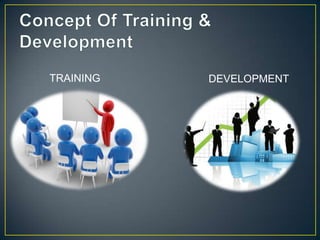
TRAINING DEVELOPMENT
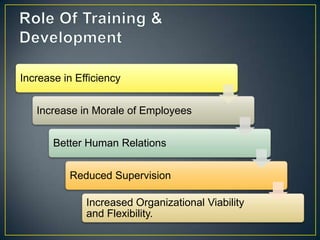
Increase in Efficiency
Increase in Morale of Employees
Better Human Relations
Reduced Supervision
Increased Organizational Viability
and Flexibility.
Basic aim of Training
• Suitable change in the individual concerned.
• Should be related both in terms of organization's demand
and that of individual’s.
Various Methods for identifying Training Needs
• Organizational Analysis.
• Task Analysis.
• Man Analysis.
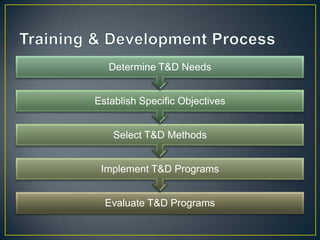
Evaluate T&D Programs
Implement T&D Programs
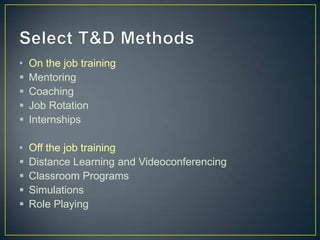
Select T&D Methods
Establish Specific Objectives
Determine T&D Needs
6
 Desired end results
 Clear and summarize objectives must be
formulated
7
• On the job training
 Mentoring
 Coaching
 Job Rotation
 Internships
• Off the job training
 Distance Learning and Videoconferencing
 Classroom Programs
 Simulations
 Role Playing
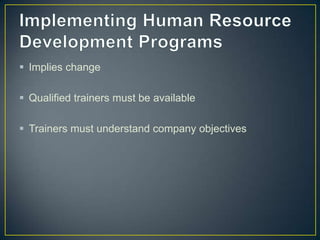
 Implies change
 Qualified trainers must be available
 Trainers must understand company objectives
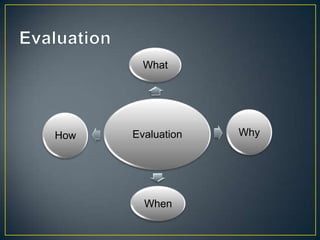
Evaluation
What
Why
When
How
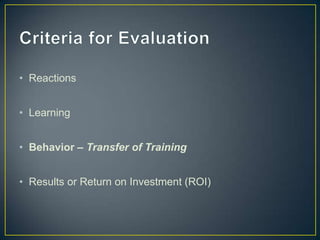
• Reactions
• Learning
• Behavior – Transfer of Training
• Results or Return on Investment (ROI)
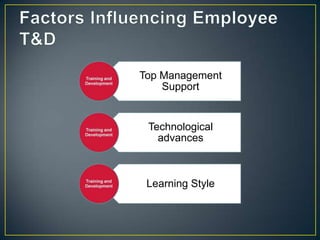
Top Management
Support
Technological
advances
Learning Style
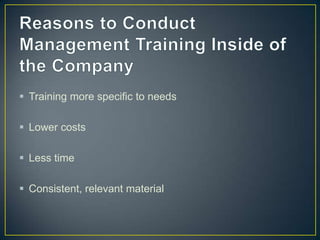
 Training more specific to needs
 Lower costs
 Less time
 Consistent, relevant material
THANKYOU
Presented By
Jagriti Singh
Karan Bhatia
Monisha Bhatia
Sanjay Rohra
Saba Shaikh
Zoheb Shaikh

training & development ppt