Fundamentals of Human 
Resource Management 
Eighth Edition 
DeCenzo and Robbins 
Chapter 5 
Human Resource Planning and Job Analysis 
Fundamentals of Human Resource
Introduction 
• Human resource planning 
is a process by which an 
organization ensures that 
– it has the right number and 
kinds of people 
– at the right place 
– at the right time 
– capable of effectively and 
efficiently completing those 
tasks that will help the 
organization achieve its overall 
strategic objectives. 
Fundamentals of Human Resource
Introduction 
• Linked to the organization’s 
overall strategy and planning to 
compete domestically and 
globally. 
• Overall plans and objectives must 
be translated into the number and 
types of workers needed. 
• Senior HRM staff need to lead top 
management in planning for HRM 
issues. 
Fundamentals of Human Resource
An Organizational Framework 
• A mission statement defines what 
business the organization is in, 
including why it exists and who its 
customers are. 
• Strategic goals 
– Set by senior management to establish 
targets for the organization to achieve. 
– Generally defined for the next 5-20 years. 
Fundamentals of Human Resource
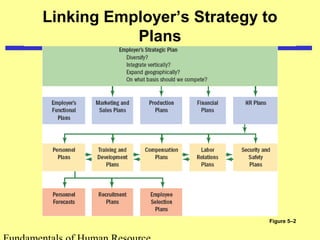
Linking Employer’s Strategy to 
Plans 
Fundamentals of Human Resource 
Figure 5–2
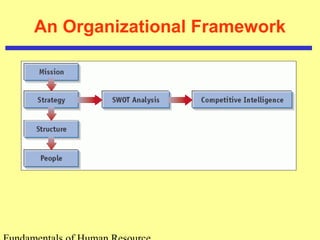
An Organizational Framework 
• Corporate assessment 
– Gap or SWOT (Strengths-Weaknesses- 
Opportunities-Threats) analysis determines 
what is needed to meet objectives. 
– Strengths and weaknesses and core 
competencies are identified. 
– HRM determines what knowledge, skills 
and abilities are needed by the 
organization’s human resources. 
Fundamentals of Human Resource
An Organizational Framework 
Fundamentals of Human Resource
Linking Organizational Strategy to 
Human Resource Planning 
• Ensures that people are available 
to meet the requirements set 
during strategic planning. 
• Assessing current human 
resources 
– A human resources inventory report 
summarizes information on current 
workers and their skills. 
Fundamentals of Human Resource
Linking Organizational Strategy to 
Human Resource Planning 
–Human Resource Information 
Systems (HRIS) are 
increasingly popular 
computerized databases that 
contain important information 
about employees. 
Fundamentals of Human Resource
Using Computers to Forecast 
Personnel Requirements 
• Computerized forecasts 
– The use software packages to determine of future staff needs by 
projecting sales, volume of production, and personnel required to 
maintain a volume of output. 
• Generates figures on average staff levels required to meet 
product demands, as well as forecasts for direct labor, indirect 
staff, and exempt staff. 
• Typical metrics: direct labor hours required to produce one 
unit of product (a measure of productivity), and three sales 
projections—minimum, maximum, and probable. 
Fundamentals of Human Resource
Forecasting the Supply of 
Inside Candidates 
• Qualifications inventories 
– Manual or computerized records listing 
employees’ education, career and development 
interests, languages, special skills, and so on, to 
be used in selecting inside candidates for 
promotion. 
Fundamentals of Human Resource
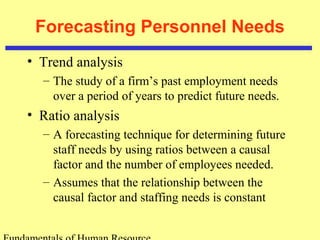
Forecasting Personnel Needs 
• Trend analysis 
– The study of a firm’s past employment needs 
over a period of years to predict future needs. 
• Ratio analysis 
– A forecasting technique for determining future 
staff needs by using ratios between a causal 
factor and the number of employees needed. 
– Assumes that the relationship between the 
causal factor and staffing needs is constant 
Fundamentals of Human Resource
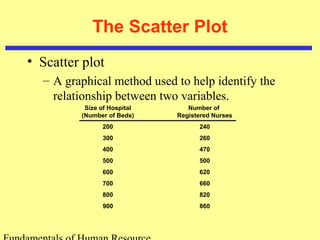
The Scatter Plot 
• Scatter plot 
– A graphical method used to help identify the 
relationship between two variables. 
Size of Hospital Number of 
(Number of Beds) Registered Nurses 
200 240 
300 260 
400 470 
500 500 
600 620 
700 660 
800 820 
900 860 
Fundamentals of Human Resource
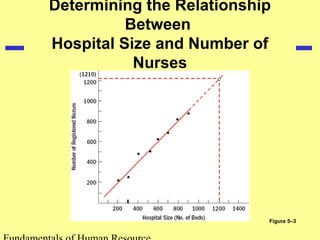
Determining the Relationship 
Between 
Hospital Size and Number of 
Nurses 
Fundamentals of Human Resource 
Figure 5–3
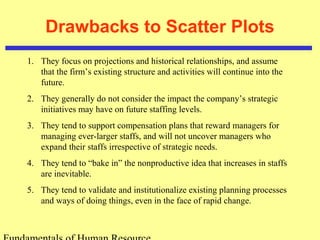
Drawbacks to Scatter Plots 
1. They focus on projections and historical relationships, and assume 
that the firm’s existing structure and activities will continue into the 
future. 
2. They generally do not consider the impact the company’s strategic 
initiatives may have on future staffing levels. 
3. They tend to support compensation plans that reward managers for 
managing ever-larger staffs, and will not uncover managers who 
expand their staffs irrespective of strategic needs. 
4. They tend to “bake in” the nonproductive idea that increases in staffs 
are inevitable. 
5. They tend to validate and institutionalize existing planning processes 
and ways of doing things, even in the face of rapid change. 
Fundamentals of Human Resource
Linking Organizational Strategy to 
Human Resource Planning 
• Assessing current human resources 
– Succession planning 
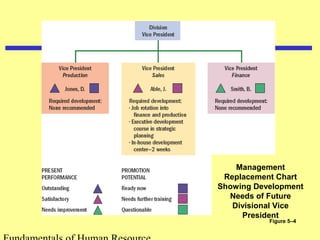
• includes the development of replacement 
charts 
• portray middle-to-upper level management 
positions that may become vacant in the near 
future 
• lists information about individuals who might 
qualify to fill the positions 
Fundamentals of Human Resource
Manual Systems and 
Replacement Charts 
• Personnel replacement charts 
– Company records showing present performance 
and promotability of inside candidates for the 
most important positions. 
• Position replacement card 
– A card prepared for each position in a company 
to show possible replacement candidates and 
their qualifications. 
Fundamentals of Human Resource
Fundamentals of Human Resource 
Management 
Replacement Chart 
Showing Development 
Needs of Future 
Divisional Vice 
President 
Figure 5–4
The Matter of Privacy of HR 
Information 
• The need to ensure the security of HR 
information 
– There is a lot of HR information to keep secure. 
– Control of HR information can be established 
through the use of access matrices that limit 
users. 
– Legal considerations: The Federal Privacy Act 
of 1974 gives employees rights regarding who 
has access to information about their work 
history and job performance. 
Fundamentals of Human Resource
Forecasting the Supply of Outside 
Candidates 
• Factors impacting the supply of outside 
candidates 
– General economic conditions 
– Expected unemployment rate 
• Sources of information 
– Periodic forecasts in business publications 
Fundamentals of Human Resource
Linking Organizational Strategy to 
Human Resource Planning 
• Determining the Demand for Labor 
– A human resource inventory can be 
developed to project year-by-year 
estimates of future HRM needs for every 
significant job level and type. 
– Forecasts must be made of the need for 
specific knowledges, skills and abilities. ? 
Fundamentals of Human Resource
Linking Organizational Strategy to 
Human Resource Planning 
• Predicting the Future Labor Supply 
– A unit’s supply of human resources comes 
from: 
• new hires 
• contingent workers 
• transfers-in 
• individuals returning from leaves 
– Predicting these can range from simple to 
complex. 
– Transfers are more difficult to predict since 
they depend on actions in other units. 
Fundamentals of Human Resource
Linking Organizational Strategy to 
Human Resource Planning 
• Predicting the Future Labor Supply 
– Decreases in internal supply come about 
through: 
• Retirements 
• Dismissals 
• Transfers-out 
• Lay-offs 
• Voluntary quits 
• Sabbaticals 
• Prolonged illnesses 
• Deaths 
Fundamentals of Human Resource
Linking Organizational Strategy to 
Human Resource Planning 
– Retirements are the easiest to forecast. 
– Other factors are much more difficult to 
project. 
– Dismissals, transfers, lay-offs, and 
sabbaticals are more easily controlled by 
management. 
Fundamentals of Human Resource
Linking Organizational Strategy to 
Human Resource Planning 
• Where Will We Find Workers 
– migration into a community 
– recent graduates 
– individuals returning from military service 
– increases in the number of unemployed 
and employed individuals seeking other 
opportunities, either part-time or full-time 
• The potential labor supply can be 
expanded by formal or on-the-job 
training. 
Fundamentals of Human Resource
Linking Organizational Strategy to 
Human Resource Planning 
• Matching Labor Demand and Supply 
– Employment planning compares forecasts 
for demand and supply of workers. 
– Special attention should be paid to current 
and future shortages and overstaffing. 
– Decruitment or downsizing may be used 
to reduce supply and balance demand. 
– Rightsizing involves linking staffing levels 
to organizational goals. 
Fundamentals of Human Resource
Linking Organizational Strategy to 
Human Resource Planning 
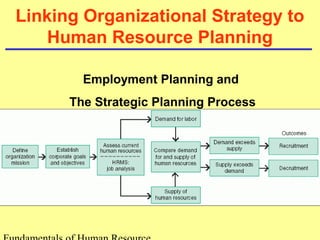
Employment Planning and 
The Strategic Planning Process 
Fundamentals of Human Resource
Job Analysis in a “Jobless” 
World 
• Job 
– Generally defined as “a set of closely related 
activities carried out for pay.” 
Fundamentals of Human Resource
Job Analysis 
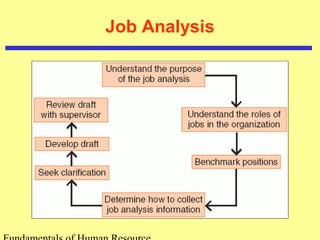
• Job Analysis is a systematic 
exploration of the activities within a job. 
• It defines and documents the duties, 
responsibilities and accountabilities of a 
job and the conditions under which a 
job is performed. ? 
Fundamentals of Human Resource
Job Analysis 
• Job Analysis Methods 
– Observation method – job analyst 
watches employees directly or reviews film 
of workers on the job. 
– Individual interview method – a team of 
job incumbents is selected and extensively 
interviewed. 
– Group interview method – a number of 
job incumbents are interviewed 
simultaneously. 
Fundamentals of Human Resource
Job Analysis 
• Job Analysis Methods 
– Structured questionnaire method – 
workers complete a specifically designed 
questionnaire. 
– Technical conference method – uses 
supervisors with an extensive knowledge of 
the job. 
– Diary method – job incumbents record 
their daily activities. 
• The best results are usually achieved 
with some combination of methods. 
Fundamentals of Human Resource
Job Analysis 
Fundamentals of Human Resource
Job Analysis 
• Structured Job Analysis Techniques 
– Department of Labor’s Job Analysis 
Process: 
• Information from observations and interviews is 
used to classify jobs by their involvement with 
data, people and things. 
• Information on thousands of titles available on 
O*Net OnLine which is the Department of 
Labor’s replacement for the Dictionary of 
Occupational Titles. 
Fundamentals of Human Resource
Job Analysis 
• Position Analysis Questionnaire 
(PAQ)(developed at Purdue 
University) 
– Jobs are rated on 194 elements, grouped 
in six major divisions and 28 sections. 
– The elements represent requirements 
that are applicable to all types of jobs. 
– This type of quantitative questionnaire 
allows many different jobs to be 
compared with each other, however, it 
appears to be more applicable to higher-level 
professional jobs. 
Fundamentals of Human Resource
Job Analysis 
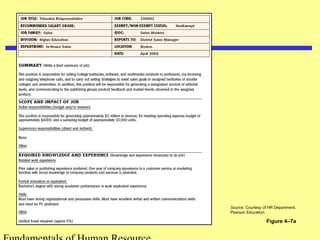
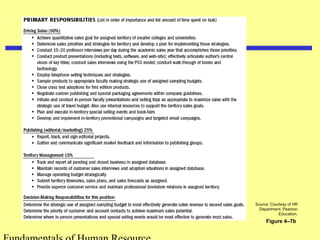
• Job Descriptions 
– Written statement of what jobholder does, how it is 
done, under what conditions and why. 
– Common format: title; duties; distinguishing 
characteristics; environmental conditions; authority 
and responsibilities. 
– Used to describe the job to applicants, to guide 
new employees, and to evaluate employees. 
– Identification of essential job functions is needed 
to assure compliance with Americans with 
Disabilities Act. 
Fundamentals of Human Resource
Fundamentals of Human Resource 
Source: Courtesy of HR Department, 
Pearson Education. 
Figure 4–7a
Fundamentals of Human Resource 
Source: Courtesy of HR 
Department, Pearson 
Education. 
Figure 4–7b
Job Analysis 
• Job Specifications 
– States minimum acceptable qualifications. 
– Used to select employees who have the 
essential qualifications. 
Fundamentals of Human Resource
Job Analysis 
• Job Evaluations 
– Specify relative value of each job in the 
organization. 
– Used to design equitable compensation 
program. 
Fundamentals of Human Resource
Job Analysis 
• The Multi-faceted Nature of Job 
Analysis 
– Almost all HRM activities are tied to job 
analysis. 
– Job analysis is the starting point for sound 
HRM. 
Fundamentals of Human Resource
Job Analysis 
• Job Analysis and the Changing World of 
Work 
– Globalization, quality initiatives, 
telecommuting, and teams require 
adjustments to the components of a job. 
– Today’s jobs often require not only 
technical skills but interpersonal skills and 
communication skills as well. 
Fundamentals of Human Resource

Human Resource Planning and Job Analysis

  • 1.
    Fundamentals of Human Resource Management Eighth Edition DeCenzo and Robbins Chapter 5 Human Resource Planning and Job Analysis Fundamentals of Human Resource
  • 2.
    Introduction • Humanresource planning is a process by which an organization ensures that – it has the right number and kinds of people – at the right place – at the right time – capable of effectively and efficiently completing those tasks that will help the organization achieve its overall strategic objectives. Fundamentals of Human Resource
  • 3.
    Introduction • Linkedto the organization’s overall strategy and planning to compete domestically and globally. • Overall plans and objectives must be translated into the number and types of workers needed. • Senior HRM staff need to lead top management in planning for HRM issues. Fundamentals of Human Resource
  • 4.
    An Organizational Framework • A mission statement defines what business the organization is in, including why it exists and who its customers are. • Strategic goals – Set by senior management to establish targets for the organization to achieve. – Generally defined for the next 5-20 years. Fundamentals of Human Resource
  • 5.
    Linking Employer’s Strategyto Plans Fundamentals of Human Resource Figure 5–2
  • 6.
    An Organizational Framework • Corporate assessment – Gap or SWOT (Strengths-Weaknesses- Opportunities-Threats) analysis determines what is needed to meet objectives. – Strengths and weaknesses and core competencies are identified. – HRM determines what knowledge, skills and abilities are needed by the organization’s human resources. Fundamentals of Human Resource
  • 7.
    An Organizational Framework Fundamentals of Human Resource
  • 8.
    Linking Organizational Strategyto Human Resource Planning • Ensures that people are available to meet the requirements set during strategic planning. • Assessing current human resources – A human resources inventory report summarizes information on current workers and their skills. Fundamentals of Human Resource
  • 9.
    Linking Organizational Strategyto Human Resource Planning –Human Resource Information Systems (HRIS) are increasingly popular computerized databases that contain important information about employees. Fundamentals of Human Resource
  • 10.
    Using Computers toForecast Personnel Requirements • Computerized forecasts – The use software packages to determine of future staff needs by projecting sales, volume of production, and personnel required to maintain a volume of output. • Generates figures on average staff levels required to meet product demands, as well as forecasts for direct labor, indirect staff, and exempt staff. • Typical metrics: direct labor hours required to produce one unit of product (a measure of productivity), and three sales projections—minimum, maximum, and probable. Fundamentals of Human Resource
  • 11.
    Forecasting the Supplyof Inside Candidates • Qualifications inventories – Manual or computerized records listing employees’ education, career and development interests, languages, special skills, and so on, to be used in selecting inside candidates for promotion. Fundamentals of Human Resource
  • 12.
    Forecasting Personnel Needs • Trend analysis – The study of a firm’s past employment needs over a period of years to predict future needs. • Ratio analysis – A forecasting technique for determining future staff needs by using ratios between a causal factor and the number of employees needed. – Assumes that the relationship between the causal factor and staffing needs is constant Fundamentals of Human Resource
  • 13.
    The Scatter Plot • Scatter plot – A graphical method used to help identify the relationship between two variables. Size of Hospital Number of (Number of Beds) Registered Nurses 200 240 300 260 400 470 500 500 600 620 700 660 800 820 900 860 Fundamentals of Human Resource
  • 14.
    Determining the Relationship Between Hospital Size and Number of Nurses Fundamentals of Human Resource Figure 5–3
  • 15.
    Drawbacks to ScatterPlots 1. They focus on projections and historical relationships, and assume that the firm’s existing structure and activities will continue into the future. 2. They generally do not consider the impact the company’s strategic initiatives may have on future staffing levels. 3. They tend to support compensation plans that reward managers for managing ever-larger staffs, and will not uncover managers who expand their staffs irrespective of strategic needs. 4. They tend to “bake in” the nonproductive idea that increases in staffs are inevitable. 5. They tend to validate and institutionalize existing planning processes and ways of doing things, even in the face of rapid change. Fundamentals of Human Resource
  • 16.
    Linking Organizational Strategyto Human Resource Planning • Assessing current human resources – Succession planning • includes the development of replacement charts • portray middle-to-upper level management positions that may become vacant in the near future • lists information about individuals who might qualify to fill the positions Fundamentals of Human Resource
  • 17.
    Manual Systems and Replacement Charts • Personnel replacement charts – Company records showing present performance and promotability of inside candidates for the most important positions. • Position replacement card – A card prepared for each position in a company to show possible replacement candidates and their qualifications. Fundamentals of Human Resource
  • 18.
    Fundamentals of HumanResource Management Replacement Chart Showing Development Needs of Future Divisional Vice President Figure 5–4
  • 19.
    The Matter ofPrivacy of HR Information • The need to ensure the security of HR information – There is a lot of HR information to keep secure. – Control of HR information can be established through the use of access matrices that limit users. – Legal considerations: The Federal Privacy Act of 1974 gives employees rights regarding who has access to information about their work history and job performance. Fundamentals of Human Resource
  • 20.
    Forecasting the Supplyof Outside Candidates • Factors impacting the supply of outside candidates – General economic conditions – Expected unemployment rate • Sources of information – Periodic forecasts in business publications Fundamentals of Human Resource
  • 21.
    Linking Organizational Strategyto Human Resource Planning • Determining the Demand for Labor – A human resource inventory can be developed to project year-by-year estimates of future HRM needs for every significant job level and type. – Forecasts must be made of the need for specific knowledges, skills and abilities. ? Fundamentals of Human Resource
  • 22.
    Linking Organizational Strategyto Human Resource Planning • Predicting the Future Labor Supply – A unit’s supply of human resources comes from: • new hires • contingent workers • transfers-in • individuals returning from leaves – Predicting these can range from simple to complex. – Transfers are more difficult to predict since they depend on actions in other units. Fundamentals of Human Resource
  • 23.
    Linking Organizational Strategyto Human Resource Planning • Predicting the Future Labor Supply – Decreases in internal supply come about through: • Retirements • Dismissals • Transfers-out • Lay-offs • Voluntary quits • Sabbaticals • Prolonged illnesses • Deaths Fundamentals of Human Resource
  • 24.
    Linking Organizational Strategyto Human Resource Planning – Retirements are the easiest to forecast. – Other factors are much more difficult to project. – Dismissals, transfers, lay-offs, and sabbaticals are more easily controlled by management. Fundamentals of Human Resource
  • 25.
    Linking Organizational Strategyto Human Resource Planning • Where Will We Find Workers – migration into a community – recent graduates – individuals returning from military service – increases in the number of unemployed and employed individuals seeking other opportunities, either part-time or full-time • The potential labor supply can be expanded by formal or on-the-job training. Fundamentals of Human Resource
  • 26.
    Linking Organizational Strategyto Human Resource Planning • Matching Labor Demand and Supply – Employment planning compares forecasts for demand and supply of workers. – Special attention should be paid to current and future shortages and overstaffing. – Decruitment or downsizing may be used to reduce supply and balance demand. – Rightsizing involves linking staffing levels to organizational goals. Fundamentals of Human Resource
  • 27.
    Linking Organizational Strategyto Human Resource Planning Employment Planning and The Strategic Planning Process Fundamentals of Human Resource
  • 28.
    Job Analysis ina “Jobless” World • Job – Generally defined as “a set of closely related activities carried out for pay.” Fundamentals of Human Resource
  • 29.
    Job Analysis •Job Analysis is a systematic exploration of the activities within a job. • It defines and documents the duties, responsibilities and accountabilities of a job and the conditions under which a job is performed. ? Fundamentals of Human Resource
  • 30.
    Job Analysis •Job Analysis Methods – Observation method – job analyst watches employees directly or reviews film of workers on the job. – Individual interview method – a team of job incumbents is selected and extensively interviewed. – Group interview method – a number of job incumbents are interviewed simultaneously. Fundamentals of Human Resource
  • 31.
    Job Analysis •Job Analysis Methods – Structured questionnaire method – workers complete a specifically designed questionnaire. – Technical conference method – uses supervisors with an extensive knowledge of the job. – Diary method – job incumbents record their daily activities. • The best results are usually achieved with some combination of methods. Fundamentals of Human Resource
  • 32.
    Job Analysis Fundamentalsof Human Resource
  • 33.
    Job Analysis •Structured Job Analysis Techniques – Department of Labor’s Job Analysis Process: • Information from observations and interviews is used to classify jobs by their involvement with data, people and things. • Information on thousands of titles available on O*Net OnLine which is the Department of Labor’s replacement for the Dictionary of Occupational Titles. Fundamentals of Human Resource
  • 34.
    Job Analysis •Position Analysis Questionnaire (PAQ)(developed at Purdue University) – Jobs are rated on 194 elements, grouped in six major divisions and 28 sections. – The elements represent requirements that are applicable to all types of jobs. – This type of quantitative questionnaire allows many different jobs to be compared with each other, however, it appears to be more applicable to higher-level professional jobs. Fundamentals of Human Resource
  • 35.
    Job Analysis •Job Descriptions – Written statement of what jobholder does, how it is done, under what conditions and why. – Common format: title; duties; distinguishing characteristics; environmental conditions; authority and responsibilities. – Used to describe the job to applicants, to guide new employees, and to evaluate employees. – Identification of essential job functions is needed to assure compliance with Americans with Disabilities Act. Fundamentals of Human Resource
  • 36.
    Fundamentals of HumanResource Source: Courtesy of HR Department, Pearson Education. Figure 4–7a
  • 37.
    Fundamentals of HumanResource Source: Courtesy of HR Department, Pearson Education. Figure 4–7b
  • 38.
    Job Analysis •Job Specifications – States minimum acceptable qualifications. – Used to select employees who have the essential qualifications. Fundamentals of Human Resource
  • 39.
    Job Analysis •Job Evaluations – Specify relative value of each job in the organization. – Used to design equitable compensation program. Fundamentals of Human Resource
  • 40.
    Job Analysis •The Multi-faceted Nature of Job Analysis – Almost all HRM activities are tied to job analysis. – Job analysis is the starting point for sound HRM. Fundamentals of Human Resource
  • 41.
    Job Analysis •Job Analysis and the Changing World of Work – Globalization, quality initiatives, telecommuting, and teams require adjustments to the components of a job. – Today’s jobs often require not only technical skills but interpersonal skills and communication skills as well. Fundamentals of Human Resource