© 2014 by McGraw-Hill Education. This is proprietary material solely for authorized instructor use. Not authorized for sale or distribution in any manner. This
document may not be copied, scanned, duplicated, forwarded, distributed, or posted on a website, in whole or part.
Chapter 5
Gross Income and Exclusions
Learning Objectives
1. Apply the concept of realization and explain when
taxpayers recognize gross income
2. Understand the distinctions between the various
sources of income, including income from services
and property
3. Apply basic income exclusion provisions to
compute gross income
5-2
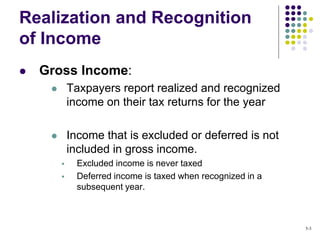
Realization and Recognition
of Income
 Gross Income:
 Taxpayers report realized and recognized
income on their tax returns for the year
 Income that is excluded or deferred is not
included in gross income.
 Excluded income is never taxed
 Deferred income is taxed when recognized in a
subsequent year.
5-3
What Is Included in Gross
Income?
 Definition of gross income for tax purposes
 §61(a) – “gross income means all income from
whatever source derived”
 Reg. §1.61-(a) – “includes income realized in any
form, whether in money, property, or services”
5-4
 Taxpayers recognize gross income when
(1) they receive an economic benefit
(2) they realize the income, and
(3) the tax law does not provide for exclusion or
deferral
What Is Included in Gross
Income?
5-5
 Economic Benefit
 Borrowed funds represent a liability, not gross income
 Realization Principle
 Taxpayer engages in a transaction with another party
 Transaction results in a measurable change in
property rights
 Recognition
 Realized income is assumed to be recognized absent
a deferral or exclusion provision
What Is Included in Gross
Income?
5-6
Other Income Concepts
 Form of Receipt – Does it Matter?
 Return of capital principle
 The cost of an asset is called tax basis
 Return on capital means the tax basis is excluded
when calculating realized income.
 Return of capital does not represent an economic benefit
 Gain from the sale or disposition of an asset is
included in realized income
5-7
Other Income Concepts
 Recovery of amounts previously deducted
 Individuals typically claim deductions in the
year paid.
 Deductions may sometimes be reimbursed or
refunded in a subsequent year.
 Tax benefit rule - Refunds of expenditures
deducted in a prior year are included in gross
income to the extent that the refund reduced
taxes in year of the deduction.
5-8
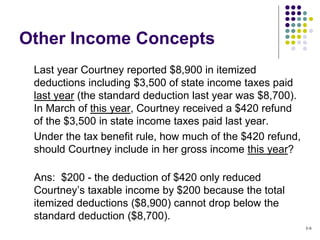
Other Income Concepts
Last year Courtney reported $8,900 in itemized
deductions including $3,500 of state income taxes paid
last year (the standard deduction last year was $8,700).
In March of this year, Courtney received a $420 refund
of the $3,500 in state income taxes paid last year.
Under the tax benefit rule, how much of the $420 refund,
should Courtney include in her gross income this year?
Ans: $200 - the deduction of $420 only reduced
Courtney’s taxable income by $200 because the total
itemized deductions ($8,900) cannot drop below the
standard deduction ($8,700).
5-9
When to Recognize Income?
 Individual taxpayers file tax returns for a
calendar-year period
 Corporations often use a fiscal year end
 The method of accounting generally
determines the calendar year in which
realized income is recognized and included in
gross income
5-10
 Accounting Methods
 Corporation: accrual method of accounting
 Individuals: Cash method
 Constructive Receipt
 Taxpayer must realize and recognize income when it is
actually or constructively received
 Deemed to occur when the income is credited to the
taxpayers account
 Claim of Right
 Income recognized when there are no restrictions on use
of income (e.g., no obligation to repay)
When to Recognize Income?
5-11
 In addition to determining when taxpayers
realize and recognize income, it is important
to consider who (which taxpayer) recognizes
the income
 This question arises when an income-shifting
strategy is involved
 Assignment of Income
 Community Property Systems
Who Recognizes the Income?
5-12
 Assignment of Income
 The assignment of income doctrine holds that the
taxpayer who earns income from services must
recognize the income
 Income from property such as dividends and interest
is taxable to the person who actually owns the
income-producing property
 To shift income from property to another person, a
taxpayer must also transfer the ownership in the
property to the other person
Who Recognizes the Income?
5-13
 Community Property Systems
 Nine states implement community property systems
 Half of the income earned from the services of one spouse
is included in the gross income of the other spouse
 Half of the income from property held as community
property by the married couple is included in the gross
income of each spouse.
 Property that a spouse brings into a marriage is treated as
that spouse’s separate property. How income from
separate property is treated varies across states (either
treated as earned solely by spouse that owns property or
equally by each spouse).
Who Recognizes the Income?
5-14
Types of Income
 Income from services (Earned Income)
 Income from labor most common source of gross
income
 Generated by the efforts of tax payer
 Income from property (Unearned Income)
 Include gain or losses from sale of property,
dividends, interests, rents, royalties, and annuities
 Depends on type of income and type of transaction
generating income
5-15
 Annuities
 An investment that pays a stream of equal payments
over time
 A portion of each annuity payment as a non-taxable
return of capital and the remainder as gross income
 Taxpayers use the annuity exclusion ratio to
determine the return of capital (non-taxable) portion of
each payment
Annuity exclusion ratio = original investment /
expected value of the annuity
Types of Income
5-16
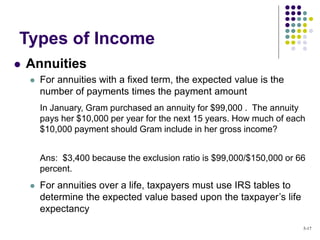
 Annuities
 For annuities with a fixed term, the expected value is the
number of payments times the payment amount
In January, Gram purchased an annuity for $99,000 . The annuity
pays her $10,000 per year for the next 15 years. How much of each
$10,000 payment should Gram include in her gross income?
Ans: $3,400 because the exclusion ratio is $99,000/$150,000 or 66
percent.
 For annuities over a life, taxpayers must use IRS tables to
determine the expected value based upon the taxpayer’s life
expectancy
Types of Income
5-17
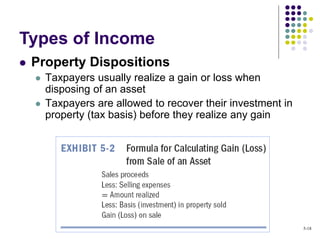
 Property Dispositions
 Taxpayers usually realize a gain or loss when
disposing of an asset
 Taxpayers are allowed to recover their investment in
property (tax basis) before they realize any gain
Types of Income
5-18
 Other Sources of Income
 Income other than wages or business and property
 Income from Flow-through Entities
 Individuals may invest in various business entities
 The legal form of the business affects how the income
generated by the business is taxed
 If the entity is a flow-through entity such as a partnership or S
corporation, the income and deductions of the entity “flow
through” to the owners of the entity (partners or shareholders)
Types of Income
5-19
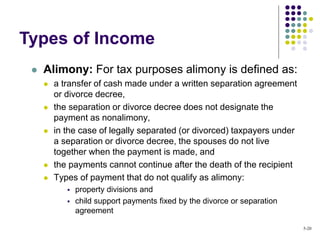
 Alimony: For tax purposes alimony is defined as:
 a transfer of cash made under a written separation agreement
or divorce decree,
 the separation or divorce decree does not designate the
payment as nonalimony,
 in the case of legally separated (or divorced) taxpayers under
a separation or divorce decree, the spouses do not live
together when the payment is made, and
 the payments cannot continue after the death of the recipient
 Types of payment that do not qualify as alimony:
 property divisions and
 child support payments fixed by the divorce or separation
agreement
Types of Income
5-20
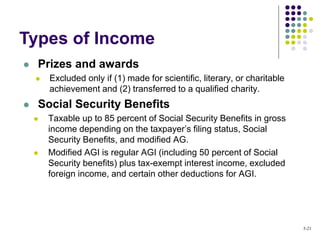
 Prizes and awards
 Excluded only if (1) made for scientific, literary, or charitable
achievement and (2) transferred to a qualified charity.
 Social Security Benefits
 Taxable up to 85 percent of Social Security Benefits in gross
income depending on the taxpayer’s filing status, Social
Security Benefits, and modified AG.
 Modified AGI is regular AGI (including 50 percent of Social
Security benefits) plus tax-exempt interest income, excluded
foreign income, and certain other deductions for AGI.
Types of Income
5-21
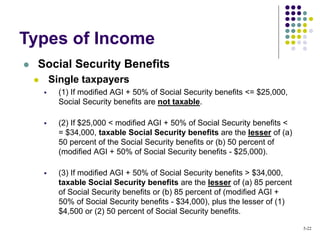
 Social Security Benefits
 Single taxpayers
 (1) If modified AGI + 50% of Social Security benefits <= $25,000,
Social Security benefits are not taxable.
 (2) If $25,000 < modified AGI + 50% of Social Security benefits <
= $34,000, taxable Social Security benefits are the lesser of (a)
50 percent of the Social Security benefits or (b) 50 percent of
(modified AGI + 50% of Social Security benefits - $25,000).
 (3) If modified AGI + 50% of Social Security benefits > $34,000,
taxable Social Security benefits are the lesser of (a) 85 percent
of Social Security benefits or (b) 85 percent of (modified AGI +
50% of Social Security benefits - $34,000), plus the lesser of (1)
$4,500 or (2) 50 percent of Social Security benefits.
Types of Income
5-22
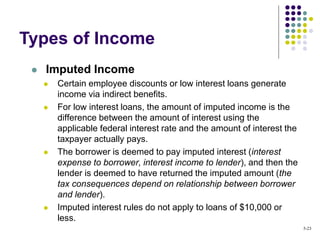
 Imputed Income
 Certain employee discounts or low interest loans generate
income via indirect benefits.
 For low interest loans, the amount of imputed income is the
difference between the amount of interest using the
applicable federal interest rate and the amount of interest the
taxpayer actually pays.
 The borrower is deemed to pay imputed interest (interest
expense to borrower, interest income to lender), and then the
lender is deemed to have returned the imputed amount (the
tax consequences depend on relationship between borrower
and lender).
 Imputed interest rules do not apply to loans of $10,000 or
less.
Types of Income
5-23
 Discharge of Indebtedness
 When a taxpayer’s debt is forgiven by a lender, the
taxpayer must usually include the amount of debt relief
in gross income
 Exceptions exist for certain types of loans
 To provide tax relief for insolvent taxpayers—tax-
payers with liabilities, including tax liabilities, exceeding
their assets—a discharge of indebtedness is not
taxable
 If the discharge of indebtedness makes the taxpayer
solvent, the taxpayer recognizes taxable income to the
extent of his solvency
Types of Income
5-24
Exclusion Provisions
 Congress allows certain specific types of income
to be excluded or deferred
 Subsidize or encourage particular activities or
 To mitigate inequity
 Municipal interest
 Bonds issued by state and local governments located
in the United States, and this exclusion is generally
recognized as a subsidy to state and local
governments
5-25
Exclusion Provisions
 Gain on the sale of personal residence
 Taxpayers may exclude up to $250,000 ($500,000 if
married filing jointly) of gain on the sale of their principal
residence.
 Must satisfy ownership and use tests.
 Any excess gain generally qualifies as long-term capital
gain.
5-26
Exclusion Provisions
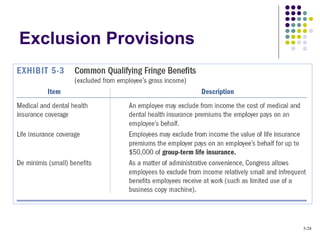
 Fringe benefits
 The value of these benefits is included in the
employee’s gross income as compensation for
services
 Certain fringe benefits, called “qualifying” fringe
benefits, are excluded from gross income
 Common qualifying fringe benefits are medical and
dental health insurance coverage, life insurance
coverage, De minimis (small) benefits
5-27
Exclusion Provisions
5-28
Exclusion Provisions
 Education- Related Exclusions
 As an incentive for taxpayers to participate in higher
education, Congress excludes certain types of income if
the funds are used for higher education
 Scholarships
 Students seeking a college degree can exclude
scholarships that pay for required tuition, fees, books,
and supplies
 Exclusion applies only if the recipient is not required to
perform services in exchange for receiving the
scholarship (limited exception for tuition waivers for
student employees and teaching and research
assistants)
5-29
Exclusion Provisions
 Other Educational Subsidies
 Taxpayers are allowed to exclude from gross income
earnings on investments in qualified education plans
such as 529 plans and Coverdell education savings
accounts as long as they use the earnings to pay for
qualifying educational expenditures
 Taxpayers can elect to exclude interest earned on
Series EE savings bonds when the redemption
proceeds are used to pay qualified higher education
expenses
 The exclusion of interest on Series EE savings bonds
is restricted to taxpayers with modified AGI below
specific limits
5-30
Exclusion Provisions
 Exclusions to mitigate double taxation
 Congress provides certain exclusions to eliminate the
potential double tax that may arise for
 Gifts and inheritances
 Individuals may receive property as gifts or from a
decedent’s estate (an inheritance)
 While the receipt of property is most certainly real income to
the recipient, the value of gifts and inheritances are
excluded from gross income because these transfers are
subject to the Federal Gift and Estate tax
5-31
 Life Insurance Proceeds
 Amounts received due to the death of the insured are
excluded from the income of the recipient
 Similar to inheritances, life insurance proceeds are typically
subject to the Federal Estate tax
 If the proceeds are paid over a period of time rather than in a
lump sum, a portion of the payments represents interest and
must be included in gross income
 Exclusion generally does not apply when (a) a life insurance
policy is transferred to another party for valuable consideration
or (b) taxpayer cancels life insurance contract and receives
proceeds in excess of previous premiums paid
 Exclusion available for accelerated death benefits in certain
circumstances
Exclusion Provisions
5-32
 Foreign earned income
 A maximum of $97,600 (2013) of foreign earned income can be
excluded from gross income for qualifying individuals
 A maximum of $13,664 (2013) of employer-provided foreign
housing also may be excluded (but only to the extent that costs
exceed $15,616 (2013))
 To be eligible for the foreign earned income and housing
exclusions, the taxpayer must be a resident or live in the foreign
country for 330 days in a consecutive 12-month period
Example: Courtney is considering a one-year rotation in one of EWD’s
overseas offices where she will be paid $120,000 for 340 days in residence.
How much income can Courtney exclude in 2013?
Ans: $90,915 [$97,600 full exclusion × 340/365 (days in foreign
country/days in year)].
Exclusion Provisions
5-33
Exclusion Provisions
 Sickness and Injury- Related Exclusions
 Several exclusion provisions apply to taxpayers who are
sick or injured to reflect their inability to pay the tax and
facilitate recovery
 Workers’ compensation
 Payments from workers’ compensation plans are excluded
from gross income
5-34
Exclusion Provisions
 Payments Associated with Personal Injury
 Awards that relate to physical injury or sickness or
are payments for the medical costs of treating
emotional distress are excluded from gross income
 Other payments including punitive damages are
fully taxable
 Health care reimbursement
 Reimbursements by health and accident insurance
policies for medical expenses paid by the taxpayer
are excluded from gross income
5-35
Exclusion Provisions
 Disability insurance
 Also called wage replacement insurance
 Pays the insured individual for wages lost when the
individual misses work due to injury or disability
 If an individual purchases disability insurance
directly, any disability benefits are excluded from
gross income
 If the individual’s employer purchases the disability
insurance and the individual excludes the benefit
from her compensation, then disability benefits are
taxable
5-36
 Deferral Provisions
 Allow taxpayers to defer (but not permanently exclude)
the recognition of certain types of realized income
 Transactions generating deferred income include
 installment sales
 like-kind exchanges
 involuntary conversions, and
 contributions to non-Roth qualified retirement accounts
Exclusion Provisions
5-37

ACCT321 Chapter 05

  • 1.
    © 2014 byMcGraw-Hill Education. This is proprietary material solely for authorized instructor use. Not authorized for sale or distribution in any manner. This document may not be copied, scanned, duplicated, forwarded, distributed, or posted on a website, in whole or part. Chapter 5 Gross Income and Exclusions
  • 2.
    Learning Objectives 1. Applythe concept of realization and explain when taxpayers recognize gross income 2. Understand the distinctions between the various sources of income, including income from services and property 3. Apply basic income exclusion provisions to compute gross income 5-2
  • 3.
    Realization and Recognition ofIncome  Gross Income:  Taxpayers report realized and recognized income on their tax returns for the year  Income that is excluded or deferred is not included in gross income.  Excluded income is never taxed  Deferred income is taxed when recognized in a subsequent year. 5-3
  • 4.
    What Is Includedin Gross Income?  Definition of gross income for tax purposes  §61(a) – “gross income means all income from whatever source derived”  Reg. §1.61-(a) – “includes income realized in any form, whether in money, property, or services” 5-4
  • 5.
     Taxpayers recognizegross income when (1) they receive an economic benefit (2) they realize the income, and (3) the tax law does not provide for exclusion or deferral What Is Included in Gross Income? 5-5
  • 6.
     Economic Benefit Borrowed funds represent a liability, not gross income  Realization Principle  Taxpayer engages in a transaction with another party  Transaction results in a measurable change in property rights  Recognition  Realized income is assumed to be recognized absent a deferral or exclusion provision What Is Included in Gross Income? 5-6
  • 7.
    Other Income Concepts Form of Receipt – Does it Matter?  Return of capital principle  The cost of an asset is called tax basis  Return on capital means the tax basis is excluded when calculating realized income.  Return of capital does not represent an economic benefit  Gain from the sale or disposition of an asset is included in realized income 5-7
  • 8.
    Other Income Concepts Recovery of amounts previously deducted  Individuals typically claim deductions in the year paid.  Deductions may sometimes be reimbursed or refunded in a subsequent year.  Tax benefit rule - Refunds of expenditures deducted in a prior year are included in gross income to the extent that the refund reduced taxes in year of the deduction. 5-8
  • 9.
    Other Income Concepts Lastyear Courtney reported $8,900 in itemized deductions including $3,500 of state income taxes paid last year (the standard deduction last year was $8,700). In March of this year, Courtney received a $420 refund of the $3,500 in state income taxes paid last year. Under the tax benefit rule, how much of the $420 refund, should Courtney include in her gross income this year? Ans: $200 - the deduction of $420 only reduced Courtney’s taxable income by $200 because the total itemized deductions ($8,900) cannot drop below the standard deduction ($8,700). 5-9
  • 10.
    When to RecognizeIncome?  Individual taxpayers file tax returns for a calendar-year period  Corporations often use a fiscal year end  The method of accounting generally determines the calendar year in which realized income is recognized and included in gross income 5-10
  • 11.
     Accounting Methods Corporation: accrual method of accounting  Individuals: Cash method  Constructive Receipt  Taxpayer must realize and recognize income when it is actually or constructively received  Deemed to occur when the income is credited to the taxpayers account  Claim of Right  Income recognized when there are no restrictions on use of income (e.g., no obligation to repay) When to Recognize Income? 5-11
  • 12.
     In additionto determining when taxpayers realize and recognize income, it is important to consider who (which taxpayer) recognizes the income  This question arises when an income-shifting strategy is involved  Assignment of Income  Community Property Systems Who Recognizes the Income? 5-12
  • 13.
     Assignment ofIncome  The assignment of income doctrine holds that the taxpayer who earns income from services must recognize the income  Income from property such as dividends and interest is taxable to the person who actually owns the income-producing property  To shift income from property to another person, a taxpayer must also transfer the ownership in the property to the other person Who Recognizes the Income? 5-13
  • 14.
     Community PropertySystems  Nine states implement community property systems  Half of the income earned from the services of one spouse is included in the gross income of the other spouse  Half of the income from property held as community property by the married couple is included in the gross income of each spouse.  Property that a spouse brings into a marriage is treated as that spouse’s separate property. How income from separate property is treated varies across states (either treated as earned solely by spouse that owns property or equally by each spouse). Who Recognizes the Income? 5-14
  • 15.
    Types of Income Income from services (Earned Income)  Income from labor most common source of gross income  Generated by the efforts of tax payer  Income from property (Unearned Income)  Include gain or losses from sale of property, dividends, interests, rents, royalties, and annuities  Depends on type of income and type of transaction generating income 5-15
  • 16.
     Annuities  Aninvestment that pays a stream of equal payments over time  A portion of each annuity payment as a non-taxable return of capital and the remainder as gross income  Taxpayers use the annuity exclusion ratio to determine the return of capital (non-taxable) portion of each payment Annuity exclusion ratio = original investment / expected value of the annuity Types of Income 5-16
  • 17.
     Annuities  Forannuities with a fixed term, the expected value is the number of payments times the payment amount In January, Gram purchased an annuity for $99,000 . The annuity pays her $10,000 per year for the next 15 years. How much of each $10,000 payment should Gram include in her gross income? Ans: $3,400 because the exclusion ratio is $99,000/$150,000 or 66 percent.  For annuities over a life, taxpayers must use IRS tables to determine the expected value based upon the taxpayer’s life expectancy Types of Income 5-17
  • 18.
     Property Dispositions Taxpayers usually realize a gain or loss when disposing of an asset  Taxpayers are allowed to recover their investment in property (tax basis) before they realize any gain Types of Income 5-18
  • 19.
     Other Sourcesof Income  Income other than wages or business and property  Income from Flow-through Entities  Individuals may invest in various business entities  The legal form of the business affects how the income generated by the business is taxed  If the entity is a flow-through entity such as a partnership or S corporation, the income and deductions of the entity “flow through” to the owners of the entity (partners or shareholders) Types of Income 5-19
  • 20.
     Alimony: Fortax purposes alimony is defined as:  a transfer of cash made under a written separation agreement or divorce decree,  the separation or divorce decree does not designate the payment as nonalimony,  in the case of legally separated (or divorced) taxpayers under a separation or divorce decree, the spouses do not live together when the payment is made, and  the payments cannot continue after the death of the recipient  Types of payment that do not qualify as alimony:  property divisions and  child support payments fixed by the divorce or separation agreement Types of Income 5-20
  • 21.
     Prizes andawards  Excluded only if (1) made for scientific, literary, or charitable achievement and (2) transferred to a qualified charity.  Social Security Benefits  Taxable up to 85 percent of Social Security Benefits in gross income depending on the taxpayer’s filing status, Social Security Benefits, and modified AG.  Modified AGI is regular AGI (including 50 percent of Social Security benefits) plus tax-exempt interest income, excluded foreign income, and certain other deductions for AGI. Types of Income 5-21
  • 22.
     Social SecurityBenefits  Single taxpayers  (1) If modified AGI + 50% of Social Security benefits <= $25,000, Social Security benefits are not taxable.  (2) If $25,000 < modified AGI + 50% of Social Security benefits < = $34,000, taxable Social Security benefits are the lesser of (a) 50 percent of the Social Security benefits or (b) 50 percent of (modified AGI + 50% of Social Security benefits - $25,000).  (3) If modified AGI + 50% of Social Security benefits > $34,000, taxable Social Security benefits are the lesser of (a) 85 percent of Social Security benefits or (b) 85 percent of (modified AGI + 50% of Social Security benefits - $34,000), plus the lesser of (1) $4,500 or (2) 50 percent of Social Security benefits. Types of Income 5-22
  • 23.
     Imputed Income Certain employee discounts or low interest loans generate income via indirect benefits.  For low interest loans, the amount of imputed income is the difference between the amount of interest using the applicable federal interest rate and the amount of interest the taxpayer actually pays.  The borrower is deemed to pay imputed interest (interest expense to borrower, interest income to lender), and then the lender is deemed to have returned the imputed amount (the tax consequences depend on relationship between borrower and lender).  Imputed interest rules do not apply to loans of $10,000 or less. Types of Income 5-23
  • 24.
     Discharge ofIndebtedness  When a taxpayer’s debt is forgiven by a lender, the taxpayer must usually include the amount of debt relief in gross income  Exceptions exist for certain types of loans  To provide tax relief for insolvent taxpayers—tax- payers with liabilities, including tax liabilities, exceeding their assets—a discharge of indebtedness is not taxable  If the discharge of indebtedness makes the taxpayer solvent, the taxpayer recognizes taxable income to the extent of his solvency Types of Income 5-24
  • 25.
    Exclusion Provisions  Congressallows certain specific types of income to be excluded or deferred  Subsidize or encourage particular activities or  To mitigate inequity  Municipal interest  Bonds issued by state and local governments located in the United States, and this exclusion is generally recognized as a subsidy to state and local governments 5-25
  • 26.
    Exclusion Provisions  Gainon the sale of personal residence  Taxpayers may exclude up to $250,000 ($500,000 if married filing jointly) of gain on the sale of their principal residence.  Must satisfy ownership and use tests.  Any excess gain generally qualifies as long-term capital gain. 5-26
  • 27.
    Exclusion Provisions  Fringebenefits  The value of these benefits is included in the employee’s gross income as compensation for services  Certain fringe benefits, called “qualifying” fringe benefits, are excluded from gross income  Common qualifying fringe benefits are medical and dental health insurance coverage, life insurance coverage, De minimis (small) benefits 5-27
  • 28.
  • 29.
    Exclusion Provisions  Education-Related Exclusions  As an incentive for taxpayers to participate in higher education, Congress excludes certain types of income if the funds are used for higher education  Scholarships  Students seeking a college degree can exclude scholarships that pay for required tuition, fees, books, and supplies  Exclusion applies only if the recipient is not required to perform services in exchange for receiving the scholarship (limited exception for tuition waivers for student employees and teaching and research assistants) 5-29
  • 30.
    Exclusion Provisions  OtherEducational Subsidies  Taxpayers are allowed to exclude from gross income earnings on investments in qualified education plans such as 529 plans and Coverdell education savings accounts as long as they use the earnings to pay for qualifying educational expenditures  Taxpayers can elect to exclude interest earned on Series EE savings bonds when the redemption proceeds are used to pay qualified higher education expenses  The exclusion of interest on Series EE savings bonds is restricted to taxpayers with modified AGI below specific limits 5-30
  • 31.
    Exclusion Provisions  Exclusionsto mitigate double taxation  Congress provides certain exclusions to eliminate the potential double tax that may arise for  Gifts and inheritances  Individuals may receive property as gifts or from a decedent’s estate (an inheritance)  While the receipt of property is most certainly real income to the recipient, the value of gifts and inheritances are excluded from gross income because these transfers are subject to the Federal Gift and Estate tax 5-31
  • 32.
     Life InsuranceProceeds  Amounts received due to the death of the insured are excluded from the income of the recipient  Similar to inheritances, life insurance proceeds are typically subject to the Federal Estate tax  If the proceeds are paid over a period of time rather than in a lump sum, a portion of the payments represents interest and must be included in gross income  Exclusion generally does not apply when (a) a life insurance policy is transferred to another party for valuable consideration or (b) taxpayer cancels life insurance contract and receives proceeds in excess of previous premiums paid  Exclusion available for accelerated death benefits in certain circumstances Exclusion Provisions 5-32
  • 33.
     Foreign earnedincome  A maximum of $97,600 (2013) of foreign earned income can be excluded from gross income for qualifying individuals  A maximum of $13,664 (2013) of employer-provided foreign housing also may be excluded (but only to the extent that costs exceed $15,616 (2013))  To be eligible for the foreign earned income and housing exclusions, the taxpayer must be a resident or live in the foreign country for 330 days in a consecutive 12-month period Example: Courtney is considering a one-year rotation in one of EWD’s overseas offices where she will be paid $120,000 for 340 days in residence. How much income can Courtney exclude in 2013? Ans: $90,915 [$97,600 full exclusion × 340/365 (days in foreign country/days in year)]. Exclusion Provisions 5-33
  • 34.
    Exclusion Provisions  Sicknessand Injury- Related Exclusions  Several exclusion provisions apply to taxpayers who are sick or injured to reflect their inability to pay the tax and facilitate recovery  Workers’ compensation  Payments from workers’ compensation plans are excluded from gross income 5-34
  • 35.
    Exclusion Provisions  PaymentsAssociated with Personal Injury  Awards that relate to physical injury or sickness or are payments for the medical costs of treating emotional distress are excluded from gross income  Other payments including punitive damages are fully taxable  Health care reimbursement  Reimbursements by health and accident insurance policies for medical expenses paid by the taxpayer are excluded from gross income 5-35
  • 36.
    Exclusion Provisions  Disabilityinsurance  Also called wage replacement insurance  Pays the insured individual for wages lost when the individual misses work due to injury or disability  If an individual purchases disability insurance directly, any disability benefits are excluded from gross income  If the individual’s employer purchases the disability insurance and the individual excludes the benefit from her compensation, then disability benefits are taxable 5-36
  • 37.
     Deferral Provisions Allow taxpayers to defer (but not permanently exclude) the recognition of certain types of realized income  Transactions generating deferred income include  installment sales  like-kind exchanges  involuntary conversions, and  contributions to non-Roth qualified retirement accounts Exclusion Provisions 5-37