Recommended
PPT
chap03 Need Assessment for training .ppt
PPTX
PPT
PPT HERMANTO (12010123410100)-NEEDS ASSESMENT.ppt
PPT
PPT
u2-lect-1-to-9-mtd-pvb-1801161758710.ppt
PPTX
Employee Training & Development Ch 03
PPT
Training Functions, Training Needs Assessment, Action Research, Organizationa...
PPT
PDF
Human Resource Management: Training and Development (HRM)
DOCX
H 1 human resourse development
PDF
Employee training and development in human resource department
PPTX
DOCX
Chapter ThreeNeeds AssessmentObjectivesAfter reading t
PPT
PPTX
DOCX
PPT
PPTX
Training Needs Assessment & Analysis
PPTX
HRM453-LATIHAN PEKERJA (Training Employees).pptx
PPTX
Need assessment as a first step of training
PPT
3 -needs_assessment___analysis_187
PPTX
PPTX
PPT
1.Training & Development.ppt
PPT
PPTX
PPTX
PPT
Pub 5012 mba training and devt 2015 may
PPTX
Digital media and the marketing mix - Final.pptx
PPTX
managing and influencing the public perception of a brand, organization, or i...
More Related Content
PPT
chap03 Need Assessment for training .ppt
PPTX
PPT
PPT HERMANTO (12010123410100)-NEEDS ASSESMENT.ppt
PPT
PPT
u2-lect-1-to-9-mtd-pvb-1801161758710.ppt
PPTX
Employee Training & Development Ch 03
PPT
Training Functions, Training Needs Assessment, Action Research, Organizationa...
PPT
Similar to chap 3 needs assessment steps and stages.ppt
PDF
Human Resource Management: Training and Development (HRM)
DOCX
H 1 human resourse development
PDF
Employee training and development in human resource department
PPTX
DOCX
Chapter ThreeNeeds AssessmentObjectivesAfter reading t
PPT
PPTX
DOCX
PPT
PPTX
Training Needs Assessment & Analysis
PPTX
HRM453-LATIHAN PEKERJA (Training Employees).pptx
PPTX
Need assessment as a first step of training
PPT
3 -needs_assessment___analysis_187
PPTX
PPTX
PPT
1.Training & Development.ppt
PPT
PPTX
PPTX
PPT
Pub 5012 mba training and devt 2015 may
More from iqrababar5
PPTX
Digital media and the marketing mix - Final.pptx
PPTX
managing and influencing the public perception of a brand, organization, or i...
PPTX
ch_9 - Online partnerships including affiliate marketing.pptx
PPTX
chapter Nine book - Email Marketing.pptx
PPT
Strategic Research planning Chapter 6.ppt
PPT
How marketing communication works Chapter 4.ppt
PDF
Strategic Research The research process Ch06.pdf
PDF
How advertising works planning and strategy Ch04.pdf
PPT
Design and Production visual communication Chap 10.ppt
PPTX
Business Research correlation Presentation1.pptx
PPT
Chapter 3 The Environment and culture of organization.ppt
PDF
Chapter 1 Managing and Manager's Job.pdf
PPT
Traning&DevelopmentChapter004 leadership.ppt
PPTX
Lecture Product Strategy and pakaging.pptx
PPTX
Setting Product Strategy and classification.pptx
Recently uploaded
PDF
Serhii Herasymov: Expert sales in outsource companies: your technical special...
PDF
Affordable Way to Buy Verified Airbnb Accounts in Bulk (2).pdf
PDF
John Michael Philbin - An Avid Hiking Enthusiast
PDF
𝐖𝐚𝐠 𝐂𝐥𝐨𝐧𝐞 𝐏𝐞𝐭 𝐂𝐚𝐫𝐞 𝐀𝐩𝐩 𝐃𝐞𝐯𝐞𝐥𝐨𝐩𝐦𝐞𝐧𝐭
PDF
How to Buy Facebook Accounts Responsibly and Safely.pdf
PDF
Prasenjit Bhaumik Plano - Proficient In JavaScript, Python, And Database Mana...
PDF
How To B,u,y Verified Cash App Accounts – Understanding Safe Usage, BTC Featu...
PDF
How to Buy Verified Bybit Accounts in 2026.pdf
PDF
Ultra Map Section II Multifaceted Second Edition.pdf
PDF
Guide to Safely Buying Gmail Accounts for Safely-Aged.pdf
PDF
LCP-consultation-response-to-TPR-CDC-code-of-practice.pdf
PDF
ICv2 White Paper - Navigating the New World of Comics
PDF
Andria Sergio - Known For Her Accuracy And Professionalism
PDF
𝐋𝐚𝐮𝐧𝐜𝐡 𝐘𝐨𝐮𝐫 𝐎𝐰𝐧 𝐀𝐥𝐥 𝐢𝐧 𝐎𝐧𝐞 𝐃𝐞𝐥𝐢𝐯𝐞𝐫𝐲 𝐀𝐩𝐩 𝐏𝐥𝐚𝐭𝐟𝐨𝐫𝐦 𝐋𝐢𝐤𝐞 𝐆𝐥𝐨𝐯𝐨
PDF
Fraud Warning MOALA WALLET Exchange Exposed
DOCX
8 Best Places to Buy Facebook Accounts at Wholesale Prices.docx
PDF
VD 570 - Robust Inline Flow Meter From CS-Instruments
PDF
LA Building Inspections & Compliance offers
PPTX
Levels of Management: Top, Middle and Lower Management Explained
PDF
AI,Analytics, Digital HR, Agentic AI.pdf
chap 3 needs assessment steps and stages.ppt 1. McGraw-Hill/Irwin © 2005 The McGraw-Hill Companies, Inc. All rights reserved. 3 - 1
3
Chapter
Needs Assessment
Needs Assessment
2. McGraw-Hill/Irwin © 2005 The McGraw-Hill Companies, Inc. All rights reserved. 3 - 2
Introduction
Introduction (1 of 2)
(1 of 2)
Effective training practices involve the use of an
instructional systems design process
The instructional systems design process begins
by conducting a needs assessment
3. McGraw-Hill/Irwin © 2005 The McGraw-Hill Companies, Inc. All rights reserved. 3 - 3
Introduction
Introduction (2 of 2)
(2 of 2)
Before choosing a training method, it is important
to determine:
what type of training is necessary, and
whether trainees are willing to learn
4. McGraw-Hill/Irwin © 2005 The McGraw-Hill Companies, Inc. All rights reserved. 3 - 4
Needs Assessment
Needs Assessment
Refers to the process used to determine whether
training is necessary
Because needs assessment is the first step in the
instructional design process:
If it is poorly conducted, training will not achieve the
outcomes or financial benefits the company expects
5. McGraw-Hill/Irwin © 2005 The McGraw-Hill Companies, Inc. All rights reserved. 3 - 5
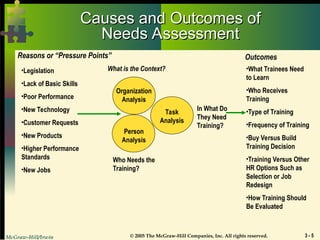
Causes and Outcomes of
Causes and Outcomes of
Needs Assessment
Needs Assessment
Reasons or “Pressure Points” Outcomes
What is the Context?
•Legislation
•Lack of Basic Skills
•Poor Performance
•New Technology
•Customer Requests
•New Products
•Higher Performance
Standards
•New Jobs
•What Trainees Need
to Learn
•Who Receives
Training
•Type of Training
•Frequency of Training
•Buy Versus Build
Training Decision
•Training Versus Other
HR Options Such as
Selection or Job
Redesign
•How Training Should
Be Evaluated
Who Needs the
Training?
In What Do
They Need
Training?
Organization
Analysis
Task
Analysis
Person
Analysis
6. McGraw-Hill/Irwin © 2005 The McGraw-Hill Companies, Inc. All rights reserved. 3 - 6
Needs assessment involves:
Needs assessment involves: (1 of 2)
(1 of 2)
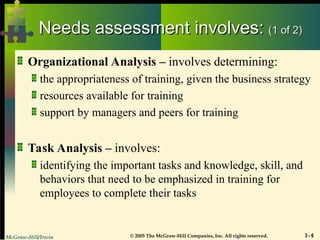
Organizational Analysis – involves determining:
the appropriateness of training, given the business strategy
resources available for training
support by managers and peers for training
Task Analysis – involves:
identifying the important tasks and knowledge, skill, and
behaviors that need to be emphasized in training for
employees to complete their tasks
7. McGraw-Hill/Irwin © 2005 The McGraw-Hill Companies, Inc. All rights reserved. 3 - 7
Needs assessment involves:
Needs assessment involves: (2 of 2)
(2 of 2)
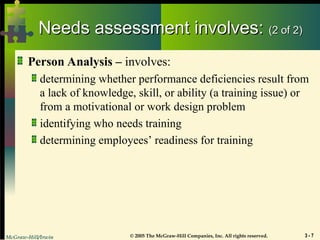
Person Analysis – involves:
determining whether performance deficiencies result from
a lack of knowledge, skill, or ability (a training issue) or
from a motivational or work design problem
identifying who needs training
determining employees’ readiness for training
8. McGraw-Hill/Irwin © 2005 The McGraw-Hill Companies, Inc. All rights reserved. 3 - 8
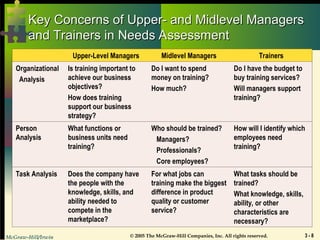
Key Concerns of Upper- and Midlevel Managers
Key Concerns of Upper- and Midlevel Managers
and Trainers in Needs Assessment
and Trainers in Needs Assessment
Upper-Level Managers Midlevel Managers Trainers
Organizational
Analysis
Is training important to
achieve our business
objectives?
How does training
support our business
strategy?
Do I want to spend
money on training?
How much?
Do I have the budget to
buy training services?
Will managers support
training?
Person
Analysis
What functions or
business units need
training?
Who should be trained?
Managers?
Professionals?
Core employees?
How will I identify which
employees need
training?
Task Analysis Does the company have
the people with the
knowledge, skills, and
ability needed to
compete in the
marketplace?
For what jobs can
training make the biggest
difference in product
quality or customer
service?
What tasks should be
trained?
What knowledge, skills,
ability, or other
characteristics are
necessary?
9. McGraw-Hill/Irwin © 2005 The McGraw-Hill Companies, Inc. All rights reserved. 3 - 9
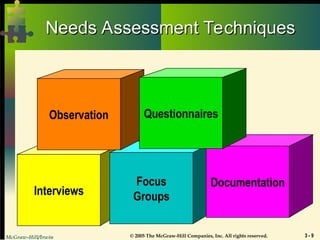
Needs Assessment Techniques
Needs Assessment Techniques
Interviews
Focus
Groups
Documentation
Observation Questionnaires
10. McGraw-Hill/Irwin © 2005 The McGraw-Hill Companies, Inc. All rights reserved. 3 - 10
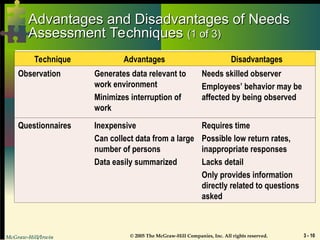
Advantages and Disadvantages of Needs
Advantages and Disadvantages of Needs
Assessment Techniques
Assessment Techniques (1 of 3)
(1 of 3)
Technique Advantages Disadvantages
Observation Generates data relevant to
work environment
Minimizes interruption of
work
Needs skilled observer
Employees’ behavior may be
affected by being observed
Questionnaires Inexpensive
Can collect data from a large
number of persons
Data easily summarized
Requires time
Possible low return rates,
inappropriate responses
Lacks detail
Only provides information
directly related to questions
asked
11. McGraw-Hill/Irwin © 2005 The McGraw-Hill Companies, Inc. All rights reserved. 3 - 11
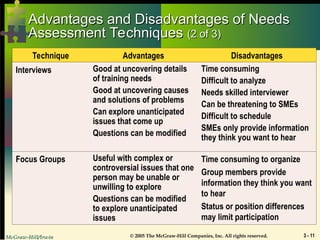
Advantages and Disadvantages of Needs
Advantages and Disadvantages of Needs
Assessment Techniques
Assessment Techniques (2 of 3)
(2 of 3)
Technique Advantages Disadvantages
Interviews Good at uncovering details
of training needs
Good at uncovering causes
and solutions of problems
Can explore unanticipated
issues that come up
Questions can be modified
Time consuming
Difficult to analyze
Needs skilled interviewer
Can be threatening to SMEs
Difficult to schedule
SMEs only provide information
they think you want to hear
Focus Groups Useful with complex or
controversial issues that one
person may be unable or
unwilling to explore
Questions can be modified
to explore unanticipated
issues
Time consuming to organize
Group members provide
information they think you want
to hear
Status or position differences
may limit participation
12. McGraw-Hill/Irwin © 2005 The McGraw-Hill Companies, Inc. All rights reserved. 3 - 12
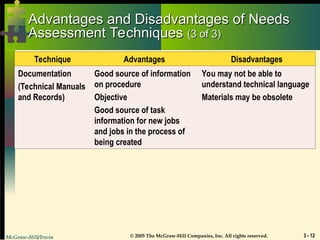
Advantages and Disadvantages of Needs
Advantages and Disadvantages of Needs
Assessment Techniques
Assessment Techniques (3 of 3)
(3 of 3)
Technique Advantages Disadvantages
Documentation
(Technical Manuals
and Records)
Good source of information
on procedure
Objective
Good source of task
information for new jobs
and jobs in the process of
being created
You may not be able to
understand technical language
Materials may be obsolete
13. McGraw-Hill/Irwin © 2005 The McGraw-Hill Companies, Inc. All rights reserved. 3 - 13
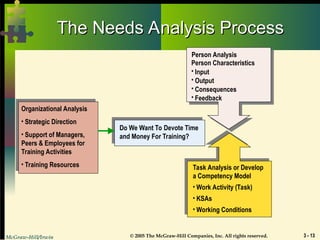
The Needs Analysis Process
The Needs Analysis Process
Do We Want To Devote Time
and Money For Training?
Person Analysis
Person Characteristics
• Input
• Output
• Consequences
• Feedback
Task Analysis or Develop
a Competency Model
• Work Activity (Task)
• KSAs
• Working Conditions
Organizational Analysis
• Strategic Direction
• Support of Managers,
Peers & Employees for
Training Activities
• Training Resources
14. McGraw-Hill/Irwin © 2005 The McGraw-Hill Companies, Inc. All rights reserved. 3 - 14
Questions to Ask in an Organizational
Questions to Ask in an Organizational
Analysis
Analysis (1 of 3)
(1 of 3)
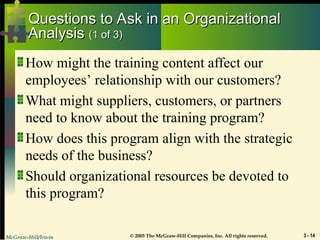
How might the training content affect our
employees’ relationship with our customers?
What might suppliers, customers, or partners
need to know about the training program?
How does this program align with the strategic
needs of the business?
Should organizational resources be devoted to
this program?
15. McGraw-Hill/Irwin © 2005 The McGraw-Hill Companies, Inc. All rights reserved. 3 - 15
Questions to Ask in an Organizational
Questions to Ask in an Organizational
Analysis
Analysis (2 of 3)
(2 of 3)
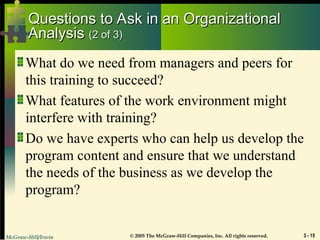
What do we need from managers and peers for
this training to succeed?
What features of the work environment might
interfere with training?
Do we have experts who can help us develop the
program content and ensure that we understand
the needs of the business as we develop the
program?
16. McGraw-Hill/Irwin © 2005 The McGraw-Hill Companies, Inc. All rights reserved. 3 - 16
Questions to Ask in an Organizational
Questions to Ask in an Organizational
Analysis
Analysis (3 of 3)
(3 of 3)
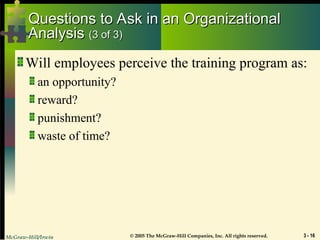
Will employees perceive the training program as:
an opportunity?
reward?
punishment?
waste of time?
17. McGraw-Hill/Irwin © 2005 The McGraw-Hill Companies, Inc. All rights reserved. 3 - 17
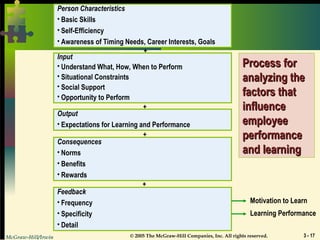
Person Characteristics
• Basic Skills
• Self-Efficiency
• Awareness of Timing Needs, Career Interests, Goals
Input
• Understand What, How, When to Perform
• Situational Constraints
• Social Support
• Opportunity to Perform
Output
• Expectations for Learning and Performance
Consequences
• Norms
• Benefits
• Rewards
Feedback
• Frequency
• Specificity
• Detail
Motivation to Learn
Learning Performance
+
+
+
+
Process for
Process for
analyzing the
analyzing the
factors that
factors that
influence
influence
employee
employee
performance
performance
and learning
and learning
18. McGraw-Hill/Irwin © 2005 The McGraw-Hill Companies, Inc. All rights reserved. 3 - 18
Person Analysis –
Person Analysis –
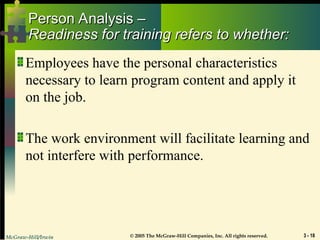
Readiness for training refers to whether:
Readiness for training refers to whether:
Employees have the personal characteristics
necessary to learn program content and apply it
on the job.
The work environment will facilitate learning and
not interfere with performance.
19. McGraw-Hill/Irwin © 2005 The McGraw-Hill Companies, Inc. All rights reserved. 3 - 19
Factors that influence employee
Factors that influence employee
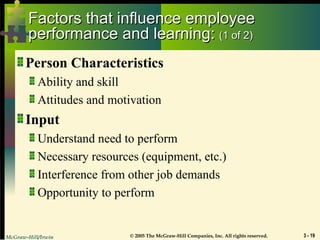
performance and learning:
performance and learning: (1 of 2)
(1 of 2)
Person Characteristics
Ability and skill
Attitudes and motivation
Input
Understand need to perform
Necessary resources (equipment, etc.)
Interference from other job demands
Opportunity to perform
20. McGraw-Hill/Irwin © 2005 The McGraw-Hill Companies, Inc. All rights reserved. 3 - 20
Factors that influence employee
Factors that influence employee
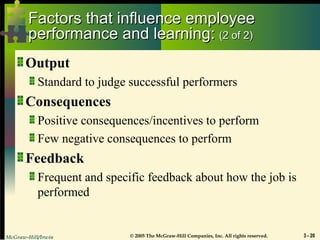
performance and learning:
performance and learning: (2 of 2)
(2 of 2)
Output
Standard to judge successful performers
Consequences
Positive consequences/incentives to perform
Few negative consequences to perform
Feedback
Frequent and specific feedback about how the job is
performed
21. McGraw-Hill/Irwin © 2005 The McGraw-Hill Companies, Inc. All rights reserved. 3 - 21
Person Analysis:
Person Analysis: Self-Efficacy
Self-Efficacy
Self-efficacy - the employees believe that they
can successfully perform their job or learn the
content of the training program
The job environment can be threatening to many
employees who may not have been successful in the
past
The training environment can also be threatening to
people who have not received training or formal
education for some length of time
22. McGraw-Hill/Irwin © 2005 The McGraw-Hill Companies, Inc. All rights reserved. 3 - 22
Employees’ self-efficacy level can be
Employees’ self-efficacy level can be
increased by:
increased by: (1 of 2)
(1 of 2)
Letting employees know that the purpose of the
training is to try to improve performance rather
than to identify areas in which employees are
incompetent
Providing as much information as possible about
the training program and purpose of training prior
to the actual training
23. McGraw-Hill/Irwin © 2005 The McGraw-Hill Companies, Inc. All rights reserved. 3 - 23
Employees’ self-efficacy level can be
Employees’ self-efficacy level can be
increased by:
increased by: (2 of 2)
(2 of 2)
Showing employees the training success of their
peers who are now in similar jobs
Providing employees with feedback that learning
is under their control and they have the ability
and the responsibility to overcome any learning
difficulties they experience in the program
24. McGraw-Hill/Irwin © 2005 The McGraw-Hill Companies, Inc. All rights reserved. 3 - 24
To ensure that the work environment
To ensure that the work environment
enhances trainees’ motivation to learn:
enhances trainees’ motivation to learn: (1 of 2)
(1 of 2)
Provide materials, time, job-related information,
and other work aids necessary for employees to
use new skills or behavior before participating in
training programs
Speak positively about the company’s training
programs to employees
Let employees know they are doing a good job
when they are using training content in their work
25. McGraw-Hill/Irwin © 2005 The McGraw-Hill Companies, Inc. All rights reserved. 3 - 25
To ensure that the work environment
To ensure that the work environment
enhances trainees’ motivation to learn:
enhances trainees’ motivation to learn: (2 of 2)
(2 of 2)
Encourage work-group members to involve each
other in trying to use new skills on the job by
soliciting feedback and sharing training
experiences and situations in which training
content was helpful
Provide employees with time and opportunities to
practice and apply new skills or behaviors to their
work
26. McGraw-Hill/Irwin © 2005 The McGraw-Hill Companies, Inc. All rights reserved. 3 - 26
To determine if training is the best solution,
To determine if training is the best solution,
assess whether:
assess whether: (1 of 3)
(1 of 3)
The performance problem is important and has
the potential to cost the company a significant
amount of money from lost productivity or
customers
Employees do not know how to perform
effectively
Perhaps they received little or no previous training or
the training was ineffective
(This problem is a characteristic of the person)
27. McGraw-Hill/Irwin © 2005 The McGraw-Hill Companies, Inc. All rights reserved. 3 - 27
To determine if training is the best solution,
To determine if training is the best solution,
assess whether:
assess whether: (2 of 3)
(2 of 3)
Employees cannot demonstrate the correct
knowledge or behavior
Employees were trained but they infrequently or never
used the training content on the job
(This is an input problem)
Performance expectations are clear (input) and
there are no obstacles to performance such as
faulty tools or equipment
28. McGraw-Hill/Irwin © 2005 The McGraw-Hill Companies, Inc. All rights reserved. 3 - 28
To determine if training is the best solution,
To determine if training is the best solution,
assess whether:
assess whether: (3 of 3)
(3 of 3)
There are positive consequences for good
performance, while poor performance is not
rewarded
Employees receive timely, relevant, accurate,
constructive, and specific feedback about their
performance (a feedback issue)
Other solutions such as job redesign or
transferring employees to other jobs are too
expensive or unrealistic
29. McGraw-Hill/Irwin © 2005 The McGraw-Hill Companies, Inc. All rights reserved. 3 - 29
Person Analysis:
Person Analysis: Is training the best
Is training the best
solution?
solution?
If employees lack the knowledge and skill to
perform and the other factors are satisfactory,
training is needed
If employees have the knowledge and skill to
perform but input, output, consequences, or
feedback are inadequate, training may not be the
best solution
30. McGraw-Hill/Irwin © 2005 The McGraw-Hill Companies, Inc. All rights reserved. 3 - 30
Task Analysis
Task Analysis
Task analysis results in a description of work
activities, including tasks performed by the
employee and the knowledge, skills, and abilities
required to complete the tasks
Should only be undertaken after you have
determined from the organizational analysis that
the company wants to devote time and money for
training
31. McGraw-Hill/Irwin © 2005 The McGraw-Hill Companies, Inc. All rights reserved. 3 - 31
Steps in a Task Analysis
Steps in a Task Analysis
1. Select the job(s) to be analyzed
2. Develop a preliminary list of tasks performed
by the job
3. Validate or confirm the preliminary list of tasks
4. Identify the knowledge, skills, or abilities
necessary to successfully perform each task
32. McGraw-Hill/Irwin © 2005 The McGraw-Hill Companies, Inc. All rights reserved. 3 - 32
Key Points to Remember When Conducting
Key Points to Remember When Conducting
a Task Analysis
a Task Analysis (1 of 3)
(1 of 3)
Task analysis should identify both what
employees are actually doing and what they
should be doing on the job
Task analysis begins by breaking the job into
duties and tasks
Use more than two methods for collecting task
information to increase the validity of the analysis
33. McGraw-Hill/Irwin © 2005 The McGraw-Hill Companies, Inc. All rights reserved. 3 - 33
Key Points to Remember When Conducting
Key Points to Remember When Conducting
a Task Analysis
a Task Analysis (2 of 3)
(2 of 3)
For task analysis to be useful, information needs
to be collected from subject matter experts
(SMEs)
SMEs include:
job incumbents
managers
employees familiar with the job
34. McGraw-Hill/Irwin © 2005 The McGraw-Hill Companies, Inc. All rights reserved. 3 - 34
Key Points to Remember When Conducting
Key Points to Remember When Conducting
a Task Analysis
a Task Analysis (3 of 3)
(3 of 3)
In deciding how to evaluate tasks, the focus
should be on tasks necessary to accomplish the
company’s goals and objectives
These may not be the tasks that are the most difficult
or take the most time
35. McGraw-Hill/Irwin © 2005 The McGraw-Hill Companies, Inc. All rights reserved. 3 - 35
Competency
Competency
A competency refers to areas of personal
capability that enable employees to successfully
perform their jobs by achieving outcomes or
successfully performing tasks
A competency can be knowledge, skills, attitudes,
values, or personal characteristics
36. McGraw-Hill/Irwin © 2005 The McGraw-Hill Companies, Inc. All rights reserved. 3 - 36
Competency Model
Competency Model
A competency model identifies the competencies
necessary for each job as well as the knowledge,
skills, behavior, and personality characteristics
underlying each competency
37. McGraw-Hill/Irwin © 2005 The McGraw-Hill Companies, Inc. All rights reserved. 3 - 37
Competency models are useful for training
Competency models are useful for training
and development in several ways:
and development in several ways: (1 of 2)
(1 of 2)
They identify behaviors needed for effective job
performance
They provide a tool for determining what skills
are needed to meet today’s needs as well as the
company’s future skill needs
They help determine what skills are needed at
different career points
38. McGraw-Hill/Irwin © 2005 The McGraw-Hill Companies, Inc. All rights reserved. 3 - 38
Competency models are useful for training
Competency models are useful for training
and development in several ways:
and development in several ways: (2 of 2)
(2 of 2)
They provide a framework for ongoing coaching
and feedback to develop employees for current
and future roles
They create a “roadmap” for identifying and
developing employees who may be candidates for
managerial positions
39. McGraw-Hill/Irwin © 2005 The McGraw-Hill Companies, Inc. All rights reserved. 3 - 39
Scope of Needs Assessment
Scope of Needs Assessment
Time constraints can limit the length and detail
obtained from needs assessment
The scope of the needs assessment depends on
the size of the potential “pressure point”
You will be able to anticipate training needs if
you are attuned to the:
business problems
technological developments
other issues facing the organization
Editor's Notes #9 The following suggestions specify the types of changes in jobs that are most likely to lead to improvements in each of the five core dimensions.
(1) Combine tasks - managers should put existing fractionalized tasks back together to form a new, larger module of work. This increases skill variety and task identify.
(2) Create natural work units - managers should design tasks that form an identifiable and meaningful whole. This increases employee “ownership” of the work and encourages employees to view their work as meaningful and important rather than as irrelevant and boring.
(3) Establish client relationships - the client is the user of the product or service that the employee works on. Whenever possible, managers should establish direct relationships between workers and their clients. This increases skill variety, autonomy, and feedback for the employee.
(4) Expand jobs vertically - vertical expansion means giving employees responsibilities and controls that were formerly reserved for management. It partially closes the gap between the “doing” and “controlling” aspects of the job, and it increases employee autonomy.
(5) Open feedback channels - by increasing feedback, employees not only learn how well they are performing their jobs but also whether their performances are improving, deteriorating, or remaining at a constant level. Ideally, employees should receive performance feedback directly as they do their jobs rather than from management on an occasional basis.