Principles of Information
Systems, Tenth Edition
Chapter 12
Systems Development:
Investigation and Analysis
1
Principles and Learning Objectives
• Effective systems development requires a team
effort from stakeholders, users, managers, systems
development specialists, and various support
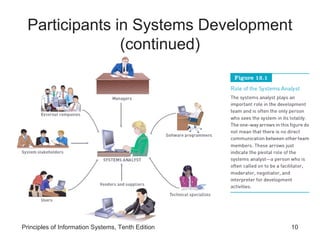
personnel, and it starts with careful planning
– Identify the key participants in the systems
development process and discuss their roles
– Define the term information systems planning and
list several reasons for initiating a systems project

Principles of Information Systems, Tenth Edition

2
Principles and Learning Objectives
(continued)
• Systems development often uses tools to select,
implement, and monitor projects, including
prototyping, rapid application development, CASE
tools, and object-oriented development
– Discuss the key features, advantages, and
disadvantages of the traditional, prototyping, rapid
application development, and end-user systems
development life cycles

Principles of Information Systems, Tenth Edition

3
Principles and Learning Objectives
(continued)
– Identify several factors that influence the success or
failure of a systems development project
– Discuss the use of CASE tools and the objectoriented approach to systems development

Principles of Information Systems, Tenth Edition

4
Principles and Learning Objectives
(continued)
• Systems development starts with investigation and
analysis of existing systems
– State the purpose of systems investigation
– Discuss the importance of performance and cost
objectives
– State the purpose of systems analysis and discuss
some of the tools and techniques used in this phase
of systems development

Principles of Information Systems, Tenth Edition

5
Why Learn About Systems
Investigation and Analysis?
• In this chapter:
– You will see how you can initiate the systems
development process
– You will see how you can use the systems
development approach to start your own business

• First two steps of the systems development
process:
– Systems investigation and systems analysis

Principles of Information Systems, Tenth Edition

6
An Overview of Systems Development
• In today’s businesses:
– Managers and employees in all functional areas
work together and use business information systems

• This chapter will:
– Help you avoid systems development failures or
projects that go over budget

Principles of Information Systems, Tenth Edition

7
Participants in Systems Development
• Development team:
– Determines objectives of the information system
– Delivers system that meets objectives

• Project:
– Planned collection of activities that achieves a goal

• Project manager:
– Responsible for coordinating all people and
resources needed to complete a project on time

Principles of Information Systems, Tenth Edition

8
Participants in Systems Development
(continued)
• Stakeholders:
– People who ultimately benefit from project

• Users:
– People who will interact with the system regularly

• Systems analysts:
– Professional who specializes in analyzing and
designing business systems

• Programmer:
– Responsible for modifying or developing programs to
satisfy user requirements
Principles of Information Systems, Tenth Edition

9
Participants in Systems Development
(continued)

Principles of Information Systems, Tenth Edition

10
Individual Systems Developers and
Users
• Individual systems developer:
– Person who performs all of the systems
development roles

• Individual users:
– Acquire applications for both personal and
professional use

• End-user systems development:
– Describes any systems development project in
which business managers and users assume the
primary effort
Principles of Information Systems, Tenth Edition

11
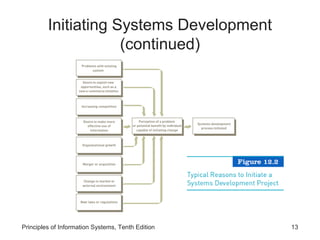
Initiating Systems Development
• Systems development initiatives:
– Arise from all levels of an organization
– Can be planned or unplanned

• Mergers and acquisitions can trigger many systems
development projects

Principles of Information Systems, Tenth Edition

12
Initiating Systems Development
(continued)

Principles of Information Systems, Tenth Edition

13
Information Systems Planning and
Aligning Corporate and IS Goals
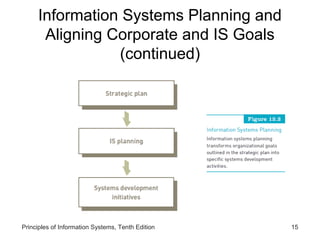
• Information systems planning:
– Translating strategic and organizational goals into
systems development initiatives

• Aligning organizational goals and IS goals:
– Critical for successful systems development effort

• Developing a competitive advantage:
– Creative analysis
– Critical analysis

Principles of Information Systems, Tenth Edition

14
Information Systems Planning and
Aligning Corporate and IS Goals
(continued)

Principles of Information Systems, Tenth Edition

15
Establishing Objectives for Systems
Development
• Mission-critical systems:
– Play pivotal role in organization’s continued
operations and goal attainment

• Critical success factors (CSFs):
– Factors essential to success of a functional area of
an organization

Principles of Information Systems, Tenth Edition

16
Establishing Objectives for Systems
Development (continued)
• Performance objectives:
–
–
–
–
–
–
–

Output quality or usefulness
Output accuracy
Speed at which output is generated
Flexibility of the system
Ease of use of the application
Scalability of resulting system
Risk of the system

Principles of Information Systems, Tenth Edition

17
Establishing Objectives for Systems
Development (continued)
• Cost objectives:
– Development costs
– Costs related to the uniqueness of the system
application
– Fixed investments in hardware and related
equipment
– Ongoing operating costs

Principles of Information Systems, Tenth Edition

18
Systems Development Life Cycles
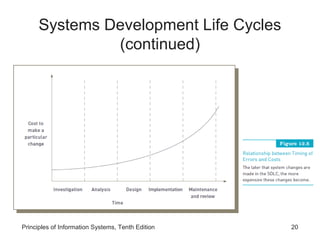
• The later in the SDLC an error is detected, the
more expensive it is to correct
– Reason for mounting costs:
• Previous phases must be reworked
• More people are affected

Principles of Information Systems, Tenth Edition

19
Systems Development Life Cycles
(continued)

Principles of Information Systems, Tenth Edition

20
Systems Development Life Cycles
(continued)
• Common systems development life cycles:
–
–
–
–

Traditional
Prototyping
Rapid application development (RAD)
Individual development

Principles of Information Systems, Tenth Edition

21
The Traditional Systems Development
Life Cycle
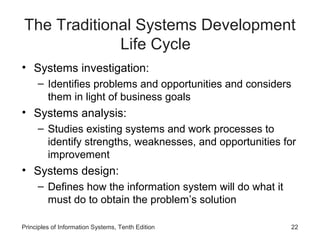
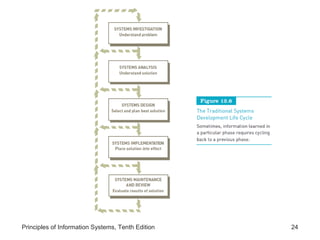
• Systems investigation:
– Identifies problems and opportunities and considers
them in light of business goals

• Systems analysis:
– Studies existing systems and work processes to
identify strengths, weaknesses, and opportunities for
improvement

• Systems design:
– Defines how the information system will do what it
must do to obtain the problem’s solution
Principles of Information Systems, Tenth Edition

22
The Traditional Systems Development
Life Cycle (continued)
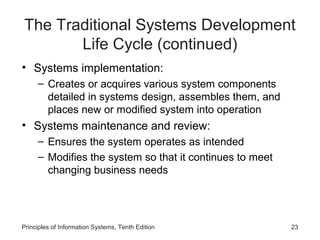
• Systems implementation:
– Creates or acquires various system components
detailed in systems design, assembles them, and
places new or modified system into operation

• Systems maintenance and review:
– Ensures the system operates as intended
– Modifies the system so that it continues to meet
changing business needs

Principles of Information Systems, Tenth Edition

23
Principles of Information Systems, Tenth Edition

24
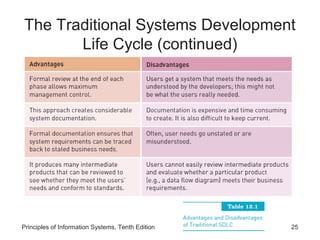
The Traditional Systems Development
Life Cycle (continued)

Principles of Information Systems, Tenth Edition

25
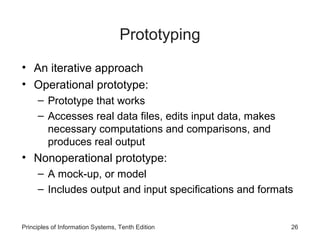
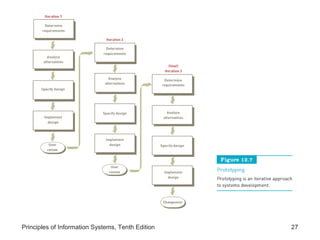
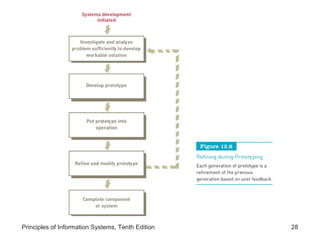
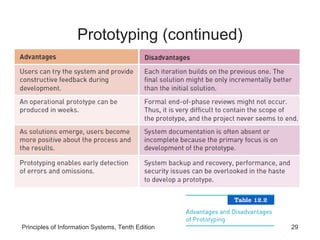
Prototyping
• An iterative approach
• Operational prototype:
– Prototype that works
– Accesses real data files, edits input data, makes
necessary computations and comparisons, and
produces real output

• Nonoperational prototype:
– A mock-up, or model
– Includes output and input specifications and formats

Principles of Information Systems, Tenth Edition

26
Principles of Information Systems, Tenth Edition

27
Principles of Information Systems, Tenth Edition

28
Prototyping (continued)

Principles of Information Systems, Tenth Edition

29
Rapid Application Development, Agile
Development, and Other Systems
Development Approaches
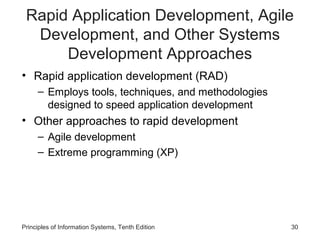
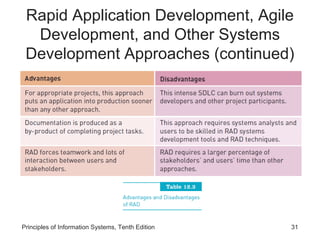
• Rapid application development (RAD)
– Employs tools, techniques, and methodologies
designed to speed application development

• Other approaches to rapid development
– Agile development
– Extreme programming (XP)

Principles of Information Systems, Tenth Edition

30
Rapid Application Development, Agile
Development, and Other Systems
Development Approaches (continued)

Principles of Information Systems, Tenth Edition

31
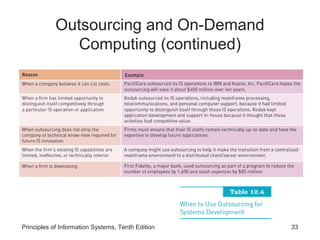
Outsourcing and On-Demand
Computing
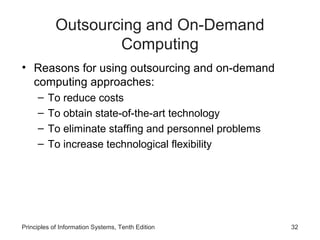
• Reasons for using outsourcing and on-demand
computing approaches:
–
–
–
–

To reduce costs
To obtain state-of-the-art technology
To eliminate staffing and personnel problems
To increase technological flexibility

Principles of Information Systems, Tenth Edition

32
Outsourcing and On-Demand
Computing (continued)

Principles of Information Systems, Tenth Edition

33
Factors Affecting Systems
Development Success
• Successful systems development:
– Delivers a system that meets user and
organizational needs on time and within budget

• Critical for most systems development projects:
– Getting users and stakeholders involved

Principles of Information Systems, Tenth Edition

34
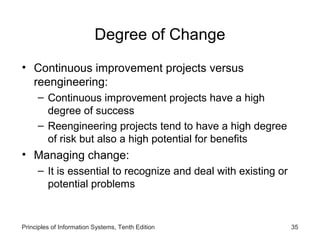
Degree of Change
• Continuous improvement projects versus
reengineering:
– Continuous improvement projects have a high
degree of success
– Reengineering projects tend to have a high degree
of risk but also a high potential for benefits

• Managing change:
– It is essential to recognize and deal with existing or
potential problems

Principles of Information Systems, Tenth Edition

35
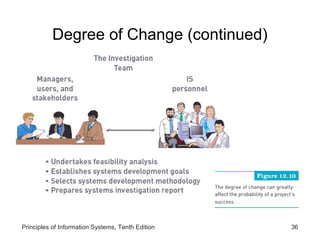
Degree of Change (continued)

Principles of Information Systems, Tenth Edition

36
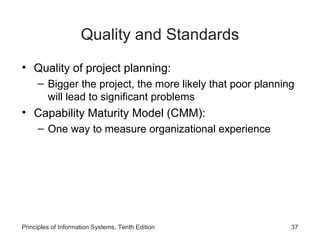
Quality and Standards
• Quality of project planning:
– Bigger the project, the more likely that poor planning
will lead to significant problems

• Capability Maturity Model (CMM):
– One way to measure organizational experience

Principles of Information Systems, Tenth Edition

37
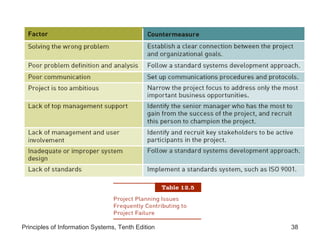
Principles of Information Systems, Tenth Edition

38
The Importance of Planning
• The bigger the project:
– The more likely that poor planning will lead to
significant problems

• Important factor for systems development success:
– Organizational experience with the systems
development process

Principles of Information Systems, Tenth Edition

39
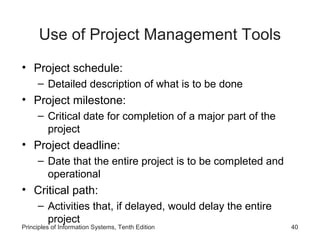
Use of Project Management Tools
• Project schedule:
– Detailed description of what is to be done

• Project milestone:
– Critical date for completion of a major part of the
project

• Project deadline:
– Date that the entire project is to be completed and
operational

• Critical path:
– Activities that, if delayed, would delay the entire
project

Principles of Information Systems, Tenth Edition

40
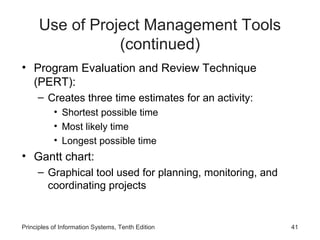
Use of Project Management Tools
(continued)
• Program Evaluation and Review Technique
(PERT):
– Creates three time estimates for an activity:
• Shortest possible time
• Most likely time
• Longest possible time

• Gantt chart:
– Graphical tool used for planning, monitoring, and
coordinating projects

Principles of Information Systems, Tenth Edition

41
Use of Computer-Aided Software
Engineering (CASE) Tools
• CASE tools:
– Automate many tasks required in a systems
development effort
– Encourage adherence to SDLC

• Upper-CASE tools:
– CASE tools that focus on activities associated with
the early stages of systems development

Principles of Information Systems, Tenth Edition

42
Object-Oriented Systems
Development
• Combines logic of systems development life cycle
with power of object-oriented modeling and
programming
• OOSD tasks:
– Identifying potential problems and opportunities that
would be appropriate for OO approach
– Defining what kind of system users require

Principles of Information Systems, Tenth Edition

43
Object-Oriented Systems
Development (continued)
• OOSD tasks (continued):
–
–
–
–

Designing the system
Programming or modifying modules
Evaluation by users
Periodic review and modification

Principles of Information Systems, Tenth Edition

44
Systems Investigation
• What primary problems might a new or enhanced
system solve?
• What opportunities might a new or enhanced
system provide?
• What new hardware, software, databases,
telecommunications, personnel, or procedures will
improve an existing system or are required in a
new system?
• What are the potential costs (variable and fixed)?
• What are the associated risks?
Principles of Information Systems, Tenth Edition

45
Initiating Systems Investigation
• Systems request form:
– Submitted by someone who wants IS department to
initiate systems investigation
– Information included:
•
•
•
•

Problems in or opportunities for system
Objectives of systems investigation
Overview of proposed system
Expected costs and benefits of proposed system

Principles of Information Systems, Tenth Edition

46
Participants in Systems Investigation
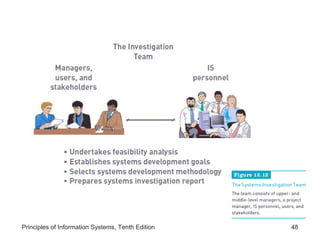
• Members of development team change from phase
to phase
• Keys to successful investigation teams:
– Cooperation and collaboration

Principles of Information Systems, Tenth Edition

47
Principles of Information Systems, Tenth Edition

48
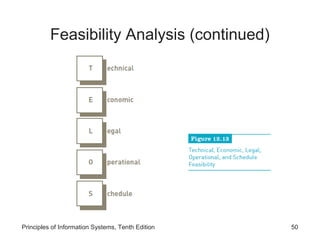
Feasibility Analysis
• Assesses:
–
–
–
–
–

Technical feasibility
Economic feasibility
Legal feasibility
Operational feasibility
Schedule feasibility

Principles of Information Systems, Tenth Edition

49
Feasibility Analysis (continued)

Principles of Information Systems, Tenth Edition

50
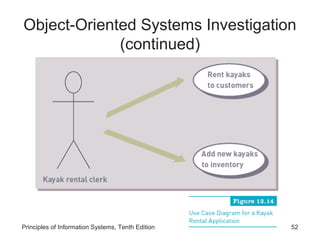
Object-Oriented Systems Investigation
• Object-oriented approach:
– Can be used during all phases of systems
development

• Use case diagram:
– Part of the Unified Modeling Language (UML) that is
used in object-oriented systems development

Principles of Information Systems, Tenth Edition

51
Object-Oriented Systems Investigation
(continued)

Principles of Information Systems, Tenth Edition

52
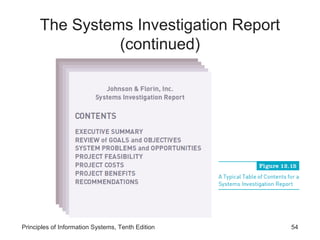
The Systems Investigation Report
• Summarizes results of systems investigation
• Summarizes the process of feasibility analysis
• Recommends a course of action:
– Continue on into systems analysis
– Modify the project in some manner
– Drop the project

• Reviewed by steering committee

Principles of Information Systems, Tenth Edition

53
The Systems Investigation Report
(continued)

Principles of Information Systems, Tenth Edition

54
Systems Analysis
• Overall emphasis of analysis:
–
–
–
–

Gathering data on existing system
Determining requirements for new system
Considering alternatives
Investigating feasibility of solutions

• Primary outcome of systems analysis:
– Prioritized list of systems requirements

Principles of Information Systems, Tenth Edition

55
General Considerations
• Steps of a formalized analysis procedure:
–
–
–
–

Assembling participants for systems analysis
Collecting data and requirements
Analyzing data and requirements
Preparing a report on existing system, new system
requirements, and project priorities

Principles of Information Systems, Tenth Edition

56
Participants in Systems Analysis
• Includes members of the original investigation team
• Systems analysis team develops:
– List of objectives and activities
– Schedule for meeting the objectives and completing
the specific activities
– Deadlines for each stage
– Statement of the resources required at each stage

Principles of Information Systems, Tenth Edition

57
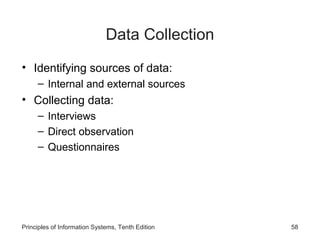
Data Collection
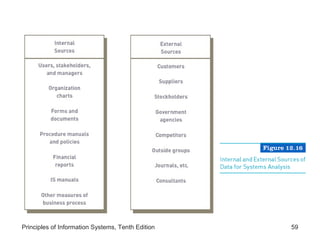
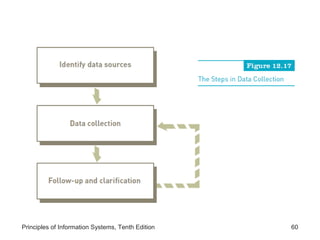
• Identifying sources of data:
– Internal and external sources

• Collecting data:
– Interviews
– Direct observation
– Questionnaires

Principles of Information Systems, Tenth Edition

58
Principles of Information Systems, Tenth Edition

59
Principles of Information Systems, Tenth Edition

60
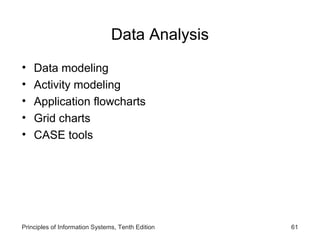
Data Analysis
•
•
•
•
•

Data modeling
Activity modeling
Application flowcharts
Grid charts
CASE tools

Principles of Information Systems, Tenth Edition

61
Requirements Analysis
• Purpose is to determine user, stakeholder, and
organizational needs
• Techniques used to capture systems requirements:
–
–
–
–
–

Asking directly
Critical success factors (CSFs)
IS plan
Screen and report layout
Requirements analysis tools

Principles of Information Systems, Tenth Edition

62
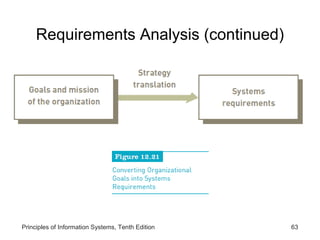
Requirements Analysis (continued)

Principles of Information Systems, Tenth Edition

63
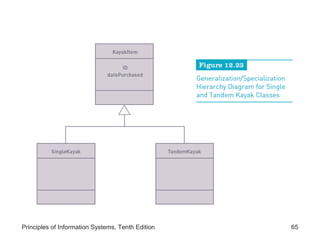
Object-Oriented Systems Analysis
• Identify problems or potential opportunities
• Identify key participants and collect data
• With the OO approach a class is used to describe
different types of objects

Principles of Information Systems, Tenth Edition

64
Principles of Information Systems, Tenth Edition

65
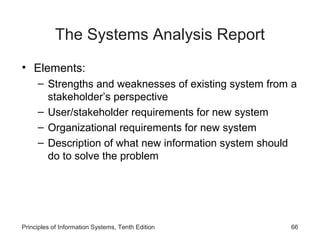
The Systems Analysis Report
• Elements:
– Strengths and weaknesses of existing system from a
stakeholder’s perspective
– User/stakeholder requirements for new system
– Organizational requirements for new system
– Description of what new information system should
do to solve the problem

Principles of Information Systems, Tenth Edition

66
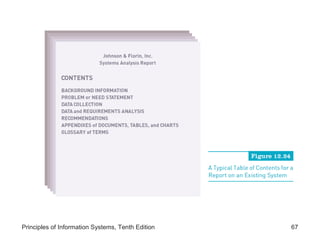
Principles of Information Systems, Tenth Edition

67
Summary
• Systems development team:
– Stakeholders, users, managers, systems
development specialists, and various support
personnel

• Five phases of the traditional SDLC:
– Investigation, analysis, design, implementation, and
maintenance and review

• Advantages of the traditional SDLC:
– Provides for maximum management control
– Creates considerable system documentation
– Produces many intermediate products for review
Principles of Information Systems, Tenth Edition

68
Summary (continued)
• Rapid application development (RAD):
– Reduces paper-based documentation
– Automates program source code generation
– Facilitates user participation in development
activities

• Factors that affect systems development success:
– Degree of change introduced by the project
– Continuous improvement and reengineering
– Use of project management tools

Principles of Information Systems, Tenth Edition

69
Summary (continued)
• Participants in systems investigation:
– Stakeholders, users, managers, employees,
analysts, and programmers

• Data collection methods:
– Observation, interviews, questionnaires, and
statistical sampling

• Requirements analysis:
– Determines the needs of users, stakeholders, and
the organization in general

Principles of Information Systems, Tenth Edition

70

IS740 Chapter 12

  • 1.
    Principles of Information Systems,Tenth Edition Chapter 12 Systems Development: Investigation and Analysis 1
  • 2.
    Principles and LearningObjectives • Effective systems development requires a team effort from stakeholders, users, managers, systems development specialists, and various support personnel, and it starts with careful planning – Identify the key participants in the systems development process and discuss their roles – Define the term information systems planning and list several reasons for initiating a systems project Principles of Information Systems, Tenth Edition 2
  • 3.
    Principles and LearningObjectives (continued) • Systems development often uses tools to select, implement, and monitor projects, including prototyping, rapid application development, CASE tools, and object-oriented development – Discuss the key features, advantages, and disadvantages of the traditional, prototyping, rapid application development, and end-user systems development life cycles Principles of Information Systems, Tenth Edition 3
  • 4.
    Principles and LearningObjectives (continued) – Identify several factors that influence the success or failure of a systems development project – Discuss the use of CASE tools and the objectoriented approach to systems development Principles of Information Systems, Tenth Edition 4
  • 5.
    Principles and LearningObjectives (continued) • Systems development starts with investigation and analysis of existing systems – State the purpose of systems investigation – Discuss the importance of performance and cost objectives – State the purpose of systems analysis and discuss some of the tools and techniques used in this phase of systems development Principles of Information Systems, Tenth Edition 5
  • 6.
    Why Learn AboutSystems Investigation and Analysis? • In this chapter: – You will see how you can initiate the systems development process – You will see how you can use the systems development approach to start your own business • First two steps of the systems development process: – Systems investigation and systems analysis Principles of Information Systems, Tenth Edition 6
  • 7.
    An Overview ofSystems Development • In today’s businesses: – Managers and employees in all functional areas work together and use business information systems • This chapter will: – Help you avoid systems development failures or projects that go over budget Principles of Information Systems, Tenth Edition 7
  • 8.
    Participants in SystemsDevelopment • Development team: – Determines objectives of the information system – Delivers system that meets objectives • Project: – Planned collection of activities that achieves a goal • Project manager: – Responsible for coordinating all people and resources needed to complete a project on time Principles of Information Systems, Tenth Edition 8
  • 9.
    Participants in SystemsDevelopment (continued) • Stakeholders: – People who ultimately benefit from project • Users: – People who will interact with the system regularly • Systems analysts: – Professional who specializes in analyzing and designing business systems • Programmer: – Responsible for modifying or developing programs to satisfy user requirements Principles of Information Systems, Tenth Edition 9
  • 10.
    Participants in SystemsDevelopment (continued) Principles of Information Systems, Tenth Edition 10
  • 11.
    Individual Systems Developersand Users • Individual systems developer: – Person who performs all of the systems development roles • Individual users: – Acquire applications for both personal and professional use • End-user systems development: – Describes any systems development project in which business managers and users assume the primary effort Principles of Information Systems, Tenth Edition 11
  • 12.
    Initiating Systems Development •Systems development initiatives: – Arise from all levels of an organization – Can be planned or unplanned • Mergers and acquisitions can trigger many systems development projects Principles of Information Systems, Tenth Edition 12
  • 13.
    Initiating Systems Development (continued) Principlesof Information Systems, Tenth Edition 13
  • 14.
    Information Systems Planningand Aligning Corporate and IS Goals • Information systems planning: – Translating strategic and organizational goals into systems development initiatives • Aligning organizational goals and IS goals: – Critical for successful systems development effort • Developing a competitive advantage: – Creative analysis – Critical analysis Principles of Information Systems, Tenth Edition 14
  • 15.
    Information Systems Planningand Aligning Corporate and IS Goals (continued) Principles of Information Systems, Tenth Edition 15
  • 16.
    Establishing Objectives forSystems Development • Mission-critical systems: – Play pivotal role in organization’s continued operations and goal attainment • Critical success factors (CSFs): – Factors essential to success of a functional area of an organization Principles of Information Systems, Tenth Edition 16
  • 17.
    Establishing Objectives forSystems Development (continued) • Performance objectives: – – – – – – – Output quality or usefulness Output accuracy Speed at which output is generated Flexibility of the system Ease of use of the application Scalability of resulting system Risk of the system Principles of Information Systems, Tenth Edition 17
  • 18.
    Establishing Objectives forSystems Development (continued) • Cost objectives: – Development costs – Costs related to the uniqueness of the system application – Fixed investments in hardware and related equipment – Ongoing operating costs Principles of Information Systems, Tenth Edition 18
  • 19.
    Systems Development LifeCycles • The later in the SDLC an error is detected, the more expensive it is to correct – Reason for mounting costs: • Previous phases must be reworked • More people are affected Principles of Information Systems, Tenth Edition 19
  • 20.
    Systems Development LifeCycles (continued) Principles of Information Systems, Tenth Edition 20
  • 21.
    Systems Development LifeCycles (continued) • Common systems development life cycles: – – – – Traditional Prototyping Rapid application development (RAD) Individual development Principles of Information Systems, Tenth Edition 21
  • 22.
    The Traditional SystemsDevelopment Life Cycle • Systems investigation: – Identifies problems and opportunities and considers them in light of business goals • Systems analysis: – Studies existing systems and work processes to identify strengths, weaknesses, and opportunities for improvement • Systems design: – Defines how the information system will do what it must do to obtain the problem’s solution Principles of Information Systems, Tenth Edition 22
  • 23.
    The Traditional SystemsDevelopment Life Cycle (continued) • Systems implementation: – Creates or acquires various system components detailed in systems design, assembles them, and places new or modified system into operation • Systems maintenance and review: – Ensures the system operates as intended – Modifies the system so that it continues to meet changing business needs Principles of Information Systems, Tenth Edition 23
  • 24.
    Principles of InformationSystems, Tenth Edition 24
  • 25.
    The Traditional SystemsDevelopment Life Cycle (continued) Principles of Information Systems, Tenth Edition 25
  • 26.
    Prototyping • An iterativeapproach • Operational prototype: – Prototype that works – Accesses real data files, edits input data, makes necessary computations and comparisons, and produces real output • Nonoperational prototype: – A mock-up, or model – Includes output and input specifications and formats Principles of Information Systems, Tenth Edition 26
  • 27.
    Principles of InformationSystems, Tenth Edition 27
  • 28.
    Principles of InformationSystems, Tenth Edition 28
  • 29.
    Prototyping (continued) Principles ofInformation Systems, Tenth Edition 29
  • 30.
    Rapid Application Development,Agile Development, and Other Systems Development Approaches • Rapid application development (RAD) – Employs tools, techniques, and methodologies designed to speed application development • Other approaches to rapid development – Agile development – Extreme programming (XP) Principles of Information Systems, Tenth Edition 30
  • 31.
    Rapid Application Development,Agile Development, and Other Systems Development Approaches (continued) Principles of Information Systems, Tenth Edition 31
  • 32.
    Outsourcing and On-Demand Computing •Reasons for using outsourcing and on-demand computing approaches: – – – – To reduce costs To obtain state-of-the-art technology To eliminate staffing and personnel problems To increase technological flexibility Principles of Information Systems, Tenth Edition 32
  • 33.
    Outsourcing and On-Demand Computing(continued) Principles of Information Systems, Tenth Edition 33
  • 34.
    Factors Affecting Systems DevelopmentSuccess • Successful systems development: – Delivers a system that meets user and organizational needs on time and within budget • Critical for most systems development projects: – Getting users and stakeholders involved Principles of Information Systems, Tenth Edition 34
  • 35.
    Degree of Change •Continuous improvement projects versus reengineering: – Continuous improvement projects have a high degree of success – Reengineering projects tend to have a high degree of risk but also a high potential for benefits • Managing change: – It is essential to recognize and deal with existing or potential problems Principles of Information Systems, Tenth Edition 35
  • 36.
    Degree of Change(continued) Principles of Information Systems, Tenth Edition 36
  • 37.
    Quality and Standards •Quality of project planning: – Bigger the project, the more likely that poor planning will lead to significant problems • Capability Maturity Model (CMM): – One way to measure organizational experience Principles of Information Systems, Tenth Edition 37
  • 38.
    Principles of InformationSystems, Tenth Edition 38
  • 39.
    The Importance ofPlanning • The bigger the project: – The more likely that poor planning will lead to significant problems • Important factor for systems development success: – Organizational experience with the systems development process Principles of Information Systems, Tenth Edition 39
  • 40.
    Use of ProjectManagement Tools • Project schedule: – Detailed description of what is to be done • Project milestone: – Critical date for completion of a major part of the project • Project deadline: – Date that the entire project is to be completed and operational • Critical path: – Activities that, if delayed, would delay the entire project Principles of Information Systems, Tenth Edition 40
  • 41.
    Use of ProjectManagement Tools (continued) • Program Evaluation and Review Technique (PERT): – Creates three time estimates for an activity: • Shortest possible time • Most likely time • Longest possible time • Gantt chart: – Graphical tool used for planning, monitoring, and coordinating projects Principles of Information Systems, Tenth Edition 41
  • 42.
    Use of Computer-AidedSoftware Engineering (CASE) Tools • CASE tools: – Automate many tasks required in a systems development effort – Encourage adherence to SDLC • Upper-CASE tools: – CASE tools that focus on activities associated with the early stages of systems development Principles of Information Systems, Tenth Edition 42
  • 43.
    Object-Oriented Systems Development • Combineslogic of systems development life cycle with power of object-oriented modeling and programming • OOSD tasks: – Identifying potential problems and opportunities that would be appropriate for OO approach – Defining what kind of system users require Principles of Information Systems, Tenth Edition 43
  • 44.
    Object-Oriented Systems Development (continued) •OOSD tasks (continued): – – – – Designing the system Programming or modifying modules Evaluation by users Periodic review and modification Principles of Information Systems, Tenth Edition 44
  • 45.
    Systems Investigation • Whatprimary problems might a new or enhanced system solve? • What opportunities might a new or enhanced system provide? • What new hardware, software, databases, telecommunications, personnel, or procedures will improve an existing system or are required in a new system? • What are the potential costs (variable and fixed)? • What are the associated risks? Principles of Information Systems, Tenth Edition 45
  • 46.
    Initiating Systems Investigation •Systems request form: – Submitted by someone who wants IS department to initiate systems investigation – Information included: • • • • Problems in or opportunities for system Objectives of systems investigation Overview of proposed system Expected costs and benefits of proposed system Principles of Information Systems, Tenth Edition 46
  • 47.
    Participants in SystemsInvestigation • Members of development team change from phase to phase • Keys to successful investigation teams: – Cooperation and collaboration Principles of Information Systems, Tenth Edition 47
  • 48.
    Principles of InformationSystems, Tenth Edition 48
  • 49.
    Feasibility Analysis • Assesses: – – – – – Technicalfeasibility Economic feasibility Legal feasibility Operational feasibility Schedule feasibility Principles of Information Systems, Tenth Edition 49
  • 50.
    Feasibility Analysis (continued) Principlesof Information Systems, Tenth Edition 50
  • 51.
    Object-Oriented Systems Investigation •Object-oriented approach: – Can be used during all phases of systems development • Use case diagram: – Part of the Unified Modeling Language (UML) that is used in object-oriented systems development Principles of Information Systems, Tenth Edition 51
  • 52.
    Object-Oriented Systems Investigation (continued) Principlesof Information Systems, Tenth Edition 52
  • 53.
    The Systems InvestigationReport • Summarizes results of systems investigation • Summarizes the process of feasibility analysis • Recommends a course of action: – Continue on into systems analysis – Modify the project in some manner – Drop the project • Reviewed by steering committee Principles of Information Systems, Tenth Edition 53
  • 54.
    The Systems InvestigationReport (continued) Principles of Information Systems, Tenth Edition 54
  • 55.
    Systems Analysis • Overallemphasis of analysis: – – – – Gathering data on existing system Determining requirements for new system Considering alternatives Investigating feasibility of solutions • Primary outcome of systems analysis: – Prioritized list of systems requirements Principles of Information Systems, Tenth Edition 55
  • 56.
    General Considerations • Stepsof a formalized analysis procedure: – – – – Assembling participants for systems analysis Collecting data and requirements Analyzing data and requirements Preparing a report on existing system, new system requirements, and project priorities Principles of Information Systems, Tenth Edition 56
  • 57.
    Participants in SystemsAnalysis • Includes members of the original investigation team • Systems analysis team develops: – List of objectives and activities – Schedule for meeting the objectives and completing the specific activities – Deadlines for each stage – Statement of the resources required at each stage Principles of Information Systems, Tenth Edition 57
  • 58.
    Data Collection • Identifyingsources of data: – Internal and external sources • Collecting data: – Interviews – Direct observation – Questionnaires Principles of Information Systems, Tenth Edition 58
  • 59.
    Principles of InformationSystems, Tenth Edition 59
  • 60.
    Principles of InformationSystems, Tenth Edition 60
  • 61.
    Data Analysis • • • • • Data modeling Activitymodeling Application flowcharts Grid charts CASE tools Principles of Information Systems, Tenth Edition 61
  • 62.
    Requirements Analysis • Purposeis to determine user, stakeholder, and organizational needs • Techniques used to capture systems requirements: – – – – – Asking directly Critical success factors (CSFs) IS plan Screen and report layout Requirements analysis tools Principles of Information Systems, Tenth Edition 62
  • 63.
    Requirements Analysis (continued) Principlesof Information Systems, Tenth Edition 63
  • 64.
    Object-Oriented Systems Analysis •Identify problems or potential opportunities • Identify key participants and collect data • With the OO approach a class is used to describe different types of objects Principles of Information Systems, Tenth Edition 64
  • 65.
    Principles of InformationSystems, Tenth Edition 65
  • 66.
    The Systems AnalysisReport • Elements: – Strengths and weaknesses of existing system from a stakeholder’s perspective – User/stakeholder requirements for new system – Organizational requirements for new system – Description of what new information system should do to solve the problem Principles of Information Systems, Tenth Edition 66
  • 67.
    Principles of InformationSystems, Tenth Edition 67
  • 68.
    Summary • Systems developmentteam: – Stakeholders, users, managers, systems development specialists, and various support personnel • Five phases of the traditional SDLC: – Investigation, analysis, design, implementation, and maintenance and review • Advantages of the traditional SDLC: – Provides for maximum management control – Creates considerable system documentation – Produces many intermediate products for review Principles of Information Systems, Tenth Edition 68
  • 69.
    Summary (continued) • Rapidapplication development (RAD): – Reduces paper-based documentation – Automates program source code generation – Facilitates user participation in development activities • Factors that affect systems development success: – Degree of change introduced by the project – Continuous improvement and reengineering – Use of project management tools Principles of Information Systems, Tenth Edition 69
  • 70.
    Summary (continued) • Participantsin systems investigation: – Stakeholders, users, managers, employees, analysts, and programmers • Data collection methods: – Observation, interviews, questionnaires, and statistical sampling • Requirements analysis: – Determines the needs of users, stakeholders, and the organization in general Principles of Information Systems, Tenth Edition 70