Social Responsibility: Legal
Issues, Managing Diversity,
and Career Challenges
Chapter 10
6th Edition
Raymond A. Noe
McGraw-Hill/Irwin

Copyright © 2013 by The McGraw-Hill Companies, Inc. All rights reserved.
Learning Objectives
• Discuss the role of training partnerships in

developing skills and contributing to local
communities
• Discuss the potential legal issues that relate to
training
• Develop a program for effectively managing diversity
• Design a program for preparing employees for crosscultural assignments

10-2
Learning Objectives
 Discuss the importance of career paths and dual

career paths for employees and companies
 Develop policies to help employees achieve work-life
balance
 Describe how companies are helping veterans
develop skills and get employment
 Explain the value of phase retirement programs for
older employees

10-3
Training Partnerships
 Sector partnerships: Government agencies,

industry trade groups that:
 Help identify the skills that local employers require
 Work with community colleges, universities, and other

educational institutions to provide qualified employees

10-4
Training Partnerships
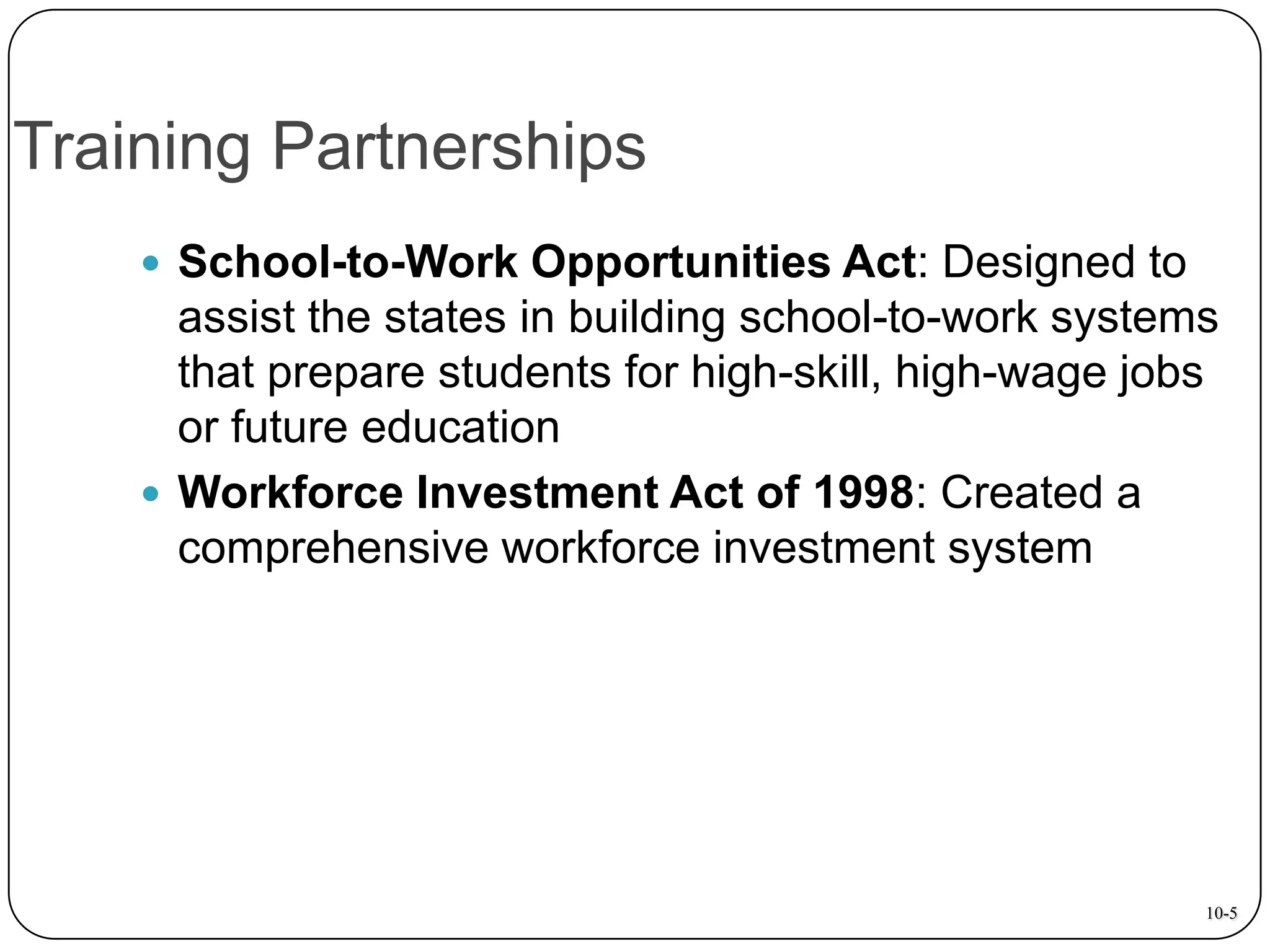
 School-to-Work Opportunities Act: Designed to

assist the states in building school-to-work systems
that prepare students for high-skill, high-wage jobs
or future education
 Workforce Investment Act of 1998: Created a
comprehensive workforce investment system

10-5
Lifelong Learning
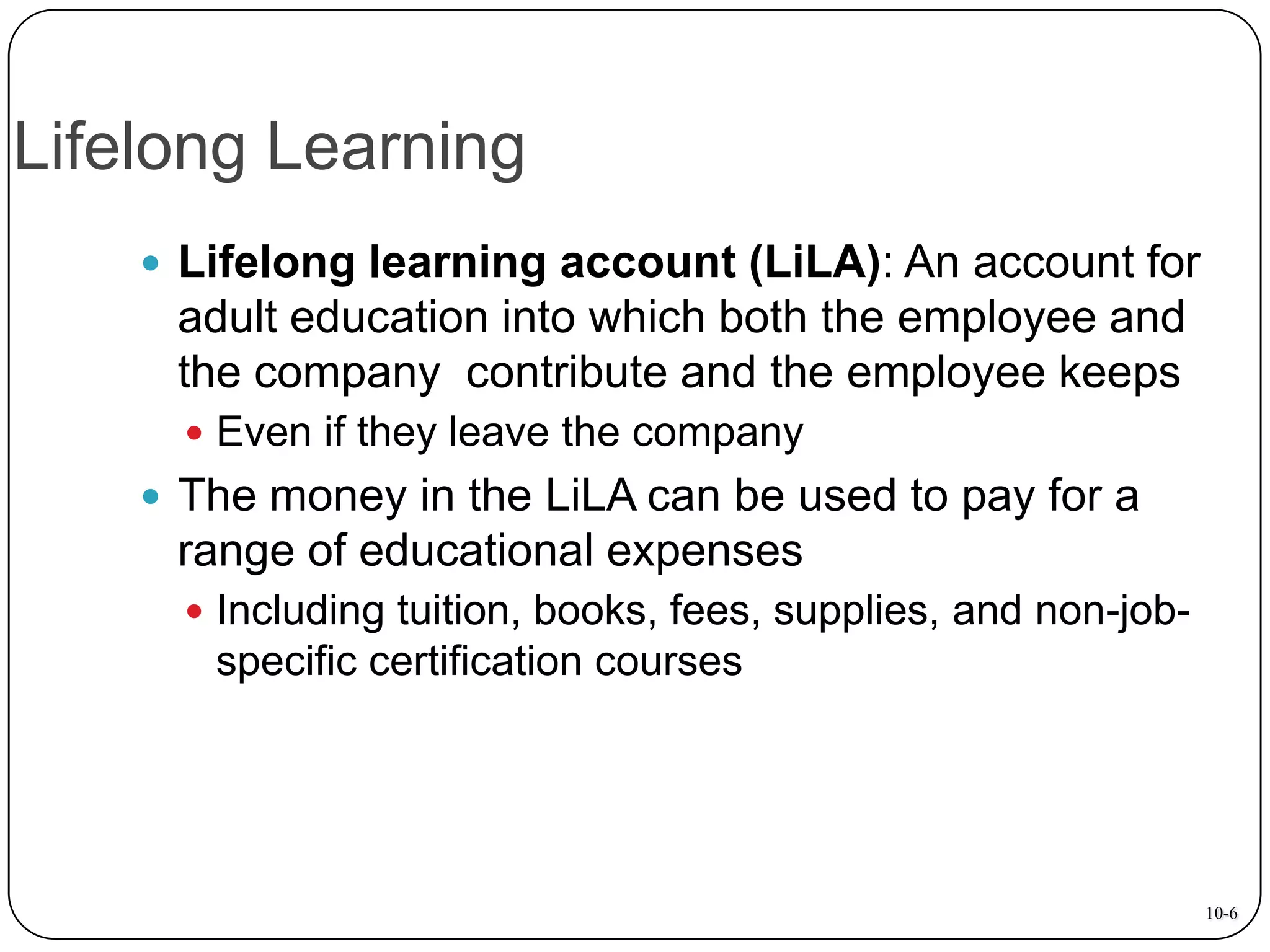
 Lifelong learning account (LiLA): An account for

adult education into which both the employee and
the company contribute and the employee keeps
 Even if they leave the company

 The money in the LiLA can be used to pay for a

range of educational expenses
 Including tuition, books, fees, supplies, and non-job-

specific certification courses

10-6
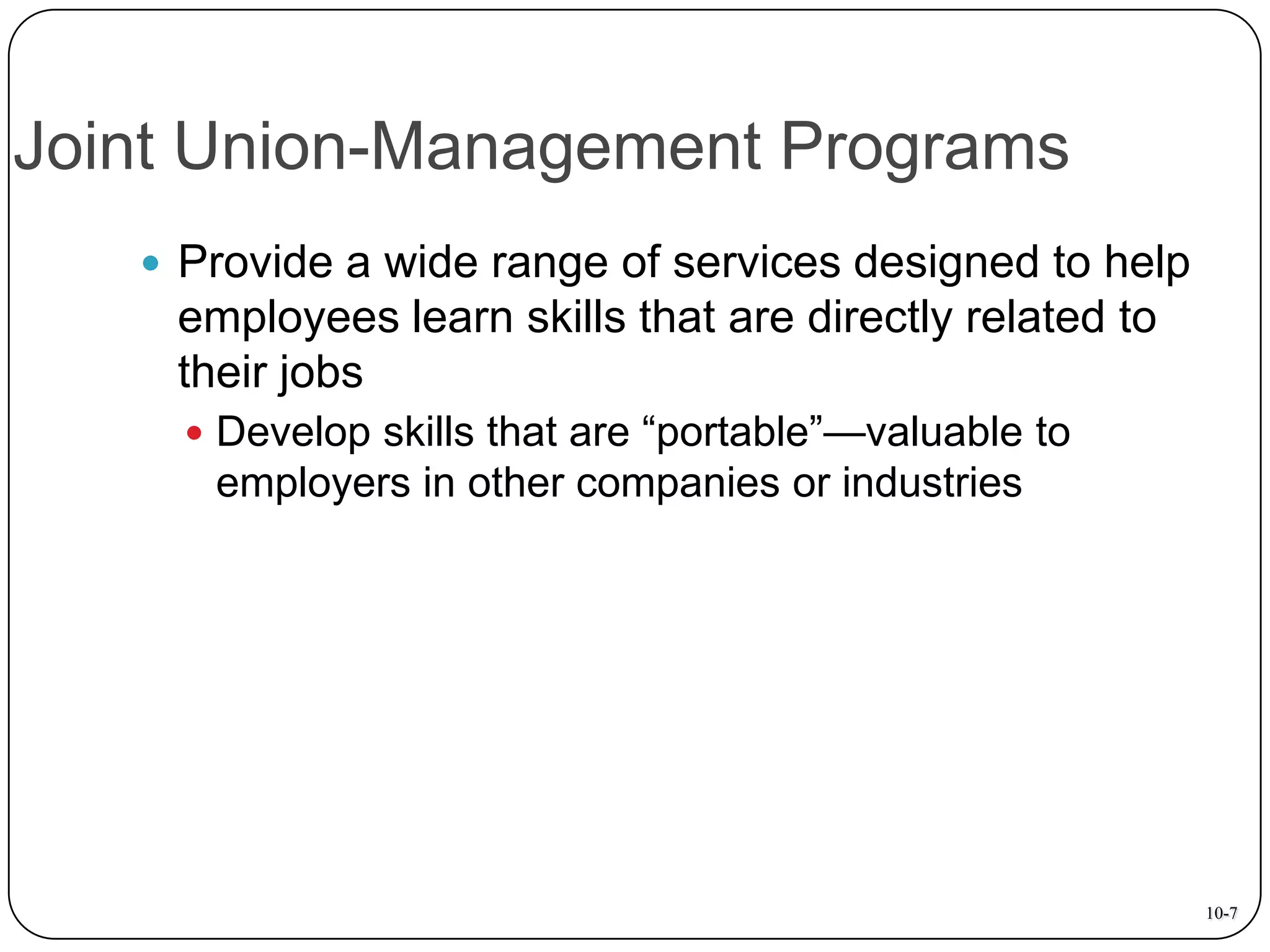
Joint Union-Management Programs
 Provide a wide range of services designed to help

employees learn skills that are directly related to
their jobs
 Develop skills that are “portable”—valuable to

employers in other companies or industries

10-7
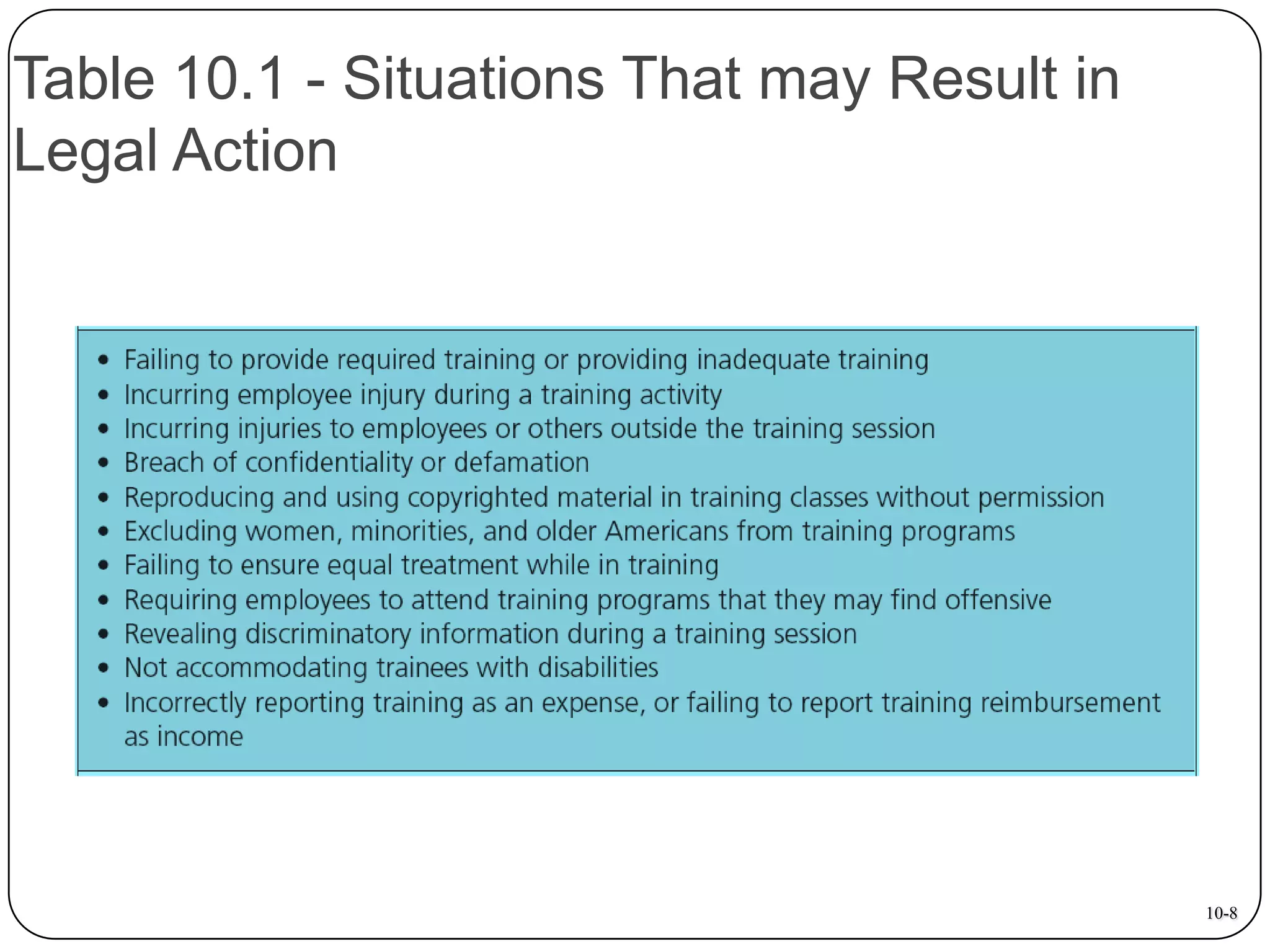
Table 10.1 - Situations That may Result in
Legal Action

10-8
Reproducing and Using Copyrighted Material
in Training Classes Without Permission
 Copyrights: Protect the expression of an idea but

not the ideas that the material contains
 Prohibit others from creating a product based on the

original work from:
 Copying
 Broadcasting
 Publishing the product without permission

10-9
Excluding Women, Minorities, and Older
Employees from Training Programs
 Title VII of the Civil Rights Act: Makes it illegal to

deny access to employment or deprive a person
employment because of the person’s
race, color, religion, gender, or national origin
 Age Discrimination in Employment Act (ADEA):
Prohibits discrimination against persons who are age
40 or older

10-10
Not Accommodating Trainees with
Disabilities
 Americans with Disabilities Act (ADA) of 1990:

Prohibits individuals with disabilities from being
discriminated against in the workplace
 Reasonable accommodation: Making training
facilities readily accessible to and usable by
individuals with disabilities

10-11
Managing Workforce Diversity and
Inclusion
 Inclusion: Creating an environment in which

employees share a sense of belonging, mutual
respect, and commitment from others so they can
perform their best work
 Diversity training: Learning efforts that are
designed to change employee attitudes about
diversity and/or develop skills needed to work with a
diverse workforce
 Managing diversity and inclusion: Involves
creating an environment that allows all employees to
contribute to organizational goals and experience
personal growth
10-12
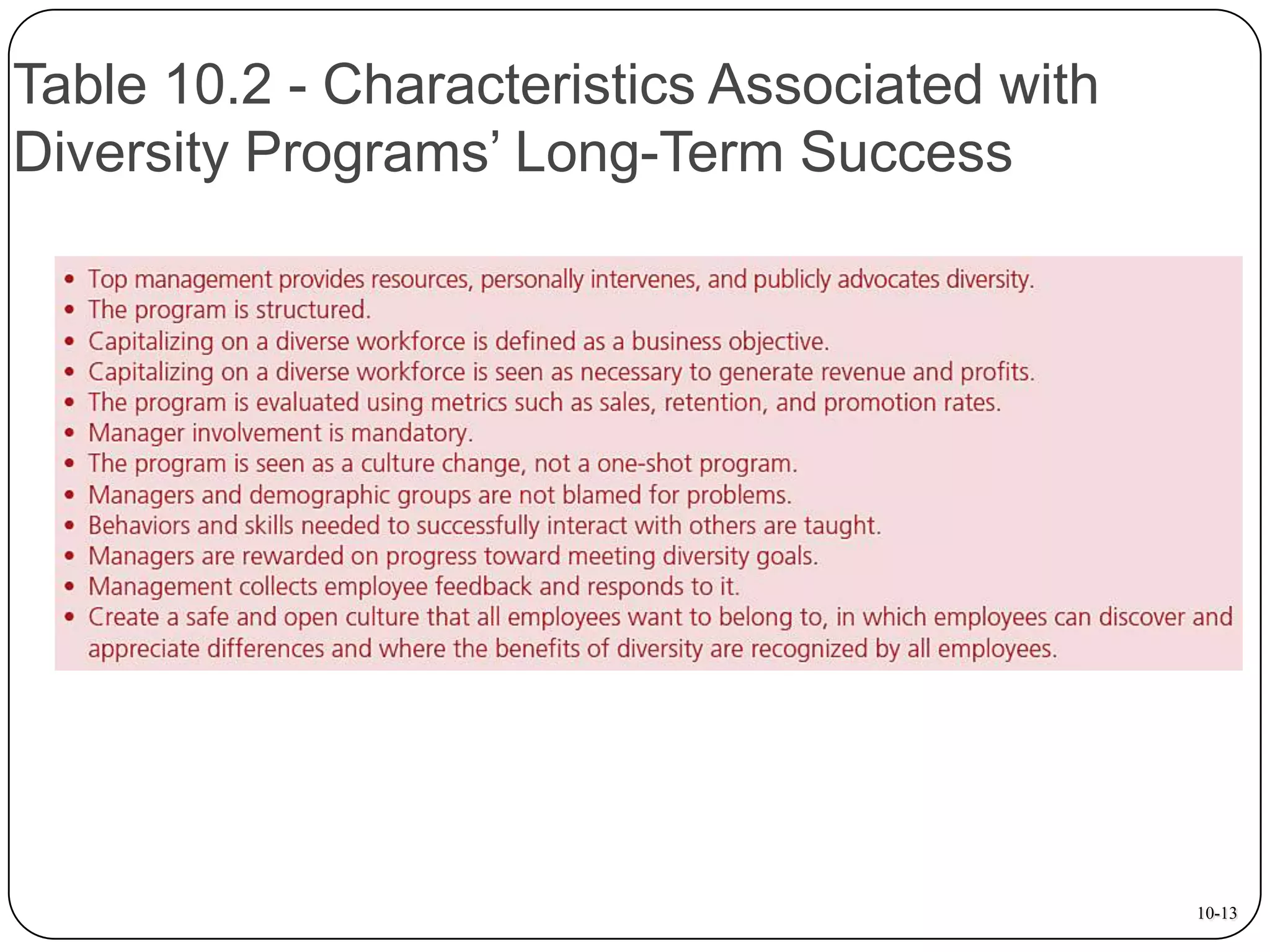
Table 10.2 - Characteristics Associated with
Diversity Programs’ Long-Term Success

10-13
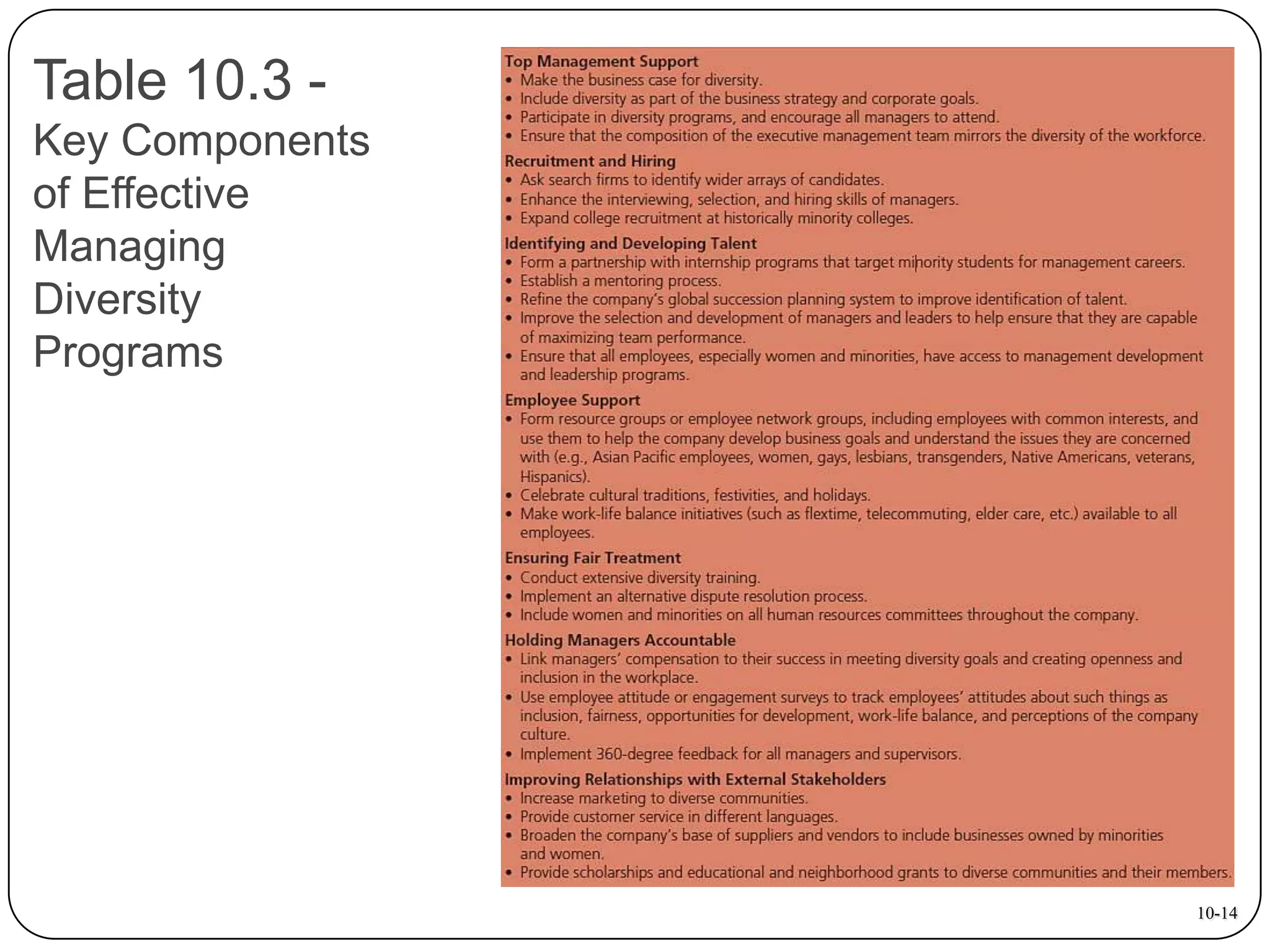
Table 10.3 Key Components
of Effective
Managing
Diversity
Programs

10-14
Melting the Glass Ceiling
 Glass ceiling: A barrier to advancement to higher-

level jobs in the company that adversely affects
women and minorities

10-15
Cross-Cultural Preparation
 Educates employees (expatriates) and their families

who are to be sent to a foreign country
 Expatriates: Work in a country other than their country

of origin

10-16
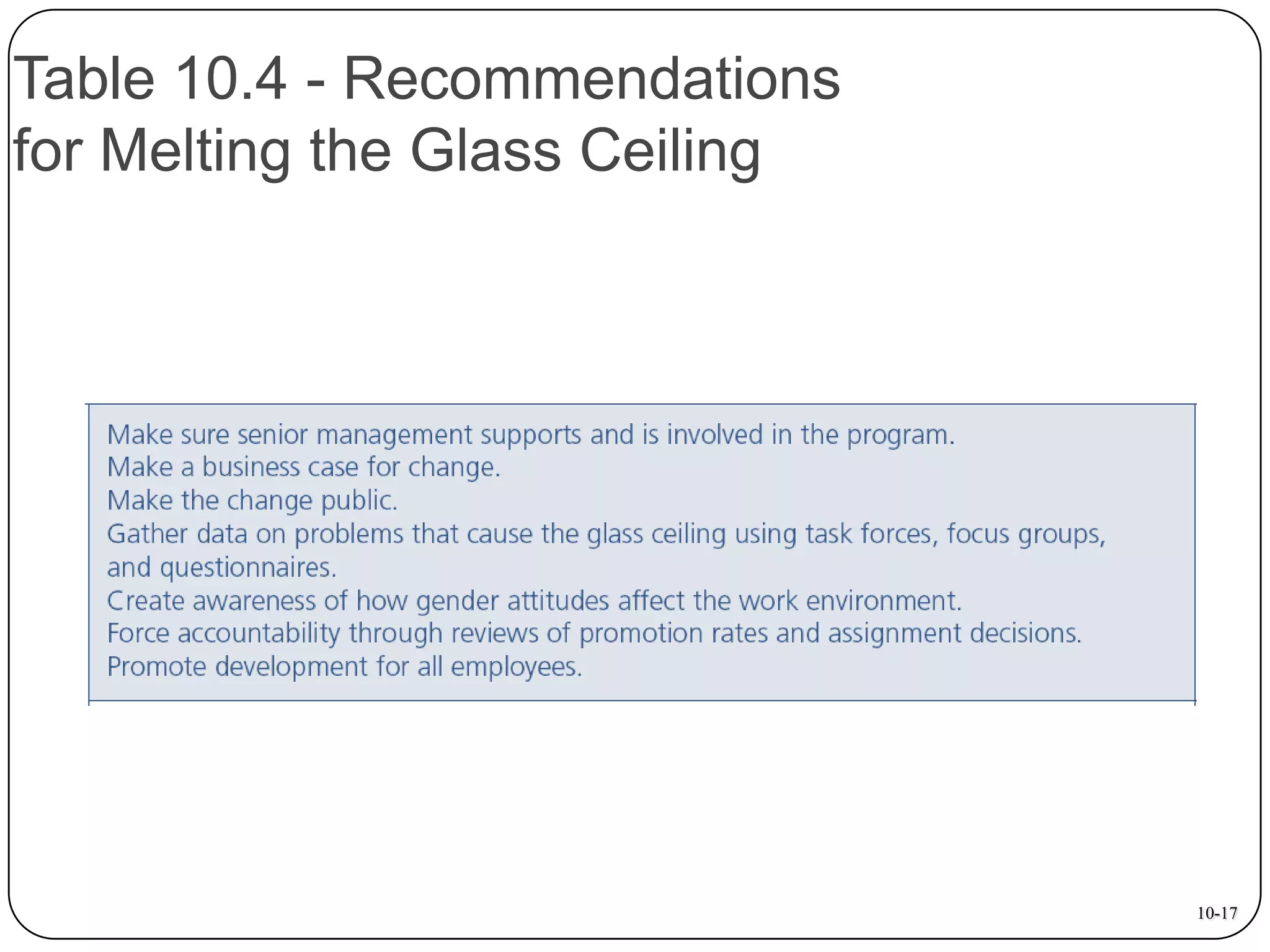
Table 10.4 - Recommendations
for Melting the Glass Ceiling

10-17
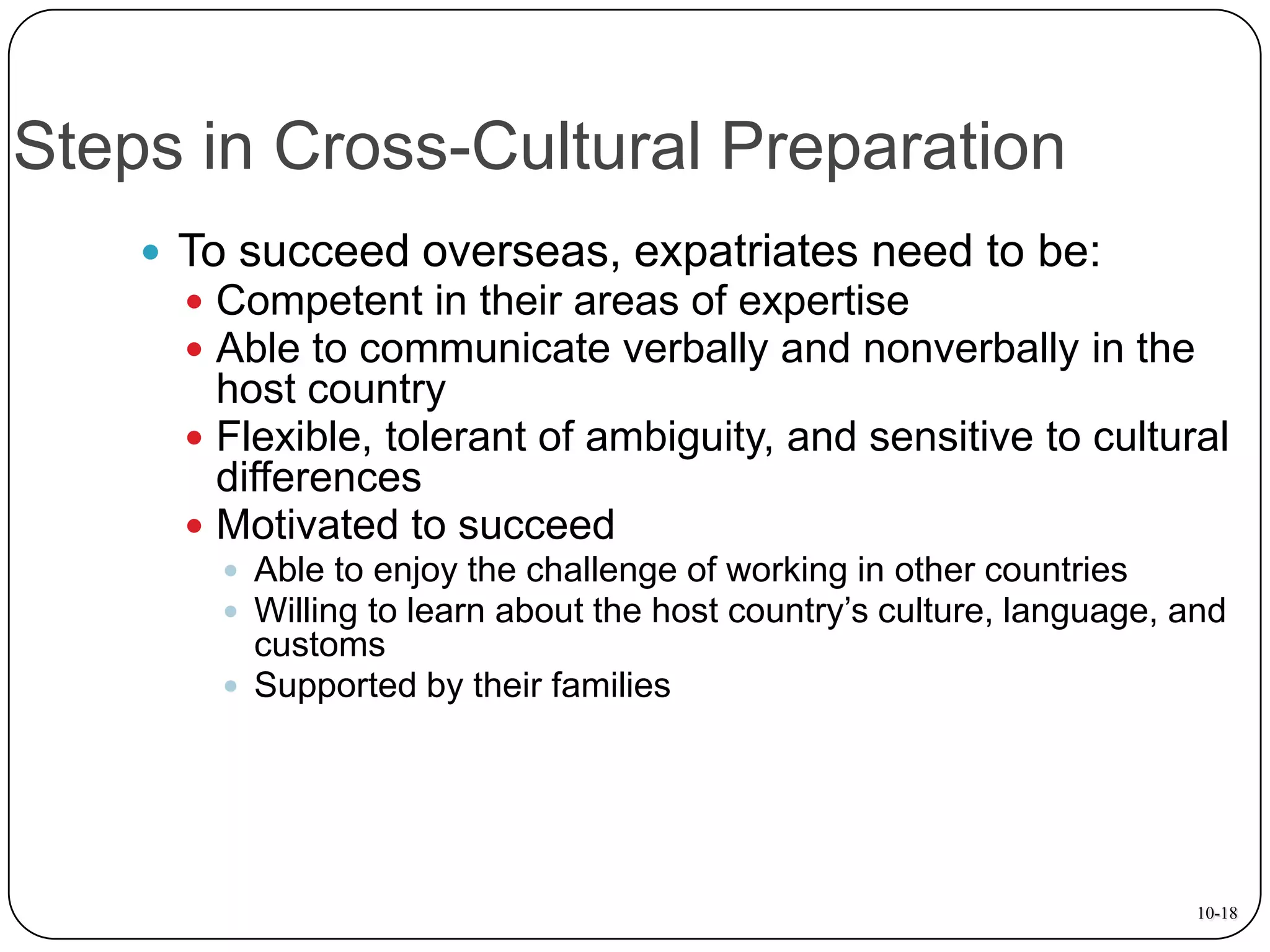
Steps in Cross-Cultural Preparation
 To succeed overseas, expatriates need to be:
 Competent in their areas of expertise
 Able to communicate verbally and nonverbally in the

host country
 Flexible, tolerant of ambiguity, and sensitive to cultural
differences
 Motivated to succeed
 Able to enjoy the challenge of working in other countries
 Willing to learn about the host country’s culture, language, and

customs
 Supported by their families

10-18
Steps in Cross-Cultural Preparation
 Three phases:
 Pre-departure phase

 On-site phase
 Repatriation phase
 Repatriation: Prepares expatriates for return to the parent
company and home country from the foreign assignment
 Virtual expatriates: Employees who have an assignment to
manage an operation abroad without being located permanently
in that country

10-19
Career Challenges Facing a
Multigenerational Workforce
 Employees’ careers involve four stages:
 Exploration - Employees attempt to identify the type of

work that interests them
 Establishment - Involves:
 Finding employment
 Making an independent contribution
 Achieving more responsibility and financial success
 Establishing a suitable lifestyle

10-20
Career Challenges Facing a
Multigenerational Workforce
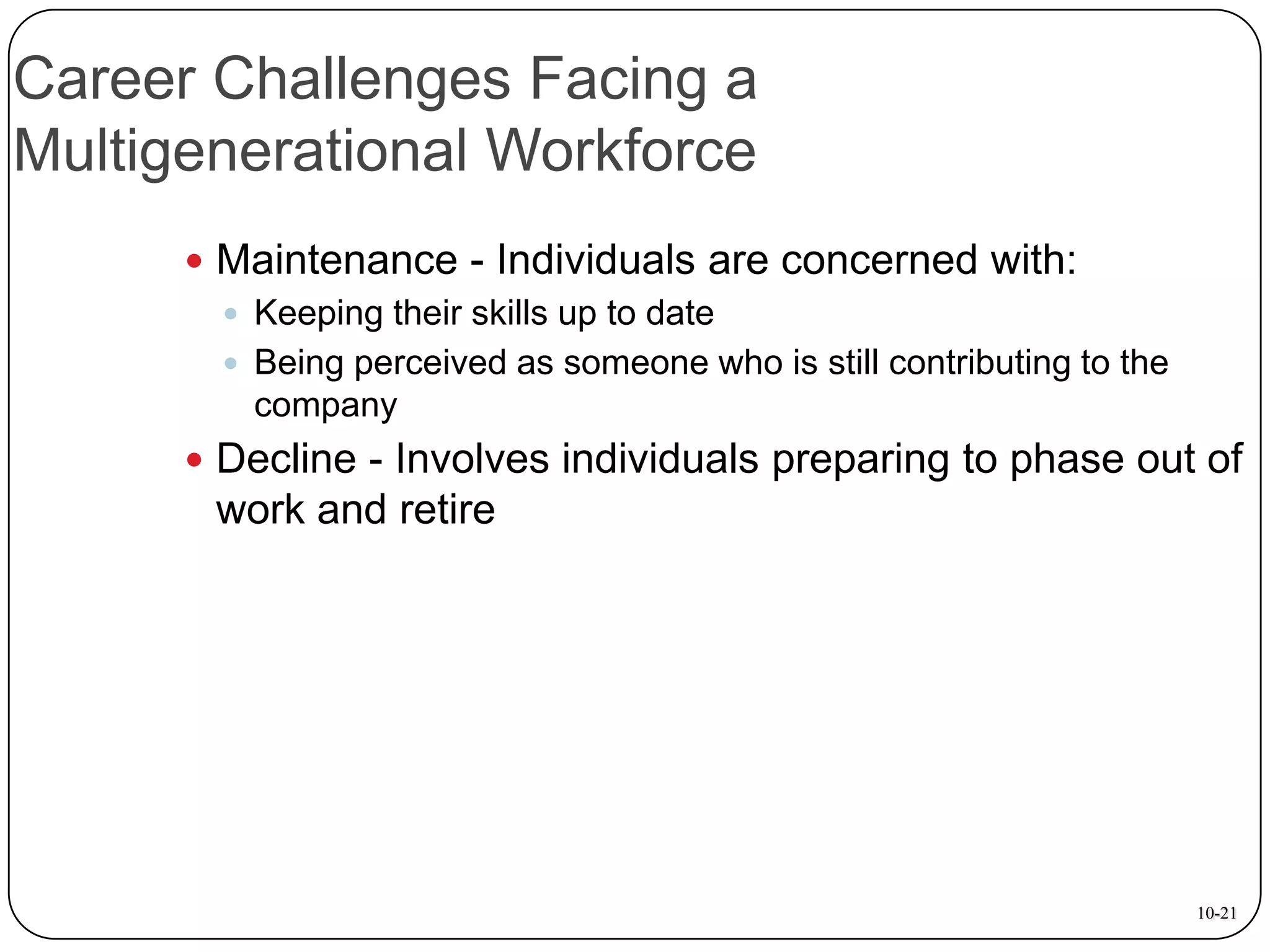
 Maintenance - Individuals are concerned with:
 Keeping their skills up to date
 Being perceived as someone who is still contributing to the
company
 Decline - Involves individuals preparing to phase out of

work and retire

10-21
Work-Life Balance
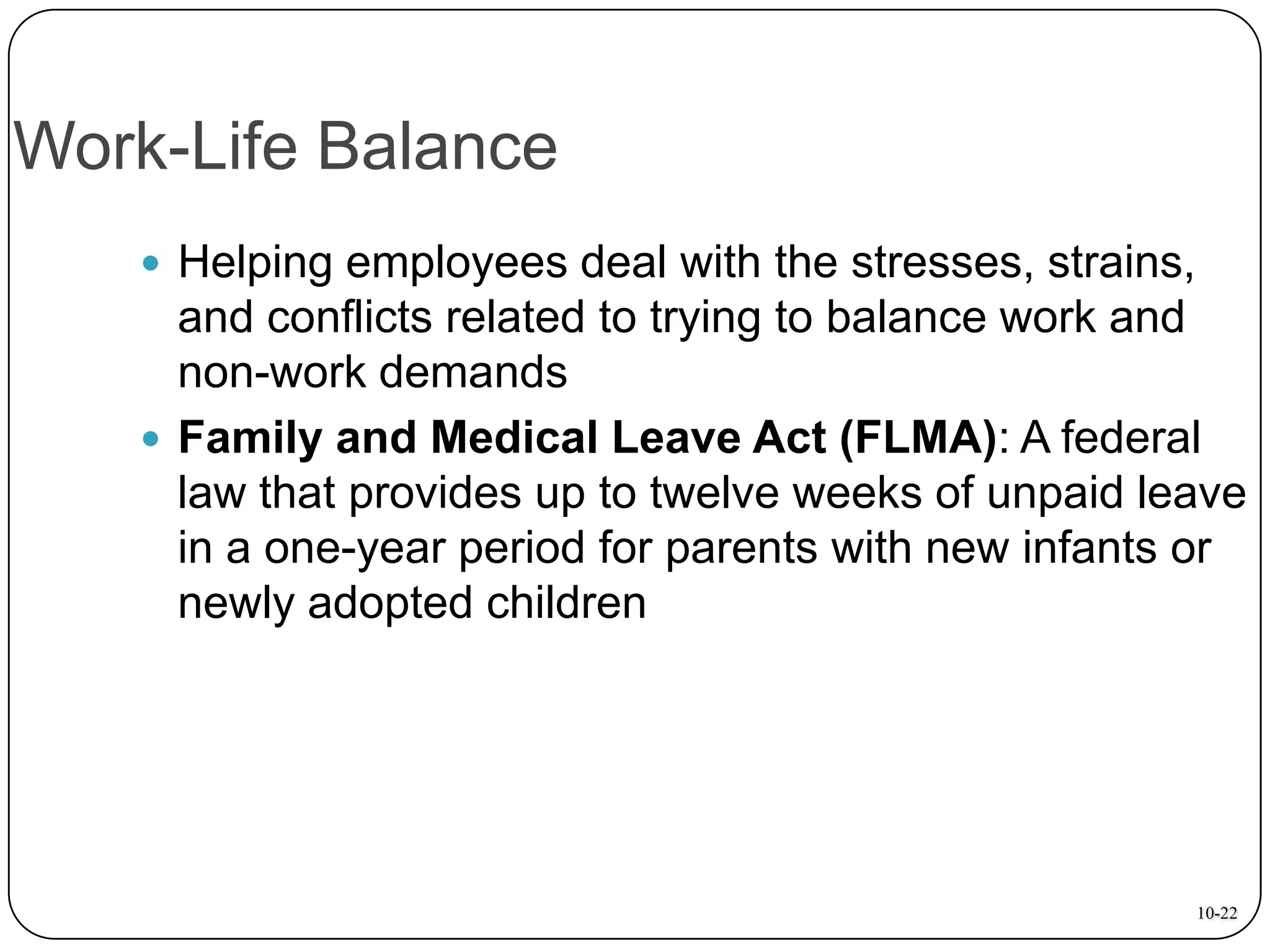
 Helping employees deal with the stresses, strains,

and conflicts related to trying to balance work and
non-work demands
 Family and Medical Leave Act (FLMA): A federal
law that provides up to twelve weeks of unpaid leave
in a one-year period for parents with new infants or
newly adopted children

10-22
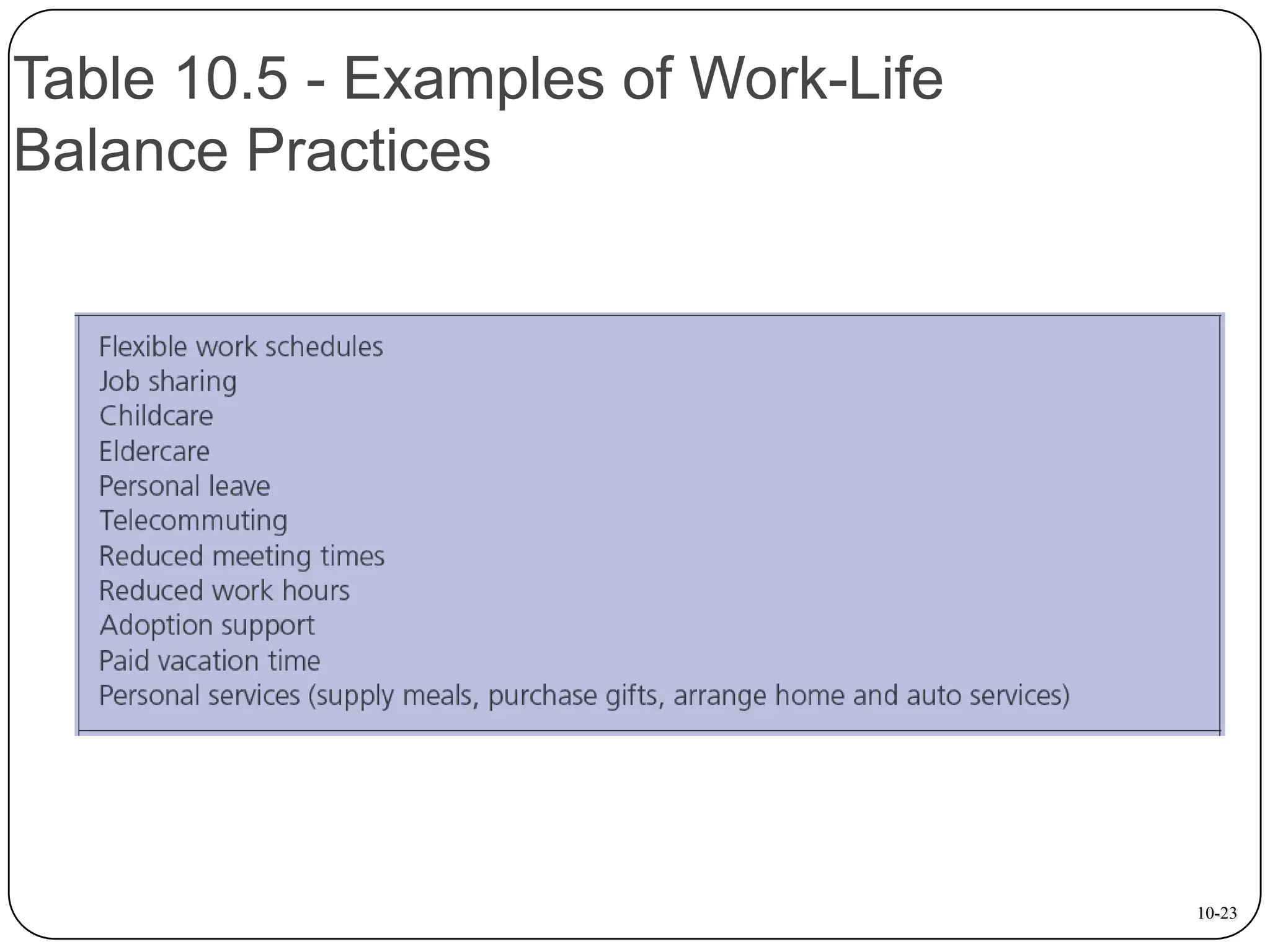
Table 10.5 - Examples of Work-Life
Balance Practices

10-23
Work-Life Balance
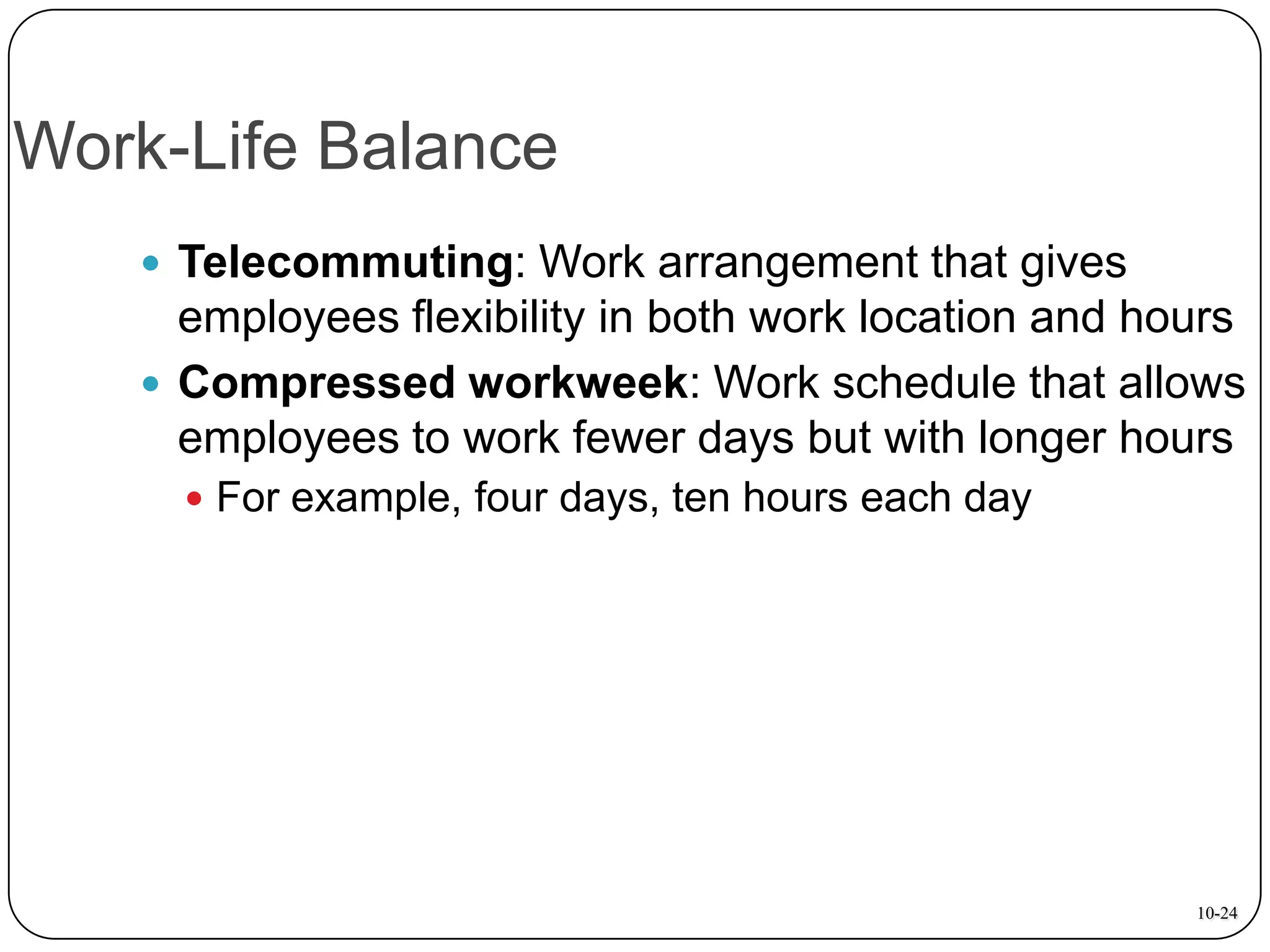
 Telecommuting: Work arrangement that gives

employees flexibility in both work location and hours
 Compressed workweek: Work schedule that allows
employees to work fewer days but with longer hours
 For example, four days, ten hours each day

10-24
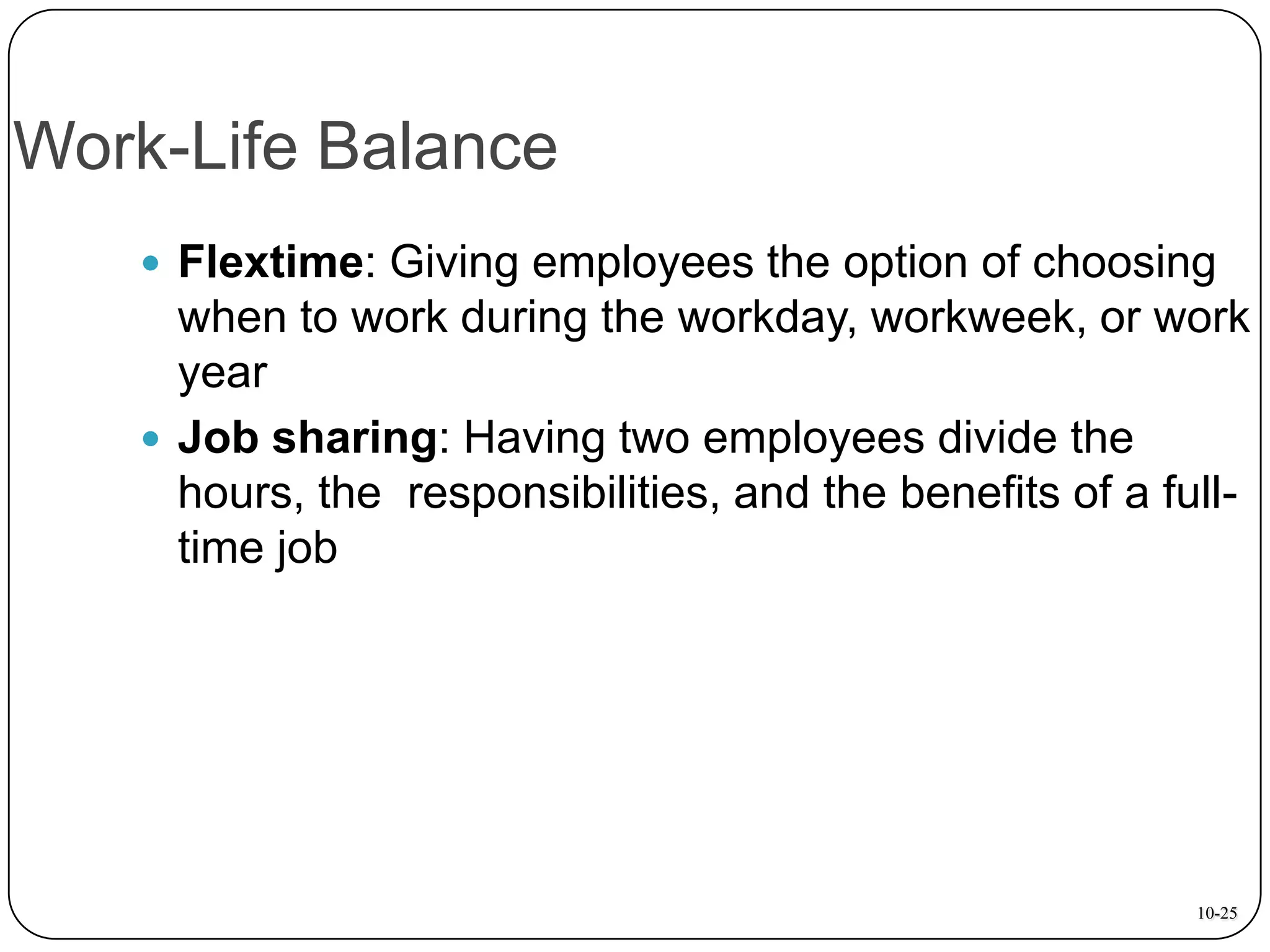
Work-Life Balance
 Flextime: Giving employees the option of choosing

when to work during the workday, workweek, or work
year
 Job sharing: Having two employees divide the
hours, the responsibilities, and the benefits of a fulltime job

10-25
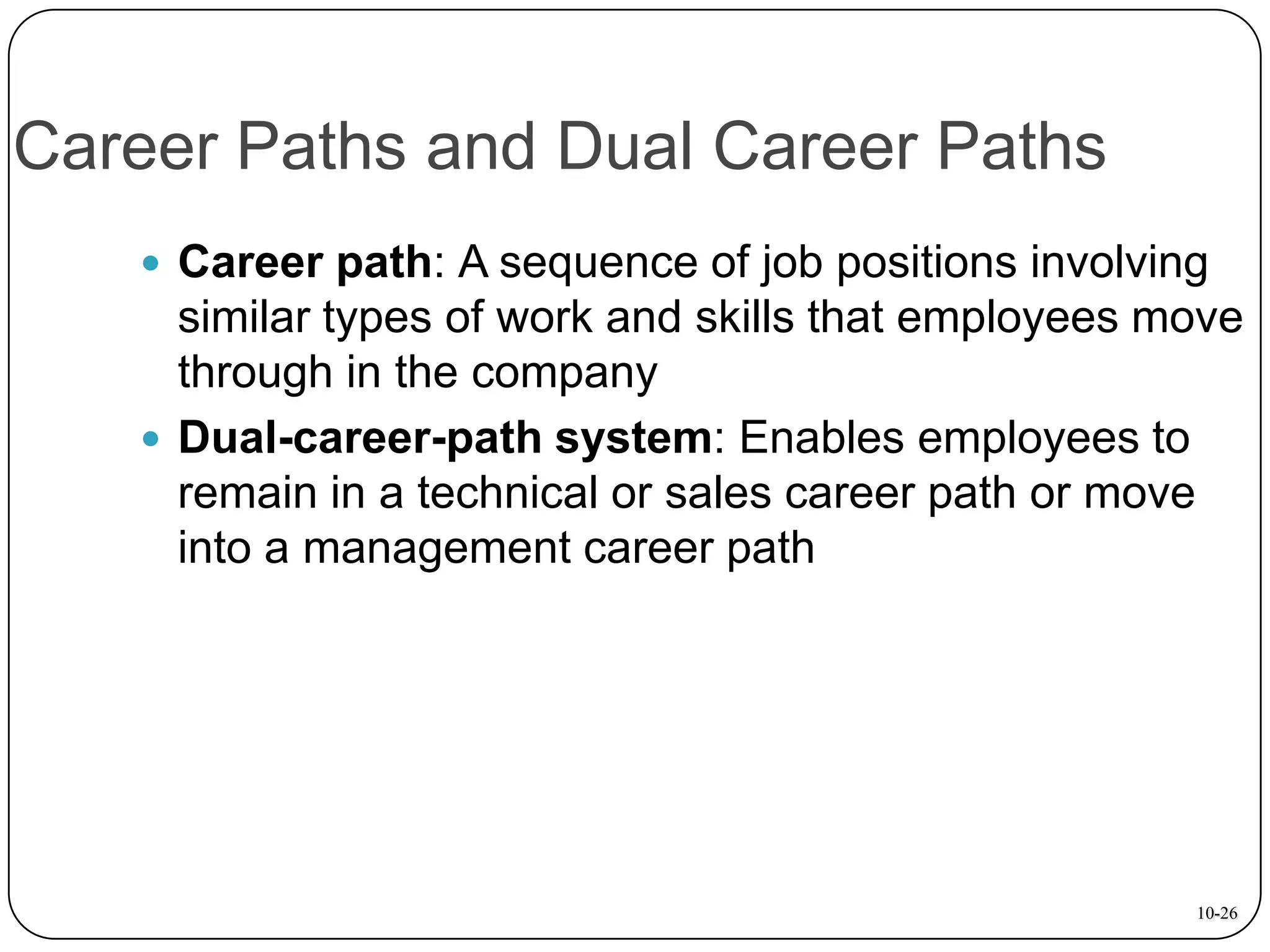
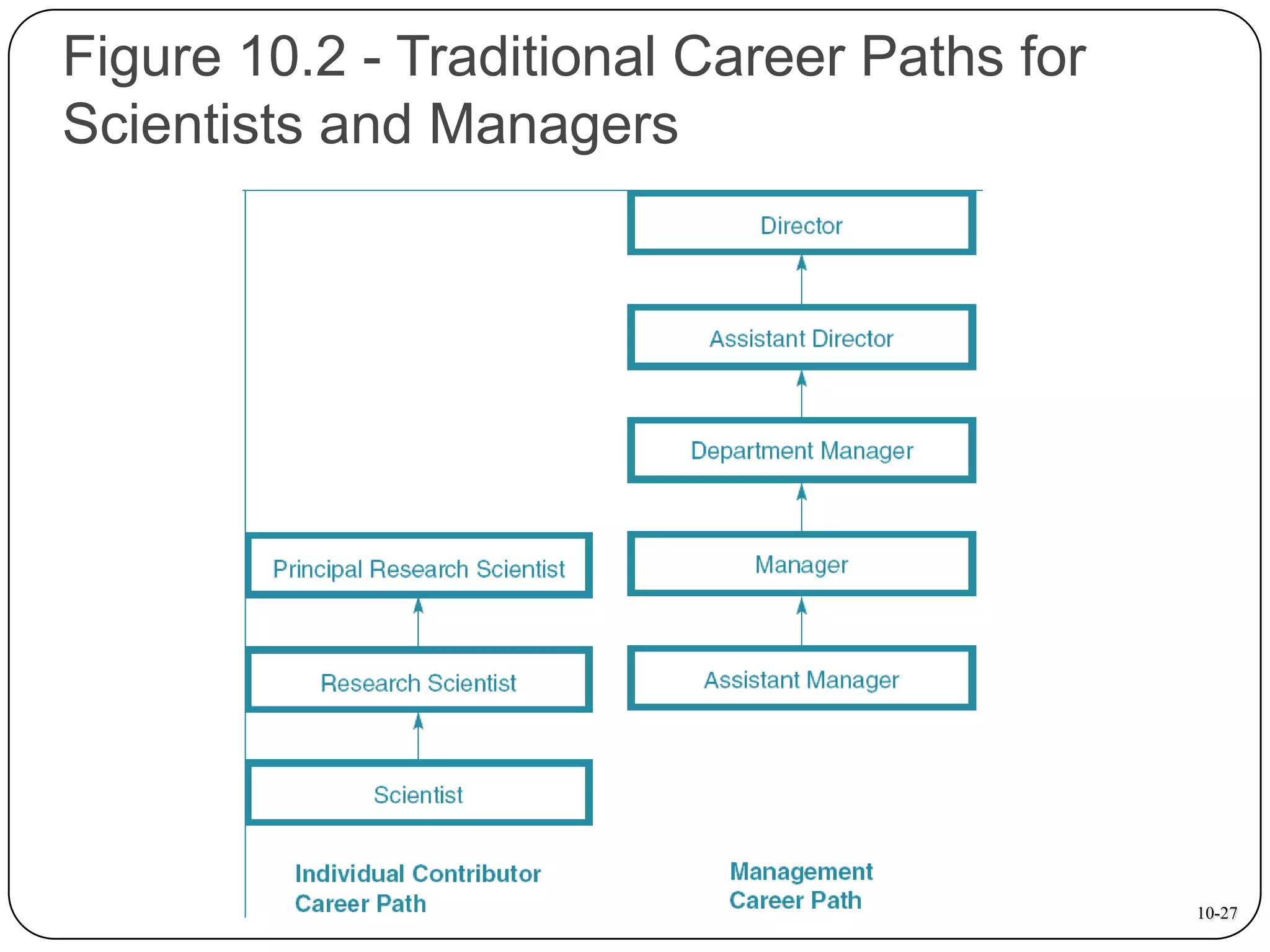
Career Paths and Dual Career Paths
 Career path: A sequence of job positions involving

similar types of work and skills that employees move
through in the company
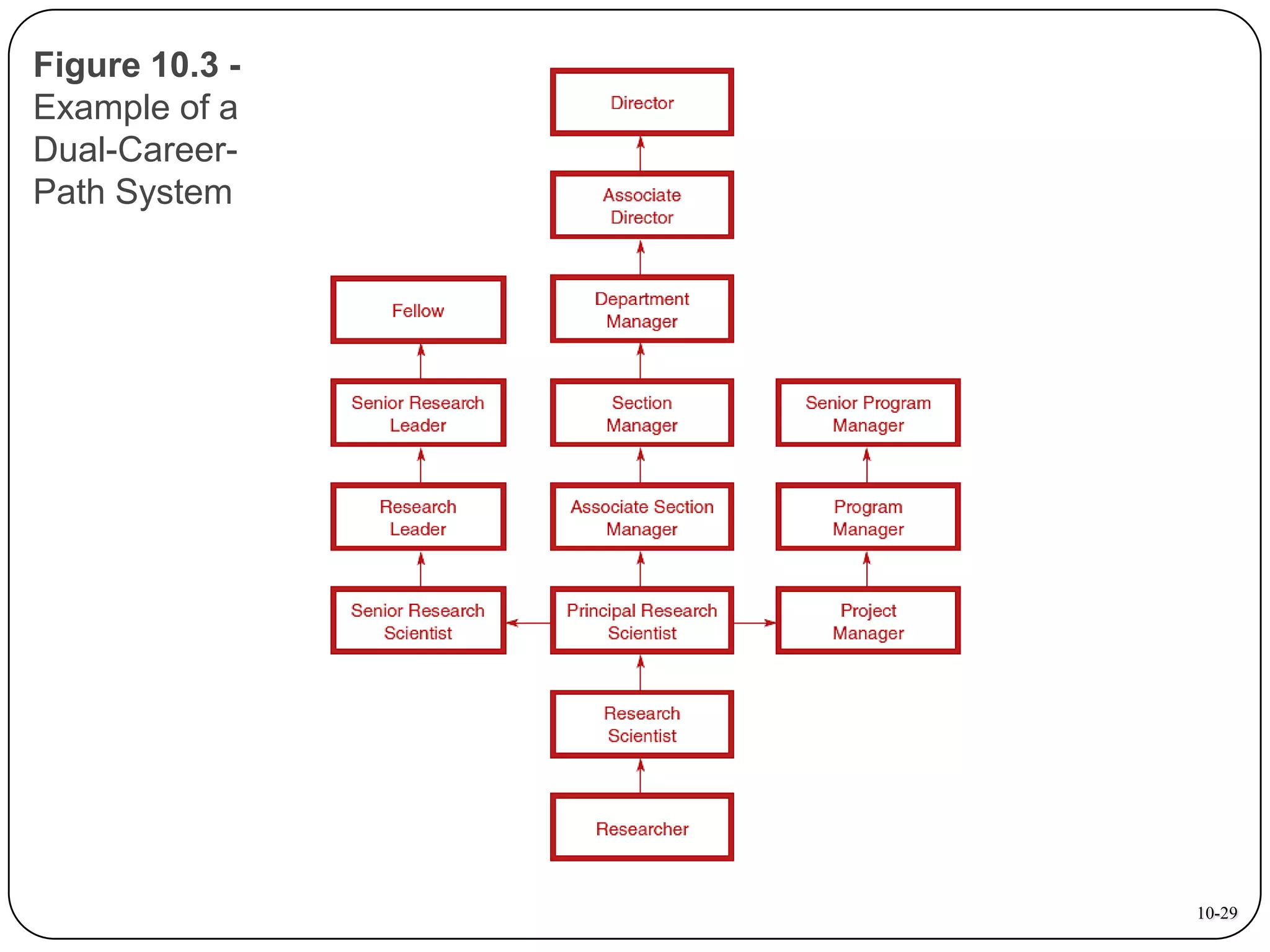
 Dual-career-path system: Enables employees to
remain in a technical or sales career path or move
into a management career path

10-26
Figure 10.2 - Traditional Career Paths for
Scientists and Managers

10-27
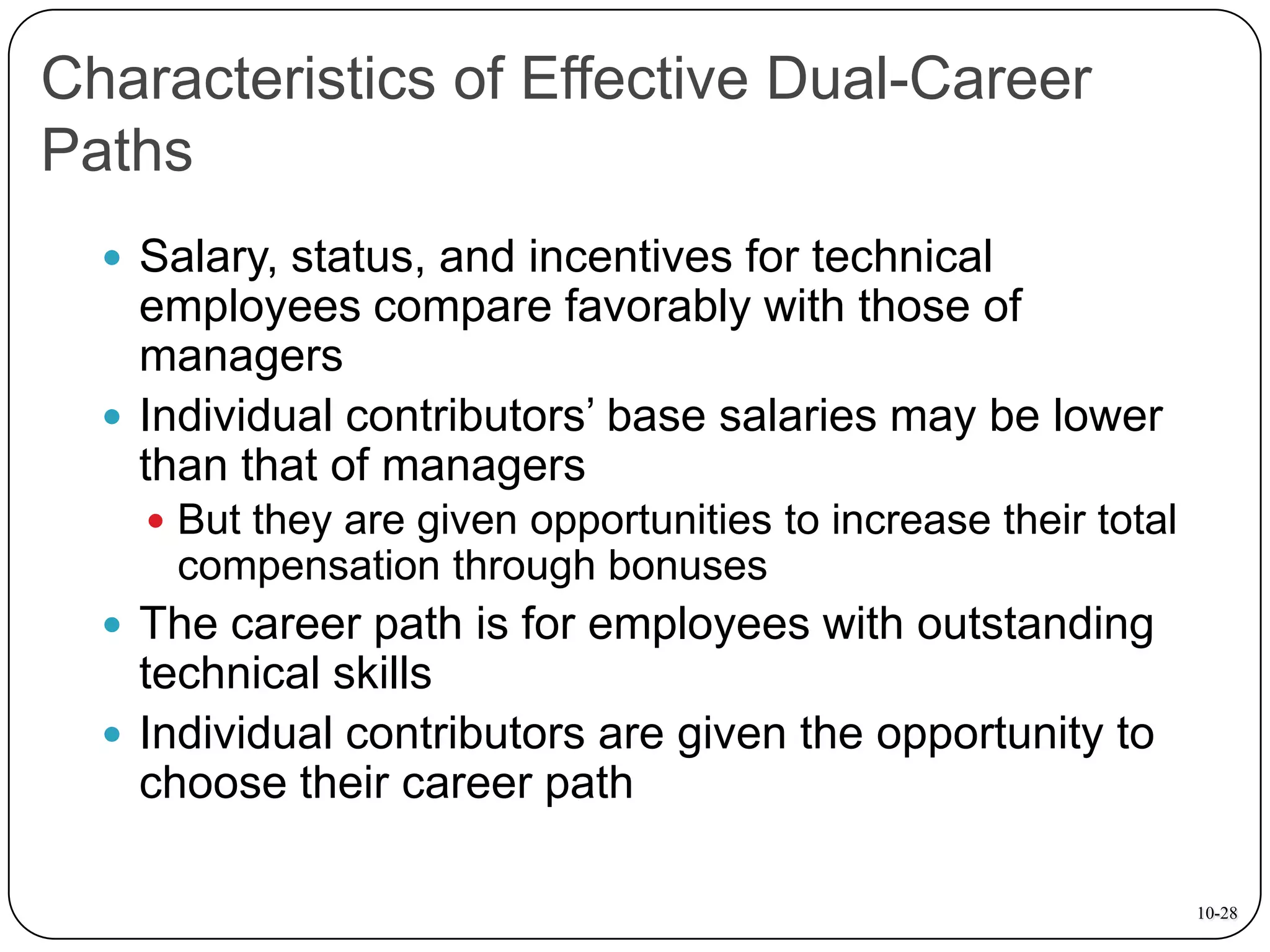
Characteristics of Effective Dual-Career
Paths
 Salary, status, and incentives for technical

employees compare favorably with those of
managers
 Individual contributors’ base salaries may be lower
than that of managers
 But they are given opportunities to increase their total

compensation through bonuses
 The career path is for employees with outstanding

technical skills
 Individual contributors are given the opportunity to
choose their career path
10-28
Figure 10.3 Example of a
Dual-CareerPath System

10-29
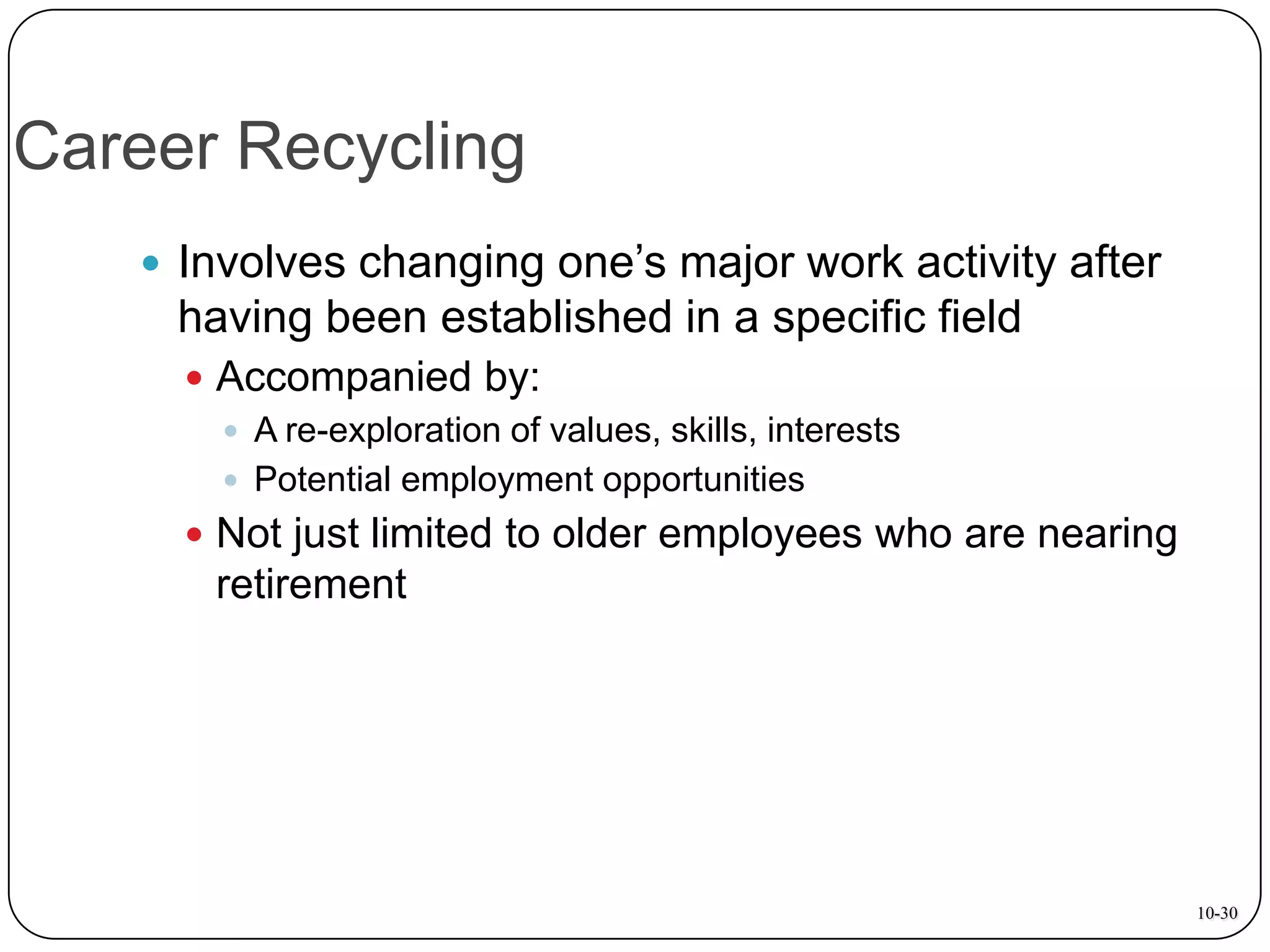
Career Recycling
 Involves changing one’s major work activity after

having been established in a specific field
 Accompanied by:
 A re-exploration of values, skills, interests
 Potential employment opportunities
 Not just limited to older employees who are nearing

retirement

10-30
Job Hopping
 Employees changing jobs, usually between

companies, every two to three years
 Was once considered damaging to an employee’s

career
 Today, companies are more used to the practice

10-31
Coping with Career Breaks
 Uniformed Services Employment and

Reemployment Act: Covers deployed employees’
rights, such as guaranteeing jobs when they return
except under certain circumstances
 The job a service member returns to may be different

from the one he or she left
 It could require new skills or be in a different location

 Women are more likely than men to leave jobs for

family reasons

10-32
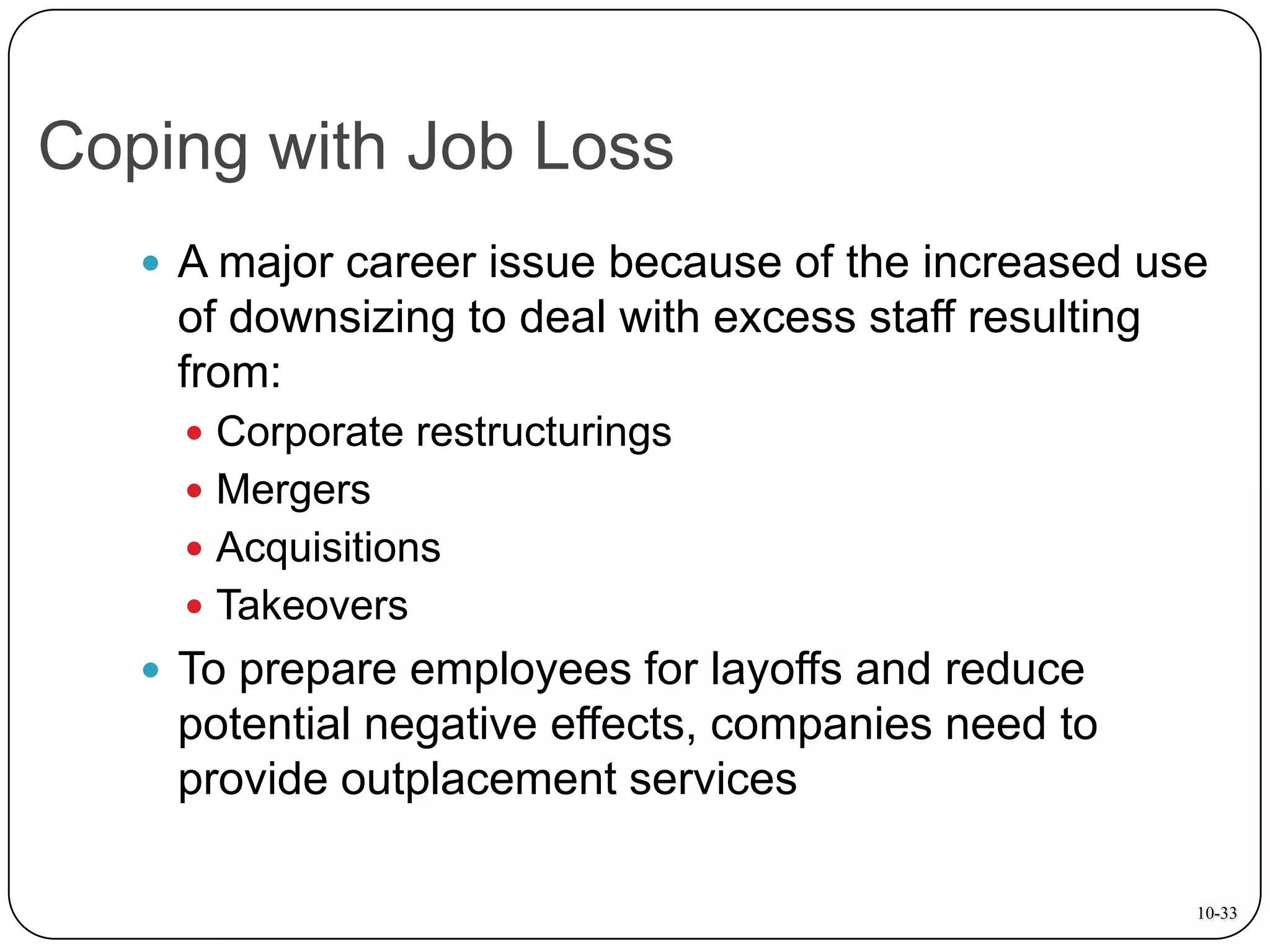
Coping with Job Loss
 A major career issue because of the increased use

of downsizing to deal with excess staff resulting
from:
 Corporate restructurings
 Mergers
 Acquisitions

 Takeovers

 To prepare employees for layoffs and reduce

potential negative effects, companies need to
provide outplacement services
10-33
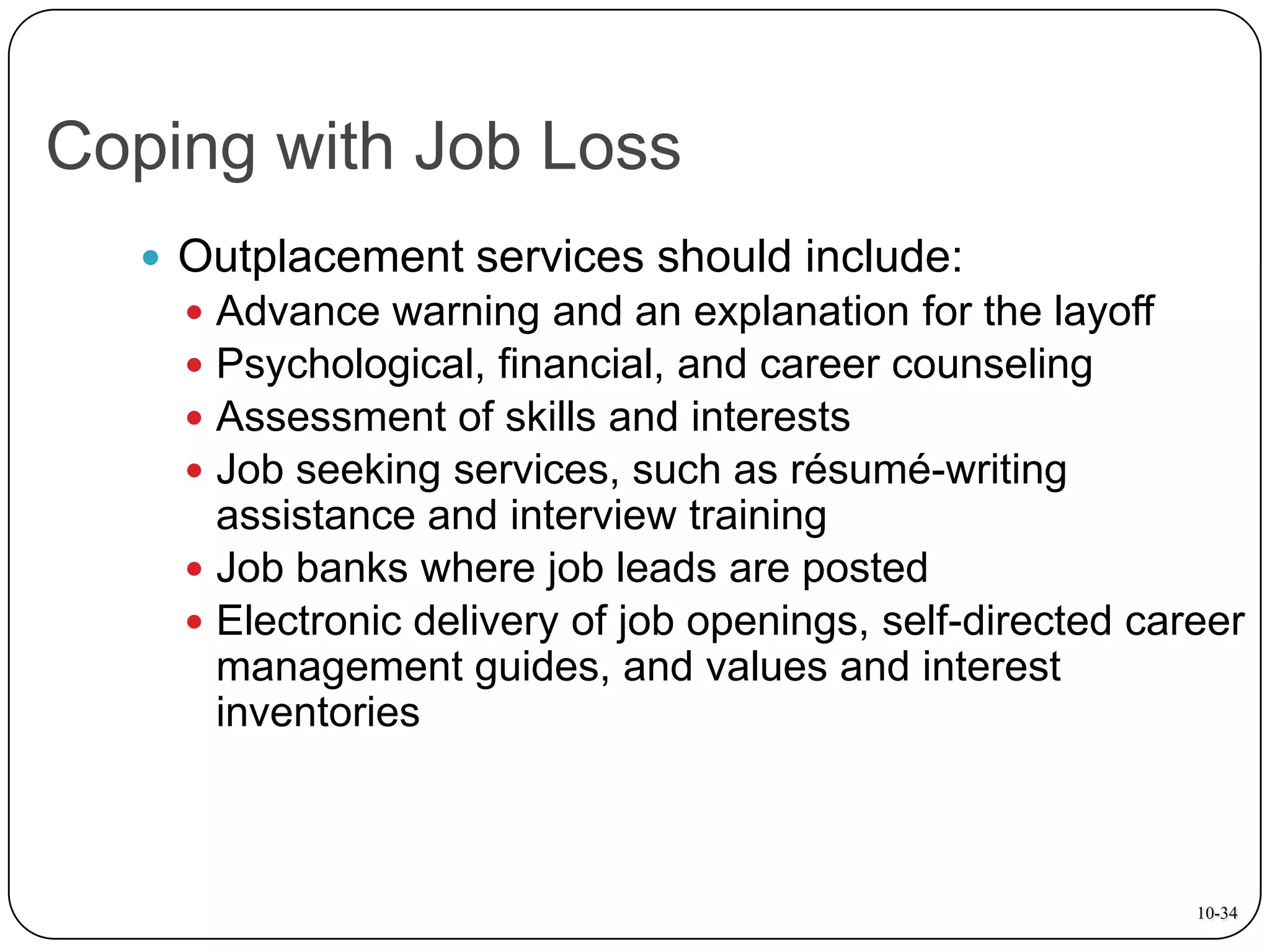
Coping with Job Loss
 Outplacement services should include:

Advance warning and an explanation for the layoff
Psychological, financial, and career counseling
Assessment of skills and interests
Job seeking services, such as résumé-writing
assistance and interview training
 Job banks where job leads are posted
 Electronic delivery of job openings, self-directed career
management guides, and values and interest
inventories





10-34
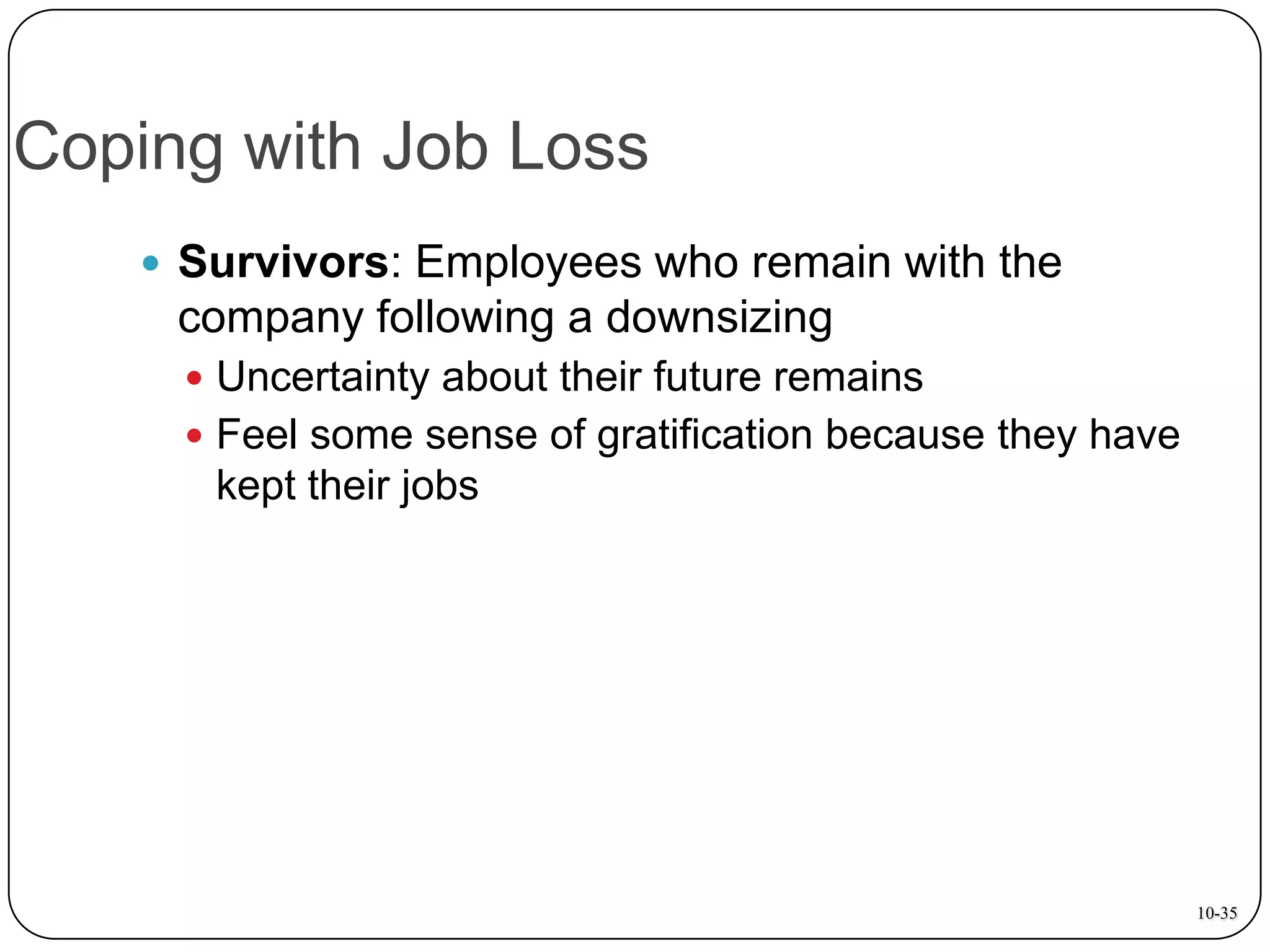
Coping with Job Loss
 Survivors: Employees who remain with the

company following a downsizing
 Uncertainty about their future remains
 Feel some sense of gratification because they have

kept their jobs

10-35
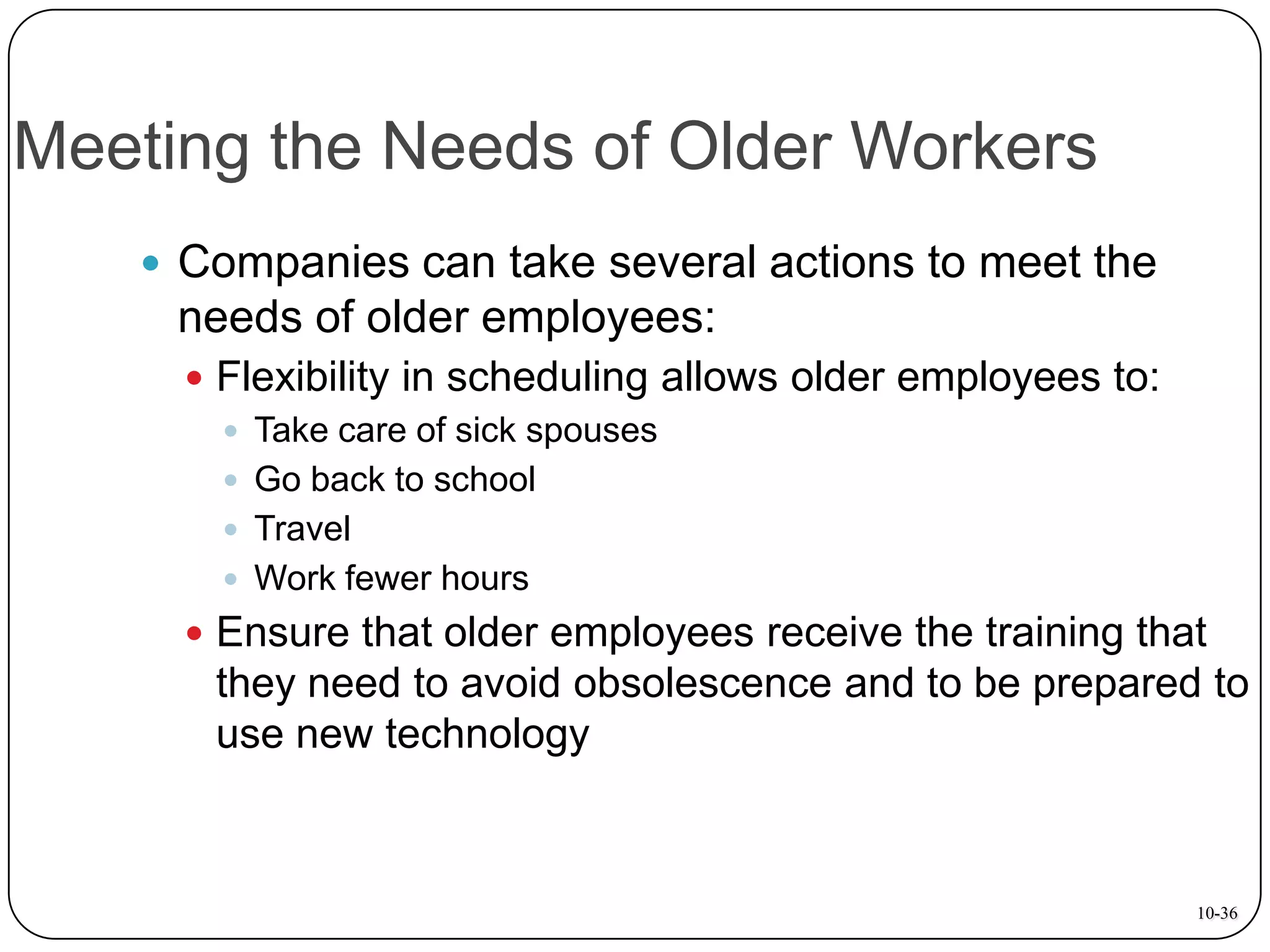
Meeting the Needs of Older Workers
 Companies can take several actions to meet the

needs of older employees:
 Flexibility in scheduling allows older employees to:
 Take care of sick spouses
 Go back to school
 Travel
 Work fewer hours
 Ensure that older employees receive the training that

they need to avoid obsolescence and to be prepared to
use new technology

10-36
Meeting the Needs of Older Workers
 Older employees need resources and referral help that

address long-term health care and elder care
 Assessment and counseling are necessary to help
older employees recycle to new jobs or careers
 Or transition to less secure positions whose responsibilities are

not as clearly defined

10-37
Meeting the Needs of Older Workers
 Important to recognize that as older employees’

physical and mental abilities decline, they can rely on
experience and motivation to avoid poor performance
 Companies should consider moving valuable older
employees who are suffering skill deterioration to other
jobs

10-38
Preretirement Socialization
 The process of helping employees prepare to exit

from work
 Encourages employees to learn about:
 Retirement life
 Plan for adequate financial, housing, and health care resources
 Form accurate expectations about retirement
 Phased retirement: Involves employees transitioning

from full-time employment to full-time retirement by
working part time

10-39
Retirement
 Involves leaving a job and a work role and making a

transition into life without work
 For some employees, it involves:
 Making a transition out of their current job and

company
 Seeking full- or part-time employment elsewhere
 Recycling into another career

10-40
Retirement
 Implications of aging workforce and use of early

retirement programs to shrink companies’
workforces:
 Companies must meet the needs of older employees
 Companies must take steps to prepare employees for

retirement
 Companies must be careful that early retirement
programs do not unfairly discriminate against older
employees

10-41
Early Retirement Programs
 Offer employees financial benefits to leave the

company
 Usually part of the company’s strategy to reduce labor

costs without having to lay off employees
 Companies should make sure:
 Program is part of the employee benefit plan
 Company can justify age-related distinctions for

eligibility for early retirement
 Employees are allowed to choose early retirement
voluntarily

10-42

MBA760 Chapter 10

  • 1.
    Social Responsibility: Legal Issues,Managing Diversity, and Career Challenges Chapter 10 6th Edition Raymond A. Noe McGraw-Hill/Irwin Copyright © 2013 by The McGraw-Hill Companies, Inc. All rights reserved.
  • 2.
    Learning Objectives • Discussthe role of training partnerships in developing skills and contributing to local communities • Discuss the potential legal issues that relate to training • Develop a program for effectively managing diversity • Design a program for preparing employees for crosscultural assignments 10-2
  • 3.
    Learning Objectives  Discussthe importance of career paths and dual career paths for employees and companies  Develop policies to help employees achieve work-life balance  Describe how companies are helping veterans develop skills and get employment  Explain the value of phase retirement programs for older employees 10-3
  • 4.
    Training Partnerships  Sectorpartnerships: Government agencies, industry trade groups that:  Help identify the skills that local employers require  Work with community colleges, universities, and other educational institutions to provide qualified employees 10-4
  • 5.
    Training Partnerships  School-to-WorkOpportunities Act: Designed to assist the states in building school-to-work systems that prepare students for high-skill, high-wage jobs or future education  Workforce Investment Act of 1998: Created a comprehensive workforce investment system 10-5
  • 6.
    Lifelong Learning  Lifelonglearning account (LiLA): An account for adult education into which both the employee and the company contribute and the employee keeps  Even if they leave the company  The money in the LiLA can be used to pay for a range of educational expenses  Including tuition, books, fees, supplies, and non-job- specific certification courses 10-6
  • 7.
    Joint Union-Management Programs Provide a wide range of services designed to help employees learn skills that are directly related to their jobs  Develop skills that are “portable”—valuable to employers in other companies or industries 10-7
  • 8.
    Table 10.1 -Situations That may Result in Legal Action 10-8
  • 9.
    Reproducing and UsingCopyrighted Material in Training Classes Without Permission  Copyrights: Protect the expression of an idea but not the ideas that the material contains  Prohibit others from creating a product based on the original work from:  Copying  Broadcasting  Publishing the product without permission 10-9
  • 10.
    Excluding Women, Minorities,and Older Employees from Training Programs  Title VII of the Civil Rights Act: Makes it illegal to deny access to employment or deprive a person employment because of the person’s race, color, religion, gender, or national origin  Age Discrimination in Employment Act (ADEA): Prohibits discrimination against persons who are age 40 or older 10-10
  • 11.
    Not Accommodating Traineeswith Disabilities  Americans with Disabilities Act (ADA) of 1990: Prohibits individuals with disabilities from being discriminated against in the workplace  Reasonable accommodation: Making training facilities readily accessible to and usable by individuals with disabilities 10-11
  • 12.
    Managing Workforce Diversityand Inclusion  Inclusion: Creating an environment in which employees share a sense of belonging, mutual respect, and commitment from others so they can perform their best work  Diversity training: Learning efforts that are designed to change employee attitudes about diversity and/or develop skills needed to work with a diverse workforce  Managing diversity and inclusion: Involves creating an environment that allows all employees to contribute to organizational goals and experience personal growth 10-12
  • 13.
    Table 10.2 -Characteristics Associated with Diversity Programs’ Long-Term Success 10-13
  • 14.
    Table 10.3 KeyComponents of Effective Managing Diversity Programs 10-14
  • 15.
    Melting the GlassCeiling  Glass ceiling: A barrier to advancement to higher- level jobs in the company that adversely affects women and minorities 10-15
  • 16.
    Cross-Cultural Preparation  Educatesemployees (expatriates) and their families who are to be sent to a foreign country  Expatriates: Work in a country other than their country of origin 10-16
  • 17.
    Table 10.4 -Recommendations for Melting the Glass Ceiling 10-17
  • 18.
    Steps in Cross-CulturalPreparation  To succeed overseas, expatriates need to be:  Competent in their areas of expertise  Able to communicate verbally and nonverbally in the host country  Flexible, tolerant of ambiguity, and sensitive to cultural differences  Motivated to succeed  Able to enjoy the challenge of working in other countries  Willing to learn about the host country’s culture, language, and customs  Supported by their families 10-18
  • 19.
    Steps in Cross-CulturalPreparation  Three phases:  Pre-departure phase  On-site phase  Repatriation phase  Repatriation: Prepares expatriates for return to the parent company and home country from the foreign assignment  Virtual expatriates: Employees who have an assignment to manage an operation abroad without being located permanently in that country 10-19
  • 20.
    Career Challenges Facinga Multigenerational Workforce  Employees’ careers involve four stages:  Exploration - Employees attempt to identify the type of work that interests them  Establishment - Involves:  Finding employment  Making an independent contribution  Achieving more responsibility and financial success  Establishing a suitable lifestyle 10-20
  • 21.
    Career Challenges Facinga Multigenerational Workforce  Maintenance - Individuals are concerned with:  Keeping their skills up to date  Being perceived as someone who is still contributing to the company  Decline - Involves individuals preparing to phase out of work and retire 10-21
  • 22.
    Work-Life Balance  Helpingemployees deal with the stresses, strains, and conflicts related to trying to balance work and non-work demands  Family and Medical Leave Act (FLMA): A federal law that provides up to twelve weeks of unpaid leave in a one-year period for parents with new infants or newly adopted children 10-22
  • 23.
    Table 10.5 -Examples of Work-Life Balance Practices 10-23
  • 24.
    Work-Life Balance  Telecommuting:Work arrangement that gives employees flexibility in both work location and hours  Compressed workweek: Work schedule that allows employees to work fewer days but with longer hours  For example, four days, ten hours each day 10-24
  • 25.
    Work-Life Balance  Flextime:Giving employees the option of choosing when to work during the workday, workweek, or work year  Job sharing: Having two employees divide the hours, the responsibilities, and the benefits of a fulltime job 10-25
  • 26.
    Career Paths andDual Career Paths  Career path: A sequence of job positions involving similar types of work and skills that employees move through in the company  Dual-career-path system: Enables employees to remain in a technical or sales career path or move into a management career path 10-26
  • 27.
    Figure 10.2 -Traditional Career Paths for Scientists and Managers 10-27
  • 28.
    Characteristics of EffectiveDual-Career Paths  Salary, status, and incentives for technical employees compare favorably with those of managers  Individual contributors’ base salaries may be lower than that of managers  But they are given opportunities to increase their total compensation through bonuses  The career path is for employees with outstanding technical skills  Individual contributors are given the opportunity to choose their career path 10-28
  • 29.
    Figure 10.3 Exampleof a Dual-CareerPath System 10-29
  • 30.
    Career Recycling  Involveschanging one’s major work activity after having been established in a specific field  Accompanied by:  A re-exploration of values, skills, interests  Potential employment opportunities  Not just limited to older employees who are nearing retirement 10-30
  • 31.
    Job Hopping  Employeeschanging jobs, usually between companies, every two to three years  Was once considered damaging to an employee’s career  Today, companies are more used to the practice 10-31
  • 32.
    Coping with CareerBreaks  Uniformed Services Employment and Reemployment Act: Covers deployed employees’ rights, such as guaranteeing jobs when they return except under certain circumstances  The job a service member returns to may be different from the one he or she left  It could require new skills or be in a different location  Women are more likely than men to leave jobs for family reasons 10-32
  • 33.
    Coping with JobLoss  A major career issue because of the increased use of downsizing to deal with excess staff resulting from:  Corporate restructurings  Mergers  Acquisitions  Takeovers  To prepare employees for layoffs and reduce potential negative effects, companies need to provide outplacement services 10-33
  • 34.
    Coping with JobLoss  Outplacement services should include: Advance warning and an explanation for the layoff Psychological, financial, and career counseling Assessment of skills and interests Job seeking services, such as résumé-writing assistance and interview training  Job banks where job leads are posted  Electronic delivery of job openings, self-directed career management guides, and values and interest inventories     10-34
  • 35.
    Coping with JobLoss  Survivors: Employees who remain with the company following a downsizing  Uncertainty about their future remains  Feel some sense of gratification because they have kept their jobs 10-35
  • 36.
    Meeting the Needsof Older Workers  Companies can take several actions to meet the needs of older employees:  Flexibility in scheduling allows older employees to:  Take care of sick spouses  Go back to school  Travel  Work fewer hours  Ensure that older employees receive the training that they need to avoid obsolescence and to be prepared to use new technology 10-36
  • 37.
    Meeting the Needsof Older Workers  Older employees need resources and referral help that address long-term health care and elder care  Assessment and counseling are necessary to help older employees recycle to new jobs or careers  Or transition to less secure positions whose responsibilities are not as clearly defined 10-37
  • 38.
    Meeting the Needsof Older Workers  Important to recognize that as older employees’ physical and mental abilities decline, they can rely on experience and motivation to avoid poor performance  Companies should consider moving valuable older employees who are suffering skill deterioration to other jobs 10-38
  • 39.
    Preretirement Socialization  Theprocess of helping employees prepare to exit from work  Encourages employees to learn about:  Retirement life  Plan for adequate financial, housing, and health care resources  Form accurate expectations about retirement  Phased retirement: Involves employees transitioning from full-time employment to full-time retirement by working part time 10-39
  • 40.
    Retirement  Involves leavinga job and a work role and making a transition into life without work  For some employees, it involves:  Making a transition out of their current job and company  Seeking full- or part-time employment elsewhere  Recycling into another career 10-40
  • 41.
    Retirement  Implications ofaging workforce and use of early retirement programs to shrink companies’ workforces:  Companies must meet the needs of older employees  Companies must take steps to prepare employees for retirement  Companies must be careful that early retirement programs do not unfairly discriminate against older employees 10-41
  • 42.
    Early Retirement Programs Offer employees financial benefits to leave the company  Usually part of the company’s strategy to reduce labor costs without having to lay off employees  Companies should make sure:  Program is part of the employee benefit plan  Company can justify age-related distinctions for eligibility for early retirement  Employees are allowed to choose early retirement voluntarily 10-42