Training design

 Training design or instructional
design is the process of creating a
 blueprint for the development of
            instruction.
It determines:
Whether  the training is to be conducted in
 a classroom,
Delivered using an electronic format or
Using some combination of methods,


     The design process sets the stage for
the development of a program that produces
results.
Factors of Training Design
Viewpoint
Elements
Considerations
Benefits
Model
BASIC PRINCIPLES OF
  TRAINING DESIGN
The  principles that constitute the field of human
performance improvement, which help to ensure that
people achieve the best possible results on the job.

The   principle that underpin adult learning
DESIGN STEPS FOR A TRAINING
PROGRAM
Eight Steps
 Step1. Define purpose of the training and
  target audience
 Step2. Determine participants’ needs
 Step3. Define training goals and objectives
 Step4. Outline training content
 Step5. Develop instructional activities
 Step6. Prepare the written training design
 Step7. Prepare participant evaluation form(s)
 Step8. Determine follow-up activities for the
  event
Step1. Define Purpose of the
Training and Target Audience


 Cleartraining needs
 Purpose & audience must be clear
 Description to promote your program to
  prospective participants
Step2. Determine Participants’
Needs
Several ways to find out about the needs:

  Written survey
  Random sample
  Review past training programmes
Step3. Define Training Goals and
Objectives
 Clarifying expected outcomes
 Outlining training content
 Planning specific training activities
 Selecting/developing materials
 Designing evaluation procedures
 Communicating program intent to the training
  participants and others (such as program
  administrators and supervisors)
 Ensuring that the training is realistic and
  appropriate for the purpose intended
STEP4. Outline training content
  Introduction
  Learningcomponents
  Wrap up and evaluation component

              Rules of thumb
    Fill in known elements-such as meals and
     breaks.
    Start with simple concepts and proceed to
     more complex.
Conti…
    Proceeds from less threatening to more
     sensitive topics.
    Schedule activities which require the greatest
     concentration when people will be focused
     and energetic.
    Give yourself- and participants- a break.
    Build in time for reflection, discussion and
     Q&A.
    Introduce the day’s events in the beginning.
    Schedule 8-10 minutes at the end of each
     day for feedback.
    Review your plan with a critical eye.
    Be flexible! Although your design is a detailed
     road map, you may encounter detours along
     the way.
STEP5. Develop Instructional
Activities
 Participants  learning style
 Principles of adult learning
 Group size
 Prior experience and /or education level of
  participants
 Type of skill or information to be presented
 Trainer’s style
Conti…
 When deciding which activities to use, consider
 these questions:
 1. Do we know that this activity us effective?
 2. Have we used it before?
 3. Are we comfortable with this technique?
 4. Do we have the expertise to use it
    effectively?
 5. Does the activity require prior knowledge or
    skill on the part of participants?
 6. Will we have the time, space and resources
    needed to accomplish the activity?
 7. Will the activity encourage learning without
    confusing participants?
STEP6. Prepare the Written
Training Design
Written document: A detailed plan of the
 training session, including goals and
 objectives. It consider:
 ◦ The skill expertise, training style and comfort
   level of each of your trainers in making this
   designation.
 ◦ Also consider identifying specific trainer who
   will take the lead in fleshing out different
   sections of the training and creating the
   necessary supporting materials.
Use your written training design to stay in
 track during the training events, make mid
 course corrections and document training
STEP7. Prepare Participant
Evaluation Forms
Issues that the evaluation forms must
addressed
1. Did the participants acquire the
   knowledge and skill that the trainer was
   supposed to provide?
2. Were the trainers knowledgeable about
   training content?
3. Were the activities interesting and
   effective?
4. Was the training format appropriate?
5. Is more training on this or related topics
STEP8. Determine Follow-up
Activities for the Event
 Newsletters  and web site posting
 Per observation and coaching
 Mentoring,
 Study groups
 Booster session
 Ongoing communication between
  participants and
 Trainers via phone or electronic mail
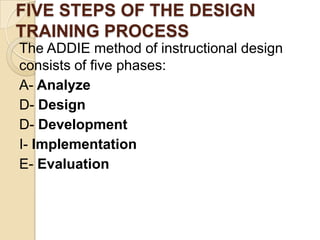
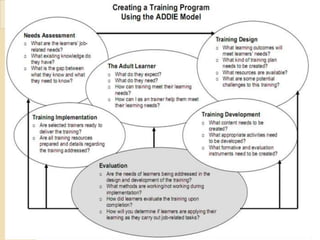
FIVE STEPS OF THE DESIGN
TRAINING PROCESS
The ADDIE method of instructional design
consists of five phases:
A- Analyze
D- Design
D- Development
I- Implementation
E- Evaluation
THE SESSION Conti…

  STAY WITH US…
Conti…

Training design

  • 1.
    Training design Trainingdesign or instructional design is the process of creating a blueprint for the development of instruction.
  • 2.
    It determines: Whether the training is to be conducted in a classroom, Delivered using an electronic format or Using some combination of methods, The design process sets the stage for the development of a program that produces results.
  • 3.
    Factors of TrainingDesign Viewpoint Elements Considerations Benefits Model
  • 4.
    BASIC PRINCIPLES OF TRAINING DESIGN The principles that constitute the field of human performance improvement, which help to ensure that people achieve the best possible results on the job. The principle that underpin adult learning
  • 5.
    DESIGN STEPS FORA TRAINING PROGRAM Eight Steps  Step1. Define purpose of the training and target audience  Step2. Determine participants’ needs  Step3. Define training goals and objectives  Step4. Outline training content  Step5. Develop instructional activities  Step6. Prepare the written training design  Step7. Prepare participant evaluation form(s)  Step8. Determine follow-up activities for the event
  • 6.
    Step1. Define Purposeof the Training and Target Audience  Cleartraining needs  Purpose & audience must be clear  Description to promote your program to prospective participants
  • 7.
    Step2. Determine Participants’ Needs Severalways to find out about the needs: Written survey Random sample Review past training programmes
  • 8.
    Step3. Define TrainingGoals and Objectives  Clarifying expected outcomes  Outlining training content  Planning specific training activities  Selecting/developing materials  Designing evaluation procedures  Communicating program intent to the training participants and others (such as program administrators and supervisors)  Ensuring that the training is realistic and appropriate for the purpose intended
  • 9.
    STEP4. Outline trainingcontent  Introduction  Learningcomponents  Wrap up and evaluation component Rules of thumb  Fill in known elements-such as meals and breaks.  Start with simple concepts and proceed to more complex.
  • 10.
    Conti…  Proceeds from less threatening to more sensitive topics.  Schedule activities which require the greatest concentration when people will be focused and energetic.  Give yourself- and participants- a break.  Build in time for reflection, discussion and Q&A.  Introduce the day’s events in the beginning.  Schedule 8-10 minutes at the end of each day for feedback.  Review your plan with a critical eye.  Be flexible! Although your design is a detailed road map, you may encounter detours along the way.
  • 11.
    STEP5. Develop Instructional Activities Participants learning style  Principles of adult learning  Group size  Prior experience and /or education level of participants  Type of skill or information to be presented  Trainer’s style
  • 12.
    Conti… When decidingwhich activities to use, consider these questions: 1. Do we know that this activity us effective? 2. Have we used it before? 3. Are we comfortable with this technique? 4. Do we have the expertise to use it effectively? 5. Does the activity require prior knowledge or skill on the part of participants? 6. Will we have the time, space and resources needed to accomplish the activity? 7. Will the activity encourage learning without confusing participants?
  • 13.
    STEP6. Prepare theWritten Training Design Written document: A detailed plan of the training session, including goals and objectives. It consider: ◦ The skill expertise, training style and comfort level of each of your trainers in making this designation. ◦ Also consider identifying specific trainer who will take the lead in fleshing out different sections of the training and creating the necessary supporting materials. Use your written training design to stay in track during the training events, make mid course corrections and document training
  • 14.
    STEP7. Prepare Participant EvaluationForms Issues that the evaluation forms must addressed 1. Did the participants acquire the knowledge and skill that the trainer was supposed to provide? 2. Were the trainers knowledgeable about training content? 3. Were the activities interesting and effective? 4. Was the training format appropriate? 5. Is more training on this or related topics
  • 15.
    STEP8. Determine Follow-up Activitiesfor the Event  Newsletters and web site posting  Per observation and coaching  Mentoring,  Study groups  Booster session  Ongoing communication between participants and  Trainers via phone or electronic mail
  • 16.
    FIVE STEPS OFTHE DESIGN TRAINING PROCESS The ADDIE method of instructional design consists of five phases: A- Analyze D- Design D- Development I- Implementation E- Evaluation
  • 18.
    THE SESSION Conti… STAY WITH US…
  • 19.