Copyright © 2015 McGraw-Hill Education. All rights reserved. No reproduction or distribution without the prior written consent of McGraw-Hill Education.
OrganizationalOrganizational
CommitmentCommitment
Chapter 3
3-2
3-3
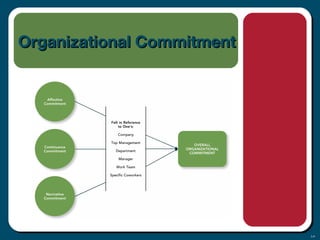
Organizational CommitmentOrganizational Commitment
• A desire on the part of an employee to remain a
member of an organization
๏ Comes in three forms
3-4
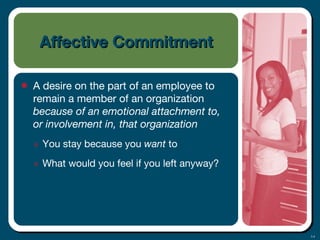
Affective CommitmentAffective Commitment
• A desire on the part of an employee to
remain a member of an organization
because of an emotional attachment to,
or involvement in, that organization
๏ You stay because you want to
๏ What would you feel if you left anyway?
3-5
Affective CommitmentAffective Commitment
3-6
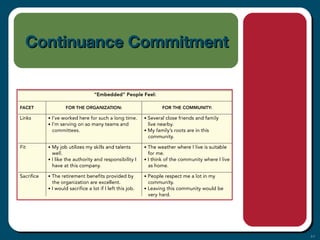
Continuance CommitmentContinuance Commitment
• A desire on the part of an employee to
remain a member of an organization
because of an awareness of the costs
associated with leaving
๏ You stay because you need to
๏ What would you feel if you left anyway?
3-7
Continuance CommitmentContinuance Commitment
3-8
Normative CommitmentNormative Commitment
• A desire on the part of an employee to
remain a member of an organization
because of a feeling of obligation
๏ You stay because you ought to
๏ What would you feel if you left anyway?
3-9
Organizational CommitmentOrganizational Commitment
3-10
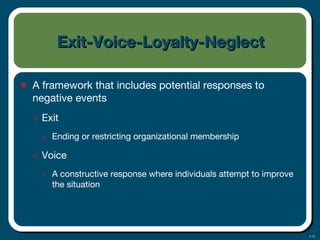
Exit-Voice-Loyalty-NeglectExit-Voice-Loyalty-Neglect
• A framework that includes potential responses to
negative events
๏ Exit
๏ Ending or restricting organizational membership
๏ Voice
๏ A constructive response where individuals attempt to improve
the situation
3-11
Exit-Voice-Loyalty-NeglectExit-Voice-Loyalty-Neglect
• A framework that includes potential responses to
negative events
๏ Loyalty
๏ A passive response where the employee remains supportive
while hoping for improvement
๏ Neglect
๏ Interest and effort in the job is reduced
3-12
Exit-Voice-Loyalty-NeglectExit-Voice-Loyalty-Neglect
3-13
WithdrawalWithdrawal
• A set of actions that employees perform
to avoid the work situation
๏ One study found that 51% of employees’
time was spent working
๏ The other 49% was allocated to coffee
breaks, late starts, early departures, and
personal things
3-14
WithdrawalWithdrawal
3-15
WithdrawalWithdrawal
3-16
WithdrawalWithdrawal
• Key question:
๏ How exactly are the different forms of withdrawal related
to one another?
๏ Independent forms
๏ Compensatory forms
๏ Progression
3-17
WithdrawalWithdrawal
• Answer:
๏ The various forms of withdrawal are almost always
moderately to strongly correlated
๏ Those correlations suggest a progression, as lateness is
strongly related to absenteeism, and absenteeism is
strongly correlated to quitting
3-18
ApplicationApplication
• Employees are more committed when
employers are committed to them
๏ Perceived organization support
๏ Fostered when organizations:
๏ Protect job security
๏ Provide rewards
๏ Improve work conditions
๏ Minimize politics

MGMT 340 - Chapter 03