Training and Development
Definition of Training and Development

• Any attempt to improve an employee’s current or
  future performance
  by increasing his or her ability to perform through
  learning
  usually by changing the employee’s attitude or
  increasing his or her skills and knowledge
• T & D need is determined by the gap between the
  current performance and the required performance
Training vs. Development vs. Education

• Education is theoretical learning in classrooms
• Training is the process of imparting specific
  skills
• Development refers to the learning
  opportunities designed to help employees
  grow
The Training Paradox

• Increasing an individual’s employability
  outside the company simultaneously increases
  his or her job security and desire to stay with
  the current employer
• “Train them to the point where you may lose
  them, and then you won’t lose them.”
Benefits of Training

• Competitive advantage to the firm
• Removes performance deficiencies
• Reduces accidents, damage, errors and wastage
• Improves productivity and profits
• Improves satisfaction and morale
• Reduces absenteeism and turnover
• Helps in knowledge upgradation and prevents
  obsolescence of skills
• Helps meet future personnel needs
• Improves the image of the organization
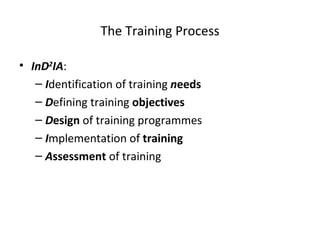
The Training Process

• InD2IA:
   – Identification of training needs
   – Defining training objectives
   – Design of training programmes
   – Implementation of training
   – Assessment of training
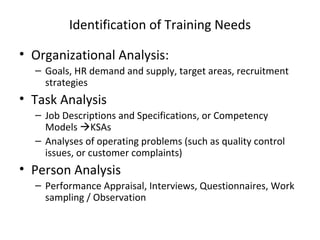
Identification of Training Needs

• Organizational Analysis:
  – Goals, HR demand and supply, target areas, recruitment
    strategies
• Task Analysis
  – Job Descriptions and Specifications, or Competency
    Models KSAs
  – Analyses of operating problems (such as quality control
    issues, or customer complaints)
• Person Analysis
  – Performance Appraisal, Interviews, Questionnaires, Work
    sampling / Observation
Defining Training Objectives

• Descriptions of what the employee should be
  capable of doing, after undergoing the
  training
  – E.g., Will be able to produce ‘x’ number of units
    per hour, with zero defects
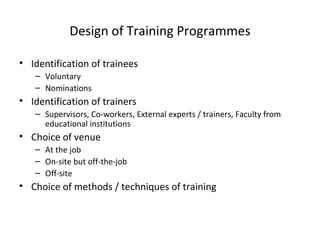
Design of Training Programmes

• Identification of trainees
   – Voluntary
   – Nominations
• Identification of trainers
   – Supervisors, Co-workers, External experts / trainers, Faculty from
     educational institutions
• Choice of venue
   – At the job
   – On-site but off-the-job
   – Off-site
• Choice of methods / techniques of training
Training Methods
              (Implementation of Training)
• Information Presentation Techniques
  –   Lectures
  –   Conferences
  –   Videos
  –   Interactive multimedia (CDs and DVDs)
  –   Distance Learning (Correspondence Courses / On-line)
• Simulation methods
  –   Case study method
  –   Role Playing
  –   Behavior Modeling
  –   Interactive Simulations
  –   In-basket exercises
  –   Business games
Training Methods (contd.)
• On-the-job training (OJT) methods
   – Methods
       • Orientation Training
       • Apprenticeships and Understudy Assignments
       • On-the-job training (learning through actual job performance)
       • Vestibule training / Near-the-job training
       • Job Rotation
       • Committee assignments
       • On-the-job coaching
   – Steps for OJT
       • Prepare the learner
       • Present the operation
       • Do a tryout
       • Follow Up
Assessment of Training
• Done in order to check
  – Training validity (did trainees learn during training?)
  – Transfer validity (Has what was learnt during training
    been transferred on to the job? Has it enhanced job
    performance?)
  – Intra-organizational validity (Is performance of the
    trainees who have undergone this training consistent
    with the performance of trainees who have undergone
    previous methods of training?)
  – Inter-organizational validity (Can the training
    programme be used successfully in another
    organization?)
Assessment of Training (contd.)

• Can be done at the following levels:
  – Reaction
  – Learning
  – Behaviour
  – Results
Factors which enhance Training
                  Effectiveness:
•   Employee motivation
•   Recognition of individual differences
•   Opportunities to practise
•   Reinforcement
•   Feedback
•   Goals
•   Suitable schedules of learning
•   Meaningfulness of the material
•   Ease of transfer of learning back to the job
•   Top Management commitment to training
Training Metrics
• Training Investment Factor
  – Training Cost per Employee
  – Total Training Cost / Headcount
• Training Outcomes
  – Using experimental designs
     • Before-and-After measurements of performance
     • After-only measurements of performance of trained
       and untrained groups
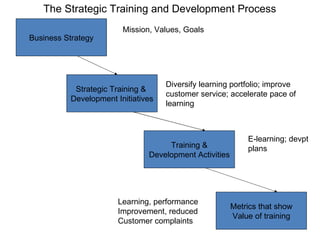
The Strategic Training and Development Process
                        Mission, Values, Goals
Business Strategy


                                    Diversify learning portfolio; improve
           Strategic Training &
                                    customer service; accelerate pace of
          Development Initiatives
                                    learning


                                                            E-learning; devpt
                                    Training &              plans
                               Development Activities


                       Learning, performance
                                                        Metrics that show
                       Improvement, reduced
                                                        Value of training
                       Customer complaints
Strategic Training & Development Initiatives & their implications

Initiatives: learning related      Implications
actions to achieve biz
strategy
Diversify the learning portfolio   *Using new technology for training
                                   *Facilitate informal training
                                   *Provide personalised learning
Expand who is trained              *Train customers, suppliers
                                   *More training to non-mgmt
Accelerate pace of employee        *Quickly identify needs and provide
learning                           learning solution
                                   *Facilitate access of learning
                                   resources
Improve customer service           *Ensuring product & service
                                   knowledge
                                   *Have skills to interact with
                                   customers

Training and development

  • 1.
  • 2.
    Definition of Trainingand Development • Any attempt to improve an employee’s current or future performance by increasing his or her ability to perform through learning usually by changing the employee’s attitude or increasing his or her skills and knowledge • T & D need is determined by the gap between the current performance and the required performance
  • 3.
    Training vs. Developmentvs. Education • Education is theoretical learning in classrooms • Training is the process of imparting specific skills • Development refers to the learning opportunities designed to help employees grow
  • 4.
    The Training Paradox •Increasing an individual’s employability outside the company simultaneously increases his or her job security and desire to stay with the current employer • “Train them to the point where you may lose them, and then you won’t lose them.”
  • 5.
    Benefits of Training •Competitive advantage to the firm • Removes performance deficiencies • Reduces accidents, damage, errors and wastage • Improves productivity and profits • Improves satisfaction and morale • Reduces absenteeism and turnover • Helps in knowledge upgradation and prevents obsolescence of skills • Helps meet future personnel needs • Improves the image of the organization
  • 6.
    The Training Process •InD2IA: – Identification of training needs – Defining training objectives – Design of training programmes – Implementation of training – Assessment of training
  • 7.
    Identification of TrainingNeeds • Organizational Analysis: – Goals, HR demand and supply, target areas, recruitment strategies • Task Analysis – Job Descriptions and Specifications, or Competency Models KSAs – Analyses of operating problems (such as quality control issues, or customer complaints) • Person Analysis – Performance Appraisal, Interviews, Questionnaires, Work sampling / Observation
  • 8.
    Defining Training Objectives •Descriptions of what the employee should be capable of doing, after undergoing the training – E.g., Will be able to produce ‘x’ number of units per hour, with zero defects
  • 9.
    Design of TrainingProgrammes • Identification of trainees – Voluntary – Nominations • Identification of trainers – Supervisors, Co-workers, External experts / trainers, Faculty from educational institutions • Choice of venue – At the job – On-site but off-the-job – Off-site • Choice of methods / techniques of training
  • 10.
    Training Methods (Implementation of Training) • Information Presentation Techniques – Lectures – Conferences – Videos – Interactive multimedia (CDs and DVDs) – Distance Learning (Correspondence Courses / On-line) • Simulation methods – Case study method – Role Playing – Behavior Modeling – Interactive Simulations – In-basket exercises – Business games
  • 11.
    Training Methods (contd.) •On-the-job training (OJT) methods – Methods • Orientation Training • Apprenticeships and Understudy Assignments • On-the-job training (learning through actual job performance) • Vestibule training / Near-the-job training • Job Rotation • Committee assignments • On-the-job coaching – Steps for OJT • Prepare the learner • Present the operation • Do a tryout • Follow Up
  • 12.
    Assessment of Training •Done in order to check – Training validity (did trainees learn during training?) – Transfer validity (Has what was learnt during training been transferred on to the job? Has it enhanced job performance?) – Intra-organizational validity (Is performance of the trainees who have undergone this training consistent with the performance of trainees who have undergone previous methods of training?) – Inter-organizational validity (Can the training programme be used successfully in another organization?)
  • 13.
    Assessment of Training(contd.) • Can be done at the following levels: – Reaction – Learning – Behaviour – Results
  • 14.
    Factors which enhanceTraining Effectiveness: • Employee motivation • Recognition of individual differences • Opportunities to practise • Reinforcement • Feedback • Goals • Suitable schedules of learning • Meaningfulness of the material • Ease of transfer of learning back to the job • Top Management commitment to training
  • 15.
    Training Metrics • TrainingInvestment Factor – Training Cost per Employee – Total Training Cost / Headcount • Training Outcomes – Using experimental designs • Before-and-After measurements of performance • After-only measurements of performance of trained and untrained groups
  • 16.
    The Strategic Trainingand Development Process Mission, Values, Goals Business Strategy Diversify learning portfolio; improve Strategic Training & customer service; accelerate pace of Development Initiatives learning E-learning; devpt Training & plans Development Activities Learning, performance Metrics that show Improvement, reduced Value of training Customer complaints
  • 17.
    Strategic Training &Development Initiatives & their implications Initiatives: learning related Implications actions to achieve biz strategy Diversify the learning portfolio *Using new technology for training *Facilitate informal training *Provide personalised learning Expand who is trained *Train customers, suppliers *More training to non-mgmt Accelerate pace of employee *Quickly identify needs and provide learning learning solution *Facilitate access of learning resources Improve customer service *Ensuring product & service knowledge *Have skills to interact with customers

Editor's Notes

  • #18 Initiatives are based on business environment, understanding of the company’s goals. How training will help achive goals