Learning and Transfer of
Training
Chapter 4
6th Edition
Raymond A. Noe
McGraw-Hill/Irwin

Copyright © 2013 by The McGraw-Hill Companies, Inc. All rights reserved.
Objectives
• Discuss the five types of learner outcomes
• Explain the implications of learning theory for instructional

design
• Incorporate adult learning theory into the design of a training
program
• Describe how learners receive, process, store, retrieve, and act
upon information

4-2
Objectives
 Discuss the internal conditions (within the learner) and

external conditions (learning environment) necessary for
the trainee to learn each type of capability
 Discuss the implications of open and closed skills and near
and far transfer for designing training programs
 Explain the features of instruction and the work
environment that are necessary for learning and transfer of
training

4-3
Introduction
 Certain conditions must be present for learning to occur:
 Provide opportunities for trainees to practice and receive feedback
 Offer meaningful training content
 Identify any prerequisites that trainees need to complete the
program successfully
 Allow trainees to learn through observation and experience and
ensure that the work environment supports use of skills

4-4
Introduction
 Transfer of training: Trainees effectively and continually

applying what they have learned in training to their jobs
 Generalization: Trainee’s ability to apply what they
learned to on-the job work problems
 Maintenance: Process of trainees continuing to use what
they learned over time

4-5
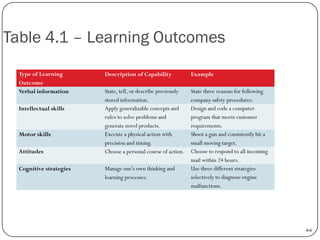
Table 4.1 – Learning Outcomes
Type of Learning
Outcome
Verbal information
Intellectual skills

Motor skills
Attitudes
Cognitive strategies

Description of Capability

Example

State, tell, or describe previously
stored information.
Apply generalizable concepts and
rules to solve problems and
generate novel products.
Execute a physical action with
precision and timing.
Choose a personal course of action.

State three reasons for following
company safety procedures.
Design and code a computer
program that meets customer
requirements.
Shoot a gun and consistently hit a
small moving target.
Choose to respond to all incoming
mail within 24 hours.
Use three different strategies
selectively to diagnose engine
malfunctions.

Manage one's own thinking and
learning processes.

4-6
Figure 4.1 A Model of Learning and
Transfer of Training

Trainee Characteristics

Training Design

Learning

Transfer of Training
• Generalization
• Maintenance

Work Environment

4-7
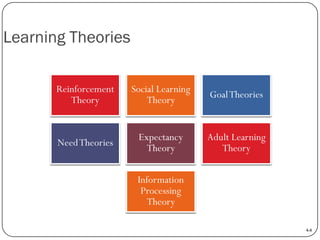
Learning Theories
Reinforcement
Theory

Social Learning
Theory

Goal Theories

Need Theories

Expectancy
Theory

Adult Learning
Theory

Information
Processing
Theory
4-8
Reinforcement Theory
 Emphasizes that people are motivated to perform or avoid

certain behaviors because of past outcomes that have
resulted from those behaviors
 Processes in reinforcement theory
 Positive reinforcement
 Negative reinforcement
 Extinction
 Punishment

 The trainer needs to identify what outcomes the learner

finds most positive and negative
4-9
Reinforcement Theory
 Trainers then need to link these outcomes to learners

acquiring knowledge, skills, or changing behaviours
 Trainers can withhold or provide job-related, personal, and
career-related benefits to learners who master program
content
 Behavior modification is a training method that is primarily
based on reinforcement theory
 Employees were encouraged to increase the number of safe

behaviors they demonstrated on the job

4-10
Social Learning Theory
 Emphasizes that people learn by observing other persons

(models) whom they believe are credible and knowledgeable
 The theory recognizes that behavior that is reinforced or
rewarded tends to be repeated
 Learning new skills or behavior comes from:
 Directly experiencing the consequences of using a behavior or

skill
 The process of observing others and seeing the consequences
of their behavior

4-11
Social Learning Theory
 Person’s self-efficacy can be increased using several methods
 Verbal persuasion

 Logical verification
 Observation of others (modeling)
 Past accomplishments

4-12
Figure 4.2 - Processes of Social Learning
Theory

Attention
• Model Stimuli
• Trainee
• Characteristics

Retention
• Coding
• Organization
• Rehearsal

Motor
Reproduction
• Physical
Capability
• Accuracy
• Feedback

Motivational
Processes
• Reinforcement

Match
Modeled
Performance

4-13
Goal Theories
 Goal setting theory: Assumes that behavior results from a

person’s conscious goals and intentions
 Goals influence a person’s behavior by:
 Directing energy and attention
 Sustaining effort over time
 Motivating the person to develop strategies for goal attainment

4-14
Goal Theories
 Goal setting theory
 It is used in training program design

 It suggests that learning can be facilitated by providing trainees

with specific challenging goals and objectives
 The influence of goal setting theory can be seen in the
development of training lesson plans

4-15
Goal Theories
 Goal orientation: Goals held by a trainee in a learning

situation
 Includes learning and performance orientation
 Learning orientation: Trying to increase ability or

competence in a task
 Performance orientation: Learners who focus on task
performance and how they compare to others

4-16
Goal Theories
 Goal orientation
 It affects the amount of effort a trainee will expend in learning

(motivation to learn)
 Learners with a high learning orientation will direct greater
attention to the task and learn for the sake of learning in
comparison to learners with a performance orientation
 Learners with a performance orientation will direct more
attention to performing well and less effort to learning

4-17
Need Theories
 Helps to explain the value that a person places on certain

outcomes
 Need: A deficiency that a person is experiencing at any
point in time
 Maslow’s and Alderfer’s need theories focused on
physiological needs, relatedness needs, and growth needs

4-18
Need Theories
 The major difference between Alderfer’s and Maslow’s

hierarchies of needs is that Alderfer allows the possibility
that if higher-level needs are not satisfied, employees will
refocus on lower-level needs
 McClelland’s need theory focused primarily on needs for
achievement, affiliation, and power

4-19
Need Theories
 Suggest that to motivate learning, trainers should identify

trainees’ needs and communicate how training program
content relates to fulfilling these needs
 If certain basic needs of trainees are not met, they are unlikely

to be motivated to learn
 Implication of need theory relates to providing employees

with a choice of training programs to attend

4-20
Expectancy Theory
 It suggests that a person’s behavior is based on three factors:
 Expectancies: Link between trying to perform a behavior

and actually performing well
 Instrumentality: Belief that performing a given behavior is
associated with a particular outcome
 Valence: Value that a person places on an outcome

4-21
Figure 4.3 - Expectancy Theory of
Motivation

4-22
Adult Learning Theory
 Was developed out of a need for a specific theory of how

adults learn
 Andragogy: Theory of adult learning

4-23
Adult Learning Theory
 Assumptions of the theory
 Adults have the need to know why they are learning something

 Adults have a need to be self-directed
 Adults bring more work-related experiences into the learning

situation
 Adults enter a learning experience with a problem-centered
approach to learning
 Adults are motivated to learn by both extrinsic and intrinsic
motivators

4-24
Table 4.2 - Implications of
Adult Learning Theory for Training
Design Issues

Implications

Self-concept

Mutual planning and collaboration in
instruction

Experience

Use learner experience as basis for
examples and applications

Readiness

Develop instruction based on the learner’s
interests and competencies

Time Perspective

Immediate application of content

Orientation to learning

Problem-centered instead of subjectcentered

4-25
Information Processing Theory
 It gives more emphasis to the internal processes that occur

when training content is learned and retained
 Highlights external events influencing learning
 Changes in the intensity of the stimulus that affect attention
 Informing the learner of the objectives to establish an

expectation
 Enhancing perceptual features of the material

4-26
Information Processing Theory
 Verbal instructions, pictures, diagrams, and maps suggesting

ways to code the training content so that it can be stored in
memory
 Meaningful learning context (examples, problems) creating
cues that facilitate coding
 Demonstration or verbal instructions helping to organize the
learner’s response as well as facilitating the selection of the
correct response

4-27
Figure 4.4 – A Model of Human Information
Processing

4-28
Transfer of Training Theory
 Transfer of training is more difficult when tasks during

training are different from the work environment
 Closed skills: Training objectives that are linked to learning

specific skills that are to be identically produced by the trainee
on their job
 Open skills: Linked to more general learning principles

4-29
Table 4.3 - Transfer of Training Theories
Theory
Identical elements

Stimulus
generalization

Cognitive theory

Emphasis

Appropriate
Conditions
Training environment is
Training focuses on
identical to work
closed skills
Work environment features
environment.
are predictable and stable.
Example: Training to use
equipment. Training focuses
on open skills.
General principles are
Work environment is
applicable to many different unpredictable and highly
variable.
work situations.
Example: Training
In interpersonal skills.
Meaningful material
All types of training and
and coding schemes
environments.
enhance storage and recall
of training content.

Type of Transfer
Near

Far

Near and far

4-30
The Learning Process
 Mental and physical processes
 Expectancy: Mental state that the learner brings to the

instructional process
 Perception: Ability to organize the message from the
environment so that it can be processed and acted upon
 Working storage: Rehearsal and repetition of information
occurs
 Semantic encoding: Actual coding process of incoming
messages

4-31
The Learning Process
 Learning strategies
 Rehearsal: Focuses on learning through repetition

 Organizing: Requires the learner to find similarities and

themes in the training material
 Elaboration: Requires the trainee to relate the training
material to other, more familiar knowledge

4-32
The Learning Process
 The learning cycle involves four stages:
 Concrete experience

 Reflective observation
 Abstract conceptualization
 Active experimentation

4-33
Table 4.5 – Learning Styles

4-34
The Learning Process
 Instruction: Trainer’s manipulation of the environment in

order to help trainees learn
 Training context: The physical, intellectual, and
emotional environment in which training occurs.
 Practice: Physical or mental rehearsal of a task, knowledge,
or skill to achieve proficiency in performing the task or skill
or demonstrating the knowledge.

4-35
Table 4.6 - Features of Instruction and the Work Environment
that Facilitate Learning and Transfer of Training

4-36
Table 4.8 - Characteristics of Good Training
Objectives

4-37
The Learning Process
 Pre-practice conditions
 Provide information about the process or strategy

 Encourage trainees to develop a strategy (metacognition) to

reflect on their own learning process
 Provide advance organizers
 Help trainees set challenging learning goals
 Create realistic expectations
 Communicate performance expectations

4-38
The Learning Process
 Overlearning: Trainees need to continue to practice even

if they have been able to perform the objective several times
 Error management training: Giving trainees
opportunities to make errors during training and to learn
from them
 Massed practice: Individuals practice a task continuously,
without resting

4-39
The Learning Process
 Spaced practice: Individuals are given rest intervals

within practice sessions
 Spaced practice is superior to massed practice

 Overall task complexity: Degree to which a task

requires a number of distinct behaviors, the number of
choices involved in performing the task, and the degree of
uncertainty in performing the task
 Mental requirements: Degree to which the task requires
the subject to use or demonstrate mental skills or cognitive
skills or abilities to perform the task
4-40
The Learning Process
 Physical requirements: Degree to which the task

requires the person to use or demonstrate physical skills and
abilities to perform and complete the task
 Whole practice: All tasks or objectives should be
practiced at the same time
 Part practice: An objective or task should be practiced
individually as soon as each is introduced in the training
program
 Practice must be related to the training objectives
4-41
The Learning Process
 To create long-term memory, training programs must be

explicit on content and elaborate on details
 If a lengthy process or procedure is to be taught, instruction
needs to be delivered in short sessions in order to not
exceed memory limits
 Automatization: Making performance of a task, recall of
knowledge, or demonstration of a skill so automatic that it
requires little thought or attention
 Feedback: Information about how well people are meeting
the training objectives
4-42
Table 4.12 - Three Types of Instructional
Interaction

4-43
The Learning Process
 Employees learn through observation, experience, and

interacting with others
 Communities of practice: Groups of employees who
work together, learn from each other, and develop a
common understanding of how to get work accomplished

4-44
The Learning Process
 Training administration: Coordinating activities before,

during, and after the program
 Communicating courses and programs to employees
 Enrolling employees in courses and programs
 Preparing and processing any pretraining materials
 Preparing materials that will be used in instruction
 Arranging for the training facility and room
 Testing equipment that will be used in instruction
 Having backup equipment

4-45
The Learning Process
 Providing support during instruction
 Distributing evaluation materials

 Facilitating communications between trainer and trainees

during and after training
 Recording course completion in the trainees’ training records

4-46
Encourage Trainee Responsibility and SelfManagement
 Self-management: Person’s attempt to control certain

aspects of decision making and behavior
 Determining the degree of support and negative consequences

in the work setting
 Setting goals for using learned capabilities
 Applying learned capabilities
 Monitoring use of learned capabilities
 Engaging in self-reinforcement

4-47
Ensure that the Work Environment Supports
Learning and Transfer
 Lapses: Take place when the trainee uses previously

learned, less effective capabilities instead of trying to
apply the capability emphasized in the training program
 Climate for transfer: Trainees’ perceptions about a
wide variety of characteristics of the work environment
that facilitate or inhibit the use of trained skills or
behavior

4-48
Table 4.13 - Examples of Obstacles in the Work
Environment That Inhibit Transfer of Training
Obstacle Work Conditions Description of Influence
Time pressures
Inadequate equipment
Few opportunities to use skills
Inadequate budget

Description of Influence
Trainee has difficulty using new knowledge, skills, or behavior.

Lack of Peer Support
Peers discourage use of new knowledge and skills on the job.
Peers are unwilling to provide feedback.
Peers see training as waste of time.

Peers do not support use of new knowledge, skills, or behavior.

Lack of Management Support
Management does not accept ideas or suggestions that are
learned in training.
Management does not discuss training opportunities.
Management opposes use of skills learned in training.
Management communicates that training is a waste of time.
Management is unwilling to provide reinforcement, feedback,
and encouragement needed for trainees
to use training content.

Managers do not reinforce training or provide opportunities to
use new knowledge, skills, or behavior

4-49
Instructional Emphasis for Learning
Outcomes
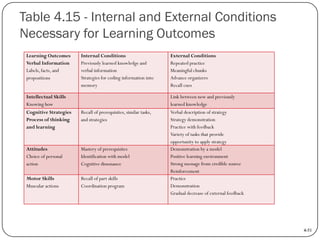
 Internal conditions: Processes within the learner

that must be present for learning to occur
 Processes include how information is registered, stored in

memory, and recalled
 External conditions: Processes in the learning

environment that facilitate learning
 Include the physical learning environment

4-50
Table 4.15 - Internal and External Conditions
Necessary for Learning Outcomes
Learning Outcomes
Verbal Information
Labels, facts, and
propositions
Intellectual Skills
Knowing how
Cognitive Strategies
Process of thinking
and learning

Internal Conditions
Previously learned knowledge and
verbal information
Strategies for coding information into
memory

Recall of prerequisites, similar tasks,
and strategies

Attitudes
Choice of personal
action

Mastery of prerequisites
Identification with model
Cognitive dissonance

Motor Skills
Muscular actions

Recall of part skills
Coordination program

External Conditions
Repeated practice
Meaningful chunks
Advance organizers
Recall cues
Link between new and previously
learned knowledge
Verbal description of strategy
Strategy demonstration
Practice with feedback
Variety of tasks that provide
opportunity to apply strategy
Demonstration by a model
Positive learning environment
Strong message from credible source
Reinforcement
Practice
Demonstration
Gradual decrease of external feedback

4-51

MBA760 Chapter 04

  • 1.
    Learning and Transferof Training Chapter 4 6th Edition Raymond A. Noe McGraw-Hill/Irwin Copyright © 2013 by The McGraw-Hill Companies, Inc. All rights reserved.
  • 2.
    Objectives • Discuss thefive types of learner outcomes • Explain the implications of learning theory for instructional design • Incorporate adult learning theory into the design of a training program • Describe how learners receive, process, store, retrieve, and act upon information 4-2
  • 3.
    Objectives  Discuss theinternal conditions (within the learner) and external conditions (learning environment) necessary for the trainee to learn each type of capability  Discuss the implications of open and closed skills and near and far transfer for designing training programs  Explain the features of instruction and the work environment that are necessary for learning and transfer of training 4-3
  • 4.
    Introduction  Certain conditionsmust be present for learning to occur:  Provide opportunities for trainees to practice and receive feedback  Offer meaningful training content  Identify any prerequisites that trainees need to complete the program successfully  Allow trainees to learn through observation and experience and ensure that the work environment supports use of skills 4-4
  • 5.
    Introduction  Transfer oftraining: Trainees effectively and continually applying what they have learned in training to their jobs  Generalization: Trainee’s ability to apply what they learned to on-the job work problems  Maintenance: Process of trainees continuing to use what they learned over time 4-5
  • 6.
    Table 4.1 –Learning Outcomes Type of Learning Outcome Verbal information Intellectual skills Motor skills Attitudes Cognitive strategies Description of Capability Example State, tell, or describe previously stored information. Apply generalizable concepts and rules to solve problems and generate novel products. Execute a physical action with precision and timing. Choose a personal course of action. State three reasons for following company safety procedures. Design and code a computer program that meets customer requirements. Shoot a gun and consistently hit a small moving target. Choose to respond to all incoming mail within 24 hours. Use three different strategies selectively to diagnose engine malfunctions. Manage one's own thinking and learning processes. 4-6
  • 7.
    Figure 4.1 AModel of Learning and Transfer of Training Trainee Characteristics Training Design Learning Transfer of Training • Generalization • Maintenance Work Environment 4-7
  • 8.
    Learning Theories Reinforcement Theory Social Learning Theory GoalTheories Need Theories Expectancy Theory Adult Learning Theory Information Processing Theory 4-8
  • 9.
    Reinforcement Theory  Emphasizesthat people are motivated to perform or avoid certain behaviors because of past outcomes that have resulted from those behaviors  Processes in reinforcement theory  Positive reinforcement  Negative reinforcement  Extinction  Punishment  The trainer needs to identify what outcomes the learner finds most positive and negative 4-9
  • 10.
    Reinforcement Theory  Trainersthen need to link these outcomes to learners acquiring knowledge, skills, or changing behaviours  Trainers can withhold or provide job-related, personal, and career-related benefits to learners who master program content  Behavior modification is a training method that is primarily based on reinforcement theory  Employees were encouraged to increase the number of safe behaviors they demonstrated on the job 4-10
  • 11.
    Social Learning Theory Emphasizes that people learn by observing other persons (models) whom they believe are credible and knowledgeable  The theory recognizes that behavior that is reinforced or rewarded tends to be repeated  Learning new skills or behavior comes from:  Directly experiencing the consequences of using a behavior or skill  The process of observing others and seeing the consequences of their behavior 4-11
  • 12.
    Social Learning Theory Person’s self-efficacy can be increased using several methods  Verbal persuasion  Logical verification  Observation of others (modeling)  Past accomplishments 4-12
  • 13.
    Figure 4.2 -Processes of Social Learning Theory Attention • Model Stimuli • Trainee • Characteristics Retention • Coding • Organization • Rehearsal Motor Reproduction • Physical Capability • Accuracy • Feedback Motivational Processes • Reinforcement Match Modeled Performance 4-13
  • 14.
    Goal Theories  Goalsetting theory: Assumes that behavior results from a person’s conscious goals and intentions  Goals influence a person’s behavior by:  Directing energy and attention  Sustaining effort over time  Motivating the person to develop strategies for goal attainment 4-14
  • 15.
    Goal Theories  Goalsetting theory  It is used in training program design  It suggests that learning can be facilitated by providing trainees with specific challenging goals and objectives  The influence of goal setting theory can be seen in the development of training lesson plans 4-15
  • 16.
    Goal Theories  Goalorientation: Goals held by a trainee in a learning situation  Includes learning and performance orientation  Learning orientation: Trying to increase ability or competence in a task  Performance orientation: Learners who focus on task performance and how they compare to others 4-16
  • 17.
    Goal Theories  Goalorientation  It affects the amount of effort a trainee will expend in learning (motivation to learn)  Learners with a high learning orientation will direct greater attention to the task and learn for the sake of learning in comparison to learners with a performance orientation  Learners with a performance orientation will direct more attention to performing well and less effort to learning 4-17
  • 18.
    Need Theories  Helpsto explain the value that a person places on certain outcomes  Need: A deficiency that a person is experiencing at any point in time  Maslow’s and Alderfer’s need theories focused on physiological needs, relatedness needs, and growth needs 4-18
  • 19.
    Need Theories  Themajor difference between Alderfer’s and Maslow’s hierarchies of needs is that Alderfer allows the possibility that if higher-level needs are not satisfied, employees will refocus on lower-level needs  McClelland’s need theory focused primarily on needs for achievement, affiliation, and power 4-19
  • 20.
    Need Theories  Suggestthat to motivate learning, trainers should identify trainees’ needs and communicate how training program content relates to fulfilling these needs  If certain basic needs of trainees are not met, they are unlikely to be motivated to learn  Implication of need theory relates to providing employees with a choice of training programs to attend 4-20
  • 21.
    Expectancy Theory  Itsuggests that a person’s behavior is based on three factors:  Expectancies: Link between trying to perform a behavior and actually performing well  Instrumentality: Belief that performing a given behavior is associated with a particular outcome  Valence: Value that a person places on an outcome 4-21
  • 22.
    Figure 4.3 -Expectancy Theory of Motivation 4-22
  • 23.
    Adult Learning Theory Was developed out of a need for a specific theory of how adults learn  Andragogy: Theory of adult learning 4-23
  • 24.
    Adult Learning Theory Assumptions of the theory  Adults have the need to know why they are learning something  Adults have a need to be self-directed  Adults bring more work-related experiences into the learning situation  Adults enter a learning experience with a problem-centered approach to learning  Adults are motivated to learn by both extrinsic and intrinsic motivators 4-24
  • 25.
    Table 4.2 -Implications of Adult Learning Theory for Training Design Issues Implications Self-concept Mutual planning and collaboration in instruction Experience Use learner experience as basis for examples and applications Readiness Develop instruction based on the learner’s interests and competencies Time Perspective Immediate application of content Orientation to learning Problem-centered instead of subjectcentered 4-25
  • 26.
    Information Processing Theory It gives more emphasis to the internal processes that occur when training content is learned and retained  Highlights external events influencing learning  Changes in the intensity of the stimulus that affect attention  Informing the learner of the objectives to establish an expectation  Enhancing perceptual features of the material 4-26
  • 27.
    Information Processing Theory Verbal instructions, pictures, diagrams, and maps suggesting ways to code the training content so that it can be stored in memory  Meaningful learning context (examples, problems) creating cues that facilitate coding  Demonstration or verbal instructions helping to organize the learner’s response as well as facilitating the selection of the correct response 4-27
  • 28.
    Figure 4.4 –A Model of Human Information Processing 4-28
  • 29.
    Transfer of TrainingTheory  Transfer of training is more difficult when tasks during training are different from the work environment  Closed skills: Training objectives that are linked to learning specific skills that are to be identically produced by the trainee on their job  Open skills: Linked to more general learning principles 4-29
  • 30.
    Table 4.3 -Transfer of Training Theories Theory Identical elements Stimulus generalization Cognitive theory Emphasis Appropriate Conditions Training environment is Training focuses on identical to work closed skills Work environment features environment. are predictable and stable. Example: Training to use equipment. Training focuses on open skills. General principles are Work environment is applicable to many different unpredictable and highly variable. work situations. Example: Training In interpersonal skills. Meaningful material All types of training and and coding schemes environments. enhance storage and recall of training content. Type of Transfer Near Far Near and far 4-30
  • 31.
    The Learning Process Mental and physical processes  Expectancy: Mental state that the learner brings to the instructional process  Perception: Ability to organize the message from the environment so that it can be processed and acted upon  Working storage: Rehearsal and repetition of information occurs  Semantic encoding: Actual coding process of incoming messages 4-31
  • 32.
    The Learning Process Learning strategies  Rehearsal: Focuses on learning through repetition  Organizing: Requires the learner to find similarities and themes in the training material  Elaboration: Requires the trainee to relate the training material to other, more familiar knowledge 4-32
  • 33.
    The Learning Process The learning cycle involves four stages:  Concrete experience  Reflective observation  Abstract conceptualization  Active experimentation 4-33
  • 34.
    Table 4.5 –Learning Styles 4-34
  • 35.
    The Learning Process Instruction: Trainer’s manipulation of the environment in order to help trainees learn  Training context: The physical, intellectual, and emotional environment in which training occurs.  Practice: Physical or mental rehearsal of a task, knowledge, or skill to achieve proficiency in performing the task or skill or demonstrating the knowledge. 4-35
  • 36.
    Table 4.6 -Features of Instruction and the Work Environment that Facilitate Learning and Transfer of Training 4-36
  • 37.
    Table 4.8 -Characteristics of Good Training Objectives 4-37
  • 38.
    The Learning Process Pre-practice conditions  Provide information about the process or strategy  Encourage trainees to develop a strategy (metacognition) to reflect on their own learning process  Provide advance organizers  Help trainees set challenging learning goals  Create realistic expectations  Communicate performance expectations 4-38
  • 39.
    The Learning Process Overlearning: Trainees need to continue to practice even if they have been able to perform the objective several times  Error management training: Giving trainees opportunities to make errors during training and to learn from them  Massed practice: Individuals practice a task continuously, without resting 4-39
  • 40.
    The Learning Process Spaced practice: Individuals are given rest intervals within practice sessions  Spaced practice is superior to massed practice  Overall task complexity: Degree to which a task requires a number of distinct behaviors, the number of choices involved in performing the task, and the degree of uncertainty in performing the task  Mental requirements: Degree to which the task requires the subject to use or demonstrate mental skills or cognitive skills or abilities to perform the task 4-40
  • 41.
    The Learning Process Physical requirements: Degree to which the task requires the person to use or demonstrate physical skills and abilities to perform and complete the task  Whole practice: All tasks or objectives should be practiced at the same time  Part practice: An objective or task should be practiced individually as soon as each is introduced in the training program  Practice must be related to the training objectives 4-41
  • 42.
    The Learning Process To create long-term memory, training programs must be explicit on content and elaborate on details  If a lengthy process or procedure is to be taught, instruction needs to be delivered in short sessions in order to not exceed memory limits  Automatization: Making performance of a task, recall of knowledge, or demonstration of a skill so automatic that it requires little thought or attention  Feedback: Information about how well people are meeting the training objectives 4-42
  • 43.
    Table 4.12 -Three Types of Instructional Interaction 4-43
  • 44.
    The Learning Process Employees learn through observation, experience, and interacting with others  Communities of practice: Groups of employees who work together, learn from each other, and develop a common understanding of how to get work accomplished 4-44
  • 45.
    The Learning Process Training administration: Coordinating activities before, during, and after the program  Communicating courses and programs to employees  Enrolling employees in courses and programs  Preparing and processing any pretraining materials  Preparing materials that will be used in instruction  Arranging for the training facility and room  Testing equipment that will be used in instruction  Having backup equipment 4-45
  • 46.
    The Learning Process Providing support during instruction  Distributing evaluation materials  Facilitating communications between trainer and trainees during and after training  Recording course completion in the trainees’ training records 4-46
  • 47.
    Encourage Trainee Responsibilityand SelfManagement  Self-management: Person’s attempt to control certain aspects of decision making and behavior  Determining the degree of support and negative consequences in the work setting  Setting goals for using learned capabilities  Applying learned capabilities  Monitoring use of learned capabilities  Engaging in self-reinforcement 4-47
  • 48.
    Ensure that theWork Environment Supports Learning and Transfer  Lapses: Take place when the trainee uses previously learned, less effective capabilities instead of trying to apply the capability emphasized in the training program  Climate for transfer: Trainees’ perceptions about a wide variety of characteristics of the work environment that facilitate or inhibit the use of trained skills or behavior 4-48
  • 49.
    Table 4.13 -Examples of Obstacles in the Work Environment That Inhibit Transfer of Training Obstacle Work Conditions Description of Influence Time pressures Inadequate equipment Few opportunities to use skills Inadequate budget Description of Influence Trainee has difficulty using new knowledge, skills, or behavior. Lack of Peer Support Peers discourage use of new knowledge and skills on the job. Peers are unwilling to provide feedback. Peers see training as waste of time. Peers do not support use of new knowledge, skills, or behavior. Lack of Management Support Management does not accept ideas or suggestions that are learned in training. Management does not discuss training opportunities. Management opposes use of skills learned in training. Management communicates that training is a waste of time. Management is unwilling to provide reinforcement, feedback, and encouragement needed for trainees to use training content. Managers do not reinforce training or provide opportunities to use new knowledge, skills, or behavior 4-49
  • 50.
    Instructional Emphasis forLearning Outcomes  Internal conditions: Processes within the learner that must be present for learning to occur  Processes include how information is registered, stored in memory, and recalled  External conditions: Processes in the learning environment that facilitate learning  Include the physical learning environment 4-50
  • 51.
    Table 4.15 -Internal and External Conditions Necessary for Learning Outcomes Learning Outcomes Verbal Information Labels, facts, and propositions Intellectual Skills Knowing how Cognitive Strategies Process of thinking and learning Internal Conditions Previously learned knowledge and verbal information Strategies for coding information into memory Recall of prerequisites, similar tasks, and strategies Attitudes Choice of personal action Mastery of prerequisites Identification with model Cognitive dissonance Motor Skills Muscular actions Recall of part skills Coordination program External Conditions Repeated practice Meaningful chunks Advance organizers Recall cues Link between new and previously learned knowledge Verbal description of strategy Strategy demonstration Practice with feedback Variety of tasks that provide opportunity to apply strategy Demonstration by a model Positive learning environment Strong message from credible source Reinforcement Practice Demonstration Gradual decrease of external feedback 4-51