Chapter Ten Training, Development, and Organizational Learning
Chapter Outline Purposes of Training and Development New Employee Orientation Assessing Training and Development Needs Designing Training and Development Programs Training and Development Techniques and Methods 10 -
Chapter Outline (cont’d) Management Development Organizational Development and Learning Evaluating Training and Development 10 -
Chapter Objectives Identify and describe the purposes of training and development. Discuss new employee orientation. Describe how training and development needs are assessed. Discuss common training and development techniques and methods. Discuss the unique considerations in management development. 10 -
Chapter Objectives (cont’d) Discuss how organizations, as well as individuals, can learn and develop. Describe how organizations can evaluate the effectiveness of their training and development programs. 10 -
Purposes of Training and Development Employee training A planned attempt by an organization to facilitate employee learning of job-related knowledge, skills, and behaviors Development Teaching managers and professionals the skills needed for both present and future jobs 10 -
The Nature of Training Training usually involves teaching operational or technical employees how to do their jobs more effectively and/or efficiently. Responsibilities for training are generally assigned to the HR function. In general, training is intended to help the organization function more effectively. Managers must be sure that productivity can be increased through training and that productivity gains are possible with existing resources. 10 -
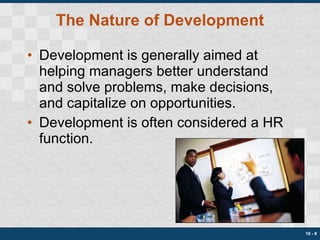
The Nature of Development Development is generally aimed at helping managers better understand and solve problems, make decisions, and capitalize on opportunities. Development is often considered a HR function. 10 -
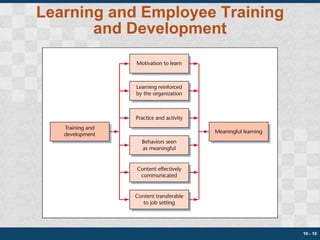
Learning Theory and Employee Training Learning A relatively permanent change in behavior or behavioral potential that results from direct or indirect experience Learning organization An organization whose employees continuously attempt to learn new information and to use what they learn to improve product or service quality 10 -
Learning and Employee Training and Development 10 -
New Employee Orientation Orientation The process of introducing new employees to the organization so that they can become effective contributors more quickly Goals of orientation To reduce anxiety and uncertainty for new employees To ease the burden of socializing newcomers for supervisors and coworkers To provide favorable initial job experiences 10 -
Basic Issues in Orientation Content of orientation Policies and procedures Work hours, compensation, schedules, who can answer questions Overview and introduction to the business Length of orientation Depends on content May include initial orientation and follow-up Who will conduct orientation HR, managers, union officials, employees 10 -
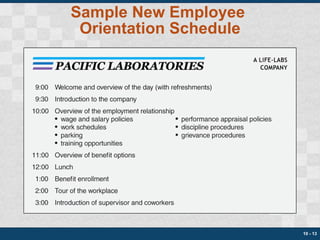
Sample New Employee  Orientation Schedule 10 -
Assessing Training and  Development Needs Needs analysis The assessment of the organization’s job-related needs and the capabilities of the current workforce The manager must carefully assess the company’s: Strategy Resources available for training General philosophy regarding training and development Decision must be made about training employees for current jobs versus for future jobs 10 -
Setting Training and Development Goals The organization should know in advance what it expects of its employees prior to training. The HR manager planning the training must look at the current state of affairs, decide what changes are necessary, and formulate these changes into specific training development goals. Goals should be objective, verifiable, and specific. 10 -
In-House Versus Outsourced Programs In-house training or development program Is conducted on the organization’s premises primarily by the organization’s employees Content can be tailored to the organization Scheduling can be flexible 10 -
In-House Versus Outsourced Programs (cont’d) Outsourced training or development program Involves having people from outside the organization perform the training Cost can be lower than in-house training Professional trainers assure quality Program may be generic rather than tailored to the organization 10 -
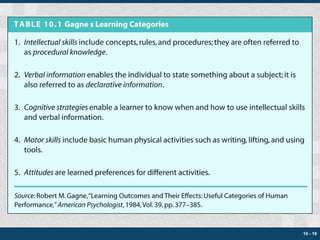
Designing Training and Development Programs The first steps are outlining and defining training and development program content. Then define the content, which specifies the material that is intended to be taught. Another approach is to focus on what is to be learned. More complex training requires a more complex definition of content. 10 -
10 -
Selecting Training and Development Instructors The most common choices regarding instructors are whether to use full-time professional trainers (who might be hired from an external firm or are part of an in-house training staff) or use operating managers. These individuals may be experts on the task to be taught, but poor instructors. Professional trainers is the other choice. 10 -
Training and Development Techniques and Methods Work-based programs Tie the training and development activities directly to the performance of the task On-the-job training Having employees learn their job while they are actually performing it Apprenticeship A combination of on-the-job and classroom instruction 10 -
Training and Development Techniques and Methods (cont’d) Work-based programs (cont’d) Vestibule training A work-simulation situation in which the job is performed under a condition that closely simulates the real work environment Systematic job rotation and transfer Systematically rotating or transferring the employee from one job to another 10 -
Training and Development Techniques and Methods (cont’d) Instructional-based programs Approach training and development from a teaching and learning perspective Lecture or discussion approach A trainer presents the material to those attending the program in a descriptive fashion Computer-assisted instruction A trainee sits at a personal computer and operates software that has been developed specifically to impart certain information to the individual 10 -
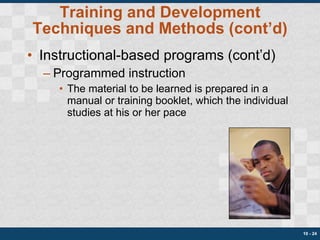
Training and Development Techniques and Methods (cont’d) Instructional-based programs (cont’d) Programmed instruction The material to be learned is prepared in a manual or training booklet, which the individual studies at his or her pace 10 -
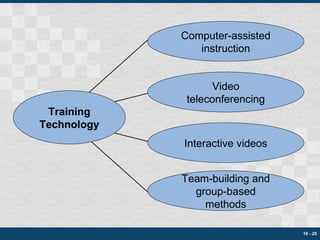
10 -  Training Technology Computer-assisted instruction Team-building and group-based methods Video teleconferencing Interactive videos
Special Needs for  Management Development Rather than attending a single training program, managers may need to participate in different programs that span a long time. Management development may be subject to different opportunities and limitations regarding materials, training methods, and modes of instruction. The learner may need to be an active participant in a development program. 10 -
Special Techniques for  Management Development In-basket exercise The trainee must play the role of manager in dealing with a hypothetical in-basket of letters, memos, reports, phone messages, and e-mail messages. Leaderless group exercise A group of trainees are placed together in a group setting and told to make a decision or solve a problem. 10 -
Organizational Development An effort that is planned systemwide and managed from the top of the organization to increase the organization’s overall performance through planned interventions Relies heavily on behavioral science technology Techniques: diagnostic OD, survey feedback OD, third-party peacemaking, process consultation 10 -
Organizational Learning The process by which an organization “learns” from past mistakes and adapts to its environment Begins with individual learning and change Depends on social processes and sharing Organizational memory The collective, institutional record of past events 10 -
Evaluating Training and Development Performance before training should be measured. When training has been completed, all trainees should be able to demonstrate capabilities from the training. For management development, organizations can rely on evaluations completed by the trainees after a particular training program. 10 -
Design of Training Programs General training Providing trainees with skills and abilities that can be applied in any organization May result in increased turnover Specific training Providing trainees with skills or information that is of use only to the present organization 10 -

Training And Development

  • 1.
    Chapter Ten Training,Development, and Organizational Learning
  • 2.
    Chapter Outline Purposesof Training and Development New Employee Orientation Assessing Training and Development Needs Designing Training and Development Programs Training and Development Techniques and Methods 10 -
  • 3.
    Chapter Outline (cont’d)Management Development Organizational Development and Learning Evaluating Training and Development 10 -
  • 4.
    Chapter Objectives Identifyand describe the purposes of training and development. Discuss new employee orientation. Describe how training and development needs are assessed. Discuss common training and development techniques and methods. Discuss the unique considerations in management development. 10 -
  • 5.
    Chapter Objectives (cont’d)Discuss how organizations, as well as individuals, can learn and develop. Describe how organizations can evaluate the effectiveness of their training and development programs. 10 -
  • 6.
    Purposes of Trainingand Development Employee training A planned attempt by an organization to facilitate employee learning of job-related knowledge, skills, and behaviors Development Teaching managers and professionals the skills needed for both present and future jobs 10 -
  • 7.
    The Nature ofTraining Training usually involves teaching operational or technical employees how to do their jobs more effectively and/or efficiently. Responsibilities for training are generally assigned to the HR function. In general, training is intended to help the organization function more effectively. Managers must be sure that productivity can be increased through training and that productivity gains are possible with existing resources. 10 -
  • 8.
    The Nature ofDevelopment Development is generally aimed at helping managers better understand and solve problems, make decisions, and capitalize on opportunities. Development is often considered a HR function. 10 -
  • 9.
    Learning Theory andEmployee Training Learning A relatively permanent change in behavior or behavioral potential that results from direct or indirect experience Learning organization An organization whose employees continuously attempt to learn new information and to use what they learn to improve product or service quality 10 -
  • 10.
    Learning and EmployeeTraining and Development 10 -
  • 11.
    New Employee OrientationOrientation The process of introducing new employees to the organization so that they can become effective contributors more quickly Goals of orientation To reduce anxiety and uncertainty for new employees To ease the burden of socializing newcomers for supervisors and coworkers To provide favorable initial job experiences 10 -
  • 12.
    Basic Issues inOrientation Content of orientation Policies and procedures Work hours, compensation, schedules, who can answer questions Overview and introduction to the business Length of orientation Depends on content May include initial orientation and follow-up Who will conduct orientation HR, managers, union officials, employees 10 -
  • 13.
    Sample New Employee Orientation Schedule 10 -
  • 14.
    Assessing Training and Development Needs Needs analysis The assessment of the organization’s job-related needs and the capabilities of the current workforce The manager must carefully assess the company’s: Strategy Resources available for training General philosophy regarding training and development Decision must be made about training employees for current jobs versus for future jobs 10 -
  • 15.
    Setting Training andDevelopment Goals The organization should know in advance what it expects of its employees prior to training. The HR manager planning the training must look at the current state of affairs, decide what changes are necessary, and formulate these changes into specific training development goals. Goals should be objective, verifiable, and specific. 10 -
  • 16.
    In-House Versus OutsourcedPrograms In-house training or development program Is conducted on the organization’s premises primarily by the organization’s employees Content can be tailored to the organization Scheduling can be flexible 10 -
  • 17.
    In-House Versus OutsourcedPrograms (cont’d) Outsourced training or development program Involves having people from outside the organization perform the training Cost can be lower than in-house training Professional trainers assure quality Program may be generic rather than tailored to the organization 10 -
  • 18.
    Designing Training andDevelopment Programs The first steps are outlining and defining training and development program content. Then define the content, which specifies the material that is intended to be taught. Another approach is to focus on what is to be learned. More complex training requires a more complex definition of content. 10 -
  • 19.
  • 20.
    Selecting Training andDevelopment Instructors The most common choices regarding instructors are whether to use full-time professional trainers (who might be hired from an external firm or are part of an in-house training staff) or use operating managers. These individuals may be experts on the task to be taught, but poor instructors. Professional trainers is the other choice. 10 -
  • 21.
    Training and DevelopmentTechniques and Methods Work-based programs Tie the training and development activities directly to the performance of the task On-the-job training Having employees learn their job while they are actually performing it Apprenticeship A combination of on-the-job and classroom instruction 10 -
  • 22.
    Training and DevelopmentTechniques and Methods (cont’d) Work-based programs (cont’d) Vestibule training A work-simulation situation in which the job is performed under a condition that closely simulates the real work environment Systematic job rotation and transfer Systematically rotating or transferring the employee from one job to another 10 -
  • 23.
    Training and DevelopmentTechniques and Methods (cont’d) Instructional-based programs Approach training and development from a teaching and learning perspective Lecture or discussion approach A trainer presents the material to those attending the program in a descriptive fashion Computer-assisted instruction A trainee sits at a personal computer and operates software that has been developed specifically to impart certain information to the individual 10 -
  • 24.
    Training and DevelopmentTechniques and Methods (cont’d) Instructional-based programs (cont’d) Programmed instruction The material to be learned is prepared in a manual or training booklet, which the individual studies at his or her pace 10 -
  • 25.
    10 - Training Technology Computer-assisted instruction Team-building and group-based methods Video teleconferencing Interactive videos
  • 26.
    Special Needs for Management Development Rather than attending a single training program, managers may need to participate in different programs that span a long time. Management development may be subject to different opportunities and limitations regarding materials, training methods, and modes of instruction. The learner may need to be an active participant in a development program. 10 -
  • 27.
    Special Techniques for Management Development In-basket exercise The trainee must play the role of manager in dealing with a hypothetical in-basket of letters, memos, reports, phone messages, and e-mail messages. Leaderless group exercise A group of trainees are placed together in a group setting and told to make a decision or solve a problem. 10 -
  • 28.
    Organizational Development Aneffort that is planned systemwide and managed from the top of the organization to increase the organization’s overall performance through planned interventions Relies heavily on behavioral science technology Techniques: diagnostic OD, survey feedback OD, third-party peacemaking, process consultation 10 -
  • 29.
    Organizational Learning Theprocess by which an organization “learns” from past mistakes and adapts to its environment Begins with individual learning and change Depends on social processes and sharing Organizational memory The collective, institutional record of past events 10 -
  • 30.
    Evaluating Training andDevelopment Performance before training should be measured. When training has been completed, all trainees should be able to demonstrate capabilities from the training. For management development, organizations can rely on evaluations completed by the trainees after a particular training program. 10 -
  • 31.
    Design of TrainingPrograms General training Providing trainees with skills and abilities that can be applied in any organization May result in increased turnover Specific training Providing trainees with skills or information that is of use only to the present organization 10 -