Exothermic and Endothermic
Reactions
© Teachable . Some rights reserved. http://teachable.net/res.asp?r=1910
By,
Abhinav.B
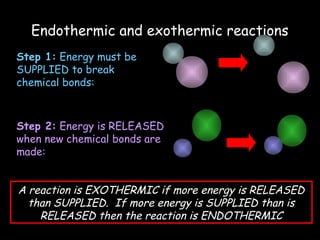
Endothermic and exothermic reactions
Step 1: Energy must be
SUPPLIED to break
chemical bonds:
Step 2: Energy is RELEASED
when new chemical bonds are
made:
A reaction is EXOTHERMIC if more energy is RELEASED
than SUPPLIED. If more energy is SUPPLIED than is
RELEASED then the reaction is ENDOTHERMIC
© Teachable . Some rights reserved. http://teachable.net/res.asp?r=1910
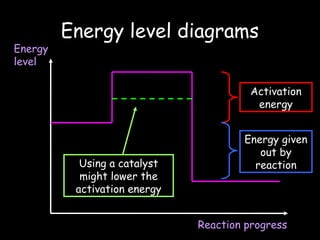
Energy level diagrams
Energy
level
Reaction progress
Activation
energy
Energy given
out by
reactionUsing a catalyst
might lower the
activation energy
© Teachable . Some rights reserved. http://teachable.net/res.asp?r=1910
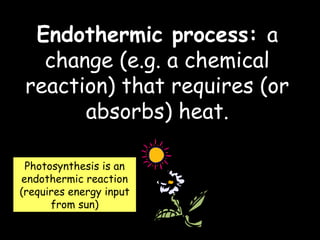
Endothermic process: a
change (e.g. a chemical
reaction) that requires (or
absorbs) heat.
Photosynthesis is an
endothermic reaction
(requires energy input
from sun)
Forming Na+
and Cl-
ions
from NaCl is an
endothermic
process
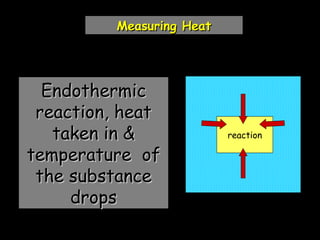
Measuring HeatMeasuring Heat
reaction
EndothermicEndothermic
reaction, heatreaction, heat
taken in &taken in &
temperature oftemperature of
the substancethe substance
dropsdrops
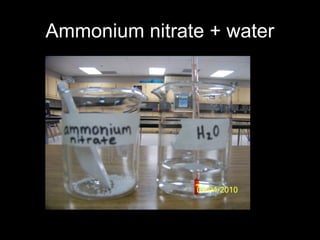
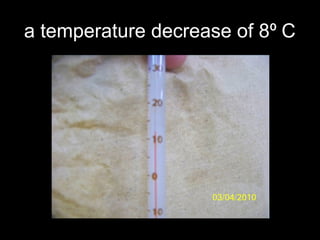
Ammonium nitrate + water
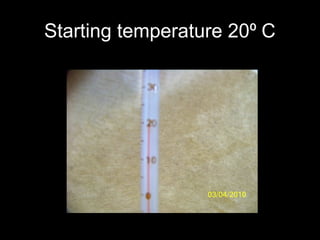
Starting temperature 20 C⁰
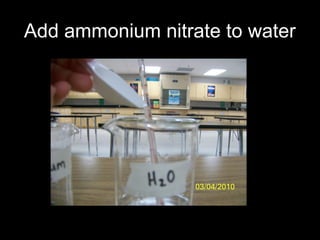
Add ammonium nitrate to water
a temperature decrease of 8 C⁰
EXOTHERMIC & ENDOTHERMIC REACTIONSEXOTHERMIC & ENDOTHERMIC REACTIONS
Exothermic process: a
change (e.g. a chemical
reaction) that releases
heat.
Burning fossil
fuels is an
exothermic
reaction
Heat Released
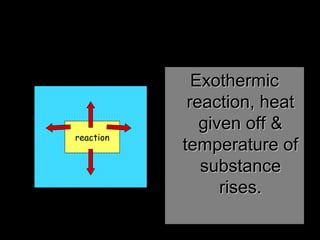
ExothermicExothermic
reaction, heatreaction, heat
given off &given off &
temperature oftemperature of
substancesubstance
rises.rises.
reaction
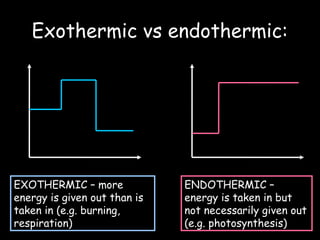
Exothermic vs endothermic:
EXOTHERMIC – more
energy is given out than is
taken in (e.g. burning,
respiration)
ENDOTHERMIC –
energy is taken in but
not necessarily given out
(e.g. photosynthesis)
© Teachable . Some rights reserved. http://teachable.net/res.asp?r=1910
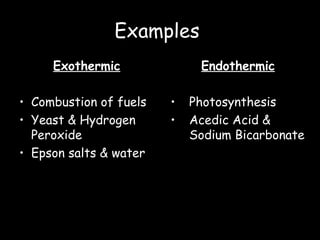
Examples
Exothermic
• Combustion of fuels
• Yeast & Hydrogen
Peroxide
• Epson salts & water
Endothermic
• Photosynthesis
• Acedic Acid &
Sodium Bicarbonate
© Teachable . Some rights reserved. http://teachable.net/res.asp?r=1910

Exothermic and endothermic_reactions