Launch: 9/25
  Grab your binder and immediately take a seat
  Place Textbook HW on desk
5. The chart below shows the relationship between
   the first ionization energy and the increase in
   atomic number. The letter on the chart that
   represents the noble gases is:
     a. W
     b. X
     c. Y
     d. Z
What is the trend for
 electronegativity?
       Mr. Heffner
        9/25/09
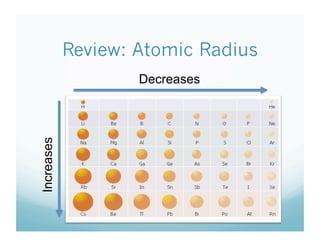
Review: Atomic Radius
                    Decreases
Increases
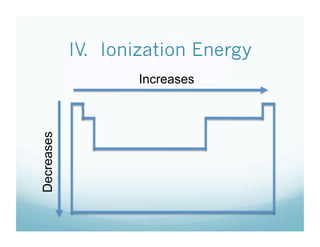
IV. Ionization Energy
                    Increases
Decreases
V. Electronegativity
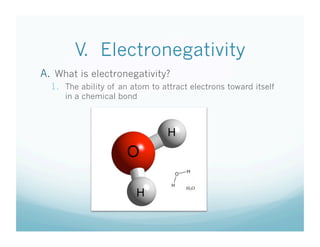
A.  What is electronegativity?
  1.  The ability of an atom to attract electrons toward itself
     in a chemical bond


                                 H
                      O

                         H
V. Electronegativity
B.  What is the trend for electronegativity?
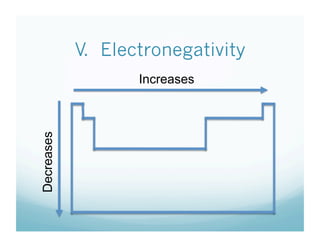
  1.  Electronegativity increases across a period (LR)
    i.  As the number of protons increases, the nucleus gets
       stronger and pulls all nearby electrons towards it
V. Electronegativity
B.  What is the trend for electronegativity?
  2.  Electronegativity decreases down a group (TopBottom)
    i.  As the number of electrons increases, more rings are added
    ii.  The inner rings shield other electrons from the attractive
       forces of the nucleus
V. Electronegativity
                   Increases
Decreases
Practice Questions
  See Periodic Trends Worksheet
Homework
  Study for Monday’s Unit #2 Exam!
    Look over Quiz #3
    Look over Exit Slips

  lpschem.wordpress.com
Exit Slip
1. Electronegativity is the
  a. energy it takes to remove an electron from an atom.
  b. number of protons and neutrons in an atom.
  c. ability of an atom to attract electrons toward itself in
      a chemical bond
  d. distance from the nucleus to the valence ring.
Exit Slip
2. In general, how does electronegativity vary
  throughout the periodic table?
  a. it decreases across a period from left to right, and
     decreases down a group from top to bottom
  b. it increases across a period from left to right, and
     increases down a group from top to bottom
  c. it increases across a period from left to right, and
     decreases down a group from top to bottom
  d. It decreases across a period from left to right, and
     increases down a group from top to bottom
Exit Slip
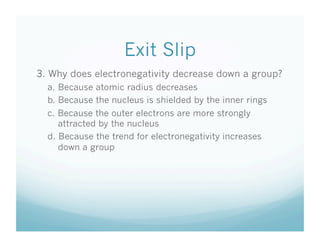
3. Why does electronegativity decrease down a group?
  a. Because atomic radius decreases
  b. Because the nucleus is shielded by the inner rings
  c. Because the outer electrons are more strongly
     attracted by the nucleus
  d. Because the trend for electronegativity increases
     down a group
Exit Slip
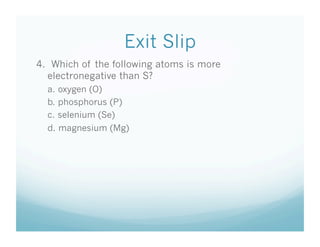
4. Which of the following atoms is more
  electronegative than S?
  a. oxygen (O)
  b. phosphorus (P)
  c. selenium (Se)
  d. magnesium (Mg)
Exit Slip
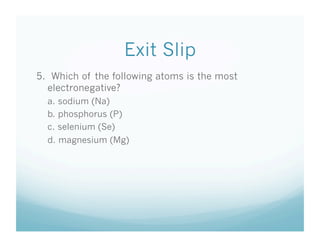
5. Which of the following atoms is the most
  electronegative?
  a. sodium (Na)
  b. phosphorus (P)
  c. selenium (Se)
  d. magnesium (Mg)

9/25 What is the trend for electronegativity?

  • 1.
    Launch: 9/25   Grabyour binder and immediately take a seat   Place Textbook HW on desk 5. The chart below shows the relationship between the first ionization energy and the increase in atomic number. The letter on the chart that represents the noble gases is: a. W b. X c. Y d. Z
  • 2.
    What is thetrend for electronegativity? Mr. Heffner 9/25/09
  • 3.
    Review: Atomic Radius Decreases Increases
  • 4.
    IV. Ionization Energy Increases Decreases
  • 5.
    V. Electronegativity A.  Whatis electronegativity? 1.  The ability of an atom to attract electrons toward itself in a chemical bond H O H
  • 6.
    V. Electronegativity B.  Whatis the trend for electronegativity? 1.  Electronegativity increases across a period (LR) i.  As the number of protons increases, the nucleus gets stronger and pulls all nearby electrons towards it
  • 7.
    V. Electronegativity B.  Whatis the trend for electronegativity? 2.  Electronegativity decreases down a group (TopBottom) i.  As the number of electrons increases, more rings are added ii.  The inner rings shield other electrons from the attractive forces of the nucleus
  • 8.
    V. Electronegativity Increases Decreases
  • 9.
    Practice Questions   SeePeriodic Trends Worksheet
  • 10.
    Homework   Study forMonday’s Unit #2 Exam!   Look over Quiz #3   Look over Exit Slips   lpschem.wordpress.com
  • 11.
    Exit Slip 1. Electronegativityis the a. energy it takes to remove an electron from an atom. b. number of protons and neutrons in an atom. c. ability of an atom to attract electrons toward itself in a chemical bond d. distance from the nucleus to the valence ring.
  • 12.
    Exit Slip 2. Ingeneral, how does electronegativity vary throughout the periodic table? a. it decreases across a period from left to right, and decreases down a group from top to bottom b. it increases across a period from left to right, and increases down a group from top to bottom c. it increases across a period from left to right, and decreases down a group from top to bottom d. It decreases across a period from left to right, and increases down a group from top to bottom
  • 13.
    Exit Slip 3. Whydoes electronegativity decrease down a group? a. Because atomic radius decreases b. Because the nucleus is shielded by the inner rings c. Because the outer electrons are more strongly attracted by the nucleus d. Because the trend for electronegativity increases down a group
  • 14.
    Exit Slip 4. Whichof the following atoms is more electronegative than S? a. oxygen (O) b. phosphorus (P) c. selenium (Se) d. magnesium (Mg)
  • 15.
    Exit Slip 5. Whichof the following atoms is the most electronegative? a. sodium (Na) b. phosphorus (P) c. selenium (Se) d. magnesium (Mg)