

PERIODICITY
Name : SHANTO
Dep : ELECTRICAL
& ELECTRONICS
ENGINEERING
Periodicity Definition
Mendeleev organized elements according to recurring
properties to make a periodic table of elements. Elements
within a group (column) display similar characteristics.
The rows in the periodic table (the periods) reflect
the filling of electrons shells around the nucleus, so when
a new row begins, the elements stack on top of each other
with similar properties. For example, helium and neon
are both fairly unreactive gases that glow when an electric
current is passed through them. Lithium and sodium both
have a +1 oxidation state and are reactive, shiny metals.
Periodic Properties
 Periodic law = elements arranged by atomic number gives
physical and chemical properties varying periodically.
 We will study the following periodic trends:
Atomic radius
Ionization energy
Electron affinity
Electronegativity
Atomic radius : It is the distance from the center of the nucleus
to the point up to which the density of the electron cloud is
maximum.
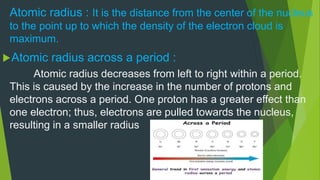
Atomic radius across a period :
Atomic radius decreases from left to right within a period.
This is caused by the increase in the number of protons and
electrons across a period. One proton has a greater effect than
one electron; thus, electrons are pulled towards the nucleus,
resulting in a smaller radius
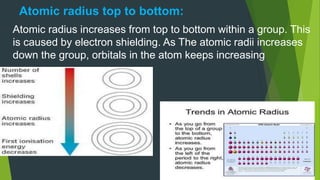
Atomic radius top to bottom:
Atomic radius increases from top to bottom within a group. This
is caused by electron shielding. As The atomic radii increases
down the group, orbitals in the atom keeps increasing
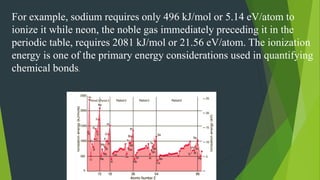
The ionization energy or ionization potential is
theenergy necessary to remove an electron from the neutral
atom. It is a minimum for the alkali metals which have a single
electron outside a closed shell. It generally increases across a
row on the periodic maximum for the noble gases which have
closed shells.
Ionization Potential :
For example, sodium requires only 496 kJ/mol or 5.14 eV/atom to
ionize it while neon, the noble gas immediately preceding it in the
periodic table, requires 2081 kJ/mol or 21.56 eV/atom. The ionization
energy is one of the primary energy considerations used in quantifying
chemical bonds.
Electron Affinity
Electron affinity is defined as the change in energy
(in kJ/mole) of a neutral atom(in the gaseous phase) when
an electron is added to the atom to form a negative ion.
Definition
Types of Electron Affinity
Exothermic & Endothermic
Exothermic : X(g)+ e− → X− (g) …… ∆H = +ve kj/mole
Endothermic : X(g)+ e− → X− (g) …… ∆H = -ve kj/mole
First & Second Electron Affinity
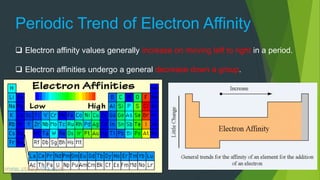
Periodic Trend of Electron Affinity
 Electron affinity values generally increase on moving left to right in a period.
 Electron affinities undergo a general decrease down a group.
Electronegativity
The force of attraction by which an atom attracts
a shared pair of electrons called electronegativity.
No electronegativity difference between two atoms leads
to a pure non-polar covalent bond.
•A small electronegativity difference leads to a polar covalent
bond.
•A large electronegativity difference leads to an ionic bond.
Summary

Periodicity

  • 1.
  • 2.
    Name : SHANTO Dep: ELECTRICAL & ELECTRONICS ENGINEERING
  • 3.
    Periodicity Definition Mendeleev organizedelements according to recurring properties to make a periodic table of elements. Elements within a group (column) display similar characteristics. The rows in the periodic table (the periods) reflect the filling of electrons shells around the nucleus, so when a new row begins, the elements stack on top of each other with similar properties. For example, helium and neon are both fairly unreactive gases that glow when an electric current is passed through them. Lithium and sodium both have a +1 oxidation state and are reactive, shiny metals.
  • 4.
    Periodic Properties  Periodiclaw = elements arranged by atomic number gives physical and chemical properties varying periodically.  We will study the following periodic trends: Atomic radius Ionization energy Electron affinity Electronegativity
  • 5.
    Atomic radius :It is the distance from the center of the nucleus to the point up to which the density of the electron cloud is maximum. Atomic radius across a period : Atomic radius decreases from left to right within a period. This is caused by the increase in the number of protons and electrons across a period. One proton has a greater effect than one electron; thus, electrons are pulled towards the nucleus, resulting in a smaller radius
  • 6.
    Atomic radius topto bottom: Atomic radius increases from top to bottom within a group. This is caused by electron shielding. As The atomic radii increases down the group, orbitals in the atom keeps increasing
  • 7.
    The ionization energyor ionization potential is theenergy necessary to remove an electron from the neutral atom. It is a minimum for the alkali metals which have a single electron outside a closed shell. It generally increases across a row on the periodic maximum for the noble gases which have closed shells. Ionization Potential :
  • 8.
    For example, sodiumrequires only 496 kJ/mol or 5.14 eV/atom to ionize it while neon, the noble gas immediately preceding it in the periodic table, requires 2081 kJ/mol or 21.56 eV/atom. The ionization energy is one of the primary energy considerations used in quantifying chemical bonds.
  • 9.
  • 10.
    Electron affinity isdefined as the change in energy (in kJ/mole) of a neutral atom(in the gaseous phase) when an electron is added to the atom to form a negative ion. Definition
  • 11.
    Types of ElectronAffinity Exothermic & Endothermic Exothermic : X(g)+ e− → X− (g) …… ∆H = +ve kj/mole Endothermic : X(g)+ e− → X− (g) …… ∆H = -ve kj/mole First & Second Electron Affinity
  • 12.
    Periodic Trend ofElectron Affinity  Electron affinity values generally increase on moving left to right in a period.  Electron affinities undergo a general decrease down a group.
  • 13.
    Electronegativity The force ofattraction by which an atom attracts a shared pair of electrons called electronegativity.
  • 14.
    No electronegativity differencebetween two atoms leads to a pure non-polar covalent bond. •A small electronegativity difference leads to a polar covalent bond. •A large electronegativity difference leads to an ionic bond.
  • 15.