1
THE PERIODIC TABLE
A listing of elements in an array such that
atomic numbers increase from left to right
and elements in any column have similar
outer electronic structures.
ROWS = PERIODS
COLUMNS = GROUPS
2
CLASSES OF ELEMENTS
1. REPRESENTATIVE ELEMENTS
The differentiating electrons fill the s and p
orbitals, Groups IA-VIIA and Group O. These are
sometimes called MAIN GROUP ELEMENTS
2. TRANSITION ELEMENTS
The differentiating electrons fill d-orbitals.
3. INNER TRANSITION ELEMENTS
Differentiating electrons fill the f-orbitals
4f - Lanthanides
5f - Actinides
3
PERIODIC PROPERTIES
1. ATOMIC RADIUS
2. IONISATION ENERGY
3. ELECTRON AFFINITY
4. ELECTRONEGATIVITY
4
ATOMIC RADIUS
nm
0.099
2
0.198
Radius
Atomic
Cl2 

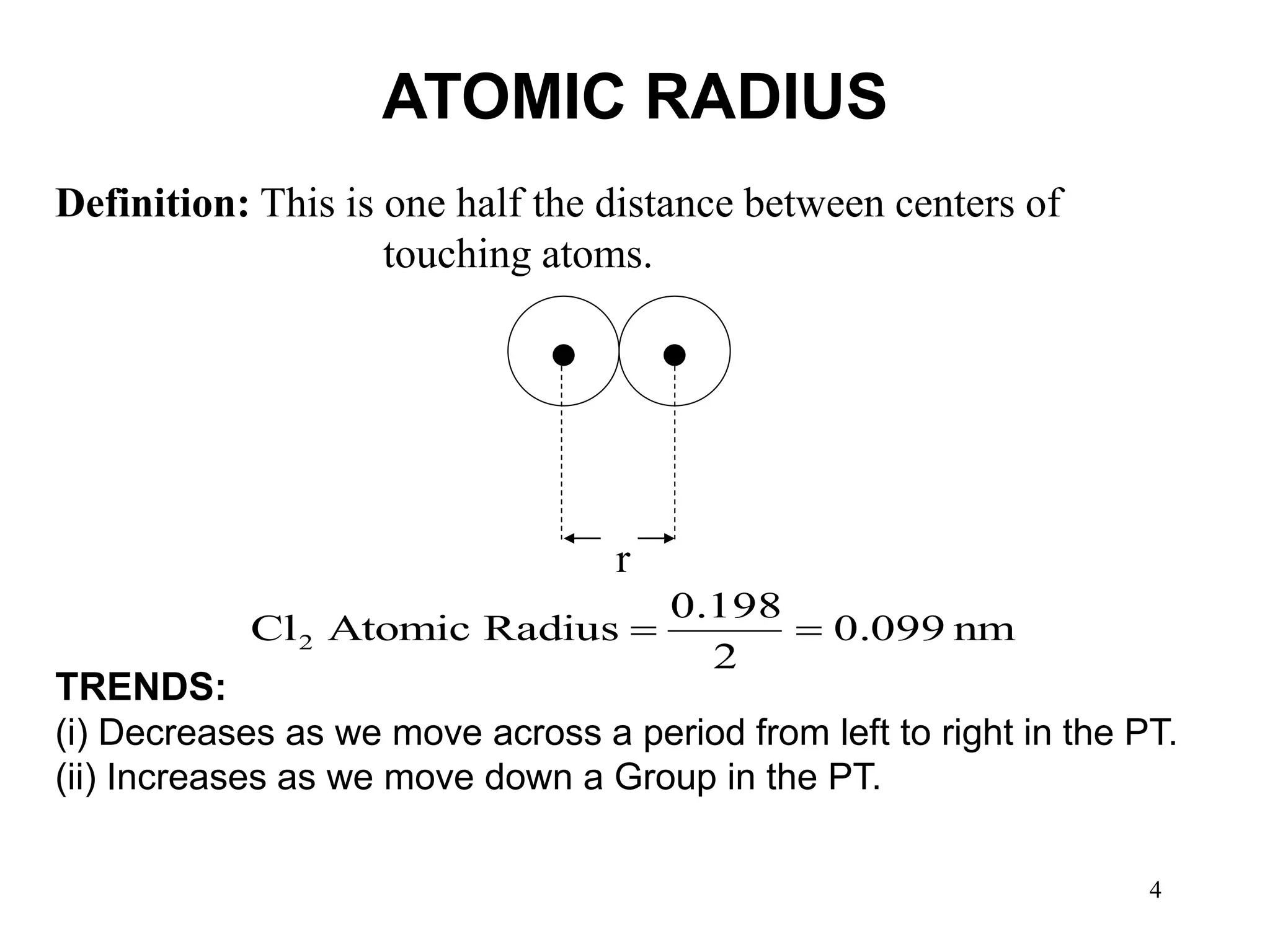
Definition: This is one half the distance between centers of
touching atoms.
r
TRENDS:
(i) Decreases as we move across a period from left to right in the PT.
(ii) Increases as we move down a Group in the PT.
5
RATIONALE:
Across a Period
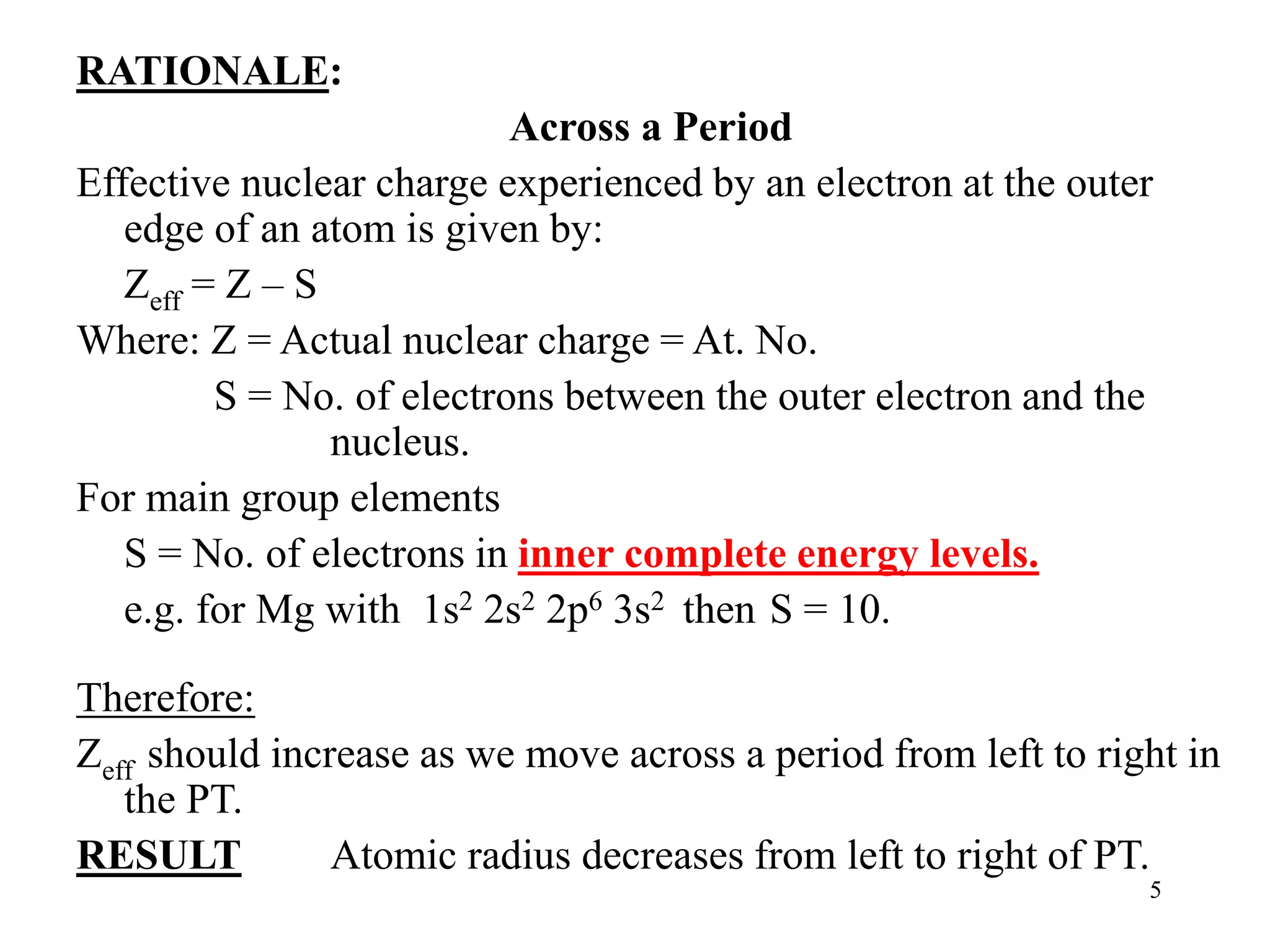
Effective nuclear charge experienced by an electron at the outer
edge of an atom is given by:
Zeff = Z – S
Where: Z = Actual nuclear charge = At. No.
S = No. of electrons between the outer electron and the
nucleus.
For main group elements
S = No. of electrons in inner complete energy levels.
e.g. for Mg with 1s2 2s2 2p6 3s2 then S = 10.
Therefore:
Zeff should increase as we move across a period from left to right in
the PT.
RESULT Atomic radius decreases from left to right of PT.
6
Down the Group:
 Down the Group, Zeff experienced by an outer electron
remains essentially constant.
 However, the distance of the electron from the nucleus
increases with the Principal Quantum Number.
At. No. S Zeff
H = 1s1 1 1
Li = 1s2 2s1 3 2 1
Na = 1s2 2s2 2p6 3s1 11 10 1
K = 1s2 2s2 2p6 3s2 3p6 4s1 19 18 1
 Hence: Atomic Radius increases as we move down the
Group in the PT.
7
FIRST IONISATION ENERGY
Definition:
 The energy that must be absorbed to remove the outermost
electron from a gaseous atom.
Mg(g)  Mg+
(g) + e-
TRENDS:
i. Increases as we move across a period (from LEFT to RIGHT)
in the Periodic Table.
ii. Decreases as we move down a Group in the Periodic Table.
There are some exceptions:
e.g. 1st ionization Energy actually decreases as one moves across
from Be (900 kJ/mol) to B (801 kJ/mol).
Be = 1s2 2s2
B = 1s2 2s2 2p1
Since 2p level is higher in Energy than 2s
it easier to remove an electron from 2p
8
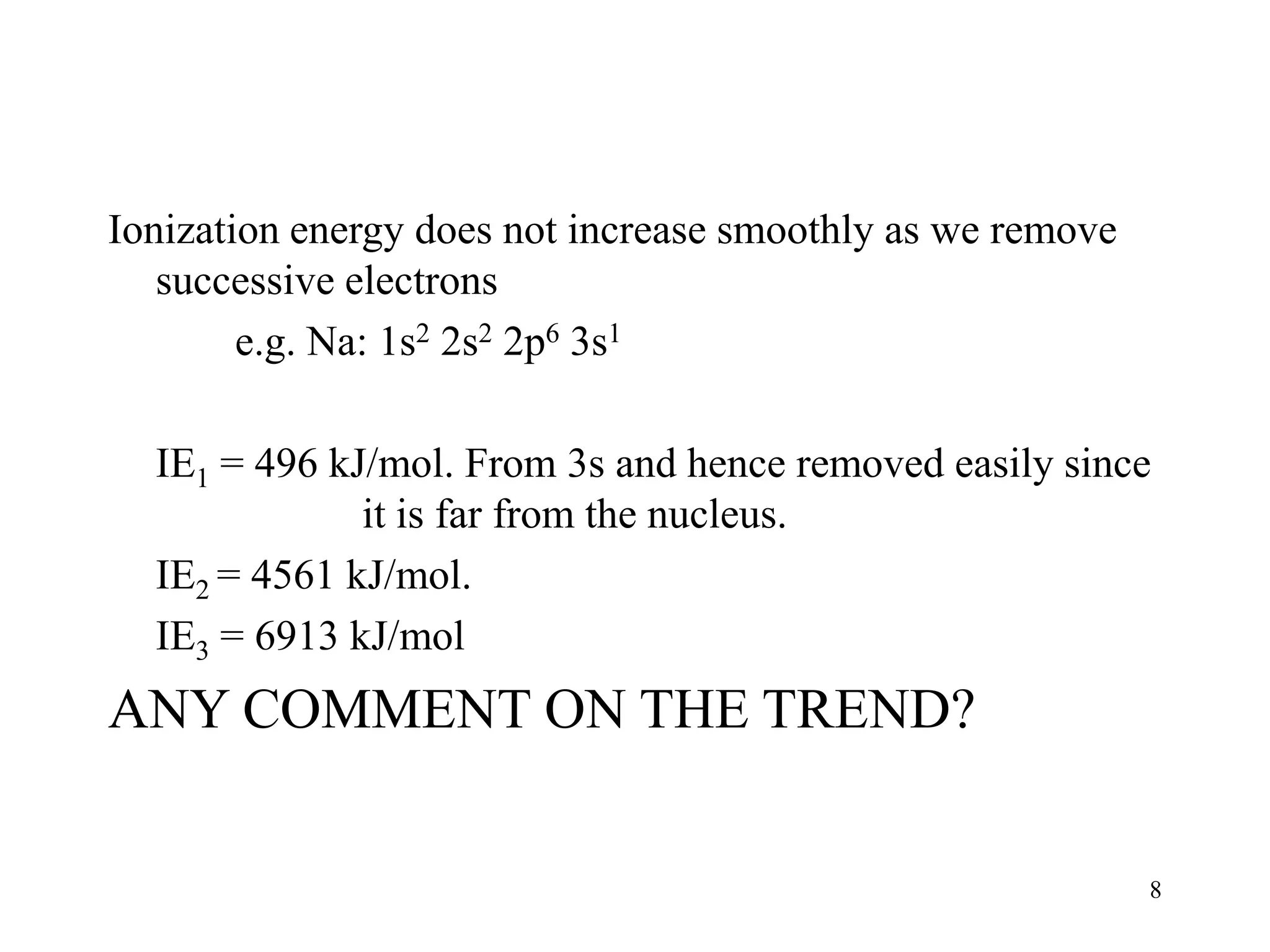
Ionization energy does not increase smoothly as we remove
successive electrons
e.g. Na: 1s2 2s2 2p6 3s1
IE1 = 496 kJ/mol. From 3s and hence removed easily since
it is far from the nucleus.
IE2 = 4561 kJ/mol.
IE3 = 6913 kJ/mol
ANY COMMENT ON THE TREND?
9
ELECTRON AFFINITY
Definition: The energy change that occurs when an electron is
added to a gaseous atom or ion.
i.e. (i) M(g) + e-  M-
(g) [Neutral atom]
(ii) M+
(g) + e-  M(g) [an ion of charge +1]
TRENDS:
(i) Across a Period
In general electron affinities become more negative (stronger
attraction for an electron) from LEFT to RIGHT of the PT.
10
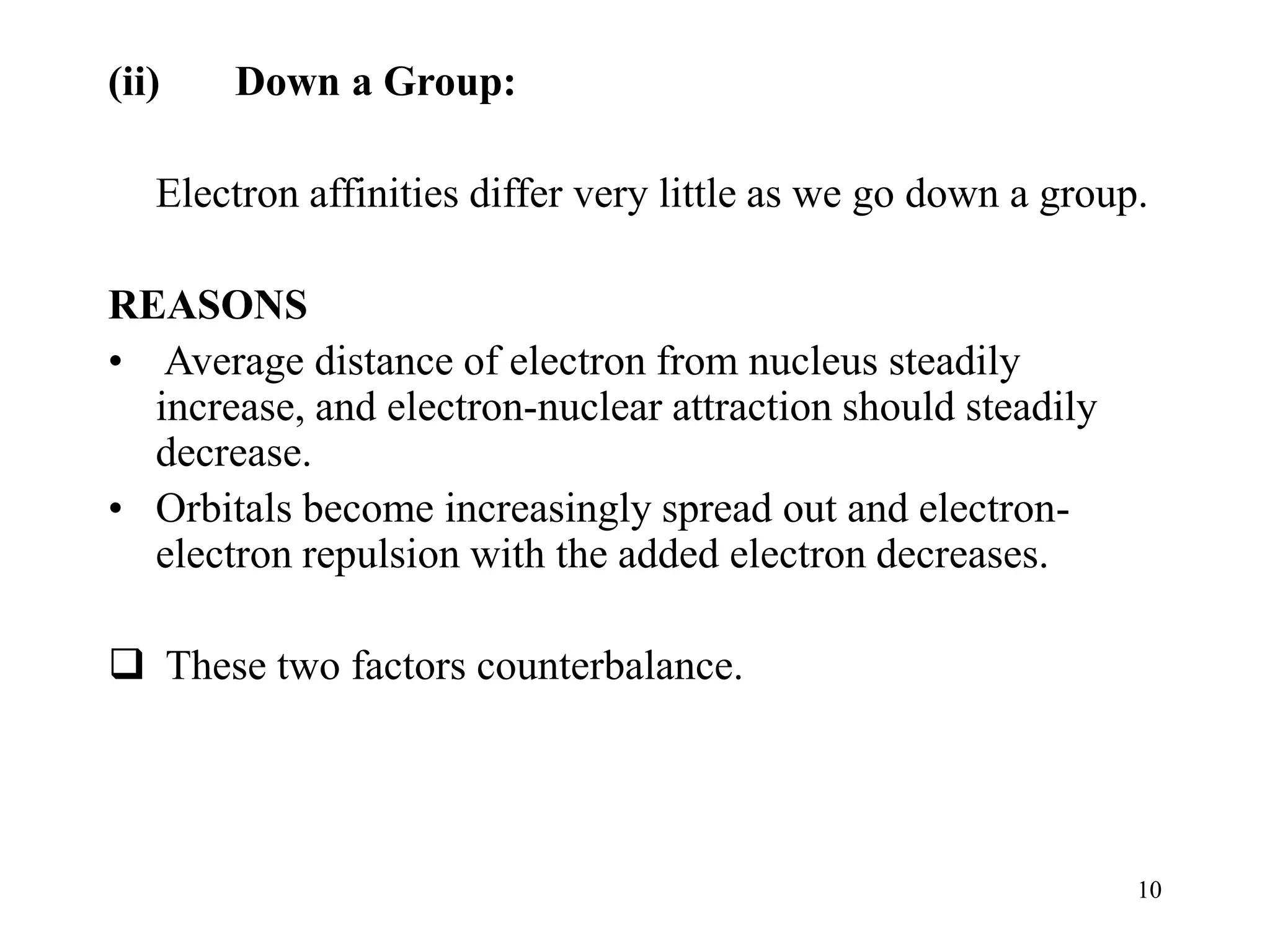
(ii) Down a Group:
Electron affinities differ very little as we go down a group.
REASONS
• Average distance of electron from nucleus steadily
increase, and electron-nuclear attraction should steadily
decrease.
• Orbitals become increasingly spread out and electron-
electron repulsion with the added electron decreases.
 These two factors counterbalance.
11
ELECTRONEGATIVITY
Definition:
The ability of an atom to attract electrons to itself in a
chemical bond.
TRENDS:
(i) Increases as we move across a Period from LEFT to
RIGHT. i.e. From the most metallic to the most non-
metallic element.
(ii)Decreases as we move down a group (excluding a few
exceptions)
i.e. From the most non-metallic to the most metallic
element.
12
NOTE:
Electronegativity varies with the TYPE of chemical environment in which
an element is in.
Eg. Chlorine : in PCl3 or in ClO3
-
The electronegativity difference between two atoms is a measure of the
polarity of the bond between them:
The greater the difference in electronegativity, the more polar is the bond.
Most electronegative element : F = 4.0
Least electronegative element : Cs = 0.79
e.g. HF  H+  F-
H  electronegativity = 2.2}
F  electronegativity = 4.0}
Therefore H-F is a POLAR BOND

1Periodic Properties.ppt

  • 1.
    1 THE PERIODIC TABLE Alisting of elements in an array such that atomic numbers increase from left to right and elements in any column have similar outer electronic structures. ROWS = PERIODS COLUMNS = GROUPS
  • 2.
    2 CLASSES OF ELEMENTS 1.REPRESENTATIVE ELEMENTS The differentiating electrons fill the s and p orbitals, Groups IA-VIIA and Group O. These are sometimes called MAIN GROUP ELEMENTS 2. TRANSITION ELEMENTS The differentiating electrons fill d-orbitals. 3. INNER TRANSITION ELEMENTS Differentiating electrons fill the f-orbitals 4f - Lanthanides 5f - Actinides
  • 3.
    3 PERIODIC PROPERTIES 1. ATOMICRADIUS 2. IONISATION ENERGY 3. ELECTRON AFFINITY 4. ELECTRONEGATIVITY
  • 4.
    4 ATOMIC RADIUS nm 0.099 2 0.198 Radius Atomic Cl2   Definition:This is one half the distance between centers of touching atoms. r TRENDS: (i) Decreases as we move across a period from left to right in the PT. (ii) Increases as we move down a Group in the PT.
  • 5.
    5 RATIONALE: Across a Period Effectivenuclear charge experienced by an electron at the outer edge of an atom is given by: Zeff = Z – S Where: Z = Actual nuclear charge = At. No. S = No. of electrons between the outer electron and the nucleus. For main group elements S = No. of electrons in inner complete energy levels. e.g. for Mg with 1s2 2s2 2p6 3s2 then S = 10. Therefore: Zeff should increase as we move across a period from left to right in the PT. RESULT Atomic radius decreases from left to right of PT.
  • 6.
    6 Down the Group: Down the Group, Zeff experienced by an outer electron remains essentially constant.  However, the distance of the electron from the nucleus increases with the Principal Quantum Number. At. No. S Zeff H = 1s1 1 1 Li = 1s2 2s1 3 2 1 Na = 1s2 2s2 2p6 3s1 11 10 1 K = 1s2 2s2 2p6 3s2 3p6 4s1 19 18 1  Hence: Atomic Radius increases as we move down the Group in the PT.
  • 7.
    7 FIRST IONISATION ENERGY Definition: The energy that must be absorbed to remove the outermost electron from a gaseous atom. Mg(g)  Mg+ (g) + e- TRENDS: i. Increases as we move across a period (from LEFT to RIGHT) in the Periodic Table. ii. Decreases as we move down a Group in the Periodic Table. There are some exceptions: e.g. 1st ionization Energy actually decreases as one moves across from Be (900 kJ/mol) to B (801 kJ/mol). Be = 1s2 2s2 B = 1s2 2s2 2p1 Since 2p level is higher in Energy than 2s it easier to remove an electron from 2p
  • 8.
    8 Ionization energy doesnot increase smoothly as we remove successive electrons e.g. Na: 1s2 2s2 2p6 3s1 IE1 = 496 kJ/mol. From 3s and hence removed easily since it is far from the nucleus. IE2 = 4561 kJ/mol. IE3 = 6913 kJ/mol ANY COMMENT ON THE TREND?
  • 9.
    9 ELECTRON AFFINITY Definition: Theenergy change that occurs when an electron is added to a gaseous atom or ion. i.e. (i) M(g) + e-  M- (g) [Neutral atom] (ii) M+ (g) + e-  M(g) [an ion of charge +1] TRENDS: (i) Across a Period In general electron affinities become more negative (stronger attraction for an electron) from LEFT to RIGHT of the PT.
  • 10.
    10 (ii) Down aGroup: Electron affinities differ very little as we go down a group. REASONS • Average distance of electron from nucleus steadily increase, and electron-nuclear attraction should steadily decrease. • Orbitals become increasingly spread out and electron- electron repulsion with the added electron decreases.  These two factors counterbalance.
  • 11.
    11 ELECTRONEGATIVITY Definition: The ability ofan atom to attract electrons to itself in a chemical bond. TRENDS: (i) Increases as we move across a Period from LEFT to RIGHT. i.e. From the most metallic to the most non- metallic element. (ii)Decreases as we move down a group (excluding a few exceptions) i.e. From the most non-metallic to the most metallic element.
  • 12.
    12 NOTE: Electronegativity varies withthe TYPE of chemical environment in which an element is in. Eg. Chlorine : in PCl3 or in ClO3 - The electronegativity difference between two atoms is a measure of the polarity of the bond between them: The greater the difference in electronegativity, the more polar is the bond. Most electronegative element : F = 4.0 Least electronegative element : Cs = 0.79 e.g. HF  H+  F- H  electronegativity = 2.2} F  electronegativity = 4.0} Therefore H-F is a POLAR BOND