









PRESENTED BY;
NAVYA JAYAKUMAR
ROLL NO: 20
CORPORATE
BOARD
COMMITTEES
CONTENT
INTRODUCTION
SIGNIFICANTS
CLASSIFICATION
COMMITTEES AND THEIR DUTIES
CONCLUSION
CORPORATE BOARD COMMITTEES
• Committees appointed by the Board focus on specific areas and take informed
decisions within the framework of delegated authority, and make specific
recommendations to the Board on matters in their areas or purview. All decisions
and recommendations of the committees are placed before the Board for
information or for approval.
• To enable better and more focused attention on the affairs of the Corporation, the
board delegates particular matters to the committees of the board set up for the
purpose. Committees review items in great detail before it is placed before the Board
for its consideration. These committees prepare the groundwork for decision
making and report at the subsequent board meeting.
SIGNIFICANCE OF BOARD COMMITTEES
• Handle a greater number of issues with greater efficiency by having experts focus
on specific areas.
• Develop subject specific expertise on areas such as compliance management, risk
management, financial reporting.
• Enhance the objectivity and independence of the board's judgment.
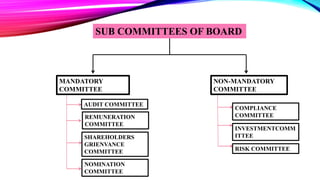
SUB COMMITTEES OF BOARD
MANDATORY
COMMITTEE
NON-MANDATORY
COMMITTEE
AUDIT COMMITTEE
REMUNERATION
COMMITTEE
SHAREHOLDERS
GRIENVANCE
COMMITTEE
NOMINATION
COMMITTEE
COMPLIANCE
COMMITTEE
INVESTMENTCOMM
ITTEE
RISK COMMITTEE
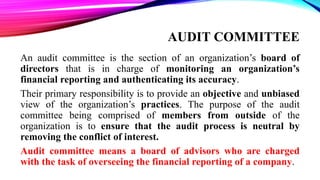
AUDIT COMMITTEE
An audit committee is the section of an organization’s board of
directors that is in charge of monitoring an organization’s
financial reporting and authenticating its accuracy.
Their primary responsibility is to provide an objective and unbiased
view of the organization’s practices. The purpose of the audit
committee being comprised of members from outside of the
organization is to ensure that the audit process is neutral by
removing the conflict of interest.
Audit committee means a board of advisors who are charged
with the task of overseeing the financial reporting of a company.
REMUNERATION COMMITTEE
The remuneration committee should have delegated responsibility for
setting remuneration for all executive directors and the
chairman, including pension rights and any compensation
payments.
The committee should also recommend and monitor the level and
structure of remuneration for senior management.
SHAREHOLDERS’ GRIEVANCE COMMITTEE
The primary function of the Shareholders’ Grievance Committee is to
assist the Board in controlling the shareholders’ grievances against
the Company and redresses the complaints of the shareholders.
NOMINATION COMMITTEE
A committee acting under an organization's corporate governance
area. These committees tend to focus on evaluating the company's
board of directors as well as the skills that are needed in order to
be such a candidate.
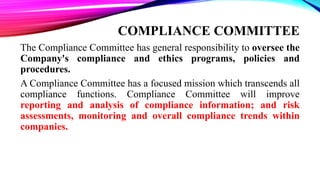
COMPLIANCE COMMITTEE
The Compliance Committee has general responsibility to oversee the
Company's compliance and ethics programs, policies and
procedures.
A Compliance Committee has a focused mission which transcends all
compliance functions. Compliance Committee will improve
reporting and analysis of compliance information; and risk
assessments, monitoring and overall compliance trends within
companies.
The Investment Committee is the primary authority on developing
the corporation's investment objectives and corporate policies on
investing. Some corporations allow the Investment Committee to
make decisions and others allow them to delegate it to consultants or
other designated firms or individuals.
RISK COMMITTEE
The Risk Committee is an independent committee of the Board of
Directors that has, as its sole and exclusive function, responsibility
for the risk management policies of the Corporation's global
operations and oversight of the operation of the Corporation's
global risk management framework.
CONCLUSION
Committees can be a practical way to structure and manage the
board's work. A committee is created to provide counseling and
advice for the board or to handle a task on the board's agenda.
Any recommendations made by a committee needs to be approved by
the board, but remember, the board is not obligated to go with
committee suggestions.
Committees are more effective when their charter and scope of work
is clearly defined by the board.
CORPORATE BOARD COMMITTEES

CORPORATE BOARD COMMITTEES

  • 1.
    PRESENTED BY; NAVYA JAYAKUMAR ROLLNO: 20 CORPORATE BOARD COMMITTEES
  • 2.
  • 3.
    CORPORATE BOARD COMMITTEES •Committees appointed by the Board focus on specific areas and take informed decisions within the framework of delegated authority, and make specific recommendations to the Board on matters in their areas or purview. All decisions and recommendations of the committees are placed before the Board for information or for approval. • To enable better and more focused attention on the affairs of the Corporation, the board delegates particular matters to the committees of the board set up for the purpose. Committees review items in great detail before it is placed before the Board for its consideration. These committees prepare the groundwork for decision making and report at the subsequent board meeting.
  • 4.
    SIGNIFICANCE OF BOARDCOMMITTEES • Handle a greater number of issues with greater efficiency by having experts focus on specific areas. • Develop subject specific expertise on areas such as compliance management, risk management, financial reporting. • Enhance the objectivity and independence of the board's judgment.
  • 5.
    SUB COMMITTEES OFBOARD MANDATORY COMMITTEE NON-MANDATORY COMMITTEE AUDIT COMMITTEE REMUNERATION COMMITTEE SHAREHOLDERS GRIENVANCE COMMITTEE NOMINATION COMMITTEE COMPLIANCE COMMITTEE INVESTMENTCOMM ITTEE RISK COMMITTEE
  • 6.
    AUDIT COMMITTEE An auditcommittee is the section of an organization’s board of directors that is in charge of monitoring an organization’s financial reporting and authenticating its accuracy. Their primary responsibility is to provide an objective and unbiased view of the organization’s practices. The purpose of the audit committee being comprised of members from outside of the organization is to ensure that the audit process is neutral by removing the conflict of interest. Audit committee means a board of advisors who are charged with the task of overseeing the financial reporting of a company.
  • 7.
    REMUNERATION COMMITTEE The remunerationcommittee should have delegated responsibility for setting remuneration for all executive directors and the chairman, including pension rights and any compensation payments. The committee should also recommend and monitor the level and structure of remuneration for senior management.
  • 8.
    SHAREHOLDERS’ GRIEVANCE COMMITTEE Theprimary function of the Shareholders’ Grievance Committee is to assist the Board in controlling the shareholders’ grievances against the Company and redresses the complaints of the shareholders. NOMINATION COMMITTEE A committee acting under an organization's corporate governance area. These committees tend to focus on evaluating the company's board of directors as well as the skills that are needed in order to be such a candidate.
  • 9.
    COMPLIANCE COMMITTEE The ComplianceCommittee has general responsibility to oversee the Company's compliance and ethics programs, policies and procedures. A Compliance Committee has a focused mission which transcends all compliance functions. Compliance Committee will improve reporting and analysis of compliance information; and risk assessments, monitoring and overall compliance trends within companies.
  • 10.
    The Investment Committeeis the primary authority on developing the corporation's investment objectives and corporate policies on investing. Some corporations allow the Investment Committee to make decisions and others allow them to delegate it to consultants or other designated firms or individuals.
  • 11.
    RISK COMMITTEE The RiskCommittee is an independent committee of the Board of Directors that has, as its sole and exclusive function, responsibility for the risk management policies of the Corporation's global operations and oversight of the operation of the Corporation's global risk management framework.
  • 12.
    CONCLUSION Committees can bea practical way to structure and manage the board's work. A committee is created to provide counseling and advice for the board or to handle a task on the board's agenda. Any recommendations made by a committee needs to be approved by the board, but remember, the board is not obligated to go with committee suggestions. Committees are more effective when their charter and scope of work is clearly defined by the board.