Supply Chain Management: Inventory
Management
Donglei Du
Faculty of Business Administration, University of New Brunswick, NB Canada Fredericton
E3B 9Y2 (ddu@umbc.edu)
Du (UNB) SCM 1 / 83
Table of contents I
1 Introduction
2 Inventory Management
3 Inventory models
4 Economic Order Quantity (EOQ)
EOQ model
When-to-order?
5 Economic Production Quantity (EPQ): model description
EPQ model
6 The Newsboy Problem-Unknown demand (probabilistic model)
The newsvendor model
7 Multiple-period stochastic model: model description
8 Managing inventory in the supply chain
Du (UNB) SCM 2 / 83
Section 1
Introduction
Du (UNB) SCM 3 / 83
Outline I
1 Introduce some basic concepts in inventory management
Inventory level (IL)
Reorder point (ROP)
Lead time
Safety stock
Continuous review and periodic review systems
Service level
2 Introduce some basic inventory models, both deterministic and
probabilistic.
deterministic models
1 EOQ model
2 EPQ model
probabilistic models
1 Single-period model: Newsboy model
2 Multiple-period model
Du (UNB) SCM 4 / 83
Section 2
Inventory Management
Du (UNB) SCM 5 / 83
What is Inventory? I
Inventory is a stock or store of goods or services, kept for use or
sale in the future. There are four types of inventory
Raw materials & purchased parts
Partially completed goods called work in progress (WIP)
Finished-goods inventories
Goods-in-transit to warehouses or customers (GIT)
The motive for inventory: there are three motives for holding
inventory, similar to cash.
Transaction motive: Economies of scale is achieved when the
number of set-ups are reduced or the number of transactions
are minimized.
Precautionary motive: hedge against uncertainty, including
demand uncertainty, supply uncertainty
Speculative motive: hedge against price increases in materials or
labor
Du (UNB) SCM 6 / 83
What is inventory management?
The objective of inventory is to achieve satisfactory levels of
customer service while keeping inventory costs within reasonable
bounds.
Level of customer service: (1) in-stock (fill) rate (2) number of
back orders (3) inventory turnover rate: the ratio of average cost
of goods sold to average inventory investment
Inventory cost: cost of ordering and carrying trade-off
Du (UNB) SCM 7 / 83
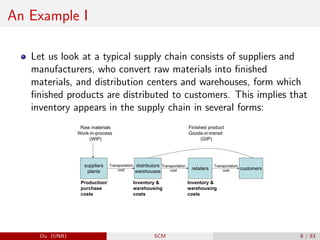
An Example I
Let us look at a typical supply chain consists of suppliers and
manufacturers, who convert raw materials into finished
materials, and distribution centers and warehouses, form which
finished products are distributed to customers. This implies that
inventory appears in the supply chain in several forms:
suppliers
plants
distributors
warehouses
retailers customers
Inventory &
warehousing
costs
Transportation
cost
Transportation
cost
Transportation
cost
Raw materials
Work-in-process
(WIP)
Finished product
Goods-in-transit
(GIP)
Inventory &
warehousing
costs
Production/
purchase
costs
Du (UNB) SCM 8 / 83
Section 3
Inventory models
Du (UNB) SCM 9 / 83
Inventory Models I
Inventory models come in all shapes. We will focus on models
for only a single product at a single location. Essentially each
inventory model is determined by three key variables:
demand:
deterministic, that is, known exactly and in advance.
random. Forecasting technique may be used in the latter case
when historical data are available to estimate the average and
standard deviation of the demand (will introduce forecasting
techniques later).
costs:
order cost: the cost of product and the transportation cost
inventory holding cost: taxes and insurances, maintenance, etc.
physical aspects of the system: the physical structure of the
inventory system, such as single or multiple-warehouse.
Usually, there are two basic decisions in all inventory models:
Du (UNB) SCM 10 / 83
Inventory Models II
1 How much to order?
2 When to order?
Du (UNB) SCM 11 / 83
Section 4
Economic Order Quantity (EOQ)
Du (UNB) SCM 12 / 83
Subsection 1
EOQ model
Du (UNB) SCM 13 / 83
Economic Order Quantity (EOQ): Model
description I
The EOQ model is a simple deterministic model that illustrates
the trade-offs between ordering and inventory costs.
Consider a single warehouse facing constant demand for a single
item. The warehouse orders from the supplier, who is assumed
to have an unlimited quantity of the product.
The EOQ model assume the following scenario:
Annual demand D is deterministic and occurs at a constant
rate—constant demand rate: i.e., the same number of units is
taken from inventory each period of time, such as 5 units per
day, 25 units per week, 100 units per month and so on.
Order quantity are fixed at Q units per order.
Du (UNB) SCM 14 / 83
Economic Order Quantity (EOQ): Model
description II
A fixed ordering cost co per order, not depending on the
quantity ordered.
A holding cost ch per unit per year, depending on the size of
the inventory. Sometimes holding cost can usually be calculated
as follows:
ch = annual holding cost rate×annual cost of holding one unit in in
Du (UNB) SCM 15 / 83
Shortages (such as stock-outs and backorder) are not permitted.
There is no lead time or the lead time is constant.
The planning horizon is long
The objective is to decide the order quantity Q per order so as
to minimize the total annual cost, including holding and
setting-up costs.
Du (UNB) SCM 16 / 83
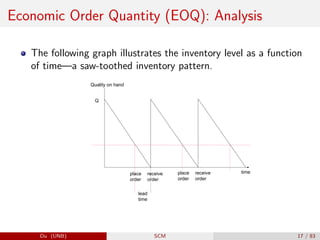
Economic Order Quantity (EOQ): Analysis
The following graph illustrates the inventory level as a function
of time—a saw-toothed inventory pattern.
Quality on hand
Q
time
place
order
receive
order
place
order
lead
time
receive
order
Du (UNB) SCM 17 / 83
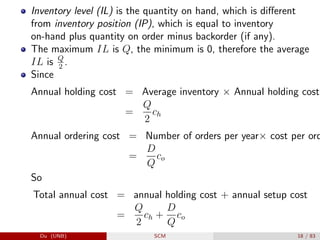
Inventory level (IL) is the quantity on hand, which is different
from inventory position (IP), which is equal to inventory
on-hand plus quantity on order minus backorder (if any).
The maximum IL is Q, the minimum is 0, therefore the average
IL is Q
2
.
Since
Annual holding cost = Average inventory × Annual holding cost
=
Q
2
ch
Annual ordering cost = Number of orders per year× cost per ord
=
D
Q
co
So
Total annual cost = annual holding cost + annual setup cost
=
Q
2
ch +
D
Q
co
Du (UNB) SCM 18 / 83
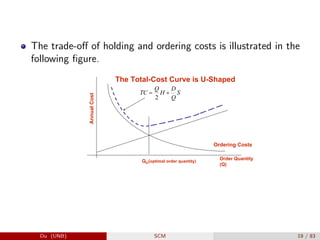
The trade-off of holding and ordering costs is illustrated in the
following figure.
Order Quantity
(Q)
The Total-Cost Curve is U-Shaped
Ordering Costs
QO
Annual
Cost
(optimal order quantity)
TC
Q
H
D
Q
S
= +
2
Du (UNB) SCM 19 / 83
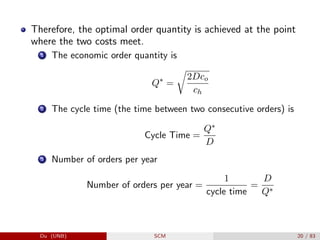
Therefore, the optimal order quantity is achieved at the point
where the two costs meet.
1 The economic order quantity is
Q∗
=
r
2Dco
ch
2 The cycle time (the time between two consecutive orders) is
Cycle Time =
Q∗
D
3 Number of orders per year
Number of orders per year =
1
cycle time
=
D
Q∗
Du (UNB) SCM 20 / 83
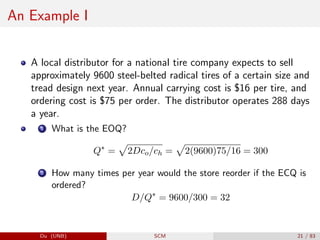
An Example I
A local distributor for a national tire company expects to sell
approximately 9600 steel-belted radical tires of a certain size and
tread design next year. Annual carrying cost is $16 per tire, and
ordering cost is $75 per order. The distributor operates 288 days
a year.
1 What is the EOQ?
Q∗
=
p
2Dco/ch =
p
2(9600)75/16 = 300
2 How many times per year would the store reorder if the ECQ is
ordered?
D/Q∗
= 9600/300 = 32
Du (UNB) SCM 21 / 83
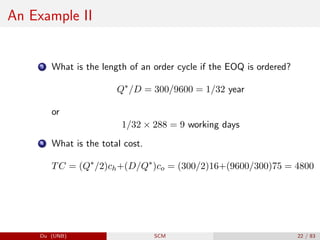
An Example II
3 What is the length of an order cycle if the EOQ is ordered?
Q∗
/D = 300/9600 = 1/32 year
or
1/32 × 288 = 9 working days
4 What is the total cost.
TC = (Q∗
/2)ch+(D/Q∗
)co = (300/2)16+(9600/300)75 = 4800
Du (UNB) SCM 22 / 83
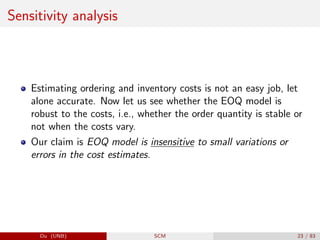
Sensitivity analysis
Estimating ordering and inventory costs is not an easy job, let
alone accurate. Now let us see whether the EOQ model is
robust to the costs, i.e., whether the order quantity is stable or
not when the costs vary.
Our claim is EOQ model is insensitive to small variations or
errors in the cost estimates.
Du (UNB) SCM 23 / 83
Subsection 2
When-to-order?
Du (UNB) SCM 24 / 83
When-to-order: some concepts
The reorder point (ROP) is defined to be the inventory level at
which a new order should be placed.
The when-to-order decision is usually expressed in terms of a
reorder point.
We will consider deterministic and stochastic models separately.
Du (UNB) SCM 25 / 83
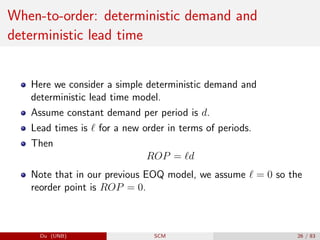
When-to-order: deterministic demand and
deterministic lead time
Here we consider a simple deterministic demand and
deterministic lead time model.
Assume constant demand per period is d.
Lead times is ` for a new order in terms of periods.
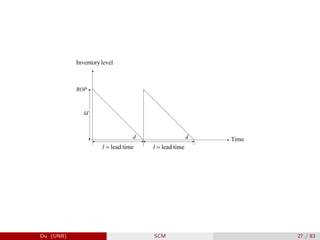
Then
ROP = `d
Note that in our previous EOQ model, we assume ` = 0 so the
reorder point is ROP = 0.
Du (UNB) SCM 26 / 83
level
Inventory
Time
time
lead
=
l
ROP
time
lead
=
l
d d
ld
Du (UNB) SCM 27 / 83
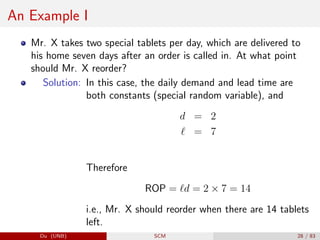
An Example I
Mr. X takes two special tablets per day, which are delivered to
his home seven days after an order is called in. At what point
should Mr. X reorder?
Solution: In this case, the daily demand and lead time are
both constants (special random variable), and
d = 2
` = 7
Therefore
ROP = `d = 2 × 7 = 14
i.e., Mr. X should reorder when there are 14 tablets
left.
Du (UNB) SCM 28 / 83
When-to-order: stochastic demand and stochastic
lead time
The reorder point for stochastic demand and stochastic lead
time is the expected demand during lead time and an extra
safety stock, which serves to reduce the probability of
experiencing a stockout during lead time. Formally
ROP = Expected demand during lead time + Safety stock
Du (UNB) SCM 29 / 83
Safety stock (SS): stock that is held in excess of expected
demand due to variable demand rate and/or variable lead time.
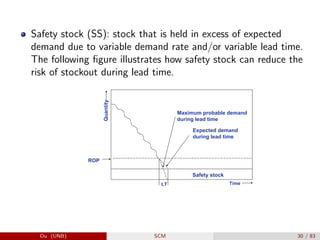
The following figure illustrates how safety stock can reduce the
risk of stockout during lead time.
LT Time
Expected demand
during lead time
Maximum probable demand
during lead time
ROP
Quantity
Safety stock
Du (UNB) SCM 30 / 83
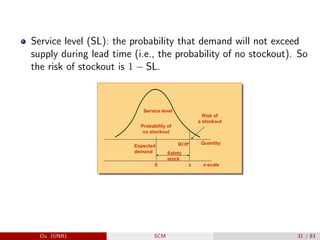
Service level (SL): the probability that demand will not exceed
supply during lead time (i.e., the probability of no stockout). So
the risk of stockout is 1 − SL.
ROP
Risk of
a stockout
Service level
Probability of
no stockout
Expected
demand Safety
stock
0 z
Quantity
z-scale
Du (UNB) SCM 31 / 83
Assumption
We assume
1 Daily demands are i.i.d. random variables;
2 Daily demands are independent of the lead time.
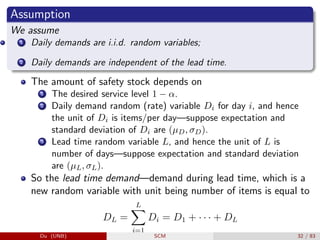
The amount of safety stock depends on
1 The desired service level 1 − α.
2 Daily demand random (rate) variable Di for day i, and hence
the unit of Di is items/per day—suppose expectation and
standard deviation of Di are (µD, σD).
3 Lead time random variable L, and hence the unit of L is
number of days—suppose expectation and standard deviation
are (µL, σL).
So the lead time demand—demand during lead time, which is a
new random variable with unit being number of items is equal to
DL =
L
X
i=1
Di = D1 + · · · + DL
Du (UNB) SCM 32 / 83
Then, we use the compound random variable property to find
the expectation and variance of DL (note that here both Di’s
and L are random variable and we cannot apply the rule of
expectation and rule of variance directly):
E[DL] = E
 L
P
i=1
Di

= µLµD
V[DL] = V
 L
P
i=1
Di

= µLσ2
D + σ2
Lµ2
D
Assume DL follows a normal distribution, that is
DL ∼ N(E[DL],
p
V[DL]).
Then ROP should be chosen such that the probability of no
stockout is at least 1 − α, that is
P(DL ≤ ROP) ≥ 1 − α
A standard given-p-value-find-x-value calculation gives us the
desired ROP:
ROP = E[DL] + zα
p
V[DL] = µDµL + zα
q
µLσ2
D + µ2
Dσ2
L
Du (UNB) SCM 33 / 83
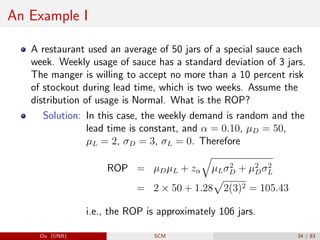
An Example I
A restaurant used an average of 50 jars of a special sauce each
week. Weekly usage of sauce has a standard deviation of 3 jars.
The manger is willing to accept no more than a 10 percent risk
of stockout during lead time, which is two weeks. Assume the
distribution of usage is Normal. What is the ROP?
Solution: In this case, the weekly demand is random and the
lead time is constant, and α = 0.10, µD = 50,
µL = 2, σD = 3, σL = 0. Therefore
ROP = µDµL + zα
q
µLσ2
D + µ2
Dσ2
L
= 2 × 50 + 1.28
p
2(3)2 = 105.43
i.e., the ROP is approximately 106 jars.
Du (UNB) SCM 34 / 83
Section 5
Economic Production Quantity (EPQ): model
description
Du (UNB) SCM 35 / 83
Subsection 1
EPQ model
Du (UNB) SCM 36 / 83
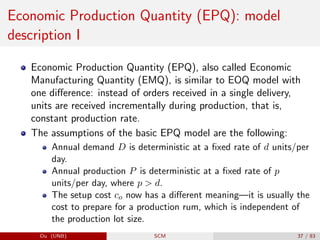
Economic Production Quantity (EPQ): model
description I
Economic Production Quantity (EPQ), also called Economic
Manufacturing Quantity (EMQ), is similar to EOQ model with
one difference: instead of orders received in a single delivery,
units are received incrementally during production, that is,
constant production rate.
The assumptions of the basic EPQ model are the following:
Annual demand D is deterministic at a fixed rate of d units/per
day.
Annual production P is deterministic at a fixed rate of p
units/per day, where p  d.
The setup cost co now has a different meaning—it is usually the
cost to prepare for a production rum, which is independent of
the production lot size.
Du (UNB) SCM 37 / 83
Economic Production Quantity (EPQ): model
description II
A holding cost ch per unit per year, depending on the size of
the inventory.
Shortages (such as stock-outs and backorder) are not permitted.
There is no lead time or the lead time is constant.
The planning horizon is long
Du (UNB) SCM 38 / 83
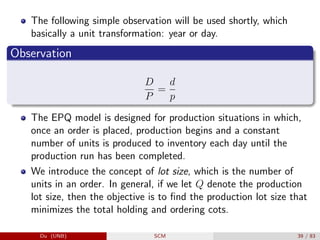
The following simple observation will be used shortly, which
basically a unit transformation: year or day.
Observation
D
P
=
d
p
The EPQ model is designed for production situations in which,
once an order is placed, production begins and a constant
number of units is produced to inventory each day until the
production run has been completed.
We introduce the concept of lot size, which is the number of
units in an order. In general, if we let Q denote the production
lot size, then the objective is to find the production lot size that
minimizes the total holding and ordering cots.
Du (UNB) SCM 39 / 83
Economic Production Quantity (EPQ): analysis
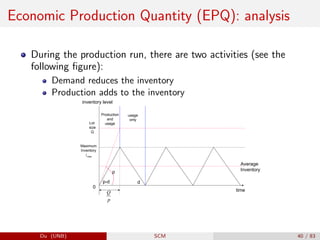
During the production run, there are two activities (see the
following figure):
Demand reduces the inventory
Production adds to the inventory
inventory level
time
Lot
size
Q
p-d d
p
Production
and
usage
usage
only
Maximum
Inventory
Imax
p
Q
Average
Inventory
0
Du (UNB) SCM 40 / 83
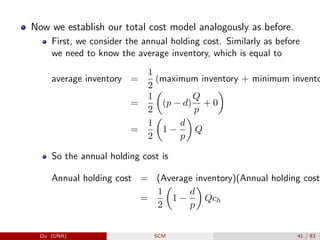
Now we establish our total cost model analogously as before.
First, we consider the annual holding cost. Similarly as before
we need to know the average inventory, which is equal to
average inventory =
1
2
(maximum inventory + minimum invento
=
1
2

(p − d)
Q
p
+ 0

=
1
2

1 −
d
p

Q
So the annual holding cost is
Annual holding cost = (Average inventory)(Annual holding cost
=
1
2

1 −
d
p

Qch
Du (UNB) SCM 41 / 83
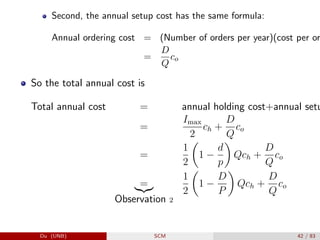
Second, the annual setup cost has the same formula:
Annual ordering cost = (Number of orders per year)(cost per or
=
D
Q
co
So the total annual cost is
Total annual cost = annual holding cost+annual setu
=
Imax
2
ch +
D
Q
co
=
1
2

1 −
d
p

Qch +
D
Q
co
=
|{z}
Observation 2
1
2

1 −
D
P

Qch +
D
Q
co
Du (UNB) SCM 42 / 83
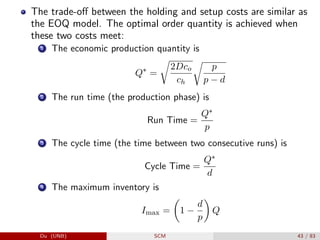
The trade-off between the holding and setup costs are similar as
the EOQ model. The optimal order quantity is achieved when
these two costs meet:
1 The economic production quantity is
Q∗
=
r
2Dco
ch
r
p
p − d
2 The run time (the production phase) is
Run Time =
Q∗
p
3 The cycle time (the time between two consecutive runs) is
Cycle Time =
Q∗
d
4 The maximum inventory is
Imax =

1 −
d
p

Q
Du (UNB) SCM 43 / 83
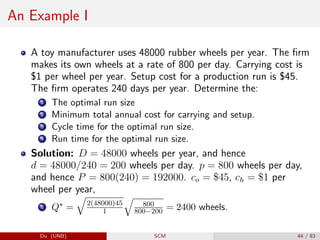
An Example I
A toy manufacturer uses 48000 rubber wheels per year. The firm
makes its own wheels at a rate of 800 per day. Carrying cost is
$1 per wheel per year. Setup cost for a production run is $45.
The firm operates 240 days per year. Determine the:
1 The optimal run size
2 Minimum total annual cost for carrying and setup.
3 Cycle time for the optimal run size.
4 Run time for the optimal run size.
Solution: D = 48000 wheels per year, and hence
d = 48000/240 = 200 wheels per day. p = 800 wheels per day,
and hence P = 800(240) = 192000. co = $45, ch = $1 per
wheel per year,
1 Q∗ =
q
2(48000)45
1
q
800
800−200 = 2400 wheels.
Du (UNB) SCM 44 / 83
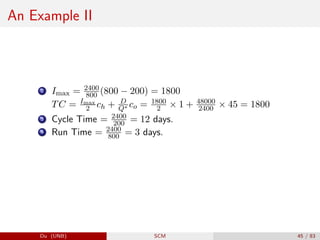
An Example II
2 Imax = 2400
800 (800 − 200) = 1800
TC = Imax
2 ch + D
Q∗ co = 1800
2 × 1 + 48000
2400 × 45 = 1800
3 Cycle Time = 2400
200 = 12 days.
4 Run Time = 2400
800 = 3 days.
Du (UNB) SCM 45 / 83
Section 6
The Newsboy Problem-Unknown demand
(probabilistic model)
Du (UNB) SCM 46 / 83
Subsection 1
The newsvendor model
Du (UNB) SCM 47 / 83
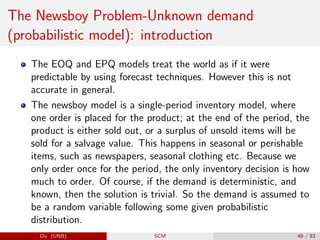
The Newsboy Problem-Unknown demand
(probabilistic model): introduction
The EOQ and EPQ models treat the world as if it were
predictable by using forecast techniques. However this is not
accurate in general.
The newsboy model is a single-period inventory model, where
one order is placed for the product; at the end of the period, the
product is either sold out, or a surplus of unsold items will be
sold for a salvage value. This happens in seasonal or perishable
items, such as newspapers, seasonal clothing etc. Because we
only order once for the period, the only inventory decision is how
much to order. Of course, if the demand is deterministic, and
known, then the solution is trivial. So the demand is assumed to
be a random variable following some given probabilistic
distribution.
Du (UNB) SCM 48 / 83
The Newsboy Problem-Unknown demand
(probabilistic model): model description
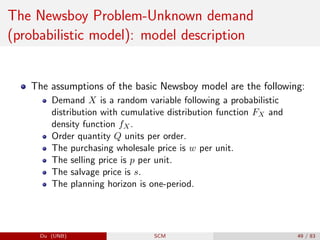
The assumptions of the basic Newsboy model are the following:
Demand X is a random variable following a probabilistic
distribution with cumulative distribution function FX and
density function fX.
Order quantity Q units per order.
The purchasing wholesale price is w per unit.
The selling price is p per unit.
The salvage price is s.
The planning horizon is one-period.
Du (UNB) SCM 49 / 83
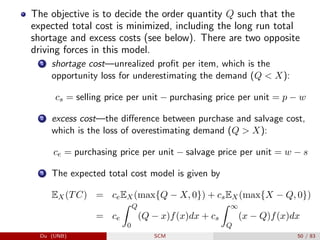
The objective is to decide the order quantity Q such that the
expected total cost is minimized, including the long run total
shortage and excess costs (see below). There are two opposite
driving forces in this model.
1 shortage cost—unrealized profit per item, which is the
opportunity loss for underestimating the demand (Q  X):
cs = selling price per unit − purchasing price per unit = p − w
2 excess cost—the difference between purchase and salvage cost,
which is the loss of overestimating demand (Q  X):
ce = purchasing price per unit − salvage price per unit = w − s
3 The expected total cost model is given by
EX(TC) = ceEX(max{Q − X, 0}) + csEX(max{X − Q, 0})
= ce
Z Q
0
(Q − x)f(x)dx + cs
Z ∞
Q
(x − Q)f(x)dx
Du (UNB) SCM 50 / 83
4 The optimal solution Q∗ depends on the underlying demand
distribution.
Du (UNB) SCM 51 / 83
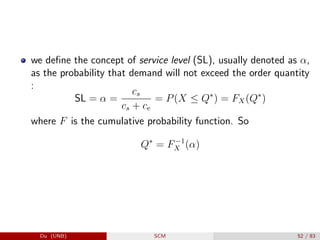
we define the concept of service level (SL), usually denoted as α,
as the probability that demand will not exceed the order quantity
:
SL = α =
cs
cs + ce
= P(X ≤ Q∗
) = FX(Q∗
)
where F is the cumulative probability function. So
Q∗
= F−1
X (α)
Du (UNB) SCM 52 / 83
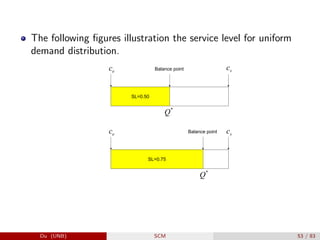
The following figures illustration the service level for uniform
demand distribution.
SL=0.50
e
c s
c
*
Q
Balance point
SL=0.75
*
Q
e
c s
c
Balance point
Du (UNB) SCM 53 / 83
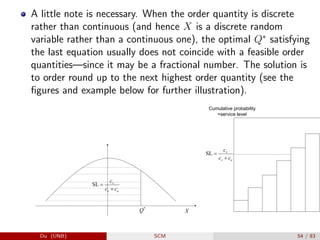
A little note is necessary. When the order quantity is discrete
rather than continuous (and hence X is a discrete random
variable rather than a continuous one), the optimal Q∗
satisfying
the last equation usually does not coincide with a feasible order
quantities—since it may be a fractional number. The solution is
to order round up to the next highest order quantity (see the
figures and example below for further illustration).
*
Q
e
s
s
c
c
c
+
=
SL
X
Cumulative probability
=service level
e
s
s
c
c
c
+
=
SL
Du (UNB) SCM 54 / 83
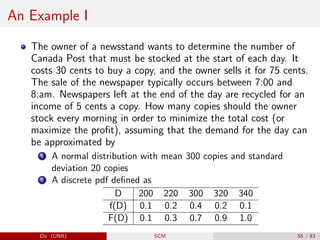
An Example I
The owner of a newsstand wants to determine the number of
Canada Post that must be stocked at the start of each day. It
costs 30 cents to buy a copy, and the owner sells it for 75 cents.
The sale of the newspaper typically occurs between 7:00 and
8:am. Newspapers left at the end of the day are recycled for an
income of 5 cents a copy. How many copies should the owner
stock every morning in order to minimize the total cost (or
maximize the profit), assuming that the demand for the day can
be approximated by
1 A normal distribution with mean 300 copies and standard
deviation 20 copies
2 A discrete pdf defined as
D 200 220 300 320 340
f(D) 0.1 0.2 0.4 0.2 0.1
F(D) 0.1 0.3 0.7 0.9 1.0
Du (UNB) SCM 55 / 83
An Example II
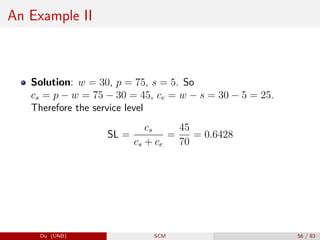
Solution: w = 30, p = 75, s = 5. So
cs = p − w = 75 − 30 = 45, ce = w − s = 30 − 5 = 25.
Therefore the service level
SL =
cs
cs + ce
=
45
70
= 0.6428
Du (UNB) SCM 56 / 83
An Example I
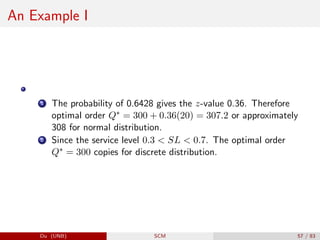
1 The probability of 0.6428 gives the z-value 0.36. Therefore
optimal order Q∗ = 300 + 0.36(20) = 307.2 or approximately
308 for normal distribution.
2 Since the service level 0.3  SL  0.7. The optimal order
Q∗ = 300 copies for discrete distribution.
Du (UNB) SCM 57 / 83
Section 7
Multiple-period stochastic model: model
description
Du (UNB) SCM 58 / 83
Multiple-period stochastic model: model
description
Previously we consider the Newsvendor model, a single-period
stochastic model. Now we consider a stochastic multiple period
model.
The inventory system operates continuously with many
repeating periods or cycles.
The lead time for a new order is L days and L is a random
variable in general, reflecting the variation of delivery time.
The daily demand is Di (i = 1, . . . , L) within the lead time,
where the D0
is are also random variables, , reflecting the
variation of demand over time.
Inventory can be carried from one period to the next.
Du (UNB) SCM 59 / 83
Multiple-period stochastic model: model
description
New orders can be placed based on one of the following two
basic classes of reorder policies:
Event-driven: These are reorder policies that are driven by
reorder point (ROP)—continuous review policy: in which
inventory is reviewed every day and a decision is made about
whether and how much to order.
Time-driven: These are reorder policies that are driven by time
—periodic review policy: in which inventory is reviewed at
regular intervals and an appropriate quantity is ordered after
each review.
Du (UNB) SCM 60 / 83
Continuous review policy: (Q, R) order-reorder
policy
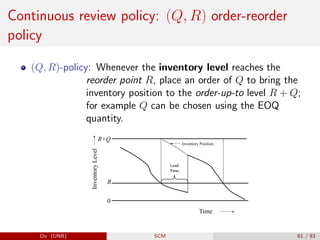
(Q, R)-policy: Whenever the inventory level reaches the
reorder point R, place an order of Q to bring the
inventory position to the order-up-to level R + Q;
for example Q can be chosen using the EOQ
quantity.
R+Q
evel
Q
Inventory Position
ntory
L
Lead
Time
Lead
Time
Inven
R
Time
0
Time
Du (UNB) SCM 61 / 83
There are two decisions to be made in an (Q, R) order-reorder
policy.
Decide the reorder level R—when-to-order.
Decide the reorder quantity Q and hence the order-up-to
level—how much to-order.
These two decisions should be made based on particular
applications. Here we consider one situation where we can
decide both quantities.
Du (UNB) SCM 62 / 83
A situation where we can decide s and Q I
The lead time L is a random variable.
Daily demand Di is random variable, i = 1, . . . , L.
The demand during lead time DL =
PL
i=1 Di follows a normal
distribution, whose expectation and variance can be calculated
similarly as before:
E[DL] = E
 L
P
i=1
Di

= µLµD
V[DL] = V
 L
P
i=1
Di

= µLσ2
D + σ2
Lµ2
D
There is an inventory holding cost of ch per unit per day.
There is a fixed order cost co per unit.
no backorders: when there is a stockout, the order is lost.
Du (UNB) SCM 63 / 83
A situation where we can decide s and Q II
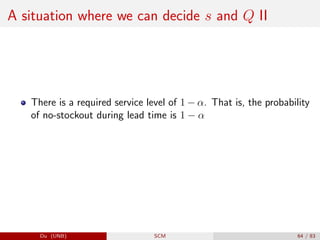
There is a required service level of 1 − α. That is, the probability
of no-stockout during lead time is 1 − α
Du (UNB) SCM 64 / 83
Solution
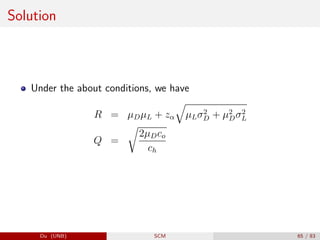
Under the about conditions, we have
R = µDµL + zα
q
µLσ2
D + µ2
Dσ2
L
Q =
r
2µDco
ch
Du (UNB) SCM 65 / 83
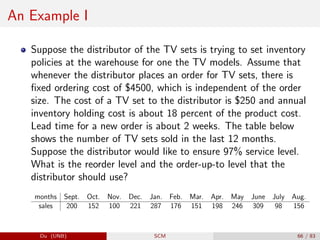
An Example I
Suppose the distributor of the TV sets is trying to set inventory
policies at the warehouse for one the TV models. Assume that
whenever the distributor places an order for TV sets, there is
fixed ordering cost of $4500, which is independent of the order
size. The cost of a TV set to the distributor is $250 and annual
inventory holding cost is about 18 percent of the product cost.
Lead time for a new order is about 2 weeks. The table below
shows the number of TV sets sold in the last 12 months.
Suppose the distributor would like to ensure 97% service level.
What is the reorder level and the order-up-to level that the
distributor should use?
months Sept. Oct. Nov. Dec. Jan. Feb. Mar. Apr. May June July Aug.
sales 200 152 100 221 287 176 151 198 246 309 98 156
Du (UNB) SCM 66 / 83
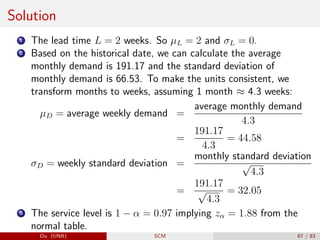
Solution
1 The lead time L = 2 weeks. So µL = 2 and σL = 0.
2 Based on the historical date, we can calculate the average
monthly demand is 191.17 and the standard deviation of
monthly demand is 66.53. To make the units consistent, we
transform months to weeks, assuming 1 month ≈ 4.3 weeks:
µD = average weekly demand =
average monthly demand
4.3
=
191.17
4.3
= 44.58
σD = weekly standard deviation =
monthly standard deviation
√
4.3
=
191.17
√
4.3
= 32.05
3 The service level is 1 − α = 0.97 implying zα = 1.88 from the
normal table.
Du (UNB) SCM 67 / 83
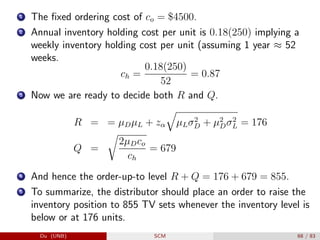
1 The fixed ordering cost of co = $4500.
2 Annual inventory holding cost per unit is 0.18(250) implying a
weekly inventory holding cost per unit (assuming 1 year ≈ 52
weeks.
ch =
0.18(250)
52
= 0.87
3 Now we are ready to decide both R and Q.
R = = µDµL + zα
q
µLσ2
D + µ2
Dσ2
L = 176
Q =
r
2µDco
ch
= 679
4 And hence the order-up-to level R + Q = 176 + 679 = 855.
5 To summarize, the distributor should place an order to raise the
inventory position to 855 TV sets whenever the inventory level is
below or at 176 units.
Du (UNB) SCM 68 / 83
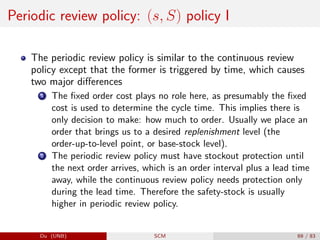
Periodic review policy: (s, S) policy I
The periodic review policy is similar to the continuous review
policy except that the former is triggered by time, which causes
two major differences
1 The fixed order cost plays no role here, as presumably the fixed
cost is used to determine the cycle time. This implies there is
only decision to make: how much to order. Usually we place an
order that brings us to a desired replenishment level (the
order-up-to-level point, or base-stock level).
2 The periodic review policy must have stockout protection until
the next order arrives, which is an order interval plus a lead time
away, while the continuous review policy needs protection only
during the lead time. Therefore the safety-stock is usually
higher in periodic review policy.
Du (UNB) SCM 69 / 83
Periodic review policy: (s, S) policy II
3 Therefore, at the time of the order, this order must raise the IP
(inventory position) to the base-stock level. This level of IP
should be enough to protect the warehouse against shortages
until the next order arrives, which is after r + L days, and hence
the current order should be enough to cover the demand during
a period of r + L (or said differently, the IP should be enough to
to cover the demand during the lead time and the order period).
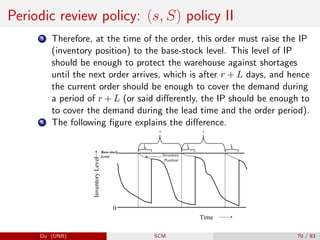
4 The following figure explains the difference.
Inventory
Level
Time
Base-stock
Level
0
Inventory
Position
r r
L L L
Du (UNB) SCM 70 / 83
Periodic review policy: (s, S) policy III
Du (UNB) SCM 71 / 83
Periodic review policy
Periodic review policy: Let r be the review period (or order
interval). For every period, place an order to bring
the inventory to some desired replenishment
position S.
There is only one decision: the base-stock level to be raised: S.
Du (UNB) SCM 72 / 83
A situation where we can decide S
Review period is r, a deterministic number.
The lead time L is a random variable.
Daily demand Di is random variable, i = 1, . . . , L.
The demand during lead time plus review period DL =
PL+r
i=1 Di
follows a normal distribution, whose expectation and variance
can be calculated similarly as before:
E[DL+r] = E
L+r
P
i=1
Di

= (r + µL)µD
V[DL+r] = V
L+r
P
i=1
Di

= (r + µL)σ2
D + σ2
Lµ2
D
no backorders: when there is a stockout, the order is lost.
There is a required service level of 1 − α. That is, the probability
of no-stockout during lead time is 1 − α
Du (UNB) SCM 73 / 83
Solution
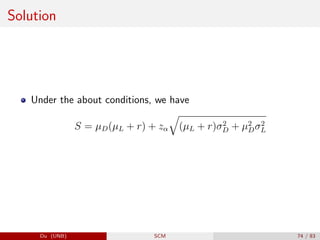
Under the about conditions, we have
S = µD(µL + r) + zα
q
(µL + r)σ2
D + µ2
Dσ2
L
Du (UNB) SCM 74 / 83
An Example I
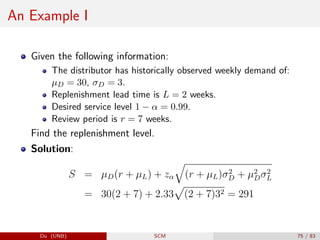
Given the following information:
The distributor has historically observed weekly demand of:
µD = 30, σD = 3.
Replenishment lead time is L = 2 weeks.
Desired service level 1 − α = 0.99.
Review period is r = 7 weeks.
Find the replenishment level.
Solution:
S = µD(r + µL) + zα
q
(r + µL)σ2
D + µ2
Dσ2
L
= 30(2 + 7) + 2.33
p
(2 + 7)32 = 291
Du (UNB) SCM 75 / 83
Section 8
Managing inventory in the supply chain
Du (UNB) SCM 76 / 83
Managing inventory in the supply chain I
Up to now, we only consider the single-facility managing its
inventory in order to minimize its own cost as much as possible.
However, in supply chain management, there are always
multi-facility. We consider a multi-facility supply chain that
satisfies the following requirements (for the purpose, consider a
retail distribution system with a single warehouse serving a
number of retailers):
1 Inventory decisions are under centralized control by a
decision-maker whose objective is to minimize systemwide cost.
2 The decision-maker has access to inventory information across
the supply chain.
Du (UNB) SCM 77 / 83
Managing inventory in the supply chain II
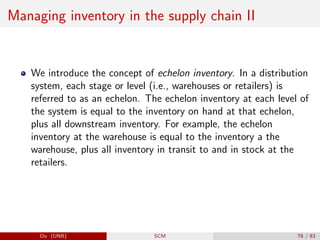
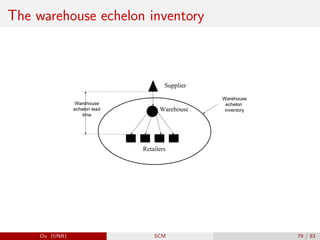
We introduce the concept of echelon inventory. In a distribution
system, each stage or level (i.e., warehouses or retailers) is
referred to as an echelon. The echelon inventory at each level of
the system is equal to the inventory on hand at that echelon,
plus all downstream inventory. For example, the echelon
inventory at the warehouse is equal to the inventory a the
warehouse, plus all inventory in transit to and in stock at the
retailers.
Du (UNB) SCM 78 / 83
The warehouse echelon inventory
Supplier
Warehouse
Retailers
Warehouse
echelon lead
time
Warehouse
echelon
inventory
Du (UNB) SCM 79 / 83
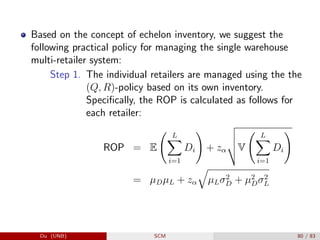
Based on the concept of echelon inventory, we suggest the
following practical policy for managing the single warehouse
multi-retailer system:
Step 1. The individual retailers are managed using the the
(Q, R)-policy based on its own inventory.
Specifically, the ROP is calculated as follows for
each retailer:
ROP = E
L
X
i=1
Di
!
+ zα
v
u
u
tV
L
X
i=1
Di
!
= µDµL + zα
q
µLσ2
D + µ2
Dσ2
L
Du (UNB) SCM 80 / 83
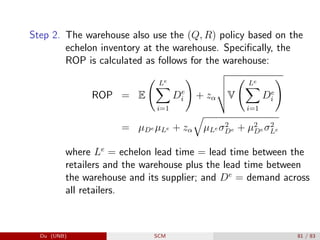
Step 2. The warehouse also use the (Q, R) policy based on the
echelon inventory at the warehouse. Specifically, the
ROP is calculated as follows for the warehouse:
ROP = E
Le
X
i=1
De
i
!
+ zα
v
u
u
tV
Le
X
i=1
De
i
!
= µDe µLe + zα
q
µLe σ2
De + µ2
De σ2
Le
where Le
= echelon lead time = lead time between the
retailers and the warehouse plus the lead time between
the warehouse and its supplier; and De
= demand across
all retailers.
Du (UNB) SCM 81 / 83
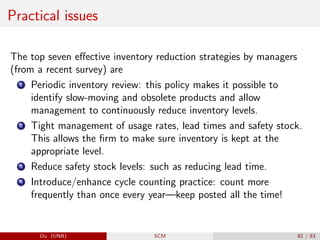
Practical issues
The top seven effective inventory reduction strategies by managers
(from a recent survey) are
1 Periodic inventory review: this policy makes it possible to
identify slow-moving and obsolete products and allow
management to continuously reduce inventory levels.
2 Tight management of usage rates, lead times and safety stock.
This allows the firm to make sure inventory is kept at the
appropriate level.
3 Reduce safety stock levels: such as reducing lead time.
4 Introduce/enhance cycle counting practice: count more
frequently than once every year—keep posted all the time!
Du (UNB) SCM 82 / 83
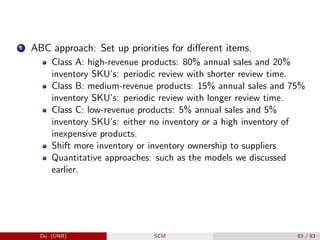
1 ABC approach: Set up priorities for different items.
Class A: high-revenue products: 80% annual sales and 20%
inventory SKU’s: periodic review with shorter review time.
Class B: medium-revenue products: 15% annual sales and 75%
inventory SKU’s: periodic review with longer review time.
Class C: low-revenue products: 5% annual sales and 5%
inventory SKU’s: either no inventory or a high inventory of
inexpensive products.
Shift more inventory or inventory ownership to suppliers
Quantitative approaches: such as the models we discussed
earlier.
Du (UNB) SCM 83 / 83

Supply Chain Management: Inventory Management

  • 1.
    Supply Chain Management:Inventory Management Donglei Du Faculty of Business Administration, University of New Brunswick, NB Canada Fredericton E3B 9Y2 (ddu@umbc.edu) Du (UNB) SCM 1 / 83
  • 2.
    Table of contentsI 1 Introduction 2 Inventory Management 3 Inventory models 4 Economic Order Quantity (EOQ) EOQ model When-to-order? 5 Economic Production Quantity (EPQ): model description EPQ model 6 The Newsboy Problem-Unknown demand (probabilistic model) The newsvendor model 7 Multiple-period stochastic model: model description 8 Managing inventory in the supply chain Du (UNB) SCM 2 / 83
  • 3.
  • 4.
    Outline I 1 Introducesome basic concepts in inventory management Inventory level (IL) Reorder point (ROP) Lead time Safety stock Continuous review and periodic review systems Service level 2 Introduce some basic inventory models, both deterministic and probabilistic. deterministic models 1 EOQ model 2 EPQ model probabilistic models 1 Single-period model: Newsboy model 2 Multiple-period model Du (UNB) SCM 4 / 83
  • 5.
  • 6.
    What is Inventory?I Inventory is a stock or store of goods or services, kept for use or sale in the future. There are four types of inventory Raw materials & purchased parts Partially completed goods called work in progress (WIP) Finished-goods inventories Goods-in-transit to warehouses or customers (GIT) The motive for inventory: there are three motives for holding inventory, similar to cash. Transaction motive: Economies of scale is achieved when the number of set-ups are reduced or the number of transactions are minimized. Precautionary motive: hedge against uncertainty, including demand uncertainty, supply uncertainty Speculative motive: hedge against price increases in materials or labor Du (UNB) SCM 6 / 83
  • 7.
    What is inventorymanagement? The objective of inventory is to achieve satisfactory levels of customer service while keeping inventory costs within reasonable bounds. Level of customer service: (1) in-stock (fill) rate (2) number of back orders (3) inventory turnover rate: the ratio of average cost of goods sold to average inventory investment Inventory cost: cost of ordering and carrying trade-off Du (UNB) SCM 7 / 83
  • 8.
    An Example I Letus look at a typical supply chain consists of suppliers and manufacturers, who convert raw materials into finished materials, and distribution centers and warehouses, form which finished products are distributed to customers. This implies that inventory appears in the supply chain in several forms: suppliers plants distributors warehouses retailers customers Inventory & warehousing costs Transportation cost Transportation cost Transportation cost Raw materials Work-in-process (WIP) Finished product Goods-in-transit (GIP) Inventory & warehousing costs Production/ purchase costs Du (UNB) SCM 8 / 83
  • 9.
  • 10.
    Inventory Models I Inventorymodels come in all shapes. We will focus on models for only a single product at a single location. Essentially each inventory model is determined by three key variables: demand: deterministic, that is, known exactly and in advance. random. Forecasting technique may be used in the latter case when historical data are available to estimate the average and standard deviation of the demand (will introduce forecasting techniques later). costs: order cost: the cost of product and the transportation cost inventory holding cost: taxes and insurances, maintenance, etc. physical aspects of the system: the physical structure of the inventory system, such as single or multiple-warehouse. Usually, there are two basic decisions in all inventory models: Du (UNB) SCM 10 / 83
  • 11.
    Inventory Models II 1How much to order? 2 When to order? Du (UNB) SCM 11 / 83
  • 12.
    Section 4 Economic OrderQuantity (EOQ) Du (UNB) SCM 12 / 83
  • 13.
    Subsection 1 EOQ model Du(UNB) SCM 13 / 83
  • 14.
    Economic Order Quantity(EOQ): Model description I The EOQ model is a simple deterministic model that illustrates the trade-offs between ordering and inventory costs. Consider a single warehouse facing constant demand for a single item. The warehouse orders from the supplier, who is assumed to have an unlimited quantity of the product. The EOQ model assume the following scenario: Annual demand D is deterministic and occurs at a constant rate—constant demand rate: i.e., the same number of units is taken from inventory each period of time, such as 5 units per day, 25 units per week, 100 units per month and so on. Order quantity are fixed at Q units per order. Du (UNB) SCM 14 / 83
  • 15.
    Economic Order Quantity(EOQ): Model description II A fixed ordering cost co per order, not depending on the quantity ordered. A holding cost ch per unit per year, depending on the size of the inventory. Sometimes holding cost can usually be calculated as follows: ch = annual holding cost rate×annual cost of holding one unit in in Du (UNB) SCM 15 / 83
  • 16.
    Shortages (such asstock-outs and backorder) are not permitted. There is no lead time or the lead time is constant. The planning horizon is long The objective is to decide the order quantity Q per order so as to minimize the total annual cost, including holding and setting-up costs. Du (UNB) SCM 16 / 83
  • 17.
    Economic Order Quantity(EOQ): Analysis The following graph illustrates the inventory level as a function of time—a saw-toothed inventory pattern. Quality on hand Q time place order receive order place order lead time receive order Du (UNB) SCM 17 / 83
  • 18.
    Inventory level (IL)is the quantity on hand, which is different from inventory position (IP), which is equal to inventory on-hand plus quantity on order minus backorder (if any). The maximum IL is Q, the minimum is 0, therefore the average IL is Q 2 . Since Annual holding cost = Average inventory × Annual holding cost = Q 2 ch Annual ordering cost = Number of orders per year× cost per ord = D Q co So Total annual cost = annual holding cost + annual setup cost = Q 2 ch + D Q co Du (UNB) SCM 18 / 83
  • 19.
    The trade-off ofholding and ordering costs is illustrated in the following figure. Order Quantity (Q) The Total-Cost Curve is U-Shaped Ordering Costs QO Annual Cost (optimal order quantity) TC Q H D Q S = + 2 Du (UNB) SCM 19 / 83
  • 20.
    Therefore, the optimalorder quantity is achieved at the point where the two costs meet. 1 The economic order quantity is Q∗ = r 2Dco ch 2 The cycle time (the time between two consecutive orders) is Cycle Time = Q∗ D 3 Number of orders per year Number of orders per year = 1 cycle time = D Q∗ Du (UNB) SCM 20 / 83
  • 21.
    An Example I Alocal distributor for a national tire company expects to sell approximately 9600 steel-belted radical tires of a certain size and tread design next year. Annual carrying cost is $16 per tire, and ordering cost is $75 per order. The distributor operates 288 days a year. 1 What is the EOQ? Q∗ = p 2Dco/ch = p 2(9600)75/16 = 300 2 How many times per year would the store reorder if the ECQ is ordered? D/Q∗ = 9600/300 = 32 Du (UNB) SCM 21 / 83
  • 22.
    An Example II 3What is the length of an order cycle if the EOQ is ordered? Q∗ /D = 300/9600 = 1/32 year or 1/32 × 288 = 9 working days 4 What is the total cost. TC = (Q∗ /2)ch+(D/Q∗ )co = (300/2)16+(9600/300)75 = 4800 Du (UNB) SCM 22 / 83
  • 23.
    Sensitivity analysis Estimating orderingand inventory costs is not an easy job, let alone accurate. Now let us see whether the EOQ model is robust to the costs, i.e., whether the order quantity is stable or not when the costs vary. Our claim is EOQ model is insensitive to small variations or errors in the cost estimates. Du (UNB) SCM 23 / 83
  • 24.
  • 25.
    When-to-order: some concepts Thereorder point (ROP) is defined to be the inventory level at which a new order should be placed. The when-to-order decision is usually expressed in terms of a reorder point. We will consider deterministic and stochastic models separately. Du (UNB) SCM 25 / 83
  • 26.
    When-to-order: deterministic demandand deterministic lead time Here we consider a simple deterministic demand and deterministic lead time model. Assume constant demand per period is d. Lead times is ` for a new order in terms of periods. Then ROP = `d Note that in our previous EOQ model, we assume ` = 0 so the reorder point is ROP = 0. Du (UNB) SCM 26 / 83
  • 27.
  • 28.
    An Example I Mr.X takes two special tablets per day, which are delivered to his home seven days after an order is called in. At what point should Mr. X reorder? Solution: In this case, the daily demand and lead time are both constants (special random variable), and d = 2 ` = 7 Therefore ROP = `d = 2 × 7 = 14 i.e., Mr. X should reorder when there are 14 tablets left. Du (UNB) SCM 28 / 83
  • 29.
    When-to-order: stochastic demandand stochastic lead time The reorder point for stochastic demand and stochastic lead time is the expected demand during lead time and an extra safety stock, which serves to reduce the probability of experiencing a stockout during lead time. Formally ROP = Expected demand during lead time + Safety stock Du (UNB) SCM 29 / 83
  • 30.
    Safety stock (SS):stock that is held in excess of expected demand due to variable demand rate and/or variable lead time. The following figure illustrates how safety stock can reduce the risk of stockout during lead time. LT Time Expected demand during lead time Maximum probable demand during lead time ROP Quantity Safety stock Du (UNB) SCM 30 / 83
  • 31.
    Service level (SL):the probability that demand will not exceed supply during lead time (i.e., the probability of no stockout). So the risk of stockout is 1 − SL. ROP Risk of a stockout Service level Probability of no stockout Expected demand Safety stock 0 z Quantity z-scale Du (UNB) SCM 31 / 83
  • 32.
    Assumption We assume 1 Dailydemands are i.i.d. random variables; 2 Daily demands are independent of the lead time. The amount of safety stock depends on 1 The desired service level 1 − α. 2 Daily demand random (rate) variable Di for day i, and hence the unit of Di is items/per day—suppose expectation and standard deviation of Di are (µD, σD). 3 Lead time random variable L, and hence the unit of L is number of days—suppose expectation and standard deviation are (µL, σL). So the lead time demand—demand during lead time, which is a new random variable with unit being number of items is equal to DL = L X i=1 Di = D1 + · · · + DL Du (UNB) SCM 32 / 83
  • 33.
    Then, we usethe compound random variable property to find the expectation and variance of DL (note that here both Di’s and L are random variable and we cannot apply the rule of expectation and rule of variance directly): E[DL] = E L P i=1 Di = µLµD V[DL] = V L P i=1 Di = µLσ2 D + σ2 Lµ2 D Assume DL follows a normal distribution, that is DL ∼ N(E[DL], p V[DL]). Then ROP should be chosen such that the probability of no stockout is at least 1 − α, that is P(DL ≤ ROP) ≥ 1 − α A standard given-p-value-find-x-value calculation gives us the desired ROP: ROP = E[DL] + zα p V[DL] = µDµL + zα q µLσ2 D + µ2 Dσ2 L Du (UNB) SCM 33 / 83
  • 34.
    An Example I Arestaurant used an average of 50 jars of a special sauce each week. Weekly usage of sauce has a standard deviation of 3 jars. The manger is willing to accept no more than a 10 percent risk of stockout during lead time, which is two weeks. Assume the distribution of usage is Normal. What is the ROP? Solution: In this case, the weekly demand is random and the lead time is constant, and α = 0.10, µD = 50, µL = 2, σD = 3, σL = 0. Therefore ROP = µDµL + zα q µLσ2 D + µ2 Dσ2 L = 2 × 50 + 1.28 p 2(3)2 = 105.43 i.e., the ROP is approximately 106 jars. Du (UNB) SCM 34 / 83
  • 35.
    Section 5 Economic ProductionQuantity (EPQ): model description Du (UNB) SCM 35 / 83
  • 36.
    Subsection 1 EPQ model Du(UNB) SCM 36 / 83
  • 37.
    Economic Production Quantity(EPQ): model description I Economic Production Quantity (EPQ), also called Economic Manufacturing Quantity (EMQ), is similar to EOQ model with one difference: instead of orders received in a single delivery, units are received incrementally during production, that is, constant production rate. The assumptions of the basic EPQ model are the following: Annual demand D is deterministic at a fixed rate of d units/per day. Annual production P is deterministic at a fixed rate of p units/per day, where p d. The setup cost co now has a different meaning—it is usually the cost to prepare for a production rum, which is independent of the production lot size. Du (UNB) SCM 37 / 83
  • 38.
    Economic Production Quantity(EPQ): model description II A holding cost ch per unit per year, depending on the size of the inventory. Shortages (such as stock-outs and backorder) are not permitted. There is no lead time or the lead time is constant. The planning horizon is long Du (UNB) SCM 38 / 83
  • 39.
    The following simpleobservation will be used shortly, which basically a unit transformation: year or day. Observation D P = d p The EPQ model is designed for production situations in which, once an order is placed, production begins and a constant number of units is produced to inventory each day until the production run has been completed. We introduce the concept of lot size, which is the number of units in an order. In general, if we let Q denote the production lot size, then the objective is to find the production lot size that minimizes the total holding and ordering cots. Du (UNB) SCM 39 / 83
  • 40.
    Economic Production Quantity(EPQ): analysis During the production run, there are two activities (see the following figure): Demand reduces the inventory Production adds to the inventory inventory level time Lot size Q p-d d p Production and usage usage only Maximum Inventory Imax p Q Average Inventory 0 Du (UNB) SCM 40 / 83
  • 41.
    Now we establishour total cost model analogously as before. First, we consider the annual holding cost. Similarly as before we need to know the average inventory, which is equal to average inventory = 1 2 (maximum inventory + minimum invento = 1 2 (p − d) Q p + 0 = 1 2 1 − d p Q So the annual holding cost is Annual holding cost = (Average inventory)(Annual holding cost = 1 2 1 − d p Qch Du (UNB) SCM 41 / 83
  • 42.
    Second, the annualsetup cost has the same formula: Annual ordering cost = (Number of orders per year)(cost per or = D Q co So the total annual cost is Total annual cost = annual holding cost+annual setu = Imax 2 ch + D Q co = 1 2 1 − d p Qch + D Q co = |{z} Observation 2 1 2 1 − D P Qch + D Q co Du (UNB) SCM 42 / 83
  • 43.
    The trade-off betweenthe holding and setup costs are similar as the EOQ model. The optimal order quantity is achieved when these two costs meet: 1 The economic production quantity is Q∗ = r 2Dco ch r p p − d 2 The run time (the production phase) is Run Time = Q∗ p 3 The cycle time (the time between two consecutive runs) is Cycle Time = Q∗ d 4 The maximum inventory is Imax = 1 − d p Q Du (UNB) SCM 43 / 83
  • 44.
    An Example I Atoy manufacturer uses 48000 rubber wheels per year. The firm makes its own wheels at a rate of 800 per day. Carrying cost is $1 per wheel per year. Setup cost for a production run is $45. The firm operates 240 days per year. Determine the: 1 The optimal run size 2 Minimum total annual cost for carrying and setup. 3 Cycle time for the optimal run size. 4 Run time for the optimal run size. Solution: D = 48000 wheels per year, and hence d = 48000/240 = 200 wheels per day. p = 800 wheels per day, and hence P = 800(240) = 192000. co = $45, ch = $1 per wheel per year, 1 Q∗ = q 2(48000)45 1 q 800 800−200 = 2400 wheels. Du (UNB) SCM 44 / 83
  • 45.
    An Example II 2Imax = 2400 800 (800 − 200) = 1800 TC = Imax 2 ch + D Q∗ co = 1800 2 × 1 + 48000 2400 × 45 = 1800 3 Cycle Time = 2400 200 = 12 days. 4 Run Time = 2400 800 = 3 days. Du (UNB) SCM 45 / 83
  • 46.
    Section 6 The NewsboyProblem-Unknown demand (probabilistic model) Du (UNB) SCM 46 / 83
  • 47.
    Subsection 1 The newsvendormodel Du (UNB) SCM 47 / 83
  • 48.
    The Newsboy Problem-Unknowndemand (probabilistic model): introduction The EOQ and EPQ models treat the world as if it were predictable by using forecast techniques. However this is not accurate in general. The newsboy model is a single-period inventory model, where one order is placed for the product; at the end of the period, the product is either sold out, or a surplus of unsold items will be sold for a salvage value. This happens in seasonal or perishable items, such as newspapers, seasonal clothing etc. Because we only order once for the period, the only inventory decision is how much to order. Of course, if the demand is deterministic, and known, then the solution is trivial. So the demand is assumed to be a random variable following some given probabilistic distribution. Du (UNB) SCM 48 / 83
  • 49.
    The Newsboy Problem-Unknowndemand (probabilistic model): model description The assumptions of the basic Newsboy model are the following: Demand X is a random variable following a probabilistic distribution with cumulative distribution function FX and density function fX. Order quantity Q units per order. The purchasing wholesale price is w per unit. The selling price is p per unit. The salvage price is s. The planning horizon is one-period. Du (UNB) SCM 49 / 83
  • 50.
    The objective isto decide the order quantity Q such that the expected total cost is minimized, including the long run total shortage and excess costs (see below). There are two opposite driving forces in this model. 1 shortage cost—unrealized profit per item, which is the opportunity loss for underestimating the demand (Q X): cs = selling price per unit − purchasing price per unit = p − w 2 excess cost—the difference between purchase and salvage cost, which is the loss of overestimating demand (Q X): ce = purchasing price per unit − salvage price per unit = w − s 3 The expected total cost model is given by EX(TC) = ceEX(max{Q − X, 0}) + csEX(max{X − Q, 0}) = ce Z Q 0 (Q − x)f(x)dx + cs Z ∞ Q (x − Q)f(x)dx Du (UNB) SCM 50 / 83
  • 51.
    4 The optimalsolution Q∗ depends on the underlying demand distribution. Du (UNB) SCM 51 / 83
  • 52.
    we define theconcept of service level (SL), usually denoted as α, as the probability that demand will not exceed the order quantity : SL = α = cs cs + ce = P(X ≤ Q∗ ) = FX(Q∗ ) where F is the cumulative probability function. So Q∗ = F−1 X (α) Du (UNB) SCM 52 / 83
  • 53.
    The following figuresillustration the service level for uniform demand distribution. SL=0.50 e c s c * Q Balance point SL=0.75 * Q e c s c Balance point Du (UNB) SCM 53 / 83
  • 54.
    A little noteis necessary. When the order quantity is discrete rather than continuous (and hence X is a discrete random variable rather than a continuous one), the optimal Q∗ satisfying the last equation usually does not coincide with a feasible order quantities—since it may be a fractional number. The solution is to order round up to the next highest order quantity (see the figures and example below for further illustration). * Q e s s c c c + = SL X Cumulative probability =service level e s s c c c + = SL Du (UNB) SCM 54 / 83
  • 55.
    An Example I Theowner of a newsstand wants to determine the number of Canada Post that must be stocked at the start of each day. It costs 30 cents to buy a copy, and the owner sells it for 75 cents. The sale of the newspaper typically occurs between 7:00 and 8:am. Newspapers left at the end of the day are recycled for an income of 5 cents a copy. How many copies should the owner stock every morning in order to minimize the total cost (or maximize the profit), assuming that the demand for the day can be approximated by 1 A normal distribution with mean 300 copies and standard deviation 20 copies 2 A discrete pdf defined as D 200 220 300 320 340 f(D) 0.1 0.2 0.4 0.2 0.1 F(D) 0.1 0.3 0.7 0.9 1.0 Du (UNB) SCM 55 / 83
  • 56.
    An Example II Solution:w = 30, p = 75, s = 5. So cs = p − w = 75 − 30 = 45, ce = w − s = 30 − 5 = 25. Therefore the service level SL = cs cs + ce = 45 70 = 0.6428 Du (UNB) SCM 56 / 83
  • 57.
    An Example I 1The probability of 0.6428 gives the z-value 0.36. Therefore optimal order Q∗ = 300 + 0.36(20) = 307.2 or approximately 308 for normal distribution. 2 Since the service level 0.3 SL 0.7. The optimal order Q∗ = 300 copies for discrete distribution. Du (UNB) SCM 57 / 83
  • 58.
    Section 7 Multiple-period stochasticmodel: model description Du (UNB) SCM 58 / 83
  • 59.
    Multiple-period stochastic model:model description Previously we consider the Newsvendor model, a single-period stochastic model. Now we consider a stochastic multiple period model. The inventory system operates continuously with many repeating periods or cycles. The lead time for a new order is L days and L is a random variable in general, reflecting the variation of delivery time. The daily demand is Di (i = 1, . . . , L) within the lead time, where the D0 is are also random variables, , reflecting the variation of demand over time. Inventory can be carried from one period to the next. Du (UNB) SCM 59 / 83
  • 60.
    Multiple-period stochastic model:model description New orders can be placed based on one of the following two basic classes of reorder policies: Event-driven: These are reorder policies that are driven by reorder point (ROP)—continuous review policy: in which inventory is reviewed every day and a decision is made about whether and how much to order. Time-driven: These are reorder policies that are driven by time —periodic review policy: in which inventory is reviewed at regular intervals and an appropriate quantity is ordered after each review. Du (UNB) SCM 60 / 83
  • 61.
    Continuous review policy:(Q, R) order-reorder policy (Q, R)-policy: Whenever the inventory level reaches the reorder point R, place an order of Q to bring the inventory position to the order-up-to level R + Q; for example Q can be chosen using the EOQ quantity. R+Q evel Q Inventory Position ntory L Lead Time Lead Time Inven R Time 0 Time Du (UNB) SCM 61 / 83
  • 62.
    There are twodecisions to be made in an (Q, R) order-reorder policy. Decide the reorder level R—when-to-order. Decide the reorder quantity Q and hence the order-up-to level—how much to-order. These two decisions should be made based on particular applications. Here we consider one situation where we can decide both quantities. Du (UNB) SCM 62 / 83
  • 63.
    A situation wherewe can decide s and Q I The lead time L is a random variable. Daily demand Di is random variable, i = 1, . . . , L. The demand during lead time DL = PL i=1 Di follows a normal distribution, whose expectation and variance can be calculated similarly as before: E[DL] = E L P i=1 Di = µLµD V[DL] = V L P i=1 Di = µLσ2 D + σ2 Lµ2 D There is an inventory holding cost of ch per unit per day. There is a fixed order cost co per unit. no backorders: when there is a stockout, the order is lost. Du (UNB) SCM 63 / 83
  • 64.
    A situation wherewe can decide s and Q II There is a required service level of 1 − α. That is, the probability of no-stockout during lead time is 1 − α Du (UNB) SCM 64 / 83
  • 65.
    Solution Under the aboutconditions, we have R = µDµL + zα q µLσ2 D + µ2 Dσ2 L Q = r 2µDco ch Du (UNB) SCM 65 / 83
  • 66.
    An Example I Supposethe distributor of the TV sets is trying to set inventory policies at the warehouse for one the TV models. Assume that whenever the distributor places an order for TV sets, there is fixed ordering cost of $4500, which is independent of the order size. The cost of a TV set to the distributor is $250 and annual inventory holding cost is about 18 percent of the product cost. Lead time for a new order is about 2 weeks. The table below shows the number of TV sets sold in the last 12 months. Suppose the distributor would like to ensure 97% service level. What is the reorder level and the order-up-to level that the distributor should use? months Sept. Oct. Nov. Dec. Jan. Feb. Mar. Apr. May June July Aug. sales 200 152 100 221 287 176 151 198 246 309 98 156 Du (UNB) SCM 66 / 83
  • 67.
    Solution 1 The leadtime L = 2 weeks. So µL = 2 and σL = 0. 2 Based on the historical date, we can calculate the average monthly demand is 191.17 and the standard deviation of monthly demand is 66.53. To make the units consistent, we transform months to weeks, assuming 1 month ≈ 4.3 weeks: µD = average weekly demand = average monthly demand 4.3 = 191.17 4.3 = 44.58 σD = weekly standard deviation = monthly standard deviation √ 4.3 = 191.17 √ 4.3 = 32.05 3 The service level is 1 − α = 0.97 implying zα = 1.88 from the normal table. Du (UNB) SCM 67 / 83
  • 68.
    1 The fixedordering cost of co = $4500. 2 Annual inventory holding cost per unit is 0.18(250) implying a weekly inventory holding cost per unit (assuming 1 year ≈ 52 weeks. ch = 0.18(250) 52 = 0.87 3 Now we are ready to decide both R and Q. R = = µDµL + zα q µLσ2 D + µ2 Dσ2 L = 176 Q = r 2µDco ch = 679 4 And hence the order-up-to level R + Q = 176 + 679 = 855. 5 To summarize, the distributor should place an order to raise the inventory position to 855 TV sets whenever the inventory level is below or at 176 units. Du (UNB) SCM 68 / 83
  • 69.
    Periodic review policy:(s, S) policy I The periodic review policy is similar to the continuous review policy except that the former is triggered by time, which causes two major differences 1 The fixed order cost plays no role here, as presumably the fixed cost is used to determine the cycle time. This implies there is only decision to make: how much to order. Usually we place an order that brings us to a desired replenishment level (the order-up-to-level point, or base-stock level). 2 The periodic review policy must have stockout protection until the next order arrives, which is an order interval plus a lead time away, while the continuous review policy needs protection only during the lead time. Therefore the safety-stock is usually higher in periodic review policy. Du (UNB) SCM 69 / 83
  • 70.
    Periodic review policy:(s, S) policy II 3 Therefore, at the time of the order, this order must raise the IP (inventory position) to the base-stock level. This level of IP should be enough to protect the warehouse against shortages until the next order arrives, which is after r + L days, and hence the current order should be enough to cover the demand during a period of r + L (or said differently, the IP should be enough to to cover the demand during the lead time and the order period). 4 The following figure explains the difference. Inventory Level Time Base-stock Level 0 Inventory Position r r L L L Du (UNB) SCM 70 / 83
  • 71.
    Periodic review policy:(s, S) policy III Du (UNB) SCM 71 / 83
  • 72.
    Periodic review policy Periodicreview policy: Let r be the review period (or order interval). For every period, place an order to bring the inventory to some desired replenishment position S. There is only one decision: the base-stock level to be raised: S. Du (UNB) SCM 72 / 83
  • 73.
    A situation wherewe can decide S Review period is r, a deterministic number. The lead time L is a random variable. Daily demand Di is random variable, i = 1, . . . , L. The demand during lead time plus review period DL = PL+r i=1 Di follows a normal distribution, whose expectation and variance can be calculated similarly as before: E[DL+r] = E L+r P i=1 Di = (r + µL)µD V[DL+r] = V L+r P i=1 Di = (r + µL)σ2 D + σ2 Lµ2 D no backorders: when there is a stockout, the order is lost. There is a required service level of 1 − α. That is, the probability of no-stockout during lead time is 1 − α Du (UNB) SCM 73 / 83
  • 74.
    Solution Under the aboutconditions, we have S = µD(µL + r) + zα q (µL + r)σ2 D + µ2 Dσ2 L Du (UNB) SCM 74 / 83
  • 75.
    An Example I Giventhe following information: The distributor has historically observed weekly demand of: µD = 30, σD = 3. Replenishment lead time is L = 2 weeks. Desired service level 1 − α = 0.99. Review period is r = 7 weeks. Find the replenishment level. Solution: S = µD(r + µL) + zα q (r + µL)σ2 D + µ2 Dσ2 L = 30(2 + 7) + 2.33 p (2 + 7)32 = 291 Du (UNB) SCM 75 / 83
  • 76.
    Section 8 Managing inventoryin the supply chain Du (UNB) SCM 76 / 83
  • 77.
    Managing inventory inthe supply chain I Up to now, we only consider the single-facility managing its inventory in order to minimize its own cost as much as possible. However, in supply chain management, there are always multi-facility. We consider a multi-facility supply chain that satisfies the following requirements (for the purpose, consider a retail distribution system with a single warehouse serving a number of retailers): 1 Inventory decisions are under centralized control by a decision-maker whose objective is to minimize systemwide cost. 2 The decision-maker has access to inventory information across the supply chain. Du (UNB) SCM 77 / 83
  • 78.
    Managing inventory inthe supply chain II We introduce the concept of echelon inventory. In a distribution system, each stage or level (i.e., warehouses or retailers) is referred to as an echelon. The echelon inventory at each level of the system is equal to the inventory on hand at that echelon, plus all downstream inventory. For example, the echelon inventory at the warehouse is equal to the inventory a the warehouse, plus all inventory in transit to and in stock at the retailers. Du (UNB) SCM 78 / 83
  • 79.
    The warehouse echeloninventory Supplier Warehouse Retailers Warehouse echelon lead time Warehouse echelon inventory Du (UNB) SCM 79 / 83
  • 80.
    Based on theconcept of echelon inventory, we suggest the following practical policy for managing the single warehouse multi-retailer system: Step 1. The individual retailers are managed using the the (Q, R)-policy based on its own inventory. Specifically, the ROP is calculated as follows for each retailer: ROP = E L X i=1 Di ! + zα v u u tV L X i=1 Di ! = µDµL + zα q µLσ2 D + µ2 Dσ2 L Du (UNB) SCM 80 / 83
  • 81.
    Step 2. Thewarehouse also use the (Q, R) policy based on the echelon inventory at the warehouse. Specifically, the ROP is calculated as follows for the warehouse: ROP = E Le X i=1 De i ! + zα v u u tV Le X i=1 De i ! = µDe µLe + zα q µLe σ2 De + µ2 De σ2 Le where Le = echelon lead time = lead time between the retailers and the warehouse plus the lead time between the warehouse and its supplier; and De = demand across all retailers. Du (UNB) SCM 81 / 83
  • 82.
    Practical issues The topseven effective inventory reduction strategies by managers (from a recent survey) are 1 Periodic inventory review: this policy makes it possible to identify slow-moving and obsolete products and allow management to continuously reduce inventory levels. 2 Tight management of usage rates, lead times and safety stock. This allows the firm to make sure inventory is kept at the appropriate level. 3 Reduce safety stock levels: such as reducing lead time. 4 Introduce/enhance cycle counting practice: count more frequently than once every year—keep posted all the time! Du (UNB) SCM 82 / 83
  • 83.
    1 ABC approach:Set up priorities for different items. Class A: high-revenue products: 80% annual sales and 20% inventory SKU’s: periodic review with shorter review time. Class B: medium-revenue products: 15% annual sales and 75% inventory SKU’s: periodic review with longer review time. Class C: low-revenue products: 5% annual sales and 5% inventory SKU’s: either no inventory or a high inventory of inexpensive products. Shift more inventory or inventory ownership to suppliers Quantitative approaches: such as the models we discussed earlier. Du (UNB) SCM 83 / 83