A
PROJECT REPORT
ON
“INVENTORY MODEL”
SUBMITTED BY-
Amrita Gharti.
Madhavi Sharma.
Nidhi Khetalpar.
MMS(2nD Semester)
Specialization: Finance
1
2
3
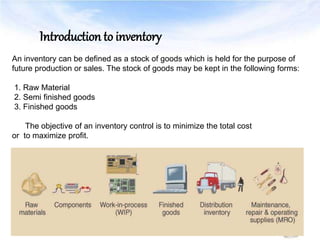
Introduction to inventory
An inventory can be defined as a stock of goods which is held for the purpose of
future production or sales. The stock of goods may be kept in the following forms:
1. Raw Material
2. Semi finished goods
3. Finished goods
The objective of an inventory control is to minimize the total cost
or to maximize profit.
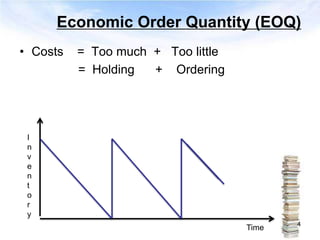
Economic Order Quantity (EOQ)
• Costs = Too much + Too little
= Holding + Ordering
I
n
v
e
n
t
o
r
y
Time 4
Assumptions of EOQ :
1. Demand is uniform and known.
2. Delivery is perfectly reliable and instant.
3. Carrying Cost , Ordering Cost
and unit price are constant.
5
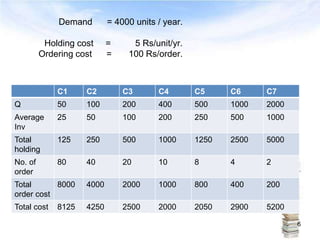
Demand = 4000 units / year.
Holding cost = 5 Rs/unit/yr.
Ordering cost = 100 Rs/order.
C1 C2 C3 C4 C5 C6 C7
Q 50 100 200 400 500 1000 2000
Average
Inv
25 50 100 200 250 500 1000
Total
holding
125 250 500 1000 1250 2500 5000
No. of
order
80 40 20 10 8 4 2
Total
order cost
8000 4000 2000 1000 800 400 200
Total cost 8125 4250 2500 2000 2050 2900 5200
6
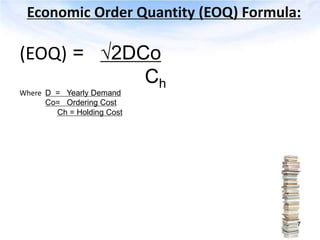
Economic Order Quantity (EOQ) Formula:
(EOQ) = √2DCo
Ch
Where D = Yearly Demand
Co= Ordering Cost
Ch = Holding Cost
7
.
8
ECONOMIC ORDER QUANTITY (EOQ) OF FROOTI:
ECONOMIC ORDER QUANTITY OF FROOTI MANUFACTURED BY PADMESH
BEVERAGES:
FOR FROOTI
ORDERING COST(PER CASE)
Quantity Amount (Rs )
200ml 273
500ml 488
1200ml 528
1.5 litre 414
CARRYING COST= Rs 2/ case
EOQ =
9
HERE,
•D = Demand for the year (1500000).
•β = Cost to place a one order.
•α = Cost to storing one unit of inventory
for a year
•Q = Order Size.
10
SOLUTION:-
EOQ FOR 200 ML:
EOQ = √ (2 x 1500000 x 273) / 2
= 20236.10 cases
EOQ FOR 500 ML:
EOQ = √ (2 x 1500000 x 488) / 2
= 27055.49 cases
EOQ FOR 1200 ML:
EOQ = √ (2 x 1500000 x 528)/2
= 28142.49 cases
11
EOQ FOR 1.5 Litres:
EOQ = √ (2 x 1500000 x 414)/ 2
= 24919.87 cases
SOLUTION:-
RE-ORDER OF PADMESH BEVERAGES,
A LICENSEE OF PARLE AGRO:
CALCULATION: Re-order level maintained by Padmesh Beverages for
the year 2011-2012.
Re-order level= Average consumption x (lead time + safety stock)
HERE,
TOTAL CONSUMPTION = 15, 00,000
LEAD TIME= 15 days
SAFETY STOCK= 7500 (6% of total consumption).
12
13
SOLUTION:-
15,00,000
12
=
= 1,25,000 units
The re-order below is calculated on the basis of average consumption:
Re-order level= average consumption x (lead time + safety stock)
= (1,25,000 x 15) + 7500
= (18,75,000 + 7500)
= 18,82,500 units
14
AVERAGE CONSUMPTION=
Total consumption
12
SOLUTION:-
15
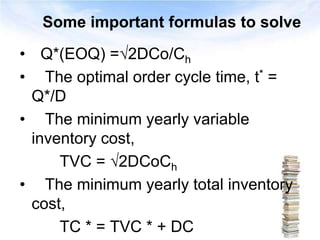
Some important formulas to solve
• Q*(EOQ) =√2DCo/Ch
• The optimal order cycle time, t* =
Q*/D
• The minimum yearly variable
inventory cost,
TVC = √2DCoCh
• The minimum yearly total inventory
cost,
TC * = TVC * + DC
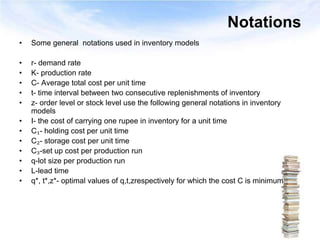
Notations
• Some general notations used in inventory models
• r- demand rate
• K- production rate
• C- Average total cost per unit time
• t- time interval between two consecutive replenishments of inventory
• z- order level or stock level use the following general notations in inventory
models
• I- the cost of carrying one rupee in inventory for a unit time
• C₁- holding cost per unit time
• C₂- storage cost per unit time
• C₃-set up cost per production run
• q-lot size per production run
• L-lead time
• q*, t*,z*- optimal values of q,t,zrespectively for which the cost C is minimum
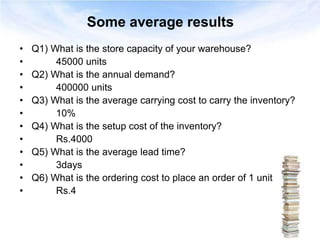
Some average results
• Q1) What is the store capacity of your warehouse?
• 45000 units
• Q2) What is the annual demand?
• 400000 units
• Q3) What is the average carrying cost to carry the inventory?
• 10%
• Q4) What is the setup cost of the inventory?
• Rs.4000
• Q5) What is the average lead time?
• 3days
• Q6) What is the ordering cost to place an order of 1 unit
• Rs.4
19
SOLUTION:-
SOLUTION:-
o The average price of commodity in Big Bazaar is Rs.200
o (EOQ) = √2DCo
Ch
Where D = Yearly Demand
Co= Ordering Cost
Ch = Holding Cost
= √ (2 x 400000 x 488) / 10% of 200
= √ (2 x 400000 x 488) / 20
= 400 unit/year.
t* =Q*/D
= 400/ 400000
= 0.001 Year.
21
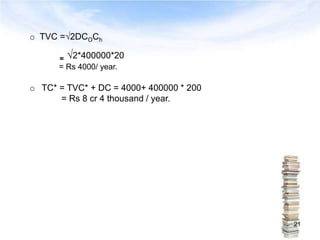
o TVC =√2DCOCh
= √2*400000*20
= Rs 4000/ year.
o TC* = TVC* + DC = 4000+ 400000 * 200
= Rs 8 cr 4 thousand / year.
Thank you!
For
Your
Kind
Attention
22
23

Inventory model (operation research)

  • 1.
    A PROJECT REPORT ON “INVENTORY MODEL” SUBMITTEDBY- Amrita Gharti. Madhavi Sharma. Nidhi Khetalpar. MMS(2nD Semester) Specialization: Finance 1
  • 2.
  • 3.
    3 Introduction to inventory Aninventory can be defined as a stock of goods which is held for the purpose of future production or sales. The stock of goods may be kept in the following forms: 1. Raw Material 2. Semi finished goods 3. Finished goods The objective of an inventory control is to minimize the total cost or to maximize profit.
  • 4.
    Economic Order Quantity(EOQ) • Costs = Too much + Too little = Holding + Ordering I n v e n t o r y Time 4
  • 5.
    Assumptions of EOQ: 1. Demand is uniform and known. 2. Delivery is perfectly reliable and instant. 3. Carrying Cost , Ordering Cost and unit price are constant. 5
  • 6.
    Demand = 4000units / year. Holding cost = 5 Rs/unit/yr. Ordering cost = 100 Rs/order. C1 C2 C3 C4 C5 C6 C7 Q 50 100 200 400 500 1000 2000 Average Inv 25 50 100 200 250 500 1000 Total holding 125 250 500 1000 1250 2500 5000 No. of order 80 40 20 10 8 4 2 Total order cost 8000 4000 2000 1000 800 400 200 Total cost 8125 4250 2500 2000 2050 2900 5200 6
  • 7.
    Economic Order Quantity(EOQ) Formula: (EOQ) = √2DCo Ch Where D = Yearly Demand Co= Ordering Cost Ch = Holding Cost 7
  • 8.
  • 9.
    ECONOMIC ORDER QUANTITY(EOQ) OF FROOTI: ECONOMIC ORDER QUANTITY OF FROOTI MANUFACTURED BY PADMESH BEVERAGES: FOR FROOTI ORDERING COST(PER CASE) Quantity Amount (Rs ) 200ml 273 500ml 488 1200ml 528 1.5 litre 414 CARRYING COST= Rs 2/ case EOQ = 9 HERE, •D = Demand for the year (1500000). •β = Cost to place a one order. •α = Cost to storing one unit of inventory for a year •Q = Order Size.
  • 10.
  • 11.
    EOQ FOR 200ML: EOQ = √ (2 x 1500000 x 273) / 2 = 20236.10 cases EOQ FOR 500 ML: EOQ = √ (2 x 1500000 x 488) / 2 = 27055.49 cases EOQ FOR 1200 ML: EOQ = √ (2 x 1500000 x 528)/2 = 28142.49 cases 11 EOQ FOR 1.5 Litres: EOQ = √ (2 x 1500000 x 414)/ 2 = 24919.87 cases SOLUTION:-
  • 12.
    RE-ORDER OF PADMESHBEVERAGES, A LICENSEE OF PARLE AGRO: CALCULATION: Re-order level maintained by Padmesh Beverages for the year 2011-2012. Re-order level= Average consumption x (lead time + safety stock) HERE, TOTAL CONSUMPTION = 15, 00,000 LEAD TIME= 15 days SAFETY STOCK= 7500 (6% of total consumption). 12
  • 13.
  • 14.
    15,00,000 12 = = 1,25,000 units There-order below is calculated on the basis of average consumption: Re-order level= average consumption x (lead time + safety stock) = (1,25,000 x 15) + 7500 = (18,75,000 + 7500) = 18,82,500 units 14 AVERAGE CONSUMPTION= Total consumption 12 SOLUTION:-
  • 15.
  • 16.
    Some important formulasto solve • Q*(EOQ) =√2DCo/Ch • The optimal order cycle time, t* = Q*/D • The minimum yearly variable inventory cost, TVC = √2DCoCh • The minimum yearly total inventory cost, TC * = TVC * + DC
  • 17.
    Notations • Some generalnotations used in inventory models • r- demand rate • K- production rate • C- Average total cost per unit time • t- time interval between two consecutive replenishments of inventory • z- order level or stock level use the following general notations in inventory models • I- the cost of carrying one rupee in inventory for a unit time • C₁- holding cost per unit time • C₂- storage cost per unit time • C₃-set up cost per production run • q-lot size per production run • L-lead time • q*, t*,z*- optimal values of q,t,zrespectively for which the cost C is minimum
  • 18.
    Some average results •Q1) What is the store capacity of your warehouse? • 45000 units • Q2) What is the annual demand? • 400000 units • Q3) What is the average carrying cost to carry the inventory? • 10% • Q4) What is the setup cost of the inventory? • Rs.4000 • Q5) What is the average lead time? • 3days • Q6) What is the ordering cost to place an order of 1 unit • Rs.4
  • 19.
  • 20.
    SOLUTION:- o The averageprice of commodity in Big Bazaar is Rs.200 o (EOQ) = √2DCo Ch Where D = Yearly Demand Co= Ordering Cost Ch = Holding Cost = √ (2 x 400000 x 488) / 10% of 200 = √ (2 x 400000 x 488) / 20 = 400 unit/year. t* =Q*/D = 400/ 400000 = 0.001 Year.
  • 21.
    21 o TVC =√2DCOCh =√2*400000*20 = Rs 4000/ year. o TC* = TVC* + DC = 4000+ 400000 * 200 = Rs 8 cr 4 thousand / year.
  • 22.
  • 23.