OF INFORMATION SYSTEMPRESENTED BY,
NAVYA JAYAKUMAR P
REG NO: MBA 105/18
CONTENT
• Introduction
• Objectives
• Characteristics of TQM
• Application of TQM
• Elements
• Parameters
• Conclusion
INTRODUCTION
Total - made up of the whole
Quality - degree of excellence a product or service provides
Management - act, art or manner of planning, controlling, directing,….
Therefore, TQM is the art of managing the whole to achieve excellence.
According to Information System:
TQM is used to assure the quality of information by ensuring,
verifying, and maintaining software integrity through an
appropriate methodology choice amongst the technology, design
and architecture.
OBJECTIVES
To assure the quality of information
To assure a precise and an accurate information
User friendly operations
Reliability of information can be assured
An ease of maintenance
CHARACTERISTICS OF TQM
Flexible
Bug free
Easy to maintain with the changing need
Ability to handle the changes with minimum cost
TQM APPLICATION
1. CURRENT TECHNOLOGY
The current technologies are database management, distributed data
processing, object orientation, parallel processing, data warehousing and
replication, networks and communication.
2. EMERGING TECHNOLOGY
They are Internet/intranet, EDI and E-Mail, Groupware for term based
application, client/server for application processing, multi media for voice,
video, image processing, imaging systems for image creation, storage mixing
knowledge based for expert, artificial intelligence system and computer aided
software engineering.
BENEFITS OF TQM
Committed management
Helps to achieve high level of user satisfaction
Helps to achieve business goals and mission
Closer provider relations
Process measuring and improvements
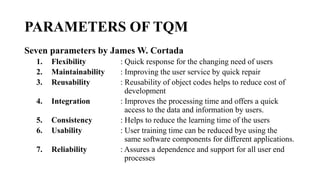
PARAMETERS OF TQM
Seven parameters by James W. Cortada
1. Flexibility : Quick response for the changing need of users
2. Maintainability : Improving the user service by quick repair
3. Reusability : Reusability of object codes helps to reduce cost of
development
4. Integration : Improves the processing time and offers a quick
access to the data and information by users.
5. Consistency : Helps to reduce the learning time of the users
6. Usability : User training time can be reduced bye using the
same software components for different applications.
7. Reliability : Assures a dependence and support for all user end
processes
CONCLUSION
TQM approach of IS ensures satisfactory level attainment of
these parameters through the implementation of various strategies in the
process of development.
The software quality assurance is nothing but what is required
which would ensure conformance to the standards set by the
management. It can be done by quality testing.

TOTAL QUALITY MANAGEMENT

  • 1.
    OF INFORMATION SYSTEMPRESENTEDBY, NAVYA JAYAKUMAR P REG NO: MBA 105/18
  • 2.
    CONTENT • Introduction • Objectives •Characteristics of TQM • Application of TQM • Elements • Parameters • Conclusion
  • 3.
    INTRODUCTION Total - madeup of the whole Quality - degree of excellence a product or service provides Management - act, art or manner of planning, controlling, directing,…. Therefore, TQM is the art of managing the whole to achieve excellence. According to Information System: TQM is used to assure the quality of information by ensuring, verifying, and maintaining software integrity through an appropriate methodology choice amongst the technology, design and architecture.
  • 4.
    OBJECTIVES To assure thequality of information To assure a precise and an accurate information User friendly operations Reliability of information can be assured An ease of maintenance
  • 5.
    CHARACTERISTICS OF TQM Flexible Bugfree Easy to maintain with the changing need Ability to handle the changes with minimum cost
  • 6.
    TQM APPLICATION 1. CURRENTTECHNOLOGY The current technologies are database management, distributed data processing, object orientation, parallel processing, data warehousing and replication, networks and communication. 2. EMERGING TECHNOLOGY They are Internet/intranet, EDI and E-Mail, Groupware for term based application, client/server for application processing, multi media for voice, video, image processing, imaging systems for image creation, storage mixing knowledge based for expert, artificial intelligence system and computer aided software engineering.
  • 7.
    BENEFITS OF TQM Committedmanagement Helps to achieve high level of user satisfaction Helps to achieve business goals and mission Closer provider relations Process measuring and improvements
  • 8.
    PARAMETERS OF TQM Sevenparameters by James W. Cortada 1. Flexibility : Quick response for the changing need of users 2. Maintainability : Improving the user service by quick repair 3. Reusability : Reusability of object codes helps to reduce cost of development 4. Integration : Improves the processing time and offers a quick access to the data and information by users. 5. Consistency : Helps to reduce the learning time of the users 6. Usability : User training time can be reduced bye using the same software components for different applications. 7. Reliability : Assures a dependence and support for all user end processes
  • 9.
    CONCLUSION TQM approach ofIS ensures satisfactory level attainment of these parameters through the implementation of various strategies in the process of development. The software quality assurance is nothing but what is required which would ensure conformance to the standards set by the management. It can be done by quality testing.