QUANTITY
DISCOUNT
MODLE
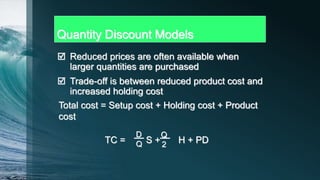
Quantity Discount Models
 Reduced prices are often available when
larger quantities are purchased
 Trade-off is between reduced product cost and
increased holding cost
Total cost = Setup cost + Holding cost + Product
cost
TC = S + H + PD
D
Q
Q
2
Quantity Discount Models
1. For each discount, calculate Q*
2. If Q* for a discount doesn’t qualify, choose
the smallest possible order size to get the
discount
3. Compute the total cost for each Q* or
adjusted value from Step 2
4. Select the Q* that gives the lowest total
cost
Steps in analyzing a quantity discount
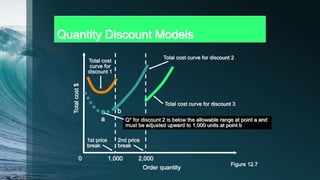
Quantity Discount Models
1,000 2,000
Totalcost$
0
Order quantity
Q* for discount 2 is below the allowable range at point a and
must be adjusted upward to 1,000 units at point b
a
b
1st price
break
2nd price
break
Total cost
curve for
discount 1
Total cost curve for discount 2
Total cost curve for discount 3
Figure 12.7
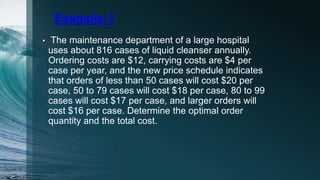
Example:1
• The maintenance department of a large hospital
uses about 816 cases of liquid cleanser annually.
Ordering costs are $12, carrying costs are $4 per
case per year, and the new price schedule indicates
that orders of less than 50 cases will cost $20 per
case, 50 to 79 cases will cost $18 per case, 80 to 99
cases will cost $17 per case, and larger orders will
cost $16 per case. Determine the optimal order
quantity and the total cost.
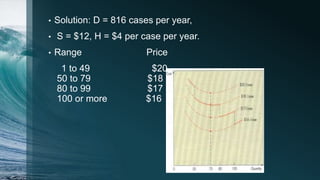
• Solution: D = 816 cases per year,
• S = $12, H = $4 per case per year.
• Range Price
1 to 49 $20
50 to 79 $18
80 to 99 $17
100 or more $16
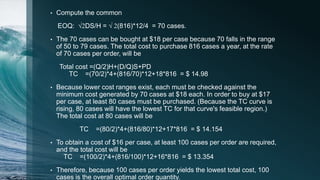
• Compute the common
EOQ: √2DS/H = √ 2(816)*12/4 = 70 cases.
• The 70 cases can be bought at $18 per case because 70 falls in the range
of 50 to 79 cases. The total cost to purchase 816 cases a year, at the rate
of 70 cases per order, will be
Total cost =(Q/2)H+(D/Q)S+PD
TC =(70/2)*4+(816/70)*12+18*816 = $ 14.98
• Because lower cost ranges exist, each must be checked against the
minimum cost generated by 70 cases at $18 each. In order to buy at $17
per case, at least 80 cases must be purchased. (Because the TC curve is
rising, 80 cases will have the lowest TC for that curve's feasible region.)
The total cost at 80 cases will be
TC =(80/2)*4+(816/80)*12+17*816 = $ 14.154
• To obtain a cost of $16 per case, at least 100 cases per order are required,
and the total cost will be
TC =(100/2)*4+(816/100)*12+16*816 = $ 13.354
• Therefore, because 100 cases per order yields the lowest total cost, 100
cases is the overall optimal order quantity.
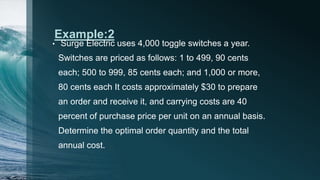
Example:2
• Surge Electric uses 4,000 toggle switches a year.
Switches are priced as follows: 1 to 499, 90 cents
each; 500 to 999, 85 cents each; and 1,000 or more,
80 cents each It costs approximately $30 to prepare
an order and receive it, and carrying costs are 40
percent of purchase price per unit on an annual basis.
Determine the optimal order quantity and the total
annual cost.
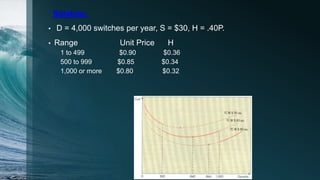
Solution:
• D = 4,000 switches per year, S = $30, H = .40P.
• Range Unit Price H
1 to 499 $0.90 $0.36
500 to 999 $0.85 $0.34
1,000 or more $0.80 $0.32
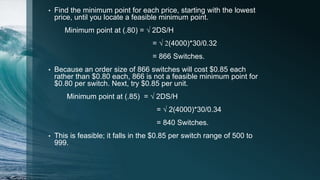
• Find the minimum point for each price, starting with the lowest
price, until you locate a feasible minimum point.
Minimum point at (.80) = √ 2DS/H
= √ 2(4000)*30/0.32
= 866 Switches.
• Because an order size of 866 switches will cost $0.85 each
rather than $0.80 each, 866 is not a feasible minimum point for
$0.80 per switch. Next, try $0.85 per unit.
Minimum point at (.85) = √ 2DS/H
= √ 2(4000)*30/0.34
= 840 Switches.
• This is feasible; it falls in the $0.85 per switch range of 500 to
999.
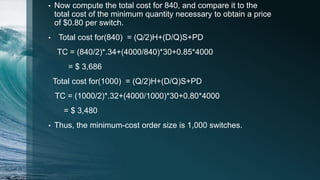
• Now compute the total cost for 840, and compare it to the
total cost of the minimum quantity necessary to obtain a price
of $0.80 per switch.
• Total cost for(840) = (Q/2)H+(D/Q)S+PD
TC = (840/2)*.34+(4000/840)*30+0.85*4000
= $ 3,686
Total cost for(1000) = (Q/2)H+(D/Q)S+PD
TC = (1000/2)*.32+(4000/1000)*30+0.80*4000
= $ 3,480
• Thus, the minimum-cost order size is 1,000 switches.
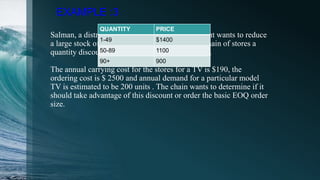
Salman, a distributor of audio and video equipment wants to reduce
a large stock of television .It has offered a local chain of stores a
quantity discount pricing schedule as given above.
The annual carrying cost for the stores for a TV is $190, the
ordering cost is $ 2500 and annual demand for a particular model
TV is estimated to be 200 units . The chain wants to determine if it
should take advantage of this discount or order the basic EOQ order
size.
QUANTITY PRICE
1-49 $1400
50-89 1100
90+ 900
EXAMPLE :3
Solution
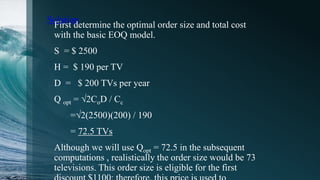
First determine the optimal order size and total cost
with the basic EOQ model.
S = $ 2500
H = $ 190 per TV
D = $ 200 TVs per year
Q opt = √2CoD / Cc
=√2(2500)(200) / 190
= 72.5 TVs
Although we will use Qopt = 72.5 in the subsequent
computations , realistically the order size would be 73
televisions. This order size is eligible for the first
Continuation
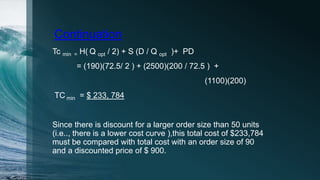
Tc min = H( Q opt / 2) + S (D / Q opt )+ PD
= (190)(72.5/ 2 ) + (2500)(200 / 72.5 ) +
(1100)(200)
TC min = $ 233, 784
Since there is discount for a larger order size than 50 units
(i.e.., there is a lower cost curve ),this total cost of $233,784
must be compared with total cost with an order size of 90
and a discounted price of $ 900.
Continuation
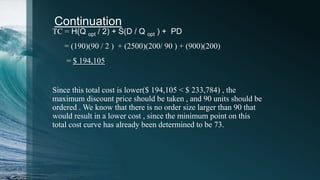
TC = H(Q opt / 2) + S(D / Q opt ) + PD
= (190)(90 / 2 ) + (2500)(200/ 90 ) + (900)(200)
= $ 194,105
Since this total cost is lower($ 194,105 < $ 233,784) , the
maximum discount price should be taken , and 90 units should be
ordered . We know that there is no order size larger than 90 that
would result in a lower cost , since the minimum point on this
total cost curve has already been determined to be 73.
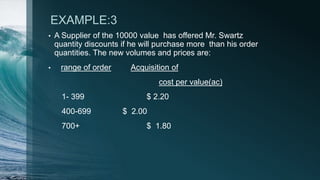
EXAMPLE:3
• A Supplier of the 10000 value has offered Mr. Swartz
quantity discounts if he will purchase more than his order
quantities. The new volumes and prices are:
• range of order Acquisition of
cost per value(ac)
1- 399 $ 2.20
400-699 $ 2.00
700+ $ 1.80
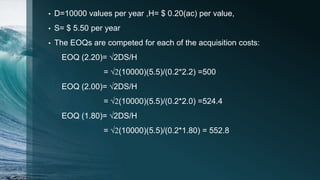
• D=10000 values per year ,H= $ 0.20(ac) per value,
• S= $ 5.50 per year
• The EOQs are competed for each of the acquisition costs:
EOQ (2.20)= √2DS/H
= √2(10000)(5.5)/(0.2*2.2) =500
EOQ (2.00)= √2DS/H
= √2(10000)(5.5)/(0.2*2.0) =524.4
EOQ (1.80)= √2DS/H
= √2(10000)(5.5)/(0.2*1.80) = 552.8
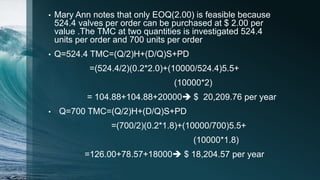
• Mary Ann notes that only EOQ(2.00) is feasible because
524.4 valves per order can be purchased at $ 2.00 per
value .The TMC at two quantities is investigated 524.4
units per order and 700 units per order
• Q=524.4 TMC=(Q/2)H+(D/Q)S+PD
=(524.4/2)(0.2*2.0)+(10000/524.4)5.5+
(10000*2)
= 104.88+104.88+20000 $ 20,209.76 per year
• Q=700 TMC=(Q/2)H+(D/Q)S+PD
=(700/2)(0.2*1.8)+(10000/700)5.5+
(10000*1.8)
=126.00+78.57+18000 $ 18,204.57 per year
EXAMPLE : 4
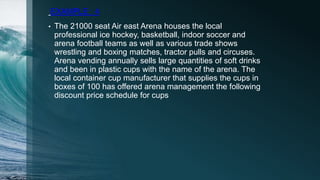
• The 21000 seat Air east Arena houses the local
professional ice hockey, basketball, indoor soccer and
arena football teams as well as various trade shows
wrestling and boxing matches, tractor pulls and circuses.
Arena vending annually sells large quantities of soft drinks
and been in plastic cups with the name of the arena. The
local container cup manufacturer that supplies the cups in
boxes of 100 has offered arena management the following
discount price schedule for cups
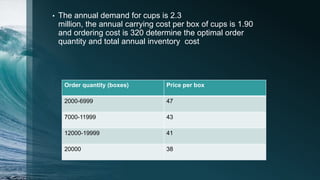
• The annual demand for cups is 2.3
million, the annual carrying cost per box of cups is 1.90
and ordering cost is 320 determine the optimal order
quantity and total annual inventory cost
Order quantity (boxes) Price per box
2000-6999 47
7000-11999 43
12000-19999 41
20000 38
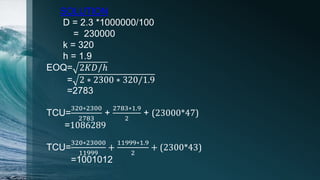
EOQ= 2𝐾𝐷/ℎ
= 2 ∗ 2300 ∗ 320/1.9
=2783
TCU=
320∗2300
2783
+
2783∗1.9
2
+ (23000*47)
=1086289
TCU=
320∗23000
11999
+
11999∗1.9
2
+ (2300*43)
=1001012
SOLUTION
D = 2.3 *1000000/100
= 230000
k = 320
h = 1.9
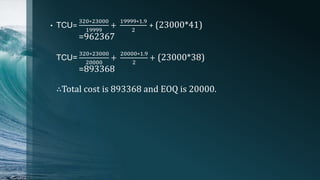
• TCU=
320∗23000
19999
+
19999∗1.9
2
+ (23000*41)
=962367
TCU=
320∗23000
20000
+
20000∗1.9
2
+ (23000*38)
=893368
∴Total cost is 893368 and EOQ is 20000.

Quantity discount

  • 1.
  • 2.
    Quantity Discount Models Reduced prices are often available when larger quantities are purchased  Trade-off is between reduced product cost and increased holding cost Total cost = Setup cost + Holding cost + Product cost TC = S + H + PD D Q Q 2
  • 3.
    Quantity Discount Models 1.For each discount, calculate Q* 2. If Q* for a discount doesn’t qualify, choose the smallest possible order size to get the discount 3. Compute the total cost for each Q* or adjusted value from Step 2 4. Select the Q* that gives the lowest total cost Steps in analyzing a quantity discount
  • 4.
    Quantity Discount Models 1,0002,000 Totalcost$ 0 Order quantity Q* for discount 2 is below the allowable range at point a and must be adjusted upward to 1,000 units at point b a b 1st price break 2nd price break Total cost curve for discount 1 Total cost curve for discount 2 Total cost curve for discount 3 Figure 12.7
  • 5.
    Example:1 • The maintenancedepartment of a large hospital uses about 816 cases of liquid cleanser annually. Ordering costs are $12, carrying costs are $4 per case per year, and the new price schedule indicates that orders of less than 50 cases will cost $20 per case, 50 to 79 cases will cost $18 per case, 80 to 99 cases will cost $17 per case, and larger orders will cost $16 per case. Determine the optimal order quantity and the total cost.
  • 6.
    • Solution: D= 816 cases per year, • S = $12, H = $4 per case per year. • Range Price 1 to 49 $20 50 to 79 $18 80 to 99 $17 100 or more $16
  • 7.
    • Compute thecommon EOQ: √2DS/H = √ 2(816)*12/4 = 70 cases. • The 70 cases can be bought at $18 per case because 70 falls in the range of 50 to 79 cases. The total cost to purchase 816 cases a year, at the rate of 70 cases per order, will be Total cost =(Q/2)H+(D/Q)S+PD TC =(70/2)*4+(816/70)*12+18*816 = $ 14.98 • Because lower cost ranges exist, each must be checked against the minimum cost generated by 70 cases at $18 each. In order to buy at $17 per case, at least 80 cases must be purchased. (Because the TC curve is rising, 80 cases will have the lowest TC for that curve's feasible region.) The total cost at 80 cases will be TC =(80/2)*4+(816/80)*12+17*816 = $ 14.154 • To obtain a cost of $16 per case, at least 100 cases per order are required, and the total cost will be TC =(100/2)*4+(816/100)*12+16*816 = $ 13.354 • Therefore, because 100 cases per order yields the lowest total cost, 100 cases is the overall optimal order quantity.
  • 8.
    Example:2 • Surge Electricuses 4,000 toggle switches a year. Switches are priced as follows: 1 to 499, 90 cents each; 500 to 999, 85 cents each; and 1,000 or more, 80 cents each It costs approximately $30 to prepare an order and receive it, and carrying costs are 40 percent of purchase price per unit on an annual basis. Determine the optimal order quantity and the total annual cost.
  • 9.
    Solution: • D =4,000 switches per year, S = $30, H = .40P. • Range Unit Price H 1 to 499 $0.90 $0.36 500 to 999 $0.85 $0.34 1,000 or more $0.80 $0.32
  • 10.
    • Find theminimum point for each price, starting with the lowest price, until you locate a feasible minimum point. Minimum point at (.80) = √ 2DS/H = √ 2(4000)*30/0.32 = 866 Switches. • Because an order size of 866 switches will cost $0.85 each rather than $0.80 each, 866 is not a feasible minimum point for $0.80 per switch. Next, try $0.85 per unit. Minimum point at (.85) = √ 2DS/H = √ 2(4000)*30/0.34 = 840 Switches. • This is feasible; it falls in the $0.85 per switch range of 500 to 999.
  • 11.
    • Now computethe total cost for 840, and compare it to the total cost of the minimum quantity necessary to obtain a price of $0.80 per switch. • Total cost for(840) = (Q/2)H+(D/Q)S+PD TC = (840/2)*.34+(4000/840)*30+0.85*4000 = $ 3,686 Total cost for(1000) = (Q/2)H+(D/Q)S+PD TC = (1000/2)*.32+(4000/1000)*30+0.80*4000 = $ 3,480 • Thus, the minimum-cost order size is 1,000 switches.
  • 12.
    Salman, a distributorof audio and video equipment wants to reduce a large stock of television .It has offered a local chain of stores a quantity discount pricing schedule as given above. The annual carrying cost for the stores for a TV is $190, the ordering cost is $ 2500 and annual demand for a particular model TV is estimated to be 200 units . The chain wants to determine if it should take advantage of this discount or order the basic EOQ order size. QUANTITY PRICE 1-49 $1400 50-89 1100 90+ 900 EXAMPLE :3
  • 13.
    Solution First determine theoptimal order size and total cost with the basic EOQ model. S = $ 2500 H = $ 190 per TV D = $ 200 TVs per year Q opt = √2CoD / Cc =√2(2500)(200) / 190 = 72.5 TVs Although we will use Qopt = 72.5 in the subsequent computations , realistically the order size would be 73 televisions. This order size is eligible for the first
  • 14.
    Continuation Tc min =H( Q opt / 2) + S (D / Q opt )+ PD = (190)(72.5/ 2 ) + (2500)(200 / 72.5 ) + (1100)(200) TC min = $ 233, 784 Since there is discount for a larger order size than 50 units (i.e.., there is a lower cost curve ),this total cost of $233,784 must be compared with total cost with an order size of 90 and a discounted price of $ 900.
  • 15.
    Continuation TC = H(Qopt / 2) + S(D / Q opt ) + PD = (190)(90 / 2 ) + (2500)(200/ 90 ) + (900)(200) = $ 194,105 Since this total cost is lower($ 194,105 < $ 233,784) , the maximum discount price should be taken , and 90 units should be ordered . We know that there is no order size larger than 90 that would result in a lower cost , since the minimum point on this total cost curve has already been determined to be 73.
  • 16.
    EXAMPLE:3 • A Supplierof the 10000 value has offered Mr. Swartz quantity discounts if he will purchase more than his order quantities. The new volumes and prices are: • range of order Acquisition of cost per value(ac) 1- 399 $ 2.20 400-699 $ 2.00 700+ $ 1.80
  • 17.
    • D=10000 valuesper year ,H= $ 0.20(ac) per value, • S= $ 5.50 per year • The EOQs are competed for each of the acquisition costs: EOQ (2.20)= √2DS/H = √2(10000)(5.5)/(0.2*2.2) =500 EOQ (2.00)= √2DS/H = √2(10000)(5.5)/(0.2*2.0) =524.4 EOQ (1.80)= √2DS/H = √2(10000)(5.5)/(0.2*1.80) = 552.8
  • 18.
    • Mary Annnotes that only EOQ(2.00) is feasible because 524.4 valves per order can be purchased at $ 2.00 per value .The TMC at two quantities is investigated 524.4 units per order and 700 units per order • Q=524.4 TMC=(Q/2)H+(D/Q)S+PD =(524.4/2)(0.2*2.0)+(10000/524.4)5.5+ (10000*2) = 104.88+104.88+20000 $ 20,209.76 per year • Q=700 TMC=(Q/2)H+(D/Q)S+PD =(700/2)(0.2*1.8)+(10000/700)5.5+ (10000*1.8) =126.00+78.57+18000 $ 18,204.57 per year
  • 19.
    EXAMPLE : 4 •The 21000 seat Air east Arena houses the local professional ice hockey, basketball, indoor soccer and arena football teams as well as various trade shows wrestling and boxing matches, tractor pulls and circuses. Arena vending annually sells large quantities of soft drinks and been in plastic cups with the name of the arena. The local container cup manufacturer that supplies the cups in boxes of 100 has offered arena management the following discount price schedule for cups
  • 20.
    • The annualdemand for cups is 2.3 million, the annual carrying cost per box of cups is 1.90 and ordering cost is 320 determine the optimal order quantity and total annual inventory cost Order quantity (boxes) Price per box 2000-6999 47 7000-11999 43 12000-19999 41 20000 38
  • 21.
    EOQ= 2𝐾𝐷/ℎ = 2∗ 2300 ∗ 320/1.9 =2783 TCU= 320∗2300 2783 + 2783∗1.9 2 + (23000*47) =1086289 TCU= 320∗23000 11999 + 11999∗1.9 2 + (2300*43) =1001012 SOLUTION D = 2.3 *1000000/100 = 230000 k = 320 h = 1.9
  • 22.