1
Course Code: BAC506A
Course Title: Operations Management
Course Leader:
Dr. Chandra Sen Mazumdar
Email: chandrasen.ms.mc@msruas.ac.in
2
Inventory Management
3
3
Learning Objectives
 You should be able to:
1. Define the term inventory, list the major reasons for holding inventories,
and list the main requirements for effective inventory management
2. Discuss the nature and importance of service inventories
3. Explain periodic and perpetual review systems
4. Explain the objectives of inventory management
5. Describe the A-B-C approach and explain how it is useful
6. Describe the basic EOQ model and its assumptions and solve typical
problems
7. Describe reorder point models
4
4
• Inventory
• A stock or store of goods
• Independent demand items
• Items that are ready to be sold or used
Inventory
Inventories are a vital part of business: (1) necessary for
operations and (2) contribute to customer satisfaction
A “typical” firm has roughly 30% of its current assets
and as much as 90% of its working capital invested in
inventory
5
Inventory Management
• Management has two basic functions concerning inventory:
1. Establish a system for tracking items in inventory
2. Make decisions about
• When to order
• How much to order
6
6
 Periodic System
 Physical count of items in inventory made at periodic intervals
 Perpetual Inventory System
 System that keeps track of removals from inventory
continuously, thus monitoring current levels of each item
 An order is placed when inventory drops to a predetermined minimum
level
• Two-bin system
• Two containers of inventory; reorder
when the first is empty
Inventory Counting Systems
7
 Purchase cost
 The amount paid to buy the inventory
 Holding (carrying) costs
 Cost to carry an item in inventory for a length of time, usually a
year
 Ordering costs
 Costs of ordering and receiving inventory
 Setup costs
 The costs involved in preparing equipment for a job
 Analogous to ordering costs
 Shortage costs
 Costs resulting when demand exceeds the supply of inventory;
often unrealized profit per unit
Inventory Costs
8
 An inventory classification system based on some
measure of importance, usually the annual dollar
(monetary) value
 Typically three classes of items are used:
 A (very important): 10 to 20% of inventory items but 60 to 70%
of annual dollar value
 B (moderately important)
 C (least important): 50 to 60% of inventory items but only about
10 to 15% of annual dollar value
 Actual number of categories may vary from organization
to organization
A-B-C Approach
9
Basic Economic Order Quantity (EOQ) Model
Assumptions
1. Only one product is involved.
2. Annual demand requirements are known.
3. Demand is spread evenly throughout the
year so that the demand rate is reasonably
constant.
4. Lead time is known and constant.
5. Each order is received in a single delivery.
6. There are no quantity discounts.
10
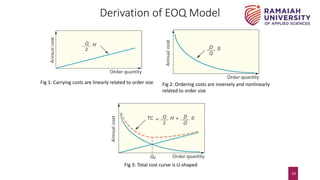
Derivation of EOQ Model
Fig 1: Carrying costs are linearly related to order size Fig 2: Ordering costs are inversely and nonlinearly
related to order size
Fig 3: Total cost curve is U-shaped
11
Derivation of EOQ Model contd.
Annual carrying cost =
𝑄
2
𝐻
Where, Q = Order quantity in Units
H = Holding (carrying) cost per unit per year
Annual ordering cost =
𝐷
𝑄
𝑆
Where, D = Demand in units per year
S = Ordering cost per order
Total cost = Annual carrying cost + Annual ordering cost
=
𝑄
2
𝐻 +
𝐷
𝑄
𝑆
Optimal order quantity occurs when, Annual carrying cost = Annual ordering cost
Or,
𝑄
2
𝐻 =
𝐷
𝑄
𝑆
cost
holding
unit
per
annual
cost)
der
demand)(or
annual
(
2
2
O 

H
DS
Q
12
Example
A local distributor for a national tire company expects to sell approximately 9,600 steel-
belted radial tires of a certain size and tread design next year. Annual carrying cost is $16
per tire, and ordering cost is $75. The distributor operates 288 days a year.
a. What is the EOQ?
b. How many times per year does the store reorder?
c. What is the length of an order cycle?
d. What is the total annual cost if the EOQ quantity is ordered?
Solution:
D = 9600 units
H = $16 per unit per year
S = $75
a) 𝑄0 =
2𝐷𝑆
𝐻
=
2∗9600∗75
16
= 300 tires
b) No. of orders per year = D/Q0 = 9600/300 = 32
c) Length of order cycle = Q0/D = (1/32)*288 = 9 days
d) Total Cost (TC) =
𝑄
2
𝐻 +
𝐷
𝑄
𝑆 = (300/2)*16 + (9600/300)*75 = $4800
13
When to Reorder
• Reorder point
• When the quantity on hand of an item drops to this amount, the item is reordered.
• Determinants of the reorder point
1. The rate of demand
2. The lead time
3. The extent of demand and/or lead time variability
4. The degree of stockout risk acceptable to management
14
14
)
as
units
time
same
(in
time
Lead
LT
per week)
day,
per
period,
per
(units
rate
Demand
where
LT
ROP
d
d
d




Reorder Point: Under Certainty
15
15
• Demand or lead time uncertainty creates the possibility that demand will be
greater than available supply
• To reduce the likelihood of a stockout, it becomes necessary to carry safety stock
• Safety stock
• Stock that is held in excess of expected demand due to variable demand and/or lead
time
Reorder Point: Under Uncertainty
Stock
Safety
time
lead
during
demand
Expected
ROP 

16
16
• The amount of safety stock that is appropriate for a given
situation depends upon:
1. The average demand rate and average lead time
2. Demand and lead time variability
3. The desired service level
How Much Safety Stock?
demand
time
lead
of
deviation
standard
The
deviations
standard
of
Number
where
time
lead
during
demand
Expected
ROP
LT
LT




d
d
z
z


17
Reorder Point: Demand Uncertainty
)
as
units
time
(same
time
Lead
LT
)
as
units
time
(same
period
per
demand
of
stdev.
The
per week)
day,
(per
period
per
demand
Average
deviations
standard
of
Number
where
LT
ROP
d
d
d
z
z
LT
d
d
d









LT
LT d
d 
 
Note: If only demand is variable, then
18
18
• Fixed-order-interval (FOI) model
• Orders are placed at fixed time intervals
• Reasons for using the FOI model
• Supplier’s policy may encourage its use
• Grouping orders from the same supplier can produce savings in shipping costs
• Some circumstances do not lend themselves to continuously monitoring inventory position
How Much to Order: FOI
19
19
me
reorder ti
at
hand
on
Amount
orders)
between
time
of
(length
interval
Order
OI
where
LT
OI
LT)
OI
(
me
reorder ti
at
hand
on
Amount
stock
Safety
interval
protection
during
demand
Expected
Order
to
Amount










A
A
z
d d

FOI Model
20
Technology in Inventory Management
• Real-time data capture
• RFID tags
• GPS navigation
• ERP system
https://www.youtube.com/watch?v=BnQG4NGyyAU
21
Behind the Scenes – Amazon Warehouse
22
Operations Strategy
• Improving inventory processes can offer significant cost reduction and customer
satisfaction benefits
• Areas that may lead to improvement:
• Record keeping
• Records and data must be accurate and up-to-date
• Variation reduction
• Lead variation
• Forecast errors
• Lean operations
• Supply chain management
23
23
Summary
• Discussed need for inventory management and inventory
costs
• The EOQ model and numerical problems related to that
• Discussed the terms reorder point, safety stock – under
demand certainty and uncertainty
24
24
References
Essential Reading
• Stevenson, William J. (2015) Operations Management, 11th Edition, Mc
Graw Hill Education
Recommended Reading
• Kumar, S. A., & Suresh, N. (2008) Operations Management, 2nd edition.
New Age International Publishers
Magazines and Journals
• Operations Research/Management Science Today
• International Journal of Operational Research, Inderscience Publishers
Websites
• https://harvardmagazine.com/tags/quantitative-methods
• https://sloanreview.mit.edu/
25
25
Disclaimer
• All data and content provided in this presentation are
taken from the reference books, internet – websites
and links, for informational purposes only.

Inventory management in operation research

  • 1.
    1 Course Code: BAC506A CourseTitle: Operations Management Course Leader: Dr. Chandra Sen Mazumdar Email: chandrasen.ms.mc@msruas.ac.in
  • 2.
  • 3.
    3 3 Learning Objectives  Youshould be able to: 1. Define the term inventory, list the major reasons for holding inventories, and list the main requirements for effective inventory management 2. Discuss the nature and importance of service inventories 3. Explain periodic and perpetual review systems 4. Explain the objectives of inventory management 5. Describe the A-B-C approach and explain how it is useful 6. Describe the basic EOQ model and its assumptions and solve typical problems 7. Describe reorder point models
  • 4.
    4 4 • Inventory • Astock or store of goods • Independent demand items • Items that are ready to be sold or used Inventory Inventories are a vital part of business: (1) necessary for operations and (2) contribute to customer satisfaction A “typical” firm has roughly 30% of its current assets and as much as 90% of its working capital invested in inventory
  • 5.
    5 Inventory Management • Managementhas two basic functions concerning inventory: 1. Establish a system for tracking items in inventory 2. Make decisions about • When to order • How much to order
  • 6.
    6 6  Periodic System Physical count of items in inventory made at periodic intervals  Perpetual Inventory System  System that keeps track of removals from inventory continuously, thus monitoring current levels of each item  An order is placed when inventory drops to a predetermined minimum level • Two-bin system • Two containers of inventory; reorder when the first is empty Inventory Counting Systems
  • 7.
    7  Purchase cost The amount paid to buy the inventory  Holding (carrying) costs  Cost to carry an item in inventory for a length of time, usually a year  Ordering costs  Costs of ordering and receiving inventory  Setup costs  The costs involved in preparing equipment for a job  Analogous to ordering costs  Shortage costs  Costs resulting when demand exceeds the supply of inventory; often unrealized profit per unit Inventory Costs
  • 8.
    8  An inventoryclassification system based on some measure of importance, usually the annual dollar (monetary) value  Typically three classes of items are used:  A (very important): 10 to 20% of inventory items but 60 to 70% of annual dollar value  B (moderately important)  C (least important): 50 to 60% of inventory items but only about 10 to 15% of annual dollar value  Actual number of categories may vary from organization to organization A-B-C Approach
  • 9.
    9 Basic Economic OrderQuantity (EOQ) Model Assumptions 1. Only one product is involved. 2. Annual demand requirements are known. 3. Demand is spread evenly throughout the year so that the demand rate is reasonably constant. 4. Lead time is known and constant. 5. Each order is received in a single delivery. 6. There are no quantity discounts.
  • 10.
    10 Derivation of EOQModel Fig 1: Carrying costs are linearly related to order size Fig 2: Ordering costs are inversely and nonlinearly related to order size Fig 3: Total cost curve is U-shaped
  • 11.
    11 Derivation of EOQModel contd. Annual carrying cost = 𝑄 2 𝐻 Where, Q = Order quantity in Units H = Holding (carrying) cost per unit per year Annual ordering cost = 𝐷 𝑄 𝑆 Where, D = Demand in units per year S = Ordering cost per order Total cost = Annual carrying cost + Annual ordering cost = 𝑄 2 𝐻 + 𝐷 𝑄 𝑆 Optimal order quantity occurs when, Annual carrying cost = Annual ordering cost Or, 𝑄 2 𝐻 = 𝐷 𝑄 𝑆 cost holding unit per annual cost) der demand)(or annual ( 2 2 O   H DS Q
  • 12.
    12 Example A local distributorfor a national tire company expects to sell approximately 9,600 steel- belted radial tires of a certain size and tread design next year. Annual carrying cost is $16 per tire, and ordering cost is $75. The distributor operates 288 days a year. a. What is the EOQ? b. How many times per year does the store reorder? c. What is the length of an order cycle? d. What is the total annual cost if the EOQ quantity is ordered? Solution: D = 9600 units H = $16 per unit per year S = $75 a) 𝑄0 = 2𝐷𝑆 𝐻 = 2∗9600∗75 16 = 300 tires b) No. of orders per year = D/Q0 = 9600/300 = 32 c) Length of order cycle = Q0/D = (1/32)*288 = 9 days d) Total Cost (TC) = 𝑄 2 𝐻 + 𝐷 𝑄 𝑆 = (300/2)*16 + (9600/300)*75 = $4800
  • 13.
    13 When to Reorder •Reorder point • When the quantity on hand of an item drops to this amount, the item is reordered. • Determinants of the reorder point 1. The rate of demand 2. The lead time 3. The extent of demand and/or lead time variability 4. The degree of stockout risk acceptable to management
  • 14.
  • 15.
    15 15 • Demand orlead time uncertainty creates the possibility that demand will be greater than available supply • To reduce the likelihood of a stockout, it becomes necessary to carry safety stock • Safety stock • Stock that is held in excess of expected demand due to variable demand and/or lead time Reorder Point: Under Uncertainty Stock Safety time lead during demand Expected ROP  
  • 16.
    16 16 • The amountof safety stock that is appropriate for a given situation depends upon: 1. The average demand rate and average lead time 2. Demand and lead time variability 3. The desired service level How Much Safety Stock? demand time lead of deviation standard The deviations standard of Number where time lead during demand Expected ROP LT LT     d d z z  
  • 17.
    17 Reorder Point: DemandUncertainty ) as units time (same time Lead LT ) as units time (same period per demand of stdev. The per week) day, (per period per demand Average deviations standard of Number where LT ROP d d d z z LT d d d          LT LT d d    Note: If only demand is variable, then
  • 18.
    18 18 • Fixed-order-interval (FOI)model • Orders are placed at fixed time intervals • Reasons for using the FOI model • Supplier’s policy may encourage its use • Grouping orders from the same supplier can produce savings in shipping costs • Some circumstances do not lend themselves to continuously monitoring inventory position How Much to Order: FOI
  • 19.
  • 20.
    20 Technology in InventoryManagement • Real-time data capture • RFID tags • GPS navigation • ERP system https://www.youtube.com/watch?v=BnQG4NGyyAU
  • 21.
    21 Behind the Scenes– Amazon Warehouse
  • 22.
    22 Operations Strategy • Improvinginventory processes can offer significant cost reduction and customer satisfaction benefits • Areas that may lead to improvement: • Record keeping • Records and data must be accurate and up-to-date • Variation reduction • Lead variation • Forecast errors • Lean operations • Supply chain management
  • 23.
    23 23 Summary • Discussed needfor inventory management and inventory costs • The EOQ model and numerical problems related to that • Discussed the terms reorder point, safety stock – under demand certainty and uncertainty
  • 24.
    24 24 References Essential Reading • Stevenson,William J. (2015) Operations Management, 11th Edition, Mc Graw Hill Education Recommended Reading • Kumar, S. A., & Suresh, N. (2008) Operations Management, 2nd edition. New Age International Publishers Magazines and Journals • Operations Research/Management Science Today • International Journal of Operational Research, Inderscience Publishers Websites • https://harvardmagazine.com/tags/quantitative-methods • https://sloanreview.mit.edu/
  • 25.
    25 25 Disclaimer • All dataand content provided in this presentation are taken from the reference books, internet – websites and links, for informational purposes only.