Classification of Measuring
Instruments
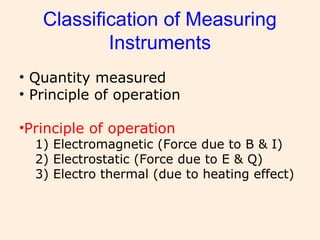
• Quantity measured
• Principle of operation
•Principle of operation
1) Electromagnetic (Force due to B & I)
2) Electrostatic (Force due to E & Q)
3) Electro thermal (due to heating effect)
Electromagnetic-Electromechanical
Indicating Instruments
Electromechanical Indicating Instruments
Input is electrical signal
Output is mechanical force
Analog (Output is a continuous
function of time)
Example: PMMC Instruments
Permanent Magnet Moving Coil
(PMMC) Instruments
• To measure DC current or DC voltage
• Can be used for measuring AC
currents and voltages by introducing
additional circuit and proper calibration
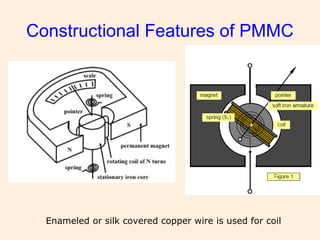
Constructional Features of PMMC
Enameled or silk covered copper wire is used for coil
Constructional Features of PMMC
6
Various Forces/ Torques in
Measuring Instruments
• The movement of the pointer in PPMC
is governed by three different torques
1) Deflection Torque
2) Control Torque
3) Damping Torque
7
Deflection Torque
8
Deflection Torque
9
Deflection Torque
10
Control Torque
11
Damping Torque
12
Damping Torque
13
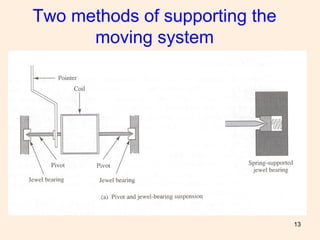
Two methods of supporting the
moving system
14
Two methods of supporting the
moving system
• To increase sensitivity,
the diameter of the hair
spring should be
reduced, but it is
limited, so Taut band is
used
• It is thin, metallic,
ribbon like structure
• It improves sensitivity
15
Effect of temperature and methods to
compensate
• Hair springs, Magnetic field, Coil
resistance are effected
• Series resistance with temperature
coefficient nearly zero (manganin) is
used
• Usually three times the coil resistance
• It is called Swamping resistance
16
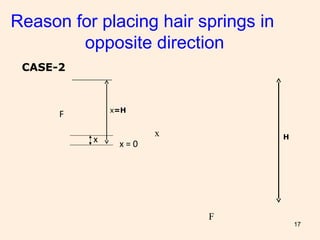
Reason for placing hair springs in
opposite direction
F
x = 0x
F
x
CASE-1
H
x=H
17
Reason for placing hair springs in
opposite direction
F
x = 0x
F
x
CASE-2
x=H
H
18
Reason for placing hair springs in
opposite direction
F
x
F
x = 0x
CASE-3
19
Multi Range Ammeter
20
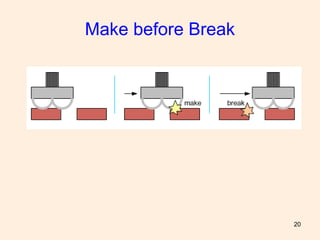
Make before Break
21
Multi Range Ammeter (alternative
design)
22
Multi Range Voltmeter
23
Break before Make
24
Advantages
• Uniform scale
• Power consumption can be made very low
(25 µW to 200 µW)
• Torque to weight ratio can be made high with
a view to achieve high accuracy (typically 2%)
• Single instrument can be used for multi range
ammeters and voltmeters
• Error due to stray magnetic field is very small
25
Limitations
• They are suitable for direct current only
• The instrument cost is high
• Variation of magnet strength with time
26
Errors can be reduced by
• Proper pivoting and balancing weight may
reduce the frictional error
• Considering the aging can reduce errors due
to magnetic decay
• Manganin in series with coil reduces
temperature effects
• Maintaining nominal temperature. The
stiffness of spring, permeability of magnetic
core decreases with increase in temperature
27
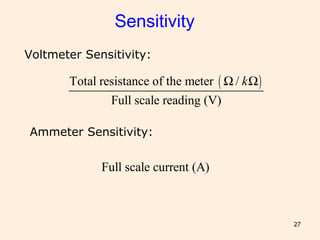
Sensitivity
Ammeter Sensitivity:
Full scale current (A)
Voltmeter Sensitivity:
( )Total resistance of the meter /
Full scale reading (V)
kΩ Ω
28
Assignment
Q1) A PMMC instrument has a coil
resistance of 100Ω and gives a full-
scale deflection (FSD) for a current of
500μA. Determine the value of shunt
resistance required if the instrument
is to be employed as an ammeter
with a FSD of 5 A.
Ans: 0.01 Ω
29
Assignment
Q2) A PMMC meter with a coil
resistance 100Ω and a full scale
deflection current of 100μA is to be
used as a voltmeter. The voltmeter
ranges are to be 50 V and 100 V.
Determine the required value of
resistances for each range.
Ans: 0.4999 MΩ, 0.9999 MΩ

Permanent Magnet Moving Coil