Data Structure and
Algorithm (CS 102)
Ashok K Turuk
Queue
• A queue is a linear list of elements in
which
– deletion can take place only at one end
called Front, and
– Insertion takes place at one end called
Rear
• Queues are also known as First-In-
First-Out (FIFO) list
Queue
• Queue are represented in two-ways
– Linear Array
– One-way Linked List
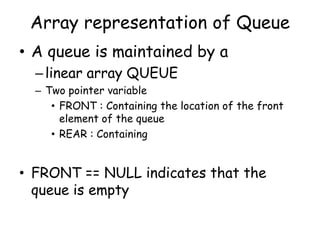
Array representation of Queue
• A queue is maintained by a
–linear array QUEUE
– Two pointer variable
• FRONT : Containing the location of the front
element of the queue
• REAR : Containing
• FRONT == NULL indicates that the
queue is empty
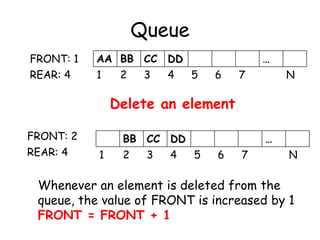
Queue
AA BB CC DD …
1 2 3 4 5 6 7 N
FRONT: 2
REAR: 4
BB CC DD …
1 2 3 4 5 6 7 N
Whenever an element is deleted from the
queue, the value of FRONT is increased by 1
FRONT = FRONT + 1
FRONT: 1
REAR: 4
Delete an element
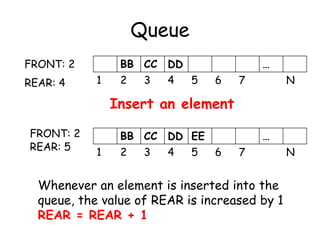
Queue
BB CC DD …
1 2 3 4 5 6 7 N
FRONT: 2
REAR: 4
Insert an element
BB CC DD EE …
1 2 3 4 5 6 7 N
FRONT: 2
REAR: 5
Whenever an element is inserted into the
queue, the value of REAR is increased by 1
REAR = REAR + 1
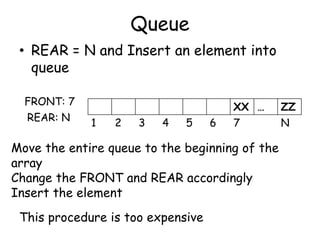
Queue
• REAR = N and Insert an element into
queue
XX … ZZ
1 2 3 4 5 6 7 N
FRONT: 7
REAR: N
Move the entire queue to the beginning of the
array
Change the FRONT and REAR accordingly
Insert the element
This procedure is too expensive
Queue
• Queue is assumed to be circular
• QUEUE[1] comes after QUEUE[N]
• Instead of increasing REAR to N +1, we
reset REAR = 1 and then assign
QUEUE[REAR] = ITEM
Queue
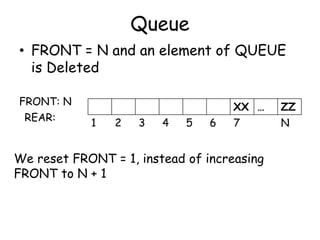
• FRONT = N and an element of QUEUE
is Deleted
XX … ZZ
1 2 3 4 5 6 7 N
FRONT: N
REAR:
We reset FRONT = 1, instead of increasing
FRONT to N + 1
Queue
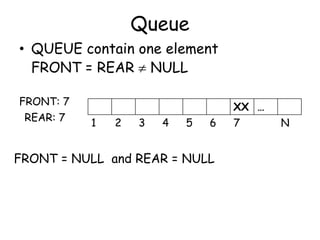
• QUEUE contain one element
FRONT = REAR  NULL
XX …
1 2 3 4 5 6 7 N
FRONT: 7
REAR: 7
FRONT = NULL and REAR = NULL
Algorithm to Insert in Q
[1] If FRONT = 1 and REAR = N or if FRONT =
REAR + 1 then Print: Overflow and Exit
[2] If FRONT = NULL then
Set FRONT = 1 and REAR = 1
Else If REAR = N then
Set REAR = 1
Else
Set REAR = REAR + 1
[3] Set QUEUE[REAR] = ITEM
[4] Exit
Queue
AA BB CC DD EE FF XX … ZZ
1 2 3 4 5 6 7 N
FRONT: 7
REAR: 6
FRONT = REAR + 1 [FULL QUEUE]
Algorithm to Delete from Q
[1] If FRONT = NULL then Print: Underflow and
Exit
[2] Set ITEM = QUEUE[FRONT]
[3] If FRONT = REAR then
Set FRONT = NULL and REAR = NULL
Else If FRONT = N then
Set FRONT = 1
Else
Set FRONT = FRONT + 1
[4] Exit
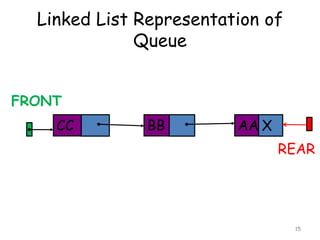
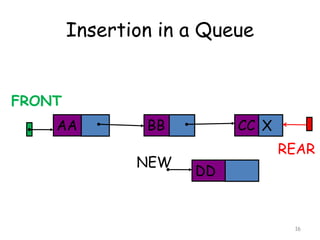
Linked List Representation of Queue
• A linked queue is a queue implemented
as linked list with two pointer variable
FRONT and REAR pointing to the nodes
which is in the FRONT and REAR of the
queue
Linked List Representation of
Queue
CC XAABB
FRONT
15
REAR
Insertion in a Queue
AA XCCBB
FRONT
16
REAR
DD
NEW
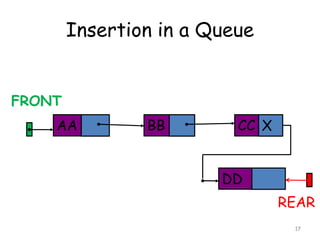
Insertion in a Queue
AA XCCBB
FRONT
17
REAR
DD
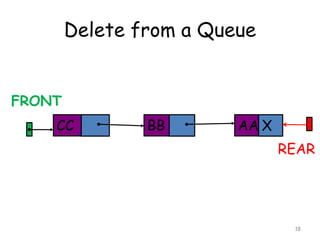
Delete from a Queue
CC XAABB
FRONT
18
REAR
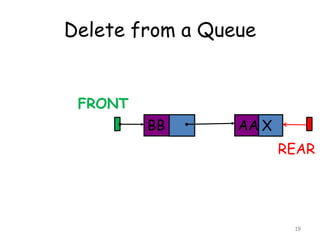
Delete from a Queue
XAABB
FRONT
19
REAR
Linked Queue
• No need to check for overflow condition
during insertion
• No need to view it as circular for
efficient management of space
Insertion
[1] NEW -> INFO = ITEM
NEW -> LINK = NULL
[2] If (FRONT = NULL) then
FRONT = REAR = NULL
else
Set REAR -> LINK = NEW
REAR = NEW
[3] Exit
Deletion
[1] If (FRONT = NULL) then
Print: Underflow, and Exit
[2] FRONT = FRONT -> LINK
[3] Exit
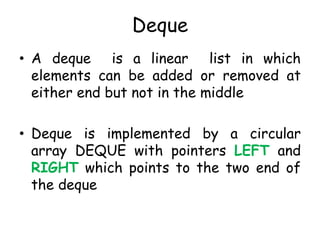
Deque
• A deque is a linear list in which
elements can be added or removed at
either end but not in the middle
• Deque is implemented by a circular
array DEQUE with pointers LEFT and
RIGHT which points to the two end of
the deque
Deque
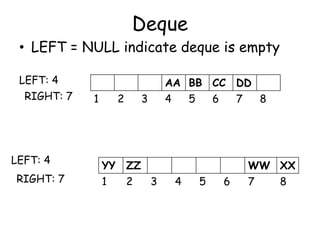
• LEFT = NULL indicate deque is empty
AA BB CC DD
1 2 3 4 5 6 7 8
LEFT: 4
RIGHT: 7
YY ZZ WW XX
1 2 3 4 5 6 7 8
LEFT: 4
RIGHT: 7
Variation of deque
• There are two variation of deque
[1] Input-restricted queue: Deque which
allows insertions at only one end of the list
but allows deletion at both ends of the list
[2] Output-restricted queue: Deque which
allows deletion at only one end of the list
but allows insertion at both ends of the
list
Deque
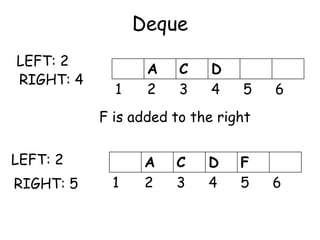
A C D
1 2 3 4 5 6
LEFT: 2
RIGHT: 4
F is added to the right
A C D F
1 2 3 4 5 6
LEFT: 2
RIGHT: 5
Deque
A C D F
1 2 3 4 5 6
LEFT: 2
RIGHT: 5
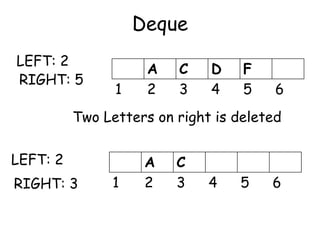
Two Letters on right is deleted
A C
1 2 3 4 5 6
LEFT: 2
RIGHT: 3
Deque
A C
1 2 3 4 5 6
LEFT: 2
RIGHT: 3
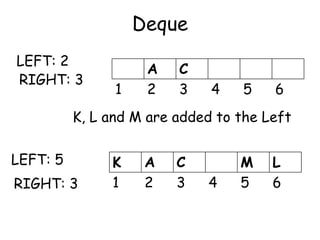
K, L and M are added to the Left
K A C M L
1 2 3 4 5 6
LEFT: 5
RIGHT: 3
Priority Queue
• A priority queue is a collection of elements
such that each elements has been assigned
a priority and such that the order in which
elements are deleted and processed comes
from the following rules:
[1] Elements of higher priority is processed
before any elements of lower priority
[2] Two elements with the same priority are
processed according to the order in which
they were added to the queue
Priority Queue
• There are different ways a priority
queue can be represented such as
[1] One-way List
[2] Multiple queue
One-Way List Representation of
a Priority Queue
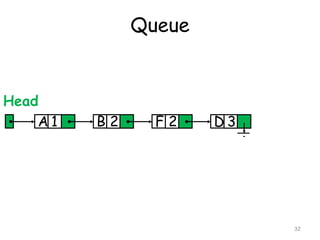
[1] Each node in the list will contain three
items of information: an information
field INFO, a priority number PRN,
and a link number LINK
[2] A node X precedes a node Y in the list
(a) when X has higher priority than Y or
(b) when both have same priority but X
was added to the list before Y
Queue
32
1A 2B 2F 3D
Head
Insertion and Deletion
• Deletion : Delete the first node in the
list.
• Insertion: Find the location of Insertion
Add an ITEM with priority number N
[a] Traverse the list until finding a node X
whose priority exceeds N. Insert ITEM
in front of node X
[b] If no such node is found, insert ITEM
as the last element of the list
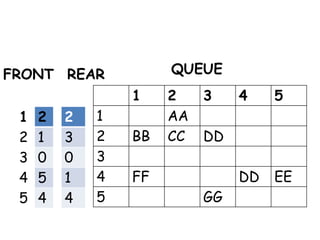
Array representation of Priority
Queue
• Separate queue for each level of
priority
• Each queue will appear in its own
circular array and must have its own
pair of pointers, FRONT and REAR
• If each queue is given the same amount
space then a 2D queue can be used
1 2 3 4 5
1 AA
2 BB CC DD
3
4 FF DD EE
5 GG
1 2
2 1
3 0
4 5
5 4
2
3
0
1
4
FRONT REAR QUEUE
Deletion Algorithm [outline]
[1] Find the smallest K such that
FRONT[K]  NULL
[2] Delete and process the front element
in row K of QUEUE
[3] Exit
Insertion Algorithm [outline]
[1] Insert ITEM as the rear element in
row M of QUEUE
[2] Exit

6.queue

  • 1.
    Data Structure and Algorithm(CS 102) Ashok K Turuk
  • 2.
    Queue • A queueis a linear list of elements in which – deletion can take place only at one end called Front, and – Insertion takes place at one end called Rear • Queues are also known as First-In- First-Out (FIFO) list
  • 3.
    Queue • Queue arerepresented in two-ways – Linear Array – One-way Linked List
  • 4.
    Array representation ofQueue • A queue is maintained by a –linear array QUEUE – Two pointer variable • FRONT : Containing the location of the front element of the queue • REAR : Containing • FRONT == NULL indicates that the queue is empty
  • 5.
    Queue AA BB CCDD … 1 2 3 4 5 6 7 N FRONT: 2 REAR: 4 BB CC DD … 1 2 3 4 5 6 7 N Whenever an element is deleted from the queue, the value of FRONT is increased by 1 FRONT = FRONT + 1 FRONT: 1 REAR: 4 Delete an element
  • 6.
    Queue BB CC DD… 1 2 3 4 5 6 7 N FRONT: 2 REAR: 4 Insert an element BB CC DD EE … 1 2 3 4 5 6 7 N FRONT: 2 REAR: 5 Whenever an element is inserted into the queue, the value of REAR is increased by 1 REAR = REAR + 1
  • 7.
    Queue • REAR =N and Insert an element into queue XX … ZZ 1 2 3 4 5 6 7 N FRONT: 7 REAR: N Move the entire queue to the beginning of the array Change the FRONT and REAR accordingly Insert the element This procedure is too expensive
  • 8.
    Queue • Queue isassumed to be circular • QUEUE[1] comes after QUEUE[N] • Instead of increasing REAR to N +1, we reset REAR = 1 and then assign QUEUE[REAR] = ITEM
  • 9.
    Queue • FRONT =N and an element of QUEUE is Deleted XX … ZZ 1 2 3 4 5 6 7 N FRONT: N REAR: We reset FRONT = 1, instead of increasing FRONT to N + 1
  • 10.
    Queue • QUEUE containone element FRONT = REAR  NULL XX … 1 2 3 4 5 6 7 N FRONT: 7 REAR: 7 FRONT = NULL and REAR = NULL
  • 11.
    Algorithm to Insertin Q [1] If FRONT = 1 and REAR = N or if FRONT = REAR + 1 then Print: Overflow and Exit [2] If FRONT = NULL then Set FRONT = 1 and REAR = 1 Else If REAR = N then Set REAR = 1 Else Set REAR = REAR + 1 [3] Set QUEUE[REAR] = ITEM [4] Exit
  • 12.
    Queue AA BB CCDD EE FF XX … ZZ 1 2 3 4 5 6 7 N FRONT: 7 REAR: 6 FRONT = REAR + 1 [FULL QUEUE]
  • 13.
    Algorithm to Deletefrom Q [1] If FRONT = NULL then Print: Underflow and Exit [2] Set ITEM = QUEUE[FRONT] [3] If FRONT = REAR then Set FRONT = NULL and REAR = NULL Else If FRONT = N then Set FRONT = 1 Else Set FRONT = FRONT + 1 [4] Exit
  • 14.
    Linked List Representationof Queue • A linked queue is a queue implemented as linked list with two pointer variable FRONT and REAR pointing to the nodes which is in the FRONT and REAR of the queue
  • 15.
    Linked List Representationof Queue CC XAABB FRONT 15 REAR
  • 16.
    Insertion in aQueue AA XCCBB FRONT 16 REAR DD NEW
  • 17.
    Insertion in aQueue AA XCCBB FRONT 17 REAR DD
  • 18.
    Delete from aQueue CC XAABB FRONT 18 REAR
  • 19.
    Delete from aQueue XAABB FRONT 19 REAR
  • 20.
    Linked Queue • Noneed to check for overflow condition during insertion • No need to view it as circular for efficient management of space
  • 21.
    Insertion [1] NEW ->INFO = ITEM NEW -> LINK = NULL [2] If (FRONT = NULL) then FRONT = REAR = NULL else Set REAR -> LINK = NEW REAR = NEW [3] Exit
  • 22.
    Deletion [1] If (FRONT= NULL) then Print: Underflow, and Exit [2] FRONT = FRONT -> LINK [3] Exit
  • 23.
    Deque • A dequeis a linear list in which elements can be added or removed at either end but not in the middle • Deque is implemented by a circular array DEQUE with pointers LEFT and RIGHT which points to the two end of the deque
  • 24.
    Deque • LEFT =NULL indicate deque is empty AA BB CC DD 1 2 3 4 5 6 7 8 LEFT: 4 RIGHT: 7 YY ZZ WW XX 1 2 3 4 5 6 7 8 LEFT: 4 RIGHT: 7
  • 25.
    Variation of deque •There are two variation of deque [1] Input-restricted queue: Deque which allows insertions at only one end of the list but allows deletion at both ends of the list [2] Output-restricted queue: Deque which allows deletion at only one end of the list but allows insertion at both ends of the list
  • 26.
    Deque A C D 12 3 4 5 6 LEFT: 2 RIGHT: 4 F is added to the right A C D F 1 2 3 4 5 6 LEFT: 2 RIGHT: 5
  • 27.
    Deque A C DF 1 2 3 4 5 6 LEFT: 2 RIGHT: 5 Two Letters on right is deleted A C 1 2 3 4 5 6 LEFT: 2 RIGHT: 3
  • 28.
    Deque A C 1 23 4 5 6 LEFT: 2 RIGHT: 3 K, L and M are added to the Left K A C M L 1 2 3 4 5 6 LEFT: 5 RIGHT: 3
  • 29.
    Priority Queue • Apriority queue is a collection of elements such that each elements has been assigned a priority and such that the order in which elements are deleted and processed comes from the following rules: [1] Elements of higher priority is processed before any elements of lower priority [2] Two elements with the same priority are processed according to the order in which they were added to the queue
  • 30.
    Priority Queue • Thereare different ways a priority queue can be represented such as [1] One-way List [2] Multiple queue
  • 31.
    One-Way List Representationof a Priority Queue [1] Each node in the list will contain three items of information: an information field INFO, a priority number PRN, and a link number LINK [2] A node X precedes a node Y in the list (a) when X has higher priority than Y or (b) when both have same priority but X was added to the list before Y
  • 32.
  • 33.
    Insertion and Deletion •Deletion : Delete the first node in the list. • Insertion: Find the location of Insertion Add an ITEM with priority number N [a] Traverse the list until finding a node X whose priority exceeds N. Insert ITEM in front of node X [b] If no such node is found, insert ITEM as the last element of the list
  • 34.
    Array representation ofPriority Queue • Separate queue for each level of priority • Each queue will appear in its own circular array and must have its own pair of pointers, FRONT and REAR • If each queue is given the same amount space then a 2D queue can be used
  • 35.
    1 2 34 5 1 AA 2 BB CC DD 3 4 FF DD EE 5 GG 1 2 2 1 3 0 4 5 5 4 2 3 0 1 4 FRONT REAR QUEUE
  • 36.
    Deletion Algorithm [outline] [1]Find the smallest K such that FRONT[K]  NULL [2] Delete and process the front element in row K of QUEUE [3] Exit
  • 37.
    Insertion Algorithm [outline] [1]Insert ITEM as the rear element in row M of QUEUE [2] Exit