Introduction to RTOS
Yong Heui Cho @ Mokwon University
Most of slides are referred to and all credits should go to:
[1] Swetanka Kumar Mishra & Kirti Chawla, RTOS Design & Implementation,
slideshare, 2014.
2
Smart Device Structure
8. Introduction to IoT
9. Smart Device RF & Antennas
10. Introduction to RTOS
11. Introduction to Bluetooth
3
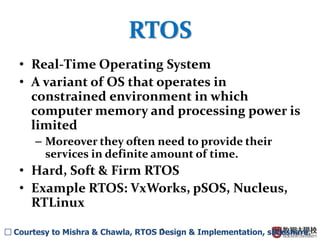
RTOS
• Real-Time Operating System
• A variant of OS that operates in
constrained environment in which
computer memory and processing power is
limited
– Moreover they often need to provide their
services in definite amount of time.
• Hard, Soft & Firm RTOS
• Example RTOS: VxWorks, pSOS, Nucleus,
RTLinux
□ Courtesy to Mishra & Chawla, RTOS Design & Implementation, slideshare.
4
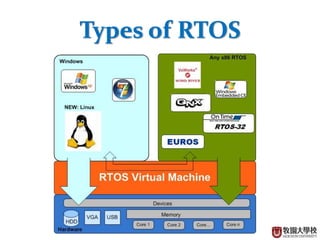
Types of RTOS
5
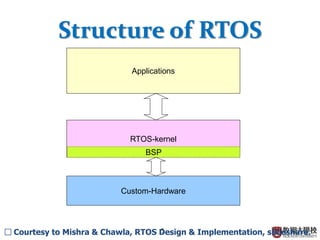
Structure of RTOS
Custom-Hardware
RTOS-kernel
Applications
BSP
□ Courtesy to Mishra & Chawla, RTOS Design & Implementation, slideshare.
6
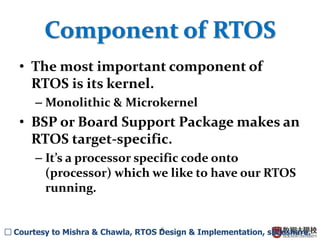
Component of RTOS
• The most important component of
RTOS is its kernel.
– Monolithic & Microkernel
• BSP or Board Support Package makes an
RTOS target-specific.
– It’s a processor specific code onto
(processor) which we like to have our RTOS
running.
□ Courtesy to Mishra & Chawla, RTOS Design & Implementation, slideshare.
7
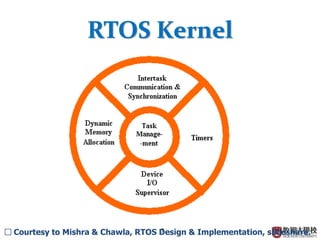
RTOS Kernel
□ Courtesy to Mishra & Chawla, RTOS Design & Implementation, slideshare.
8
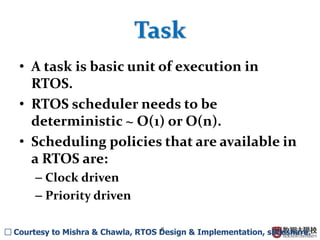
Task
• A task is basic unit of execution in
RTOS.
• RTOS scheduler needs to be
deterministic ~ O(1) or O(n).
• Scheduling policies that are available in
a RTOS are:
– Clock driven
– Priority driven
□ Courtesy to Mishra & Chawla, RTOS Design & Implementation, slideshare.
9
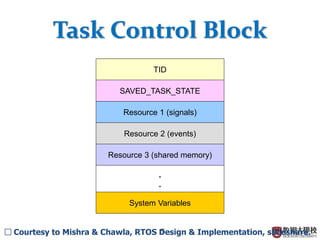
Task Control Block
.
.
TID
SAVED_TASK_STATE
Resource 1 (signals)
Resource 2 (events)
Resource 3 (shared memory)
System Variables
□ Courtesy to Mishra & Chawla, RTOS Design & Implementation, slideshare.
10
Memory
• Memory is premium in environments
where RTOS work.
• Supports Virtual Memory (MMU:
Memory Management Unit) and
Memory Protection (MPU) models.
• User space and Kernel space memory.
□ Courtesy to Mishra & Chawla, RTOS Design & Implementation, slideshare.
11
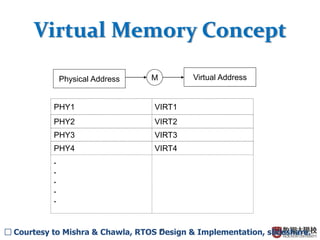
Virtual Memory Concept
Physical Address Virtual AddressM
.
.
.
.
.
PHY1 VIRT1
PHY2 VIRT2
PHY3 VIRT3
PHY4 VIRT4
□ Courtesy to Mishra & Chawla, RTOS Design & Implementation, slideshare.
12
Timer
• Timer is SW entity derived from
hardware clock.
• Timer provides mechanism to introduce
task-delays and/or to help synchronize
and provide time off-course.
• Watchdog Timers, Programmable
Timers
□ Courtesy to Mishra & Chawla, RTOS Design & Implementation, slideshare.
13
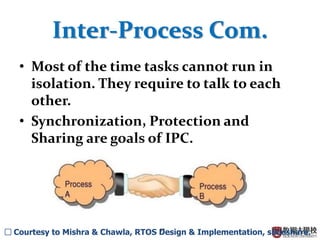
Inter-Process Com.
• Most of the time tasks cannot run in
isolation. They require to talk to each
other.
• Synchronization, Protection and
Sharing are goals of IPC.
□ Courtesy to Mishra & Chawla, RTOS Design & Implementation, slideshare.
14
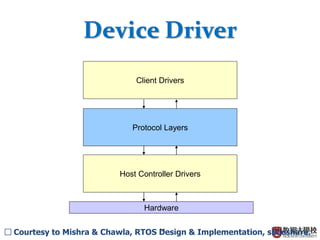
Device Driver
Client Drivers
Protocol Layers
Host Controller Drivers
Hardware
□ Courtesy to Mishra & Chawla, RTOS Design & Implementation, slideshare.

Introduction to RTOS

  • 1.
    Introduction to RTOS YongHeui Cho @ Mokwon University Most of slides are referred to and all credits should go to: [1] Swetanka Kumar Mishra & Kirti Chawla, RTOS Design & Implementation, slideshare, 2014.
  • 2.
    2 Smart Device Structure 8.Introduction to IoT 9. Smart Device RF & Antennas 10. Introduction to RTOS 11. Introduction to Bluetooth
  • 3.
    3 RTOS • Real-Time OperatingSystem • A variant of OS that operates in constrained environment in which computer memory and processing power is limited – Moreover they often need to provide their services in definite amount of time. • Hard, Soft & Firm RTOS • Example RTOS: VxWorks, pSOS, Nucleus, RTLinux □ Courtesy to Mishra & Chawla, RTOS Design & Implementation, slideshare.
  • 4.
  • 5.
    5 Structure of RTOS Custom-Hardware RTOS-kernel Applications BSP □Courtesy to Mishra & Chawla, RTOS Design & Implementation, slideshare.
  • 6.
    6 Component of RTOS •The most important component of RTOS is its kernel. – Monolithic & Microkernel • BSP or Board Support Package makes an RTOS target-specific. – It’s a processor specific code onto (processor) which we like to have our RTOS running. □ Courtesy to Mishra & Chawla, RTOS Design & Implementation, slideshare.
  • 7.
    7 RTOS Kernel □ Courtesyto Mishra & Chawla, RTOS Design & Implementation, slideshare.
  • 8.
    8 Task • A taskis basic unit of execution in RTOS. • RTOS scheduler needs to be deterministic ~ O(1) or O(n). • Scheduling policies that are available in a RTOS are: – Clock driven – Priority driven □ Courtesy to Mishra & Chawla, RTOS Design & Implementation, slideshare.
  • 9.
    9 Task Control Block . . TID SAVED_TASK_STATE Resource1 (signals) Resource 2 (events) Resource 3 (shared memory) System Variables □ Courtesy to Mishra & Chawla, RTOS Design & Implementation, slideshare.
  • 10.
    10 Memory • Memory ispremium in environments where RTOS work. • Supports Virtual Memory (MMU: Memory Management Unit) and Memory Protection (MPU) models. • User space and Kernel space memory. □ Courtesy to Mishra & Chawla, RTOS Design & Implementation, slideshare.
  • 11.
    11 Virtual Memory Concept PhysicalAddress Virtual AddressM . . . . . PHY1 VIRT1 PHY2 VIRT2 PHY3 VIRT3 PHY4 VIRT4 □ Courtesy to Mishra & Chawla, RTOS Design & Implementation, slideshare.
  • 12.
    12 Timer • Timer isSW entity derived from hardware clock. • Timer provides mechanism to introduce task-delays and/or to help synchronize and provide time off-course. • Watchdog Timers, Programmable Timers □ Courtesy to Mishra & Chawla, RTOS Design & Implementation, slideshare.
  • 13.
    13 Inter-Process Com. • Mostof the time tasks cannot run in isolation. They require to talk to each other. • Synchronization, Protection and Sharing are goals of IPC. □ Courtesy to Mishra & Chawla, RTOS Design & Implementation, slideshare.
  • 14.
    14 Device Driver Client Drivers ProtocolLayers Host Controller Drivers Hardware □ Courtesy to Mishra & Chawla, RTOS Design & Implementation, slideshare.