Life Saving College Of Nursing
M. Farooq Marwat
RN, Dip. Card, BSN
Objectives:
At theend of this presentation, thestudentwill beable to :
⚫Understand the Protozoa
⚫Know about the characteristics of Protozoa
⚫Know about the Morphology of Protozoa
⚫Know about the Types of Protozoa
⚫Know about the Methods of reproduction in
Protozoa
⚫Know about the disease cause by Protozoa
⚫Know about the drugs used against Protozoa
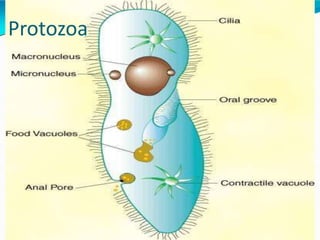
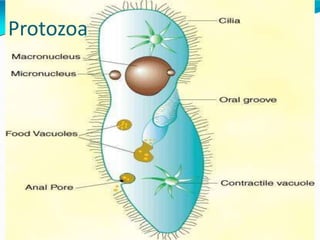
Protozoa
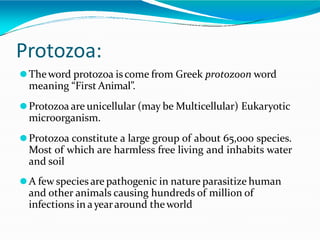
Protozoa:
⚫Theword protozoa iscome from Greek protozoon word
meaning “First Animal”.
⚫Protozoa are unicellular (may be Multicellular) Eukaryotic
microorganism.
⚫Protozoa constitute a large group of about 65,000 species.
Most of which are harmless free living and inhabits water
and soil
⚫A few species are pathogenic in nature parasitize human
and other animals causing hundreds of million of
infections in ayeararound theworld
Characteristics
⚫Mostly Unicellularorganism with fully functional cell
⚫Live freely, may be parasitic orsymbiotic
⚫Protozoaare chemo-hetrotrops
⚫Theyare motile have locomotiveorganelles. E.g.
Flagellaand Cilia for movement
Morphology
⚫Protozoa are Eukaryotic resemble to animal cell,
contain majorcell organelles (including Nucleus,
Mitochondria)
⚫Theirorganellesare highly specialized for feeding,
reproduction and movement
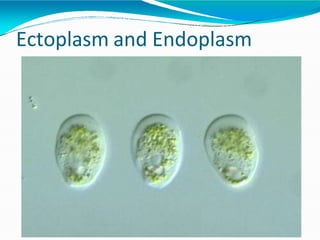
⚫Thecytoplasmof protozoaaredivided intoan outer
layer called Ectoplasm and an inner layer called
Endoplasm
Protozoa
Morphology
⚫Ectoplasm helps in movement, feeding and Protection
⚫Endoplasm houses Nucleus, mitochondria and food
⚫Some protozoa havespecial appendages Flagella and
cilia that helps in their movements
⚫Freshwaterprotozoa have contractilevacuoles to
pumpoutexcess water
⚫Theirshape may remain constant (specially in Ciliates)
orchange constantly (as seen in Amoeba)
Ectoplasm and Endoplasm
Morphology
⚫The size of Protozoa is range between 3 to 300
micrometer.
⚫Fewciliate and Amoebaare largerenough to be seen
with naked eyes (theyareabout 4 to 5 mm).
⚫Except Sporozoates, all typesof protozoaare motile
either through Flagella, ciliaor Pseudopodia
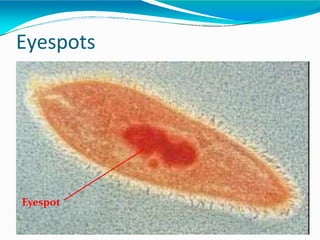
⚫Have Eyespot thatcan detectchange in light
⚫ Respond to light & learn by trial & error
Eyespots
Eyespot
Nutrition
⚫Mostlyprotozoa feed on dead plantsand animal debris
whilesome (trophozoites) feed on bacteriaand Algae.
⚫Parasitic Protozoa feeds on the fluids and tissuesof
their host(e.g. Plasmaand blood cells)
⚫Some Protozoa live in symbioticrelationshipwith
otherplantsand animals
Classification of Protozoa
⚫Protozoaare classified on the basis of their motility
and method of reproduction
⚫Theyareclassified into Four main types
⚫Flagellates
⚫Ciliates
⚫Sarcodina
⚫Sporozoates
Flagellates
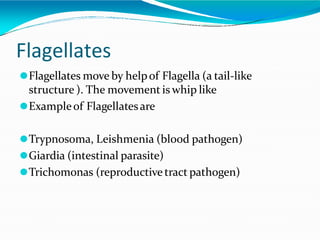
⚫Flagellates move by helpof Flagella (a tail-like
structure ). The movement is whip like
⚫Exampleof Flagellatesare
⚫Trypnosoma, Leishmenia (blood pathogen)
⚫Giardia (intestinal parasite)
⚫Trichomonas (reproductivetract pathogen)
Ciliates
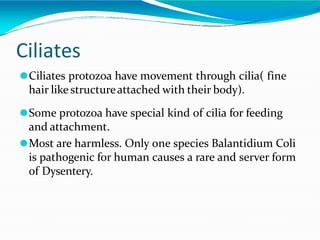
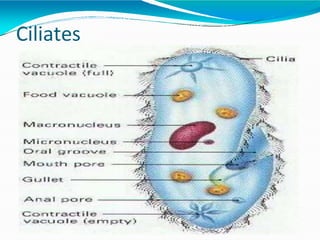
⚫Ciliates protozoa have movement through cilia( fine
hair like structureattached with their body).
⚫Some protozoa have special kind of cilia for feeding
and attachment.
⚫Most are harmless. Only one species Balantidium Coli
is pathogenic for human causes a rare and server form
of Dysentery.
Ciliates
Sarcodina
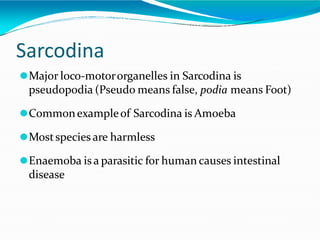
⚫Major loco-motororganelles in Sarcodina is
pseudopodia (Pseudo means false, podia means Foot)
⚫Commonexampleof Sarcodina is Amoeba
⚫Mostspecies are harmless
⚫Enaemoba is a parasitic for human causes intestinal
disease
Sporozoates
⚫Sporozoatesare theonly non-motile form of protozoa.
⚫Sporozoates havewell developed sexual and asexual
stages
⚫Entiregroup is parasitic in natureand are harmful
⚫Somecommonexamples of Sporozoatesand their
infectionsare
⚫Plasmodium (causativeagentof Malaria, causes 100 to
300 million infection world wide)
⚫Toxoplasma Gondii (causes Toxoplasmosis)
Reproduction in Protozoa
⚫Protozoacan reproduce theiroff spring by both Sexual
and Asexual methods
⚫Asexual methodsof reproduction are:
⚫Budding
⚫Binary Fission
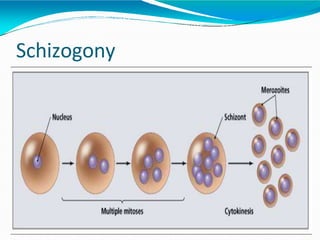
⚫Schizogonyor Multiple Fission
⚫Sexual Methods
⚫Conjugation
⚫Gametogony
Schizogony
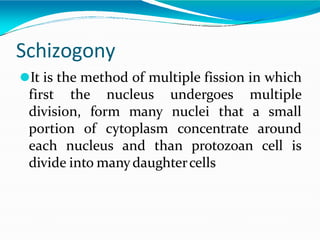
⚫It is the method of multiple fission in which
first the nucleus undergoes multiple
division, form many nuclei that a small
portion of cytoplasm concentrate around
each nucleus and than protozoan cell is
divide into many daughtercells
Schizogony
Sexual Reproduction
⚫Conjugation:
⚫Two protozoa meet togetherand exchange
theirgenetic material
⚫Gametogony:
⚫Unionof twosexuallydifferentiated cells
Disease Caused Protozoa
Disease Causative Agent
Malaria Plasmodium
(P. Falciparum, P. Oval,P. Vivax,
P.malariae)
Giardiasis (diarrhea) Giardia intestinalis
Amoebic Dysentery Entamoeba histolytica
Toxoplasmosis
(immune deficiency )
Toxoplasma Gondii
Cryptosporidiosis Cryptosporidia
Sleeping sickness Trypanosoma
Leishmmaniasis (kala-azar) Leishmania
Antiprotozoal Drugs
⚫Examplesof antiprotozoal drugs include: Chloroquine
Mef loquineand Pyrimethamine.
Theseare used in malaria treatment.
⚫Metronidazolewasdeveloped as an antiprotozoal
drug. It induces strand breaks in the DNA of sensitive
organisms and alsodisrupts membrane integrity.
⚫Otherantiprotozoal agents are Sulphonamidesand
trimethoprim, inhibit folicacid synthesis

introduction to protozoa.pptx

  • 1.
    Life Saving CollegeOf Nursing M. Farooq Marwat RN, Dip. Card, BSN
  • 2.
    Objectives: At theend ofthis presentation, thestudentwill beable to : ⚫Understand the Protozoa ⚫Know about the characteristics of Protozoa ⚫Know about the Morphology of Protozoa ⚫Know about the Types of Protozoa ⚫Know about the Methods of reproduction in Protozoa ⚫Know about the disease cause by Protozoa ⚫Know about the drugs used against Protozoa
  • 3.
  • 4.
    Protozoa: ⚫Theword protozoa iscomefrom Greek protozoon word meaning “First Animal”. ⚫Protozoa are unicellular (may be Multicellular) Eukaryotic microorganism. ⚫Protozoa constitute a large group of about 65,000 species. Most of which are harmless free living and inhabits water and soil ⚫A few species are pathogenic in nature parasitize human and other animals causing hundreds of million of infections in ayeararound theworld
  • 5.
    Characteristics ⚫Mostly Unicellularorganism withfully functional cell ⚫Live freely, may be parasitic orsymbiotic ⚫Protozoaare chemo-hetrotrops ⚫Theyare motile have locomotiveorganelles. E.g. Flagellaand Cilia for movement
  • 6.
    Morphology ⚫Protozoa are Eukaryoticresemble to animal cell, contain majorcell organelles (including Nucleus, Mitochondria) ⚫Theirorganellesare highly specialized for feeding, reproduction and movement ⚫Thecytoplasmof protozoaaredivided intoan outer layer called Ectoplasm and an inner layer called Endoplasm
  • 7.
  • 8.
    Morphology ⚫Ectoplasm helps inmovement, feeding and Protection ⚫Endoplasm houses Nucleus, mitochondria and food ⚫Some protozoa havespecial appendages Flagella and cilia that helps in their movements ⚫Freshwaterprotozoa have contractilevacuoles to pumpoutexcess water ⚫Theirshape may remain constant (specially in Ciliates) orchange constantly (as seen in Amoeba)
  • 9.
  • 10.
    Morphology ⚫The size ofProtozoa is range between 3 to 300 micrometer. ⚫Fewciliate and Amoebaare largerenough to be seen with naked eyes (theyareabout 4 to 5 mm). ⚫Except Sporozoates, all typesof protozoaare motile either through Flagella, ciliaor Pseudopodia ⚫Have Eyespot thatcan detectchange in light ⚫ Respond to light & learn by trial & error
  • 11.
  • 12.
    Nutrition ⚫Mostlyprotozoa feed ondead plantsand animal debris whilesome (trophozoites) feed on bacteriaand Algae. ⚫Parasitic Protozoa feeds on the fluids and tissuesof their host(e.g. Plasmaand blood cells) ⚫Some Protozoa live in symbioticrelationshipwith otherplantsand animals
  • 13.
    Classification of Protozoa ⚫Protozoaareclassified on the basis of their motility and method of reproduction ⚫Theyareclassified into Four main types ⚫Flagellates ⚫Ciliates ⚫Sarcodina ⚫Sporozoates
  • 14.
    Flagellates ⚫Flagellates move byhelpof Flagella (a tail-like structure ). The movement is whip like ⚫Exampleof Flagellatesare ⚫Trypnosoma, Leishmenia (blood pathogen) ⚫Giardia (intestinal parasite) ⚫Trichomonas (reproductivetract pathogen)
  • 15.
    Ciliates ⚫Ciliates protozoa havemovement through cilia( fine hair like structureattached with their body). ⚫Some protozoa have special kind of cilia for feeding and attachment. ⚫Most are harmless. Only one species Balantidium Coli is pathogenic for human causes a rare and server form of Dysentery.
  • 16.
  • 17.
    Sarcodina ⚫Major loco-motororganelles inSarcodina is pseudopodia (Pseudo means false, podia means Foot) ⚫Commonexampleof Sarcodina is Amoeba ⚫Mostspecies are harmless ⚫Enaemoba is a parasitic for human causes intestinal disease
  • 18.
    Sporozoates ⚫Sporozoatesare theonly non-motileform of protozoa. ⚫Sporozoates havewell developed sexual and asexual stages ⚫Entiregroup is parasitic in natureand are harmful ⚫Somecommonexamples of Sporozoatesand their infectionsare ⚫Plasmodium (causativeagentof Malaria, causes 100 to 300 million infection world wide) ⚫Toxoplasma Gondii (causes Toxoplasmosis)
  • 19.
    Reproduction in Protozoa ⚫Protozoacanreproduce theiroff spring by both Sexual and Asexual methods ⚫Asexual methodsof reproduction are: ⚫Budding ⚫Binary Fission ⚫Schizogonyor Multiple Fission ⚫Sexual Methods ⚫Conjugation ⚫Gametogony
  • 20.
    Schizogony ⚫It is themethod of multiple fission in which first the nucleus undergoes multiple division, form many nuclei that a small portion of cytoplasm concentrate around each nucleus and than protozoan cell is divide into many daughtercells
  • 21.
  • 22.
    Sexual Reproduction ⚫Conjugation: ⚫Two protozoameet togetherand exchange theirgenetic material ⚫Gametogony: ⚫Unionof twosexuallydifferentiated cells
  • 24.
    Disease Caused Protozoa DiseaseCausative Agent Malaria Plasmodium (P. Falciparum, P. Oval,P. Vivax, P.malariae) Giardiasis (diarrhea) Giardia intestinalis Amoebic Dysentery Entamoeba histolytica Toxoplasmosis (immune deficiency ) Toxoplasma Gondii Cryptosporidiosis Cryptosporidia Sleeping sickness Trypanosoma Leishmmaniasis (kala-azar) Leishmania
  • 25.
    Antiprotozoal Drugs ⚫Examplesof antiprotozoaldrugs include: Chloroquine Mef loquineand Pyrimethamine. Theseare used in malaria treatment. ⚫Metronidazolewasdeveloped as an antiprotozoal drug. It induces strand breaks in the DNA of sensitive organisms and alsodisrupts membrane integrity.
  • 26.
    ⚫Otherantiprotozoal agents areSulphonamidesand trimethoprim, inhibit folicacid synthesis