 Submitted By :: HAMMAD ALI ( 9035)
 FAHAD IRSHAD MUGHAL(9034)
 UMAIR TALIB ABBAASI (9058)
 Submitted To :: Ma’am PALWASHA
 Topic :: PROTOZOA
 Department :: ZOOLOGY
INTRODUCTION TO PROTOZOA
Objectives:
At the end of this presentation, we will be able to :
 Understand the Protozoa
 Know about the characteristics of Protozoa
 Know about the Morphology of Protozoa
 Know about the Types of Protozoa
 Know about the Methods of reproduction in
Protozoa
 Know about the disease cause by Protozoa
 Know about the drugs used against Protozoa
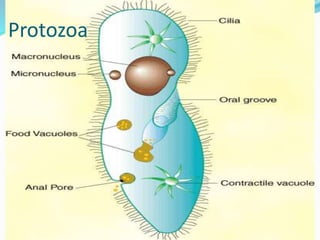
Protozoa
Protozoa:
 The word protozoa is come from Greek protozoon word
meaning “First Animal”.
 Protozoa are unicellular (may be Multicellular) Eukaryotic
microorganism.
 Protozoa constitute a large group of about 65,000 species.
Most of which are harmless free living and inhabits water
and soil
 A few species are pathogenic in nature parasitize human
and other animals causing hundreds of million of
infections in a year around the world
Characteristics
 Mostly Unicellular organism with fully functional cell
 Live freely, may be parasitic or symbiotic
 Protozoa are chemo-hetrotrops
 They are motile have locomotive organelles. E.g.
Flagella and Cilia for movement
Morphology
 Protozoa are Eukaryotic resemble to animal cell,
contain major cell organelles (including Nucleus,
Mitochondria)
 Their organelles are highly specialized for feeding,
reproduction and movement
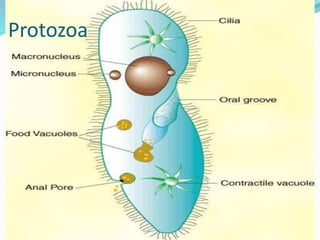
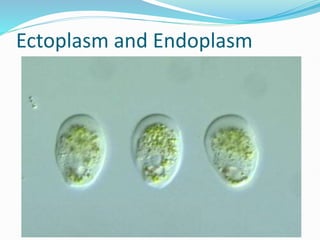
 The cytoplasm of protozoa are divided into an outer
layer called Ectoplasm and an inner layer called
Endoplasm
Protozoa
Morphology
 Ectoplasm helps in movement, feeding and Protection
 Endoplasm houses Nucleus, mitochondria and food
 Some protozoa have special appendages Flagella and
cilia that helps in their movements
 Freshwater protozoa have contractile vacuoles to
pump out excess water
 Their shape may remain constant (specially in Ciliates)
or change constantly (as seen in Amoeba)
Ectoplasm and Endoplasm
Morphology
 The size of Protozoa is range between 3 to 300
micrometer.
 Few ciliate and Amoeba are larger enough to be seen
with naked eyes (they are about 4 to 5 mm).
 Except Sporozoates, all types of protozoa are motile
either through Flagella, cilia or Pseudopodia
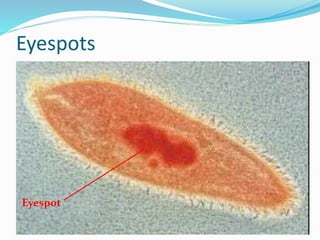
 Have Eyespot that can detect change in light
 Respond to light & learn by trial & error
Eyespots
Eyespot
Nutrition
 Mostly protozoa feed on dead plants and animal debris
while some (trophozoites) feed on bacteria and Algae.
 Parasitic Protozoa feeds on the fluids and tissues of
their host(e.g. Plasma and blood cells)
 Some Protozoa live in symbiotic relationship with
other plants and animals
Classification of Protozoa
 Protozoa are classified on the basis of their motility
and method of reproduction
 They are classified into Four main types
 Flagellates
 Ciliates
 Sarcodina
 Sporozoates
Flagellates
 Flagellates move by help of Flagella (a tail-like
structure ). The movement is whip like
 Example of Flagellates are
 Trypnosoma, Leishmenia (blood pathogen)
 Giardia (intestinal parasite)
 Trichomonas (reproductive tract pathogen)
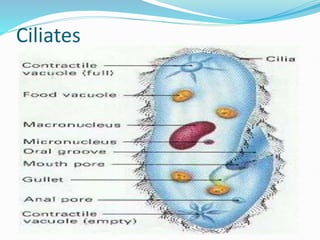
Ciliates
 Ciliates protozoa have movement through cilia( fine
hair like structure attached with their body).
 Some protozoa have special kind of cilia for feeding
and attachment.
 Most are harmless. Only one species Balantidium Coli
is pathogenic for human causes a rare and server form
of Dysentery.
Ciliates
Sarcodina
 Major loco-motor organelles in Sarcodina is
pseudopodia (Pseudo means false, podia means Foot)
 Common example of Sarcodina is Amoeba
 Most species are harmless
 Enaemoba is a parasitic for human causes intestinal
disease
Sporozoates
 Sporozoates are the only non-motile form of protozoa.
 Sporozoates have well developed sexual and asexual
stages
 Entire group is parasitic in nature and are harmful
 Some common examples of Sporozoates and their
infections are
 Plasmodium (causative agent of Malaria, causes 100 to
300 million infection world wide)
 Toxoplasma Gondii (causes Toxoplasmosis)
Reproduction in Protozoa
 Protozoa can reproduce their off spring by both Sexual
and Asexual methods
 Asexual methods of reproduction are:
 Budding
 Binary Fission
 Schizogony or Multiple Fission
 Sexual Methods
 Conjugation
 Gametogony
Budding
 A bud forms on the surface of the parent cell.
 The bud grows and develops, eventually forming a
miniature version of the parent cell.
 The bud breaks away from the parent cell, forming a
new individual.
 Budding is seen in protozoa like Giardia and some
species of Amoeba.
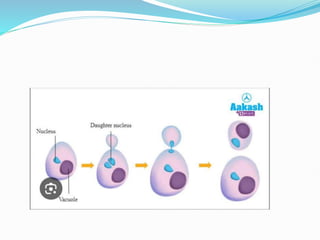
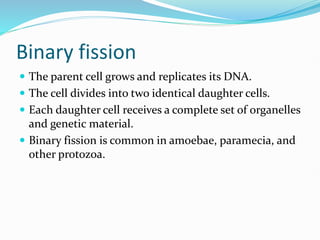
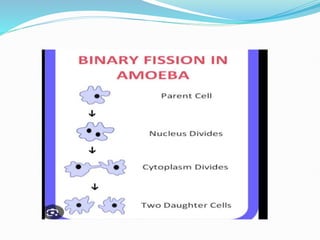
Binary fission
 The parent cell grows and replicates its DNA.
 The cell divides into two identical daughter cells.
 Each daughter cell receives a complete set of organelles
and genetic material.
 Binary fission is common in amoebae, paramecia, and
other protozoa.
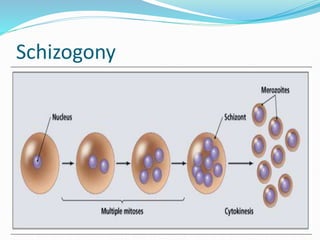
Schizogony
 It is the method of multiple fission in which
first the nucleus undergoes multiple
division, form many nuclei that a small
portion of cytoplasm concentrate around
each nucleus and than protozoan cell is
divide into many daughter cells
Schizogony
Sexual Reproduction
 Conjugation:
 Two protozoa meet together and exchange
their genetic material
 Gametogony:
 Union of two sexually differentiated cells
Disease Caused Protozoa
Disease Causative Agent
Malaria Plasmodium
(P. Falciparum, P. Oval,P. Vivax,
P.malariae)
Giardiasis (diarrhea) Giardia intestinalis
Amoebic Dysentery Entamoeba histolytica
Toxoplasmosis
(immune deficiency )
Toxoplasma Gondii
Cryptosporidiosis Cryptosporidia
Sleeping sickness Trypanosoma
Leishmmaniasis (kala-azar) Leishmania
Antiprotozoal Drugs
 Examples of antiprotozoal drugs include: Chloroquine
Mefloquine and Pyrimethamine.
These are used in malaria treatment.
 Metronidazole was developed as an antiprotozoal
drug. It induces strand breaks in the DNA of sensitive
organisms and also disrupts membrane integrity.
 Other antiprotozoal agents are Sulphonamides and
trimethoprim, inhibit folic acid synthesis
References
 Google
 YouTube
Ppresentation protozoa microbiology.pptx

Ppresentation protozoa microbiology.pptx

  • 1.
     Submitted By:: HAMMAD ALI ( 9035)  FAHAD IRSHAD MUGHAL(9034)  UMAIR TALIB ABBAASI (9058)  Submitted To :: Ma’am PALWASHA  Topic :: PROTOZOA  Department :: ZOOLOGY
  • 2.
  • 3.
    Objectives: At the endof this presentation, we will be able to :  Understand the Protozoa  Know about the characteristics of Protozoa  Know about the Morphology of Protozoa  Know about the Types of Protozoa  Know about the Methods of reproduction in Protozoa  Know about the disease cause by Protozoa  Know about the drugs used against Protozoa
  • 4.
  • 5.
    Protozoa:  The wordprotozoa is come from Greek protozoon word meaning “First Animal”.  Protozoa are unicellular (may be Multicellular) Eukaryotic microorganism.  Protozoa constitute a large group of about 65,000 species. Most of which are harmless free living and inhabits water and soil  A few species are pathogenic in nature parasitize human and other animals causing hundreds of million of infections in a year around the world
  • 6.
    Characteristics  Mostly Unicellularorganism with fully functional cell  Live freely, may be parasitic or symbiotic  Protozoa are chemo-hetrotrops  They are motile have locomotive organelles. E.g. Flagella and Cilia for movement
  • 7.
    Morphology  Protozoa areEukaryotic resemble to animal cell, contain major cell organelles (including Nucleus, Mitochondria)  Their organelles are highly specialized for feeding, reproduction and movement  The cytoplasm of protozoa are divided into an outer layer called Ectoplasm and an inner layer called Endoplasm
  • 8.
  • 9.
    Morphology  Ectoplasm helpsin movement, feeding and Protection  Endoplasm houses Nucleus, mitochondria and food  Some protozoa have special appendages Flagella and cilia that helps in their movements  Freshwater protozoa have contractile vacuoles to pump out excess water  Their shape may remain constant (specially in Ciliates) or change constantly (as seen in Amoeba)
  • 10.
  • 11.
    Morphology  The sizeof Protozoa is range between 3 to 300 micrometer.  Few ciliate and Amoeba are larger enough to be seen with naked eyes (they are about 4 to 5 mm).  Except Sporozoates, all types of protozoa are motile either through Flagella, cilia or Pseudopodia  Have Eyespot that can detect change in light  Respond to light & learn by trial & error
  • 12.
  • 13.
    Nutrition  Mostly protozoafeed on dead plants and animal debris while some (trophozoites) feed on bacteria and Algae.  Parasitic Protozoa feeds on the fluids and tissues of their host(e.g. Plasma and blood cells)  Some Protozoa live in symbiotic relationship with other plants and animals
  • 14.
    Classification of Protozoa Protozoa are classified on the basis of their motility and method of reproduction  They are classified into Four main types  Flagellates  Ciliates  Sarcodina  Sporozoates
  • 15.
    Flagellates  Flagellates moveby help of Flagella (a tail-like structure ). The movement is whip like  Example of Flagellates are  Trypnosoma, Leishmenia (blood pathogen)  Giardia (intestinal parasite)  Trichomonas (reproductive tract pathogen)
  • 16.
    Ciliates  Ciliates protozoahave movement through cilia( fine hair like structure attached with their body).  Some protozoa have special kind of cilia for feeding and attachment.  Most are harmless. Only one species Balantidium Coli is pathogenic for human causes a rare and server form of Dysentery.
  • 17.
  • 18.
    Sarcodina  Major loco-motororganelles in Sarcodina is pseudopodia (Pseudo means false, podia means Foot)  Common example of Sarcodina is Amoeba  Most species are harmless  Enaemoba is a parasitic for human causes intestinal disease
  • 19.
    Sporozoates  Sporozoates arethe only non-motile form of protozoa.  Sporozoates have well developed sexual and asexual stages  Entire group is parasitic in nature and are harmful  Some common examples of Sporozoates and their infections are  Plasmodium (causative agent of Malaria, causes 100 to 300 million infection world wide)  Toxoplasma Gondii (causes Toxoplasmosis)
  • 20.
    Reproduction in Protozoa Protozoa can reproduce their off spring by both Sexual and Asexual methods  Asexual methods of reproduction are:  Budding  Binary Fission  Schizogony or Multiple Fission  Sexual Methods  Conjugation  Gametogony
  • 21.
    Budding  A budforms on the surface of the parent cell.  The bud grows and develops, eventually forming a miniature version of the parent cell.  The bud breaks away from the parent cell, forming a new individual.  Budding is seen in protozoa like Giardia and some species of Amoeba.
  • 23.
    Binary fission  Theparent cell grows and replicates its DNA.  The cell divides into two identical daughter cells.  Each daughter cell receives a complete set of organelles and genetic material.  Binary fission is common in amoebae, paramecia, and other protozoa.
  • 25.
    Schizogony  It isthe method of multiple fission in which first the nucleus undergoes multiple division, form many nuclei that a small portion of cytoplasm concentrate around each nucleus and than protozoan cell is divide into many daughter cells
  • 26.
  • 27.
    Sexual Reproduction  Conjugation: Two protozoa meet together and exchange their genetic material  Gametogony:  Union of two sexually differentiated cells
  • 28.
    Disease Caused Protozoa DiseaseCausative Agent Malaria Plasmodium (P. Falciparum, P. Oval,P. Vivax, P.malariae) Giardiasis (diarrhea) Giardia intestinalis Amoebic Dysentery Entamoeba histolytica Toxoplasmosis (immune deficiency ) Toxoplasma Gondii Cryptosporidiosis Cryptosporidia Sleeping sickness Trypanosoma Leishmmaniasis (kala-azar) Leishmania
  • 29.
    Antiprotozoal Drugs  Examplesof antiprotozoal drugs include: Chloroquine Mefloquine and Pyrimethamine. These are used in malaria treatment.  Metronidazole was developed as an antiprotozoal drug. It induces strand breaks in the DNA of sensitive organisms and also disrupts membrane integrity.
  • 30.
     Other antiprotozoalagents are Sulphonamides and trimethoprim, inhibit folic acid synthesis
  • 31.