



Group # 3
 Abdul Rehman 2018-ag-3545
 Muhammad Imran 2018-ag-3571
 Aftab Aslam 2018-ag-3531
 Shakir Hussain 2018-ag-3504
 Sundas Qadeer 2018-ag-3505
 Azka Mehar 2018-ag-3538
 Areena Kiran 2018-ag-3525
 Adeela Ghaffar 2018-ag-3591
 Sania Asghar 2018-ag-3592
 Dua Zahra 2016-ag-974
Proteomics
 Outline
Introduction
History
Techniques
Advantages
Disadvantages
Applications
Introduction
 Proteome:
The word “proteome” represents the complete protein pool of an organism
encoded by the genome. (Dr. Vikash Kumar Dubey)
 Proteomics:
Proteomics, is defined as the study of complete set of proteins present in a
cell, organ, or organism at a given time. (Wilkins MR et al., 1995)
Continued…
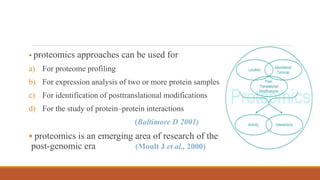
 proteomics approaches can be used for
a) For proteome profiling
b) For expression analysis of two or more protein samples
c) For identification of posttranslational modifications
d) For the study of protein–protein interactions
(Baltimore D 2001)
 proteomics is an emerging area of research of the
post-genomic era (Moult J et al., 2000)
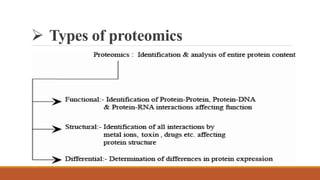
 Types of proteomics
 History
 History
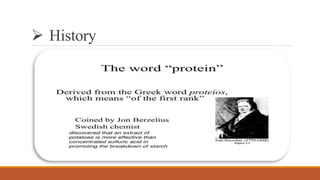
 Berzelius in 1838 given the title “protein”, which is originated from the Greek word,
proteios, meaning “the first rank”. (cristea et al., 2004)
 In 1993, Henzel et al. reported the first work related to the identification of protein
from the 2DE.
The term “proteomics” was first used by Marc Wilkins in 1996 to denote the
“PROTein complement of a genOME”. (Wilkins MR et al., 1996)
 SDS-PAGE discovered by Laemmli in 1970.
 Fenn (1988) developed ESI-MS.
 Hillenkamp (1988) developed MALDI-MS.
 JJ Thomson (1913) identified M/Z ratio.
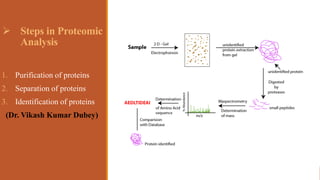
 Steps in Proteomic
Analysis
1. Purification of proteins
2. Separation of proteins
3. Identification of proteins
(Dr. Vikash Kumar Dubey)
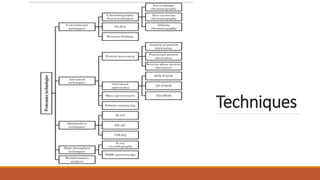
Techniques
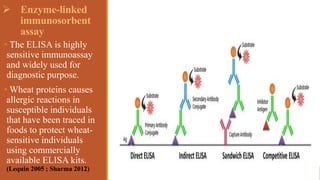
 Enzyme-linked
immunosorbent
assay
• The ELISA is highly
sensitive immunoassay
and widely used for
diagnostic purpose.
• Wheat proteins causes
allergic reactions in
susceptible individuals
that have been traced in
foods to protect wheat-
sensitive individuals
using commercially
available ELISA kits.
(Lequin 2005 ; Sharma 2012)
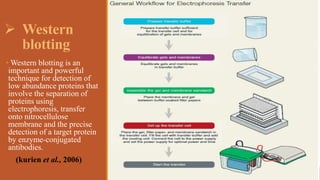
 Western
blotting
• Western blotting is an
important and powerful
technique for detection of
low abundance proteins that
involve the separation of
proteins using
electrophoresis, transfer
onto nitrocellulose
membrane and the precise
detection of a target protein
by enzyme-conjugated
antibodies.
(kurien et al., 2006)
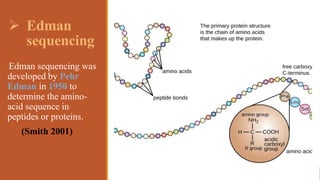
 Edman
sequencing
• Edman sequencing was
developed by Pehr
Edman in 1950 to
determine the amino-
acid sequence in
peptides or proteins.
(Smith 2001)
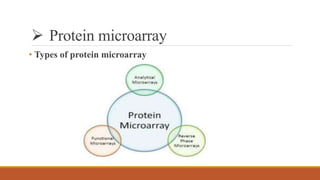
 Protein microarray
• Types of protein microarray
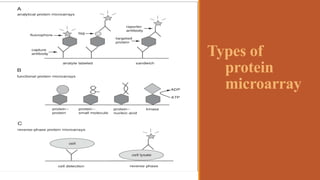
Types of
protein
microarray
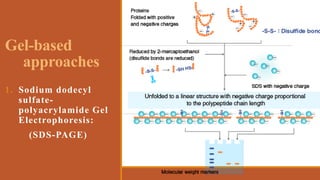
Gel-based
approaches
1. Sodium dodecyl
sulfate-
polyacrylamide Gel
Electrophoresis:
(SDS-PAGE)
 Gel based
approaches
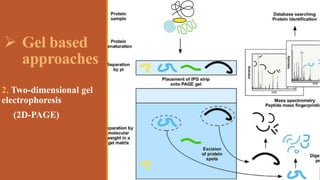
2. Two-dimensional gel
electrophoresis
(2D-PAGE)
 Gel based
approaches
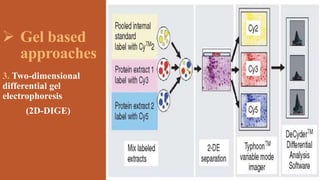
3. Two-dimensional
differential gel
electrophoresis
(2D-DIGE)
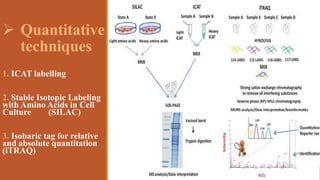
 Quantitative
techniques
1. ICAT labelling
2. Stable Isotopic Labeling
with Amino Acids in Cell
Culture (SILAC)
3. Isobaric tag for relative
and absolute quantitation
(iTRAQ)
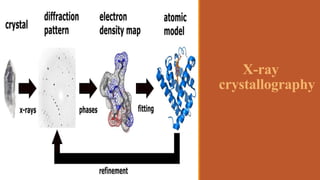
X-ray
crystallography
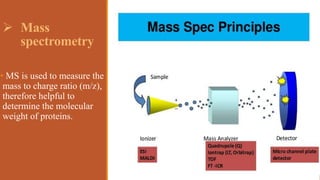
 Mass
spectrometry
• MS is used to measure the
mass to charge ratio (m/z),
therefore helpful to
determine the molecular
weight of proteins.
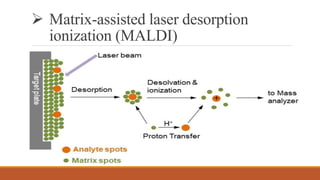
 Matrix-assisted laser desorption
ionization (MALDI)
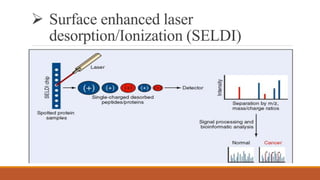
 Surface enhanced laser
desorption/Ionization (SELDI)
 Advantages of proteomics
1. Helps in determining the proper treatment of diseases.
2. Modifications of the proteins that are not apparent from the DNA
sequence, such as isoforms and post-translational modifications,
cn be determined only by proteomic methodologies.
3. Mechanisms such as regulation of protein function by proteolysis,
recycling and sequestration in cell compartments affect gene
products and not genes.
4. Protein-protein interactions and the molecular composition of
cellular structures such as organelles can be determined only at the
protein level.
 Disadvantages of proteomics
1. Requires more handling, refinement and sample manipulation.
2. Requires more expensive and complicated equipment.
3. Data analysis can be complex since so much data is collected for a
single sample.
4. There is some loss of sensitivity when data are collected in an
untargeted mannar.
 Applications of proteomics
1. Oncology
Proteomics is a systematic research, the main aim of this research is to
characterize the protein expressions, functions of tumor cells and widely used in
biomarker discovery.
2. Bio-medical applications
The study of interactions between microbial pathogens and their hosts is
called “infectomics”. It is very interesting area in proteomics. The main aim of
this research is to prevent or cure disease at starting level.
(Chiang 2008)
 Applications of proteomics
3. Agricultural applications
Proteomics is also used to know plant-insect interactions that help identify
candidate genes involved in the defensive response of plants to herbivore.
4. Food Microbiology
The use of proteomics in food technology is presented especially for
characterisation and standardisation of raw materials, process development, and
detection of batch-to batch variations and quality control of the final product.
(Sangha et al.,2013; Dajana Gaso Sokac et al.,2010)
 References
o Proteomics & Genomics (Dr. Vikash Kumar Dubey)
o Wilkins, M.R., Sanchez, J.-C., Gooley, A.A., Appel, R.D., HumpherySmith, I., Hochstrasser, D.F., et al.; Progress
with proteome projects: why all proteins expressed by a genome should be identified and how to do it; Biotechnology
and Genetic Engineering Reviews, (1996); 13(1): 19–50.
o Baltimore, D., 2001. Our genome unveiled. Nature, 409(6822), p.814.
o Moult J, Melamud E. From fold to function. Curr Opin Struct Biol 2000; 10: 384-389.
o Cristea, I.M., Gaskell, S.J., Whetton, A.D.; Proteomics techniques and their application to hematology; Blood,
(2004); 103(10): 3624–3634.
o Azzoni, A.R., Takahashi, K., Woodard, S.L., Miranda, E.A., Nikolov, Z.L.; Purification of recombinant aprotinin
produced in transgenic corn seed: separation from CTI utilizing ion-exchange chromatography; Brazilian Journal of
Chemical Engineering, (2005); 22(3): 323–330.
o Voedisch, B., Thie, H.; Size exclusion chromatography. In Antibody Engineering. Springer, Berlin, Heidelberg,
(2010), pp. 607–612.
 References
o Yoo, C.; Purification and physical characterization of intrinsically disordered lea protein from Arabidopsis thaliana.
The University of Utah Department, (2014).
o Hage, D.S., Anguizola, J.A., Bi, C., Li, R., Matsuda, R., Papastavros, E., et al.; Pharmaceutical and biomedical
applications of affinity chromatography: Recent trends and developments; Journal of Pharmaceutical and Biomedical
Analysis, (2012); 69: 93–105.
o Calero, M., Rostagno, A., Ghiso, J.; Search for amyloid-binding proteins by affinity chromatography. In Methods in
Molecular Biology. Springer Science + Business Media, (2012): 213–223.
o Lequin, R.M.; Enzyme Immunoassay (EIA)/Enzyme-Linked Immunosorbent Assay (ELISA); Clinical Chemistry,
(2005); 51(12): 2415–2418.
o Sharma, G.M.; Immunoreactivity and detection of wheat proteins by commercial ELISA kits; Journal of AOAC
International, (2012); 95(2): 364–371.
o Kurien, B., Scofield, R.; Western blotting; Methods (San Diego, CA), (2006); 38(4): 283–293
 References
o Smith, J.B.; Peptide sequencing by Edman degradation. In Encyclopedia of Life
Sciences. Wiley-Blackwell, Hoboken, NJ, USA, (2001).
o Chiang A.C., Massague J., The new England Journal of Medicine 359 (2008) 2814-
2823.
o Dajana Gaso Sokac, Spomenka Kova, Djuro Josi, Food Technology and Biotechnology
48 (2010) 284-295.
o Sangha J.S., Chen Y.H., Kaur J., Khan Wajahatullah, Abduljaleel Zainularifeen,
Alanazi Mohammaed S., Mills Aaron., Adalla C.B., Bennett John., Balakrishnan P.,
Jahn G.C., Hei Leung., International Journal of Molecular Sciences 14 (2013) 3921-3945.
PROTEOMICS  INTRODUCTION AND TECHNIQUES

PROTEOMICS INTRODUCTION AND TECHNIQUES

  • 2.
    Group # 3 Abdul Rehman 2018-ag-3545  Muhammad Imran 2018-ag-3571  Aftab Aslam 2018-ag-3531  Shakir Hussain 2018-ag-3504  Sundas Qadeer 2018-ag-3505  Azka Mehar 2018-ag-3538  Areena Kiran 2018-ag-3525  Adeela Ghaffar 2018-ag-3591  Sania Asghar 2018-ag-3592  Dua Zahra 2016-ag-974
  • 3.
  • 4.
  • 5.
    Introduction  Proteome: The word“proteome” represents the complete protein pool of an organism encoded by the genome. (Dr. Vikash Kumar Dubey)  Proteomics: Proteomics, is defined as the study of complete set of proteins present in a cell, organ, or organism at a given time. (Wilkins MR et al., 1995) Continued…
  • 6.
     proteomics approachescan be used for a) For proteome profiling b) For expression analysis of two or more protein samples c) For identification of posttranslational modifications d) For the study of protein–protein interactions (Baltimore D 2001)  proteomics is an emerging area of research of the post-genomic era (Moult J et al., 2000)
  • 7.
     Types ofproteomics
  • 8.
  • 9.
     History  Berzeliusin 1838 given the title “protein”, which is originated from the Greek word, proteios, meaning “the first rank”. (cristea et al., 2004)  In 1993, Henzel et al. reported the first work related to the identification of protein from the 2DE. The term “proteomics” was first used by Marc Wilkins in 1996 to denote the “PROTein complement of a genOME”. (Wilkins MR et al., 1996)  SDS-PAGE discovered by Laemmli in 1970.  Fenn (1988) developed ESI-MS.  Hillenkamp (1988) developed MALDI-MS.  JJ Thomson (1913) identified M/Z ratio.
  • 10.
     Steps inProteomic Analysis 1. Purification of proteins 2. Separation of proteins 3. Identification of proteins (Dr. Vikash Kumar Dubey)
  • 11.
  • 12.
     Enzyme-linked immunosorbent assay • TheELISA is highly sensitive immunoassay and widely used for diagnostic purpose. • Wheat proteins causes allergic reactions in susceptible individuals that have been traced in foods to protect wheat- sensitive individuals using commercially available ELISA kits. (Lequin 2005 ; Sharma 2012)
  • 13.
     Western blotting • Westernblotting is an important and powerful technique for detection of low abundance proteins that involve the separation of proteins using electrophoresis, transfer onto nitrocellulose membrane and the precise detection of a target protein by enzyme-conjugated antibodies. (kurien et al., 2006)
  • 14.
     Edman sequencing • Edmansequencing was developed by Pehr Edman in 1950 to determine the amino- acid sequence in peptides or proteins. (Smith 2001)
  • 15.
     Protein microarray •Types of protein microarray
  • 16.
  • 17.
  • 18.
     Gel based approaches 2.Two-dimensional gel electrophoresis (2D-PAGE)
  • 19.
     Gel based approaches 3.Two-dimensional differential gel electrophoresis (2D-DIGE)
  • 20.
     Quantitative techniques 1. ICATlabelling 2. Stable Isotopic Labeling with Amino Acids in Cell Culture (SILAC) 3. Isobaric tag for relative and absolute quantitation (iTRAQ)
  • 21.
  • 22.
     Mass spectrometry • MSis used to measure the mass to charge ratio (m/z), therefore helpful to determine the molecular weight of proteins.
  • 23.
     Matrix-assisted laserdesorption ionization (MALDI)
  • 24.
     Surface enhancedlaser desorption/Ionization (SELDI)
  • 25.
     Advantages ofproteomics 1. Helps in determining the proper treatment of diseases. 2. Modifications of the proteins that are not apparent from the DNA sequence, such as isoforms and post-translational modifications, cn be determined only by proteomic methodologies. 3. Mechanisms such as regulation of protein function by proteolysis, recycling and sequestration in cell compartments affect gene products and not genes. 4. Protein-protein interactions and the molecular composition of cellular structures such as organelles can be determined only at the protein level.
  • 26.
     Disadvantages ofproteomics 1. Requires more handling, refinement and sample manipulation. 2. Requires more expensive and complicated equipment. 3. Data analysis can be complex since so much data is collected for a single sample. 4. There is some loss of sensitivity when data are collected in an untargeted mannar.
  • 27.
     Applications ofproteomics 1. Oncology Proteomics is a systematic research, the main aim of this research is to characterize the protein expressions, functions of tumor cells and widely used in biomarker discovery. 2. Bio-medical applications The study of interactions between microbial pathogens and their hosts is called “infectomics”. It is very interesting area in proteomics. The main aim of this research is to prevent or cure disease at starting level. (Chiang 2008)
  • 28.
     Applications ofproteomics 3. Agricultural applications Proteomics is also used to know plant-insect interactions that help identify candidate genes involved in the defensive response of plants to herbivore. 4. Food Microbiology The use of proteomics in food technology is presented especially for characterisation and standardisation of raw materials, process development, and detection of batch-to batch variations and quality control of the final product. (Sangha et al.,2013; Dajana Gaso Sokac et al.,2010)
  • 29.
     References o Proteomics& Genomics (Dr. Vikash Kumar Dubey) o Wilkins, M.R., Sanchez, J.-C., Gooley, A.A., Appel, R.D., HumpherySmith, I., Hochstrasser, D.F., et al.; Progress with proteome projects: why all proteins expressed by a genome should be identified and how to do it; Biotechnology and Genetic Engineering Reviews, (1996); 13(1): 19–50. o Baltimore, D., 2001. Our genome unveiled. Nature, 409(6822), p.814. o Moult J, Melamud E. From fold to function. Curr Opin Struct Biol 2000; 10: 384-389. o Cristea, I.M., Gaskell, S.J., Whetton, A.D.; Proteomics techniques and their application to hematology; Blood, (2004); 103(10): 3624–3634. o Azzoni, A.R., Takahashi, K., Woodard, S.L., Miranda, E.A., Nikolov, Z.L.; Purification of recombinant aprotinin produced in transgenic corn seed: separation from CTI utilizing ion-exchange chromatography; Brazilian Journal of Chemical Engineering, (2005); 22(3): 323–330. o Voedisch, B., Thie, H.; Size exclusion chromatography. In Antibody Engineering. Springer, Berlin, Heidelberg, (2010), pp. 607–612.
  • 30.
     References o Yoo,C.; Purification and physical characterization of intrinsically disordered lea protein from Arabidopsis thaliana. The University of Utah Department, (2014). o Hage, D.S., Anguizola, J.A., Bi, C., Li, R., Matsuda, R., Papastavros, E., et al.; Pharmaceutical and biomedical applications of affinity chromatography: Recent trends and developments; Journal of Pharmaceutical and Biomedical Analysis, (2012); 69: 93–105. o Calero, M., Rostagno, A., Ghiso, J.; Search for amyloid-binding proteins by affinity chromatography. In Methods in Molecular Biology. Springer Science + Business Media, (2012): 213–223. o Lequin, R.M.; Enzyme Immunoassay (EIA)/Enzyme-Linked Immunosorbent Assay (ELISA); Clinical Chemistry, (2005); 51(12): 2415–2418. o Sharma, G.M.; Immunoreactivity and detection of wheat proteins by commercial ELISA kits; Journal of AOAC International, (2012); 95(2): 364–371. o Kurien, B., Scofield, R.; Western blotting; Methods (San Diego, CA), (2006); 38(4): 283–293
  • 31.
     References o Smith,J.B.; Peptide sequencing by Edman degradation. In Encyclopedia of Life Sciences. Wiley-Blackwell, Hoboken, NJ, USA, (2001). o Chiang A.C., Massague J., The new England Journal of Medicine 359 (2008) 2814- 2823. o Dajana Gaso Sokac, Spomenka Kova, Djuro Josi, Food Technology and Biotechnology 48 (2010) 284-295. o Sangha J.S., Chen Y.H., Kaur J., Khan Wajahatullah, Abduljaleel Zainularifeen, Alanazi Mohammaed S., Mills Aaron., Adalla C.B., Bennett John., Balakrishnan P., Jahn G.C., Hei Leung., International Journal of Molecular Sciences 14 (2013) 3921-3945.