Fermentation Process in Yogurt
Industry
12th November, 2019
Shryli K S
Vth Semester
Molecular Biology
Yuvaraja’s College (Autonomous)
Mysuru
Guided by,
Dr Anu Appaiah K A
Sr. Principal Scientist
Microbiology & Fermentation Technology
Central Food Technological Research Institute
Mysuru
Contents
Introduction
Nutritional Value
History
Production
Health benefits
Conclusion
References
Acknowledgement
6/14/2021 Yogurt 2
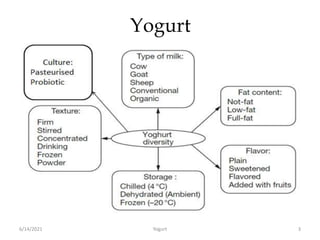
Yogurt
• Streptococcus thermophilus
• Lactobacillus delbrueckii subsp. bulgaricus
“ Live microorganisms that, when administered in adequate
amounts, confer a health benefit to the host”
6/14/2021 Yogurt 3
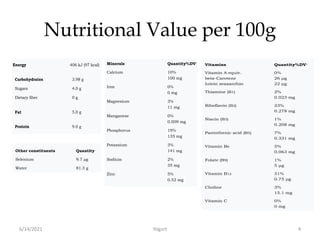
Nutritional Value per 100g
Energy 406 kJ (97 kcal)
Carbohydrates 3.98 g
Sugars 4.0 g
Dietary fiber 0 g
Fat 5.0 g
Protein 9.0 g
Vitamins Quantity%DV†
Vitamin A equiv.
beta-Carotene
lutein zeaxanthin
0%
26 μg
22 μg
Thiamine (B1) 2%
0.023 mg
Riboflavin (B2) 23%
0.278 mg
Niacin (B3) 1%
0.208 mg
Pantothenic acid (B5) 7%
0.331 mg
Vitamin B6 5%
0.063 mg
Carbohydrates 3.98 g
Sugars 4.0 g
Dietary fiber 0 g
Fat 5.0 g
Protein 9.0 g
Vitamins Quantity%DV†
Vitamin A equiv.
beta-Carotene
lutein zeaxanthin
0%
26 μg
22 μg
Thiamine (B1) 2%
0.023 mg
Riboflavin (B2) 23%
0.278 mg
Niacin (B3) 1%
0.208 mg
Pantothenic acid (B5) 7%
0.331 mg
Vitamin B6 5%
0.063 mg
Folate (B9) 1%
5 μg
Vitamin B12 31%
0.75 μg
Choline 3%
15.1 mg
Vitamin C 0%
0 mg
Minerals Quantity%DV†
Calcium 10%
100 mg
Minerals Quantity%DV†
Calcium 10%
100 mg
Iron 0%
0 mg
Magnesium 3%
11 mg
Manganese 0%
0.009 mg
Phosphorus 19%
135 mg
Potassium 3%
141 mg
Sodium 2%
35 mg
Zinc 5%
0.52 mg
Other constituents Quantity
Selenium 9.7 µg
Water 81.3 g
Minerals Quantity%DV†
Calcium 10%
100 mg
Iron 0%
0 mg
Magnesium 3%
11 mg
Manganese 0%
0.009 mg
Phosphorus 19%
135 mg
Potassium 3%
141 mg
Sodium 2%
35 mg
Zinc 5%
0.52 mg
Other constituents Quantity
Selenium 9.7 µg
Water 81.3 g
6/14/2021 Yogurt 4
History
• “Yogurmark”
9000-8000 BC
• Stamen Grigorov (1905)
Fig 1: Carvings of mesopotamia civilisation of
yogurt production
Fig 2: Stamen Grigorov (1878–1945)
• Elie Metchnikoff
Fig 3: Elie MetchnikoffElie
(1845- 1916)
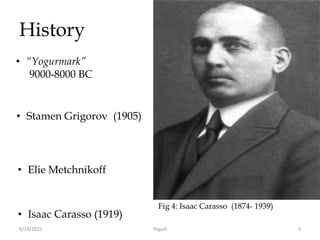
• Isaac Carasso (1919)
Fig 4: Isaac Carasso (1874- 1939)
6/14/2021 Yogurt 5
Fig 6: Present Dannon
Yogurt products.
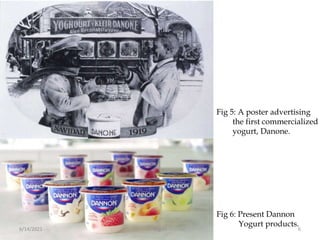
Fig 5: A poster advertising
the first commercialized
yogurt, Danone.
6/14/2021 Yogurt 6
Production of Yogurt
1) The preparation of the mix and all corresponding physical
treatments such as homogenization, heat treatment, cooling, and
deaeration;
2) the fermentation process starting after inoculation of the mix; and
3) the yogurt harvesting, post-treatment, and packaging.
• The quality checking
6/14/2021 Yogurt 7
1) Preparation of the mix
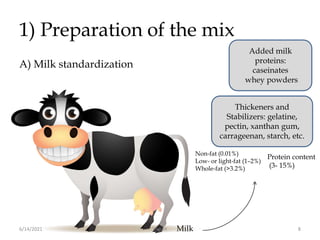
A) Milk standardization
Non-fat (0.01%)
Low- or light-fat (1–2%)
Whole-fat (>3.2%)
Milk
Protein content
(3- 15%)
Added milk
proteins:
caseinates
whey powders
Thickeners and
Stabilizers: gelatine,
pectin, xanthan gum,
carrageenan, starch, etc.
6/14/2021 Yogurt 8
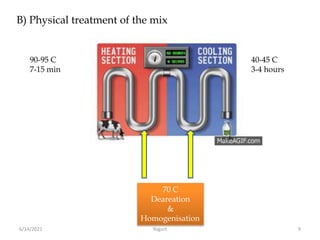
B) Physical treatment of the mix
70 C
Deareation
&
Homogenisation
90-95 C
7-15 min
40-45 C
3-4 hours
6/14/2021 Yogurt 9
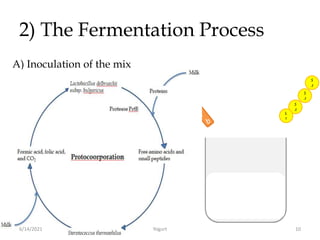
2) The Fermentation Process
A) Inoculation of the mix
S
.t
S
.t
S.
t
S
.t
Fig 7: Mixed culture of S.
thermophilus & L.
delbrueckii subsp. bulgaricus
6/14/2021 Yogurt 10
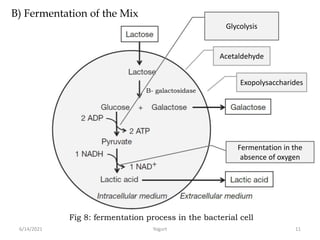
B) Fermentation of the Mix
Glycolysis
Fermentation in the
absence of oxygen
Acetaldehyde
Exopolysaccharides
Fig 8: fermentation process in the bacterial cell
B- galactosidase
6/14/2021 Yogurt 11
3) Yogurt Harvesting and Packaging
Cooling and harvesting
.
Control and Quality checking
6/14/2021 Yogurt 12
Health benefits
• It is Rich in Important Nutrients.
• It is High in Protein.
• Some Varieties May Benefit Digestive Health.
• It Strengthens Your Immune System.
• It lowers the blood pressure, bad cholesterol and risk of
heart attacks.
• It Promotes Weight Management .
• Yoghurt is rich in calcium so; it protects the bones
against osteoporosis and arthritis.
• It strengthens the collagen in the skin.
• Consumption of yoghurt can shut down Helicobater
pylori; the bacterium responsible for most ulcers.
6/14/2021 Yogurt 13
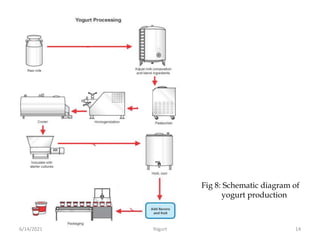
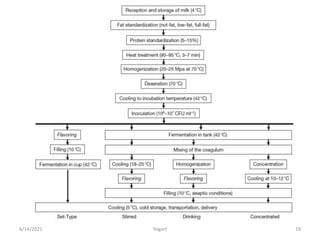
Fig 8: Schematic diagram of
yogurt production
a
a
a
a
a
a
a
6/14/2021 Yogurt 14
6/14/2021 Yogurt 15
“Sour Milk Is Elixir”
Fig
9:
An
article
of
Elie
Metchnikoff
in
The
Washington
times.
[volume],
January
28,
1906,
Greater
Washington
Edition,
Magazine
Section,
Page
4,
Image
42
6/14/2021 Yogurt 16
References
• Benjamin Caballero, Paul M Finglas, Fidel Toldra, Yogurt: The Product
and its Manufacture; The Encyclopedia of Food and Health; Academic
Press, Oxford; 2016, 617-624pp
• Francoise Rul, Yogurt: microbiology, organoleptic properties and probiotic
potential, Part-II: Technological Inventions, CRC Press, 2017, 525pp.
• ITDG, Practical answers to poverty, Yoghurt Production; Technical Brief,
2012, 2pp
• Yogurt Production; The Northeast Center for Food Entrepreneurship at the
New York State Food Venture Center, Cornell University; 2007, 3pp
• I. H. Ko, M. K. Wang, B. J. Jeon and H. S. Kwak; Fermentation for Liquid-
type Yogurt with Lactobacillus casei 911LC, 2014; 5pp
• Priyanka Aswal, Anubha Shukla and *Siddharth Priyadarshi; Yoghurt :
Preparation, Characteristics and Recent Advancements; Cibtech Journal of
Bio-Protocols; Vol-1, 2012, 32pp
• http://www.milkfacts.info/Milk%20Processing/Yogurt%20Production.ht
m
• http://www.madehow.com/Volume-4/Yogurt.html
• https://dairyconsultant.co.uk/yoghurt-yogurt-production.php
6/14/2021 Yogurt 17
Acknowledgement
I thank the department of Molecular Biology for providing
me an opportunity to present this seminar. I also thank my
guide Dr Anu Appaiah K A, Sr. Principal Scientist, CFTRI
for his valuable guidance and support throughout the
preparation of my seminar.
Thank you all for your patience.
6/14/2021 Yogurt 18
6/14/2021 Yogurt 19
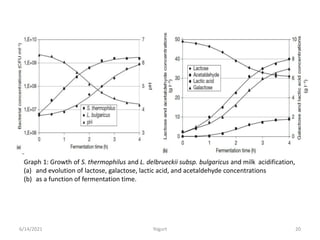
Graph 1: Growth of S. thermophilus and L. delbrueckii subsp. bulgaricus and milk acidification,
(a) and evolution of lactose, galactose, lactic acid, and acetaldehyde concentrations
(b) as a function of fermentation time.
6/14/2021 Yogurt 20

Fermentation Process in Yogurt Industry

  • 1.
    Fermentation Process inYogurt Industry 12th November, 2019 Shryli K S Vth Semester Molecular Biology Yuvaraja’s College (Autonomous) Mysuru Guided by, Dr Anu Appaiah K A Sr. Principal Scientist Microbiology & Fermentation Technology Central Food Technological Research Institute Mysuru
  • 2.
  • 3.
    Yogurt • Streptococcus thermophilus •Lactobacillus delbrueckii subsp. bulgaricus “ Live microorganisms that, when administered in adequate amounts, confer a health benefit to the host” 6/14/2021 Yogurt 3
  • 4.
    Nutritional Value per100g Energy 406 kJ (97 kcal) Carbohydrates 3.98 g Sugars 4.0 g Dietary fiber 0 g Fat 5.0 g Protein 9.0 g Vitamins Quantity%DV† Vitamin A equiv. beta-Carotene lutein zeaxanthin 0% 26 μg 22 μg Thiamine (B1) 2% 0.023 mg Riboflavin (B2) 23% 0.278 mg Niacin (B3) 1% 0.208 mg Pantothenic acid (B5) 7% 0.331 mg Vitamin B6 5% 0.063 mg Carbohydrates 3.98 g Sugars 4.0 g Dietary fiber 0 g Fat 5.0 g Protein 9.0 g Vitamins Quantity%DV† Vitamin A equiv. beta-Carotene lutein zeaxanthin 0% 26 μg 22 μg Thiamine (B1) 2% 0.023 mg Riboflavin (B2) 23% 0.278 mg Niacin (B3) 1% 0.208 mg Pantothenic acid (B5) 7% 0.331 mg Vitamin B6 5% 0.063 mg Folate (B9) 1% 5 μg Vitamin B12 31% 0.75 μg Choline 3% 15.1 mg Vitamin C 0% 0 mg Minerals Quantity%DV† Calcium 10% 100 mg Minerals Quantity%DV† Calcium 10% 100 mg Iron 0% 0 mg Magnesium 3% 11 mg Manganese 0% 0.009 mg Phosphorus 19% 135 mg Potassium 3% 141 mg Sodium 2% 35 mg Zinc 5% 0.52 mg Other constituents Quantity Selenium 9.7 µg Water 81.3 g Minerals Quantity%DV† Calcium 10% 100 mg Iron 0% 0 mg Magnesium 3% 11 mg Manganese 0% 0.009 mg Phosphorus 19% 135 mg Potassium 3% 141 mg Sodium 2% 35 mg Zinc 5% 0.52 mg Other constituents Quantity Selenium 9.7 µg Water 81.3 g 6/14/2021 Yogurt 4
  • 5.
    History • “Yogurmark” 9000-8000 BC •Stamen Grigorov (1905) Fig 1: Carvings of mesopotamia civilisation of yogurt production Fig 2: Stamen Grigorov (1878–1945) • Elie Metchnikoff Fig 3: Elie MetchnikoffElie (1845- 1916) • Isaac Carasso (1919) Fig 4: Isaac Carasso (1874- 1939) 6/14/2021 Yogurt 5
  • 6.
    Fig 6: PresentDannon Yogurt products. Fig 5: A poster advertising the first commercialized yogurt, Danone. 6/14/2021 Yogurt 6
  • 7.
    Production of Yogurt 1)The preparation of the mix and all corresponding physical treatments such as homogenization, heat treatment, cooling, and deaeration; 2) the fermentation process starting after inoculation of the mix; and 3) the yogurt harvesting, post-treatment, and packaging. • The quality checking 6/14/2021 Yogurt 7
  • 8.
    1) Preparation ofthe mix A) Milk standardization Non-fat (0.01%) Low- or light-fat (1–2%) Whole-fat (>3.2%) Milk Protein content (3- 15%) Added milk proteins: caseinates whey powders Thickeners and Stabilizers: gelatine, pectin, xanthan gum, carrageenan, starch, etc. 6/14/2021 Yogurt 8
  • 9.
    B) Physical treatmentof the mix 70 C Deareation & Homogenisation 90-95 C 7-15 min 40-45 C 3-4 hours 6/14/2021 Yogurt 9
  • 10.
    2) The FermentationProcess A) Inoculation of the mix S .t S .t S. t S .t Fig 7: Mixed culture of S. thermophilus & L. delbrueckii subsp. bulgaricus 6/14/2021 Yogurt 10
  • 11.
    B) Fermentation ofthe Mix Glycolysis Fermentation in the absence of oxygen Acetaldehyde Exopolysaccharides Fig 8: fermentation process in the bacterial cell B- galactosidase 6/14/2021 Yogurt 11
  • 12.
    3) Yogurt Harvestingand Packaging Cooling and harvesting . Control and Quality checking 6/14/2021 Yogurt 12
  • 13.
    Health benefits • Itis Rich in Important Nutrients. • It is High in Protein. • Some Varieties May Benefit Digestive Health. • It Strengthens Your Immune System. • It lowers the blood pressure, bad cholesterol and risk of heart attacks. • It Promotes Weight Management . • Yoghurt is rich in calcium so; it protects the bones against osteoporosis and arthritis. • It strengthens the collagen in the skin. • Consumption of yoghurt can shut down Helicobater pylori; the bacterium responsible for most ulcers. 6/14/2021 Yogurt 13
  • 14.
    Fig 8: Schematicdiagram of yogurt production a a a a a a a 6/14/2021 Yogurt 14
  • 15.
  • 16.
    “Sour Milk IsElixir” Fig 9: An article of Elie Metchnikoff in The Washington times. [volume], January 28, 1906, Greater Washington Edition, Magazine Section, Page 4, Image 42 6/14/2021 Yogurt 16
  • 17.
    References • Benjamin Caballero,Paul M Finglas, Fidel Toldra, Yogurt: The Product and its Manufacture; The Encyclopedia of Food and Health; Academic Press, Oxford; 2016, 617-624pp • Francoise Rul, Yogurt: microbiology, organoleptic properties and probiotic potential, Part-II: Technological Inventions, CRC Press, 2017, 525pp. • ITDG, Practical answers to poverty, Yoghurt Production; Technical Brief, 2012, 2pp • Yogurt Production; The Northeast Center for Food Entrepreneurship at the New York State Food Venture Center, Cornell University; 2007, 3pp • I. H. Ko, M. K. Wang, B. J. Jeon and H. S. Kwak; Fermentation for Liquid- type Yogurt with Lactobacillus casei 911LC, 2014; 5pp • Priyanka Aswal, Anubha Shukla and *Siddharth Priyadarshi; Yoghurt : Preparation, Characteristics and Recent Advancements; Cibtech Journal of Bio-Protocols; Vol-1, 2012, 32pp • http://www.milkfacts.info/Milk%20Processing/Yogurt%20Production.ht m • http://www.madehow.com/Volume-4/Yogurt.html • https://dairyconsultant.co.uk/yoghurt-yogurt-production.php 6/14/2021 Yogurt 17
  • 18.
    Acknowledgement I thank thedepartment of Molecular Biology for providing me an opportunity to present this seminar. I also thank my guide Dr Anu Appaiah K A, Sr. Principal Scientist, CFTRI for his valuable guidance and support throughout the preparation of my seminar. Thank you all for your patience. 6/14/2021 Yogurt 18
  • 19.
  • 20.
    Graph 1: Growthof S. thermophilus and L. delbrueckii subsp. bulgaricus and milk acidification, (a) and evolution of lactose, galactose, lactic acid, and acetaldehyde concentrations (b) as a function of fermentation time. 6/14/2021 Yogurt 20