WEL COME
Submitted to
P.M. MISTRY
Assistant professor
Dept. of Genetics and Plant Breeding
N.M. College of agriculture
NAU, Navsari-396 450
Submitted by
Name: SENTHILKUMAR.V
Dept. of Genetics and Plant Breeding
M.sc.( Agri.) 1st semester
N.M. College of agriculture
NAU, Navsari-396 450
PROTEOMICS AND PROTEIN – PROTEIN INTERACTION
2
Proteomics and
Protein-Protein
interaction
OVERVIEW OF THE TOPIC
 Introduction
Protein structure
Proteomics types
Proteome analysis and steps
Protein –protein interaction
Applications of proteomics
 Conclusion
Chapter 1
Introduction
PROTEOMICS INTRODUCTION
 PROTEOMICS is the study of the proteome, the full
protein complement of organisms e.g. plasma, cells
and tissue.
 PROTEOMICS is the large scale study of proteins,
particularly their structures and functions
 Understanding the proteome allows for:
 Characterisation of proteins
 Understanding protein interactions
 Identification of disease biomarkers
HISTORY
 “The Total Protein Complement Of A Genome.”
M. Wilkins Et Al. Electrophoresis 1995, 16, 1090-1094
 “The Analysis Of The Entire Protein Complement
Expressed By A Genome, Or By A Cell Or Tissue Type.”
S. Fey, P.Mose-larsen, Centre For Proteome Analysis,
Odense, Denmark
 Pharmaceutical Proteomics: “Proteome Approach To The
Interaction Of Drugs With Biological Systems.”
L. Anderson, Large Scale Biology, MA, USA
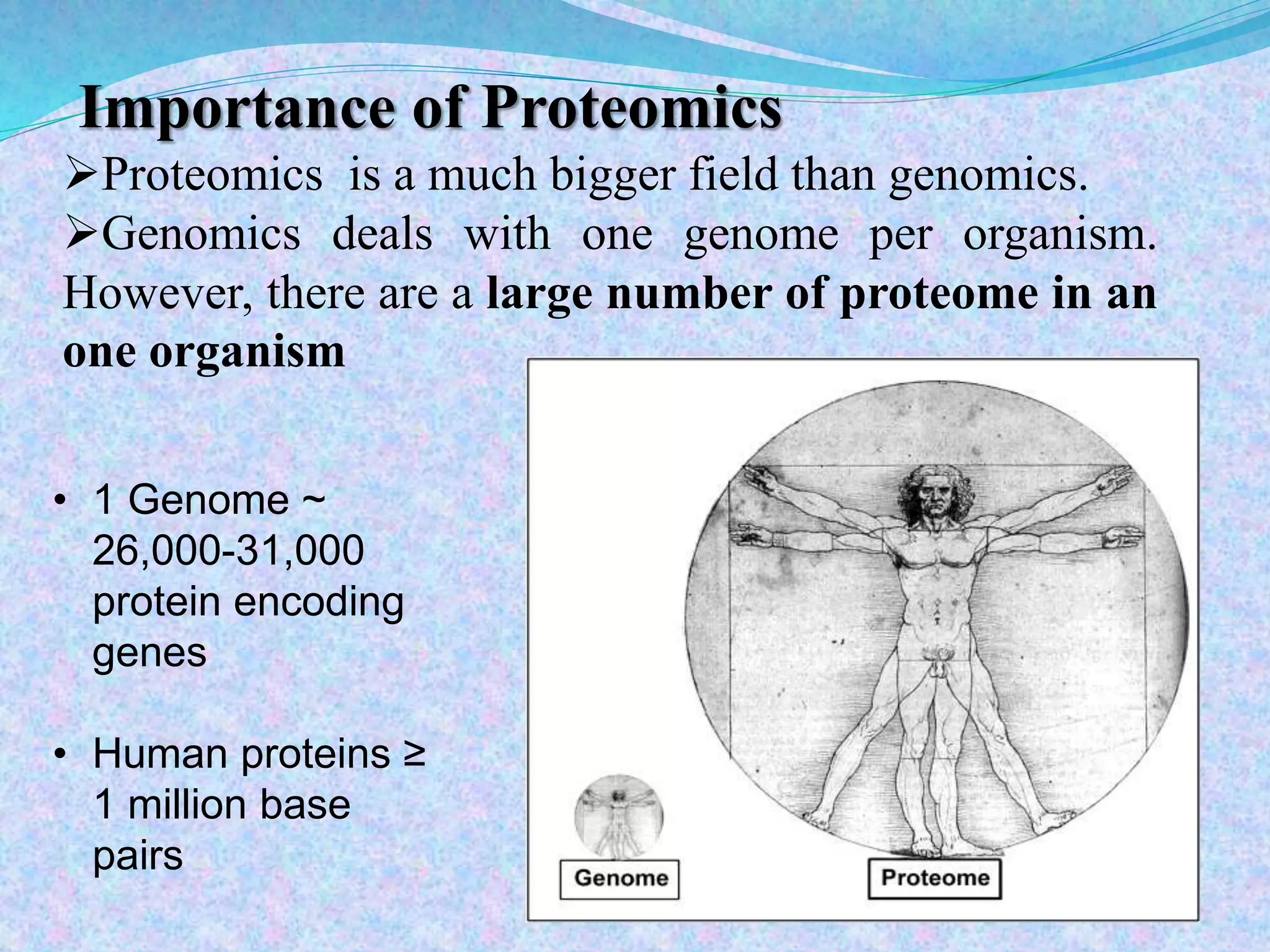
Importance of Proteomics
Proteomics is a much bigger field than genomics.
Genomics deals with one genome per organism.
However, there are a large number of proteome in an
one organism
• 1 Genome ~
26,000-31,000
protein encoding
genes
• Human proteins ≥
1 million base
pairs
Traditional molecular
genetics
Transcription
Translation
MODERN MOLECULAR GENETICS
Genome Transcriptome Proteome
DNA
Transcription Transcriptional control
RNA
Processing Post-transcriptional control
Translation Translational and degradation
Controls Translational frameshifting
mRNA
Protein > 200 known
post translation modifications
Fig. Protein Synthesis pathway.
FOCUS OF PROTEOMICS STUDIES
Aims of post translation
studies
Detect the protein expression by cell
to cell.
Store those information about
protein functions.
Compare the expression profiles
between a healthy cell vs diseased
cell.
Rational drug design.
Structure
Of
protein
Function
of
protein
proteomics
PROTEOMICS STUDY INVOLVED IN
Chapter 2
Protein structure
FOUR LEVELS OF PROTEIN STRUCTURE
The primary structure of a protein is its unique
sequence of amino acids.
The Secondary structure, found in most proteins,
consists of coils and folds in the polypeptide chain.
The Tertiary structure is determined by interactions
among various side chains (R groups).
The Quaternary structure results when a protein
consists of multiple polypeptide chains.
STRUCTURE OF PROTEIN
Amino acid
subunits
+H3N
Amino end
25
20
15
10
5
1
Primary Structure
16
Secondary Structure
β pleated sheet
Examples of
amino acid
subunits
α helix
17
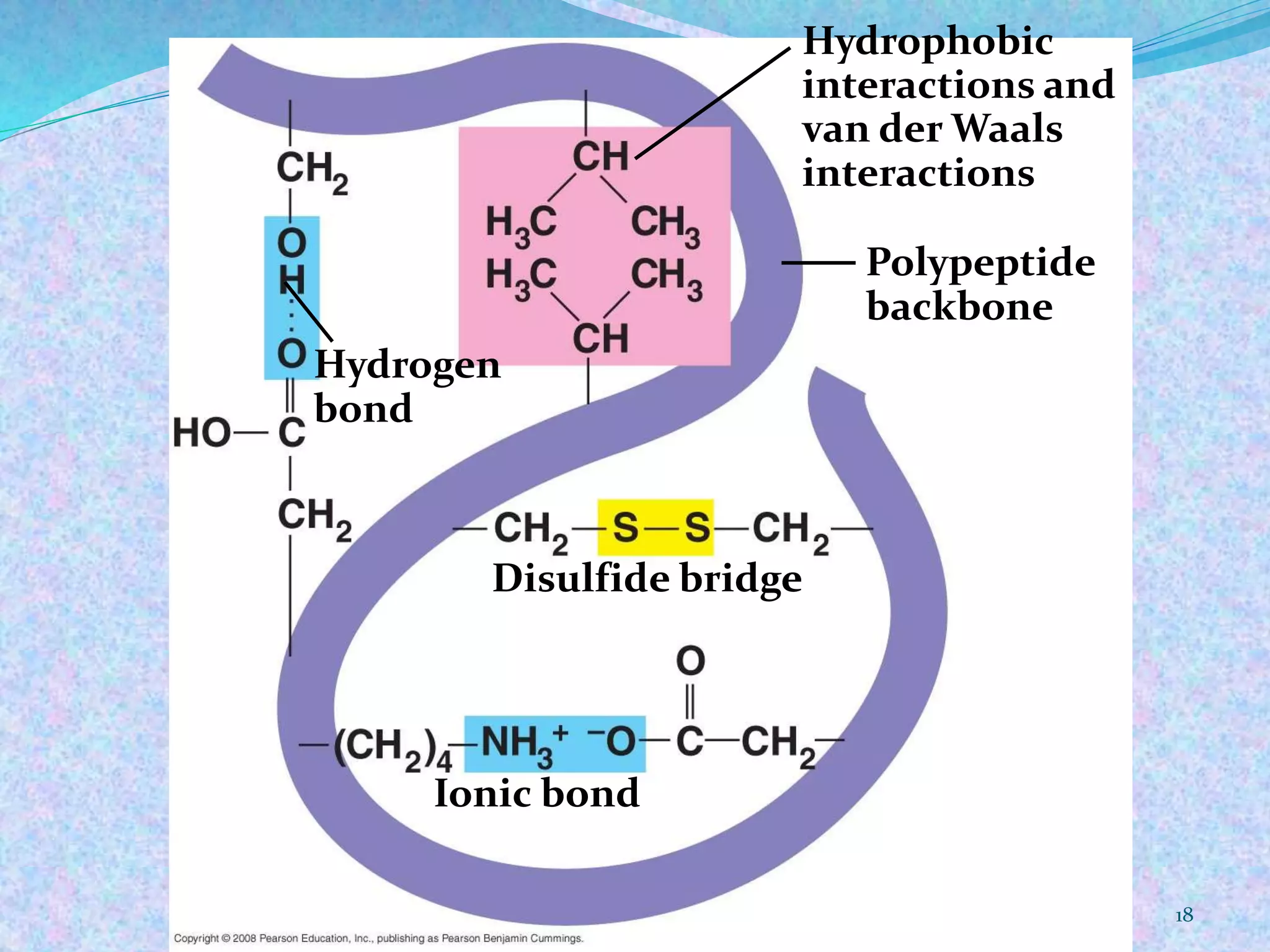
Polypeptide
backbone
Hydrophobic
interactions and
van der Waals
interactions
Disulfide bridge
Ionic bond
Hydrogen
bond
18
Polypeptide
chain
β Chains
α Chains
Collagen
Hemoglobin
19
TECHNIQUES INVOLVED TO STUDY OF PROTEIN
STRUCTURES
1) VIRTUAL LIGAND SCREENING
2) MALDI -TOF (Matrix Assisted Laser Desorption -
Time of Flight)
3) ESI -MS (Electro-spray ionization mass
spectrometry)
VIRTUAL LIGAND SCREENING
 A computer technique, attempts to fit millions of
small molecules to 3D structure of protein.
 The computer rates the quality of fit to various sites
in the protein with the goal of either enhancing or
disabling the function of protein in the cell.
1.Introduced in 1988.
2.It provides for the nondestructive vaporization
and ionization of both large and small
biomolecules.
3.Matrix play a key role.
MALDI-TOF TECHNIQUE
(Matrix-Assisted-Laser-Desorption-Ionization-
Time of Flight)
MALDI-TOF (MATRIX ASSISTED LASER DESORPTION-
Time Of Flight)
 Protein placed on light absorbing material, and with a short
pulse of laser protein are ionized and desorbed in to
vacuum system known as MATRIX ASSISTED LASER
DESORPTION.
Time of Flight (TOF)
1.Accelerating a set of ions to a detector with the
same amount of energy.
2.Ions have the same energy, yet a different mass they
reach the detector at different time.
3.Arrival time of an ion at the detector is dependent
upon the mass, charge and kinetic energy of the ion.
Electro-spray Ionization Mass
Spectrometry (ESI MS)
 Solution are forced directly from liquid
to gas phase.
 A solution of analytes pass through
charged needle that is kept at high
electricpotential dispersed in to charged
microdroplets.
 The solvent surrounding the
macromolecules rapidly evaporates, and
the resulting multiply charged
macromolecular ions are thus
introduced nondestructively in to a gas
is to be called as ESI MS.
Fenn's first electrospray
ionization source (top) coupled to
a single quadrupole mass
spectrometer
Chapter 3
Proteomics types
TYPES OF PROTEOMICS
1. Expression proteomics
2.Structural proteomics
3.Functional proteomics
EXPRESSION PROTEOMICS
To the quantitative study of
protein expression between
samples that differ by some
variable.
 It is quite useful in identifying
disease-specific proteins.
STRUCTURAL PROTEOMICS
 To Concerns with mapping out the 3-D
structure and nature of protein complexes
present specifically in a particular
cell/organelle.
 Aim of structural proteomics is to build a
body of structural information that will help
predict the probable structure and potential
function for almost any protein from a
knowledge of its coding sequence.
FUNCTIONAL PROTEOMICS
 To study protein-protein interaction, cellular
localization and in order to understand the
physiological function of the whole set of proteome.
One of the recent successes of functional proteomics
is the identification and analysis of molecular
protein-network involved in the nuclear pore
complex (NPC) in yeast.
This success helps understand the translocation of
molecules from nucleus to the cytoplasm and vice-
versa.
TECHNIQUES INVOLVED IN
STUDY OF PROTEOMICS
TYPES
Techniques of Expression Proteomics
 Two-dimensional gel Electrophoresis
 Protein Chips
 Mass Spectrometry
 Microsequencing
PROTEIN CHIP
Techniques of Structural Proteomics
High Throughput protein
structure determination
via
1) X-ray crystallography,
2) NMR spectroscopy or
3) comparative molecular
modeling
X-ray crystallography,
Techniques of Functional Proteomics
 Silico method
 Genome-wide Protein Tagging
 Genome-wide Gene Deletion
 Random Tagged Mutagenesis or Transposon Tagging
 Yeast two-hybrid Methods(protein –protein interaction)
 Protein Chips
Chapter 4
Proteomics
analysis and steps
PROTEOMICS ANAYSIS
AND STEPS
Sample prep.
• Immunoaffinity
depletion
• BCA protein assay
• Digestion of proteins
• Concentration
Sample analysis
• Spiking with internal
standard
• Blind run for protein
loading estimation
• Analysing samples in
triplicate
Bioinformatics
• Identification &
quantification using
• Expression analysis
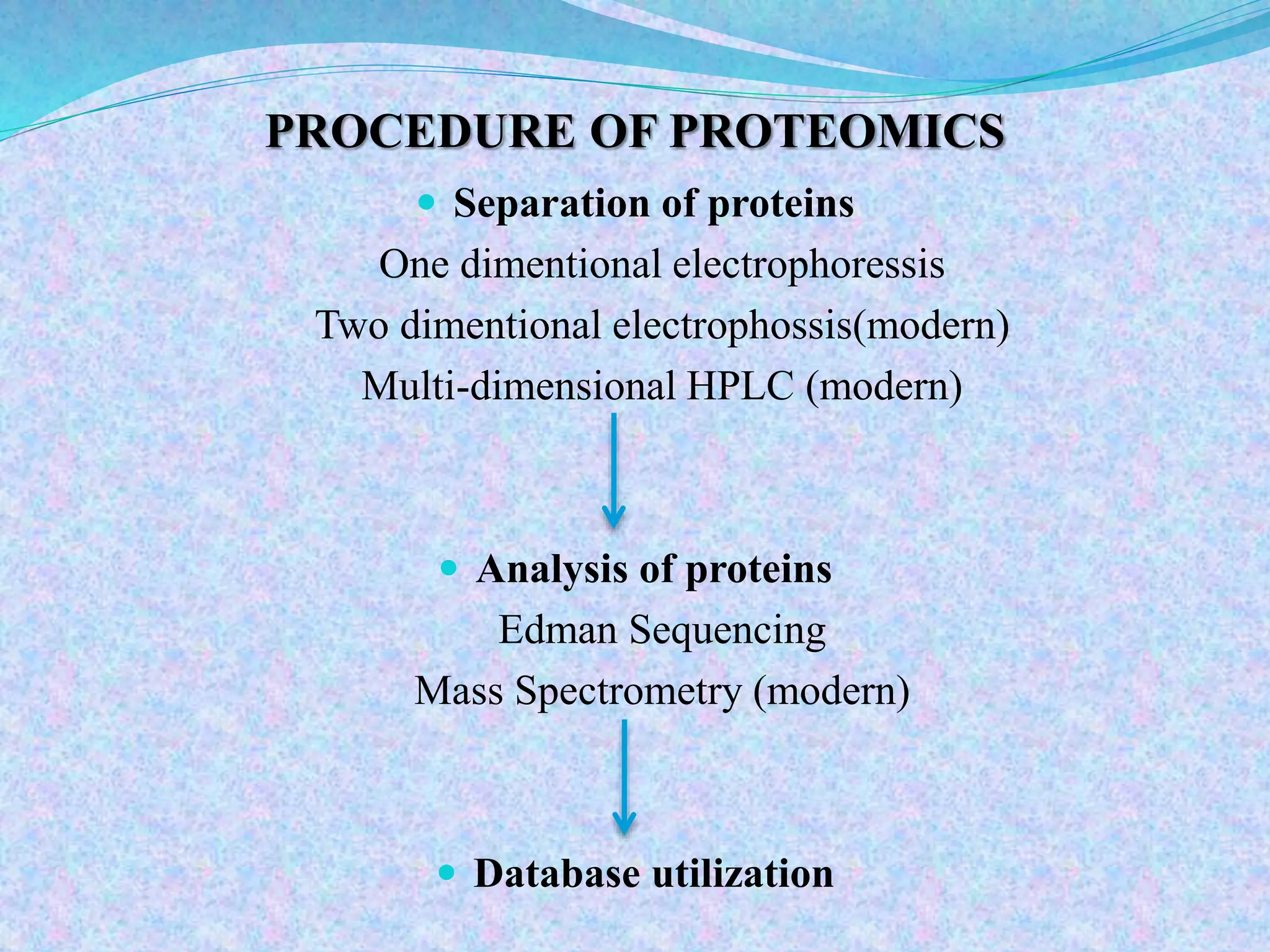
PROCEDURE OF PROTEOMICS
 Separation of proteins
One dimentional electrophoressis
Two dimentional electrophossis(modern)
Multi-dimensional HPLC (modern)
 Analysis of proteins
Edman Sequencing
Mass Spectrometry (modern)
 Database utilization
STEPS IN PROTEOME
ANALYSIS
Five main step in proteome analysis:
1. Sample collection, handling and storage.
2. Separation of individual proteins by 2-D
electrophoresis.
3. Protein characterization.
4. Identification by mass spectrometry or other
methods.
5. Storage, manipulation, and comparison of the data
using bioinformatics.
FIRST STEP
 Sample collection,
 Handling and
 Storage.
Sample prep.
•Immunoaffinity depletion
•BCA protein assay
•Digestion of proteins
•Concentration
2D electrophoresis + Mass spectrometry
②.SEPARATION OF PROTEINS
3.IDENTIFICATION AND
CHARACTERIZATION OF PROTEINS
.
•The primary method is electrophoresis or chromatography
coupled with mass spectrometry(MS).
•Defining the protein composition of a cell
A. mRNA splicing
B. covalent modification generate protein isoforms that
might contribute to important regulatory processes in the
cell.
C. Several approaches are being used to study post-
translational modifications on a proteome-wide scale.
4.PROTEIN CHARACTERIZATION AND
QUANTIFICATION
1.Mass spectrometry
2.Protein fingerprinting
3.2-D gel electrophorsis
Mass Spectrometry (MS)
• Mass spectrometry is used for protein identification.
•It is useful to obtain structural information like peptide
mass sequence.
•It is also useful in identifying type and location of
protein modification.
•A mass spectrometer separates proteins according to
their mass-to-charge(m/z) ratio. The molecule is first
ionized.
•The process of ionization of proteins forces them to move
towards the analyzer because of the charges on ions.
•MS can provide molecular weight and structural
information.
•MS always work with positive ions.
PRINCIPLE OF MASS SPECTROMETRY
Protein Fingerprinting
• Protein fingerprinting , also called peptide mass fingerprinting
or peptide mapping.
•It is a technique for identification of proteins.
•Separated protein spots are obtained from the gel and then
identified using protein fingerprinting.
•The method is based on the use of a proteolytic enzyme to
digest the protein into a number of smaller peptides.
•Finger printing of the protein depends on the protease used, but is
always the same for each one.
•The most commonly used protease is trypsin, which cuts protein
at lysine and arginine positions.
•When the digestion in complete, a set of peptides are produced of
varying masses that are unique to that protein.
Two –dimensional Gel Electrophoresis
• 2-D gel electrophoresis a method for the separation and
identification of proteins in a sample by displacement in 2
dimensions.
• First step is to separate based on charge or isoelectric point,
called isoelectric focusing.
•Then separate based on size (SDS-PAGE).
Isoelectric Focusing
•The isoelectric point is the pH at which the net
charge of the protein molecule is neutral.
•Different proteins have different isoelectric
points.
•Isoelectric point is found by drawing the sample
through a stable pH gradient.
•The range of the gradient determines the
resolution of the separation.
5.Protein databases
UniProt
Protein Information Resource (PIR)
Swiss-Prot
Protein Data Bank (PDB)
National Center for Biotechnology Information
(NCBI)
Human Protein Reference Database
Proteomics Identifications Database (PRIDE)
POST-TRANSLATIONAL MODIFICATION
(PMTs)
• A protein can under go post-translational modification and hence
various proteins can be formed from a single gene.
•After transcription from DNA to RNA , the gene mRNA can be
spliced in different ways prior to translation into protein.
•Following translation, most proteins are chemically modified through
post-translation modification, mainly through the addition of
carbohydrate and phosphate groups.
•PTM events can affect nearly all properties of 3-D structure of a
protein: size, charge , hydrophobicity.
•A phosphorylation event would change the local environment
substantially, making likely changes in the 3-D structure.
•As proteomics is the elucidation of the totality of protein-related
events in the cell, it also includes PTM protein variants.
Chapter 5
Protein-protein
interaction
Protein – Protein interaction
Proteins often interact with each
other in very complex ways.
Proteins may act upon and be acted
upon by many other proteins in the
cell, or outside the cell.
That’s figuring out the function of
a gene’s protein product.
Individual proteins are rarely
able to perform their functions by
themselves.
 Shown here, a protein
embedded in the membrane of the
cell is interacting with six other
proteins.
Protein-protein interaction
Types of Protein – Protein
interaction
Domain – domain
interactions
Domain – Peptide
interactions
Intramolecular protein-
protein interactions
Domain –Domain
Interactions
In domain –domain interactions, two independently
folded domains (completed protein)
It is interacted with more than one segments of
polypeptide
Domain – Peptide interactions
In interaction between a small unstructured proteins of
one structure and a folded domain protein.
Intramolecular protein-
protein interactions
In interaction represent the sequential association and
signal transduction of proteins.
METHODS TO INVESTIGATE
PROTEIN-PROTEIN
INTERACTIONS
Biochemical methods
 Co-immunoprecipitation
 Biomolecular fluorsecene
complementation
 Affinity electrophoresis
 Pull-down assays
 Yeast two hybrid screening
system
 Tandam affinity purification
 Strep-protein interaction
experiment
Biophysical and theortical
methods
 Dual polarisation
interferometry
 Static light scattering
 Surface plasmon resonance
 Protein activity ②D-FT
NMR spectroscopy
 Protein-protein docking
Biochemical methods
1.Co-immuno precipitation
This method considered to be the gold standard
assay
Its isolated with specific antibody
2.Biomolecular fluroscence complementation
This method used for screening the protein –
protein interactions
3.Affinity electrophoresis
This method characterization of molecule
identify the glycan content and ligand binding
4.Pulldown assay
Screening the protein-protein interactions
This methods combining from immuno
precipitation and affinity electro phoreosis
5.Tandam affinity purificaton
This method detect the transistant protein-
protein interactions
6.Strep –protein interaction
It is uses a combination of reversible link with
formaldehyde
Biophysical and theoretical
methods
 Dual polarisation interferometry
DPI provides real time ,high resolution mesurements of molecular
size,density and mass based on kinetics principles
 Static light shattering
This method used for rayleigh scattering of protein complexes
 Fluorscence energy 2D FT –NMR spectro scopy
Basic method study in protein-protein interactions based on
fluorscence emitted.
 Protein-protein docking
This method based on three dimensional protein structure from x-ray
diffraction of protein crystals
YEAST TWO-HYBRID SYSTEM FOR
PROTEIN-PROTEIN INTERACTION
•Most of the yeast two- hybrid systems utilize the reconstitution of an
active transcription factor to assay for protein-protein to make in
interactions.
•The Y2H system uses the trancription process to make the
prediction about protein interaction.
•The system requires that two yeast hybrids be prepared called
“bait-prey” system.
•The “bait” protein is fused to a transcrition factor DNA binding
domain.
•The other “prey” protein is fused to a transcription factor
activation domain.
•When expressed in a yeast cell containing the
appropriate reporter gene, interaction of the “bait”
with the “prey” brings the DNA binding domain and
the activation domain into close proximity, creating a
functional transcription factor.
•The ‘ bait prey’ nomenclature has applied to in
vitro method used to study protein analysis.
• In vitro method for protein interaction analysis
are often employed to confirm interaction
indicated by the Y2H method.
Chapter 6
Application of
proteomics
APPLICATION OF PROTEOMICS
 To identify of potential of new drugs for
treatment of diseases.
 This relies on identification of proteins which
associated with a disease , which computer
software can use as targets for drugs.
 If a certain protein when implicated to a disease,
3D structure provides in turn to drug design to
interfere with the action of protein.
 To identify unknown protein of interest.
 Post translation modifaction.
 Quantify protein and peptide.
Chapter 7
conclusion
1. Proteomics is a composite study of a set of proteins .
2. The detailed protein studies will shed light on the role of protein
modification in protein function.
3. The development of proteomics renders us with a powerful tool to
examine biochemical processes at the molecular level and
identify sets of proteins.
4. During plant life some times in adverse conditions it can passes
through biotic/abiotic stresses, at a time proteomics can useful
to identify sets of proteins.
Medical
Microbiology
Signal
Transduction
Disease
Mechanisms
Protein Expression
Profiling
Post-
translational
modifications
Glycosylation
Phosphorylation
Proteolysis
PROTEOMICS
Yeast two-hybrid
Phage Display
Co-precipitation
Protein-Protein
Interactions
Proteome
Mining
Drug
Discovery
Target
Identification/Val
idation
Differential
Display
Functional
Proteomics
Yeast
Genomics
Affinity
Purified
Protein
Complexes
Structural
Proteomics
Organelle
Composition
Subproteome
Isolation
Protein
Complexes
Various field of proteomics
Proteomics  and protein-protein interaction

Proteomics and protein-protein interaction

  • 1.
  • 2.
    Submitted to P.M. MISTRY Assistantprofessor Dept. of Genetics and Plant Breeding N.M. College of agriculture NAU, Navsari-396 450 Submitted by Name: SENTHILKUMAR.V Dept. of Genetics and Plant Breeding M.sc.( Agri.) 1st semester N.M. College of agriculture NAU, Navsari-396 450 PROTEOMICS AND PROTEIN – PROTEIN INTERACTION 2
  • 3.
  • 4.
    OVERVIEW OF THETOPIC  Introduction Protein structure Proteomics types Proteome analysis and steps Protein –protein interaction Applications of proteomics  Conclusion
  • 5.
  • 6.
    PROTEOMICS INTRODUCTION  PROTEOMICSis the study of the proteome, the full protein complement of organisms e.g. plasma, cells and tissue.  PROTEOMICS is the large scale study of proteins, particularly their structures and functions  Understanding the proteome allows for:  Characterisation of proteins  Understanding protein interactions  Identification of disease biomarkers
  • 7.
    HISTORY  “The TotalProtein Complement Of A Genome.” M. Wilkins Et Al. Electrophoresis 1995, 16, 1090-1094  “The Analysis Of The Entire Protein Complement Expressed By A Genome, Or By A Cell Or Tissue Type.” S. Fey, P.Mose-larsen, Centre For Proteome Analysis, Odense, Denmark  Pharmaceutical Proteomics: “Proteome Approach To The Interaction Of Drugs With Biological Systems.” L. Anderson, Large Scale Biology, MA, USA
  • 8.
    Importance of Proteomics Proteomicsis a much bigger field than genomics. Genomics deals with one genome per organism. However, there are a large number of proteome in an one organism • 1 Genome ~ 26,000-31,000 protein encoding genes • Human proteins ≥ 1 million base pairs
  • 9.
  • 10.
    MODERN MOLECULAR GENETICS GenomeTranscriptome Proteome
  • 11.
    DNA Transcription Transcriptional control RNA ProcessingPost-transcriptional control Translation Translational and degradation Controls Translational frameshifting mRNA Protein > 200 known post translation modifications Fig. Protein Synthesis pathway. FOCUS OF PROTEOMICS STUDIES
  • 12.
    Aims of posttranslation studies Detect the protein expression by cell to cell. Store those information about protein functions. Compare the expression profiles between a healthy cell vs diseased cell. Rational drug design.
  • 13.
  • 14.
  • 15.
    FOUR LEVELS OFPROTEIN STRUCTURE The primary structure of a protein is its unique sequence of amino acids. The Secondary structure, found in most proteins, consists of coils and folds in the polypeptide chain. The Tertiary structure is determined by interactions among various side chains (R groups). The Quaternary structure results when a protein consists of multiple polypeptide chains. STRUCTURE OF PROTEIN
  • 16.
  • 17.
    Secondary Structure β pleatedsheet Examples of amino acid subunits α helix 17
  • 18.
    Polypeptide backbone Hydrophobic interactions and van derWaals interactions Disulfide bridge Ionic bond Hydrogen bond 18
  • 19.
  • 20.
    TECHNIQUES INVOLVED TOSTUDY OF PROTEIN STRUCTURES 1) VIRTUAL LIGAND SCREENING 2) MALDI -TOF (Matrix Assisted Laser Desorption - Time of Flight) 3) ESI -MS (Electro-spray ionization mass spectrometry)
  • 21.
    VIRTUAL LIGAND SCREENING A computer technique, attempts to fit millions of small molecules to 3D structure of protein.  The computer rates the quality of fit to various sites in the protein with the goal of either enhancing or disabling the function of protein in the cell.
  • 23.
    1.Introduced in 1988. 2.Itprovides for the nondestructive vaporization and ionization of both large and small biomolecules. 3.Matrix play a key role. MALDI-TOF TECHNIQUE (Matrix-Assisted-Laser-Desorption-Ionization- Time of Flight)
  • 24.
    MALDI-TOF (MATRIX ASSISTEDLASER DESORPTION- Time Of Flight)  Protein placed on light absorbing material, and with a short pulse of laser protein are ionized and desorbed in to vacuum system known as MATRIX ASSISTED LASER DESORPTION.
  • 25.
    Time of Flight(TOF) 1.Accelerating a set of ions to a detector with the same amount of energy. 2.Ions have the same energy, yet a different mass they reach the detector at different time. 3.Arrival time of an ion at the detector is dependent upon the mass, charge and kinetic energy of the ion.
  • 26.
    Electro-spray Ionization Mass Spectrometry(ESI MS)  Solution are forced directly from liquid to gas phase.  A solution of analytes pass through charged needle that is kept at high electricpotential dispersed in to charged microdroplets.  The solvent surrounding the macromolecules rapidly evaporates, and the resulting multiply charged macromolecular ions are thus introduced nondestructively in to a gas is to be called as ESI MS. Fenn's first electrospray ionization source (top) coupled to a single quadrupole mass spectrometer
  • 27.
  • 28.
    TYPES OF PROTEOMICS 1.Expression proteomics 2.Structural proteomics 3.Functional proteomics
  • 29.
    EXPRESSION PROTEOMICS To thequantitative study of protein expression between samples that differ by some variable.  It is quite useful in identifying disease-specific proteins.
  • 30.
    STRUCTURAL PROTEOMICS  ToConcerns with mapping out the 3-D structure and nature of protein complexes present specifically in a particular cell/organelle.  Aim of structural proteomics is to build a body of structural information that will help predict the probable structure and potential function for almost any protein from a knowledge of its coding sequence.
  • 31.
    FUNCTIONAL PROTEOMICS  Tostudy protein-protein interaction, cellular localization and in order to understand the physiological function of the whole set of proteome. One of the recent successes of functional proteomics is the identification and analysis of molecular protein-network involved in the nuclear pore complex (NPC) in yeast. This success helps understand the translocation of molecules from nucleus to the cytoplasm and vice- versa.
  • 32.
    TECHNIQUES INVOLVED IN STUDYOF PROTEOMICS TYPES
  • 33.
    Techniques of ExpressionProteomics  Two-dimensional gel Electrophoresis  Protein Chips  Mass Spectrometry  Microsequencing
  • 34.
  • 35.
    Techniques of StructuralProteomics High Throughput protein structure determination via 1) X-ray crystallography, 2) NMR spectroscopy or 3) comparative molecular modeling X-ray crystallography,
  • 36.
    Techniques of FunctionalProteomics  Silico method  Genome-wide Protein Tagging  Genome-wide Gene Deletion  Random Tagged Mutagenesis or Transposon Tagging  Yeast two-hybrid Methods(protein –protein interaction)  Protein Chips
  • 37.
  • 38.
    PROTEOMICS ANAYSIS AND STEPS Sampleprep. • Immunoaffinity depletion • BCA protein assay • Digestion of proteins • Concentration Sample analysis • Spiking with internal standard • Blind run for protein loading estimation • Analysing samples in triplicate Bioinformatics • Identification & quantification using • Expression analysis
  • 39.
    PROCEDURE OF PROTEOMICS Separation of proteins One dimentional electrophoressis Two dimentional electrophossis(modern) Multi-dimensional HPLC (modern)  Analysis of proteins Edman Sequencing Mass Spectrometry (modern)  Database utilization
  • 40.
  • 41.
    Five main stepin proteome analysis: 1. Sample collection, handling and storage. 2. Separation of individual proteins by 2-D electrophoresis. 3. Protein characterization. 4. Identification by mass spectrometry or other methods. 5. Storage, manipulation, and comparison of the data using bioinformatics.
  • 42.
    FIRST STEP  Samplecollection,  Handling and  Storage. Sample prep. •Immunoaffinity depletion •BCA protein assay •Digestion of proteins •Concentration
  • 43.
    2D electrophoresis +Mass spectrometry ②.SEPARATION OF PROTEINS
  • 44.
    3.IDENTIFICATION AND CHARACTERIZATION OFPROTEINS . •The primary method is electrophoresis or chromatography coupled with mass spectrometry(MS). •Defining the protein composition of a cell A. mRNA splicing B. covalent modification generate protein isoforms that might contribute to important regulatory processes in the cell. C. Several approaches are being used to study post- translational modifications on a proteome-wide scale.
  • 45.
    4.PROTEIN CHARACTERIZATION AND QUANTIFICATION 1.Massspectrometry 2.Protein fingerprinting 3.2-D gel electrophorsis
  • 46.
    Mass Spectrometry (MS) •Mass spectrometry is used for protein identification. •It is useful to obtain structural information like peptide mass sequence. •It is also useful in identifying type and location of protein modification. •A mass spectrometer separates proteins according to their mass-to-charge(m/z) ratio. The molecule is first ionized. •The process of ionization of proteins forces them to move towards the analyzer because of the charges on ions. •MS can provide molecular weight and structural information. •MS always work with positive ions.
  • 47.
    PRINCIPLE OF MASSSPECTROMETRY
  • 50.
    Protein Fingerprinting • Proteinfingerprinting , also called peptide mass fingerprinting or peptide mapping. •It is a technique for identification of proteins. •Separated protein spots are obtained from the gel and then identified using protein fingerprinting. •The method is based on the use of a proteolytic enzyme to digest the protein into a number of smaller peptides. •Finger printing of the protein depends on the protease used, but is always the same for each one. •The most commonly used protease is trypsin, which cuts protein at lysine and arginine positions. •When the digestion in complete, a set of peptides are produced of varying masses that are unique to that protein.
  • 52.
    Two –dimensional GelElectrophoresis • 2-D gel electrophoresis a method for the separation and identification of proteins in a sample by displacement in 2 dimensions. • First step is to separate based on charge or isoelectric point, called isoelectric focusing. •Then separate based on size (SDS-PAGE).
  • 53.
    Isoelectric Focusing •The isoelectricpoint is the pH at which the net charge of the protein molecule is neutral. •Different proteins have different isoelectric points. •Isoelectric point is found by drawing the sample through a stable pH gradient. •The range of the gradient determines the resolution of the separation.
  • 54.
    5.Protein databases UniProt Protein InformationResource (PIR) Swiss-Prot Protein Data Bank (PDB) National Center for Biotechnology Information (NCBI) Human Protein Reference Database Proteomics Identifications Database (PRIDE)
  • 55.
    POST-TRANSLATIONAL MODIFICATION (PMTs) • Aprotein can under go post-translational modification and hence various proteins can be formed from a single gene. •After transcription from DNA to RNA , the gene mRNA can be spliced in different ways prior to translation into protein. •Following translation, most proteins are chemically modified through post-translation modification, mainly through the addition of carbohydrate and phosphate groups. •PTM events can affect nearly all properties of 3-D structure of a protein: size, charge , hydrophobicity. •A phosphorylation event would change the local environment substantially, making likely changes in the 3-D structure. •As proteomics is the elucidation of the totality of protein-related events in the cell, it also includes PTM protein variants.
  • 56.
  • 57.
    Protein – Proteininteraction Proteins often interact with each other in very complex ways. Proteins may act upon and be acted upon by many other proteins in the cell, or outside the cell. That’s figuring out the function of a gene’s protein product.
  • 58.
    Individual proteins arerarely able to perform their functions by themselves.  Shown here, a protein embedded in the membrane of the cell is interacting with six other proteins. Protein-protein interaction
  • 59.
    Types of Protein– Protein interaction Domain – domain interactions Domain – Peptide interactions Intramolecular protein- protein interactions
  • 60.
    Domain –Domain Interactions In domain–domain interactions, two independently folded domains (completed protein) It is interacted with more than one segments of polypeptide
  • 61.
    Domain – Peptideinteractions In interaction between a small unstructured proteins of one structure and a folded domain protein.
  • 62.
    Intramolecular protein- protein interactions Ininteraction represent the sequential association and signal transduction of proteins.
  • 63.
    METHODS TO INVESTIGATE PROTEIN-PROTEIN INTERACTIONS Biochemicalmethods  Co-immunoprecipitation  Biomolecular fluorsecene complementation  Affinity electrophoresis  Pull-down assays  Yeast two hybrid screening system  Tandam affinity purification  Strep-protein interaction experiment Biophysical and theortical methods  Dual polarisation interferometry  Static light scattering  Surface plasmon resonance  Protein activity ②D-FT NMR spectroscopy  Protein-protein docking
  • 64.
    Biochemical methods 1.Co-immuno precipitation Thismethod considered to be the gold standard assay Its isolated with specific antibody 2.Biomolecular fluroscence complementation This method used for screening the protein – protein interactions 3.Affinity electrophoresis This method characterization of molecule identify the glycan content and ligand binding
  • 65.
    4.Pulldown assay Screening theprotein-protein interactions This methods combining from immuno precipitation and affinity electro phoreosis 5.Tandam affinity purificaton This method detect the transistant protein- protein interactions 6.Strep –protein interaction It is uses a combination of reversible link with formaldehyde
  • 66.
    Biophysical and theoretical methods Dual polarisation interferometry DPI provides real time ,high resolution mesurements of molecular size,density and mass based on kinetics principles  Static light shattering This method used for rayleigh scattering of protein complexes  Fluorscence energy 2D FT –NMR spectro scopy Basic method study in protein-protein interactions based on fluorscence emitted.  Protein-protein docking This method based on three dimensional protein structure from x-ray diffraction of protein crystals
  • 67.
    YEAST TWO-HYBRID SYSTEMFOR PROTEIN-PROTEIN INTERACTION •Most of the yeast two- hybrid systems utilize the reconstitution of an active transcription factor to assay for protein-protein to make in interactions. •The Y2H system uses the trancription process to make the prediction about protein interaction. •The system requires that two yeast hybrids be prepared called “bait-prey” system. •The “bait” protein is fused to a transcrition factor DNA binding domain. •The other “prey” protein is fused to a transcription factor activation domain.
  • 68.
    •When expressed ina yeast cell containing the appropriate reporter gene, interaction of the “bait” with the “prey” brings the DNA binding domain and the activation domain into close proximity, creating a functional transcription factor. •The ‘ bait prey’ nomenclature has applied to in vitro method used to study protein analysis. • In vitro method for protein interaction analysis are often employed to confirm interaction indicated by the Y2H method.
  • 70.
  • 71.
    APPLICATION OF PROTEOMICS To identify of potential of new drugs for treatment of diseases.  This relies on identification of proteins which associated with a disease , which computer software can use as targets for drugs.  If a certain protein when implicated to a disease, 3D structure provides in turn to drug design to interfere with the action of protein.  To identify unknown protein of interest.  Post translation modifaction.  Quantify protein and peptide.
  • 72.
  • 73.
    1. Proteomics isa composite study of a set of proteins . 2. The detailed protein studies will shed light on the role of protein modification in protein function. 3. The development of proteomics renders us with a powerful tool to examine biochemical processes at the molecular level and identify sets of proteins. 4. During plant life some times in adverse conditions it can passes through biotic/abiotic stresses, at a time proteomics can useful to identify sets of proteins.
  • 74.
    Medical Microbiology Signal Transduction Disease Mechanisms Protein Expression Profiling Post- translational modifications Glycosylation Phosphorylation Proteolysis PROTEOMICS Yeast two-hybrid PhageDisplay Co-precipitation Protein-Protein Interactions Proteome Mining Drug Discovery Target Identification/Val idation Differential Display Functional Proteomics Yeast Genomics Affinity Purified Protein Complexes Structural Proteomics Organelle Composition Subproteome Isolation Protein Complexes Various field of proteomics