Proteomics – Tools and
Techniques
Presented By:
Dr. Shikha Thakur
Assistant Professor
Thakur College of Science and
Commerce
Introduction
• Proteomics is the study of the complete set of proteins expressed in
an organism or under a particular condition. In other words
Proteomics can be defined as the qualitative and quantitative
comparision of proteomes under different conditions to further
unravel biological processes.
• The number of proteins expressed from DNA changes constantly as a
result of altering conditions like eating, during sleep, as the result of
an infection or other disease. Proteomics aim to understand the
protein expression in response to such conditions.
• Proteomics is a new fundamental concept called proteome (PROTE in
complement to a genome) has recently emerged that should
drastically help phenomics to unravel biochemical and physiological
mechanisms of complex multivariate diseases at the functional
molecular level.
Tools in Proteomics
• Proteomics investigates on a large-scale the proteins expressed in a given
organism or biological system. A top-down proteomic approach aims to
identify characteristics of whole proteins, while bottom-up proteomics—
also known as shotgun proteomics—uses a high throughput workflow to
analyze complex mixtures containing hundreds to thousands of unique
proteins.
• Large amounts of proteomic data is increasingly being produced, often as a
complement to genomic results. As proteins are the functional
macromolecules directly driving cellular activity and physiology, proteomics
offers significant biological insights not readily addressed by genomics and
transcriptomics. These include studies in post-translational protein
modifications, spatial and temporal protein localization, the biochemistry
of metabolic pathways, protein interactions, and more.
Tools in Proteomics
• Cell lysis and extraction
• Cell Fractionation
• Protein concentration and Quantification
• Protein digestion
• Peptide cleanup and Mass spectometry
Cell Lysis and Extraction
• Cell lysis that precedes protein extraction can occur mechanically,
through homogenizers or sonicators , or chemical solubilization via
detergents and lysis buffers. While mechanical disruption offers an
advantage of maintaining a relatively native chemical environment,
reagents-based lysis via detergents or lysis buffers are generally more
accommodating to smaller sample volumes and higher throughput
processing. Ready-to-use protein extraction kits can offer a rapid,
straightforward solution for lysing cells and subsequent protein
collection.
Cell Fractionation
• Depending on the aim of the study, complex samples, such as whole
tissue and cell extracts, may require additional fractionation . This
step can ensure enrichment of proteins enriched in subcellular
locations, such as membrane proteins or nuclear proteins . Highly
abundant proteins can also limit peptide identification during LC-MS
analysis.
• Further fractionation, through the use of
centrifugation, chromatography or protein concentration kits , can
help to account for the variations in protein amounts and to
effectively capture lower abundance proteins.
Protein Concentration and Quantification
• Protocols leading up to protein digestion often specify a certain
amount of necessary sample protein. Protein concentration kits are
available when working with dilute or low-abundance protein
samples. Such kits may serve to further cleanup the sample by
desalting or buffer exchange. For protein quantification, a variety
of protein assay kits may be used, but be careful to consider any
detergent or buffer compatibilities.
Protein Digestion
• To generate peptides for mass spectrometric analysis, in-solution or
in-gel digestion are the two common strategies.
• With in-solution digestion, proteins can be denatured, digested,
alkylated and reduced in a single tube, making this option ideal for
less complex, detergent-sensitive, or low-volume samples. With in-gel
digestion, protein electrophoresis (typically SDS-PAGE) is used to first
separate and denature proteins, which are then digested while
embedded in a gel slice. Gel-based digestion is widely used in LC-
MS/MS analyses of complex samples. The choice of protease may
vary depending on the nature of sample proteins, trypsin being the
most common.
Peptide Cleanup and Mass Spectrometry
• As detergents and other contaminants obscure mass spectrometry
readings, peptides must be cleaned prior to analysis. The C18 reverse
phase is the most commonly used liquid chromatography stationary
phase resin for cleanup and can come in column, cartridge, or pipette
tip formats. MALDI “Matrix Assisted Laser Desorption/Ionization."
and ESI “Electro Spray ionization” are the two choice ionization
methods leading up to MS and MS/MS analysis, with LC-ESI-MS/MS
systems being favoured for complex samples. Mass
spectrometry services that specialize in proteomic analyses are also
available.
Proteomics Techniques
• Molecular techniques
• Separation techniques
• Protein identification techniques
• Protein Structure techniques
Molecular techniques
• DNA Microarrays or Gene Chips
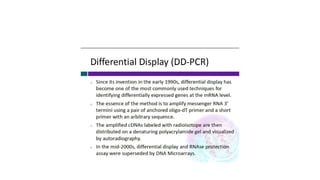
• Differential Display
• Northern/Southern Blotting
• RNAi (small RNA interference)
• Serial Analysis of Gene Expression (SAGE)
• Yeast two-hybrid analysis
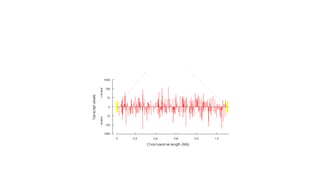
SAGE
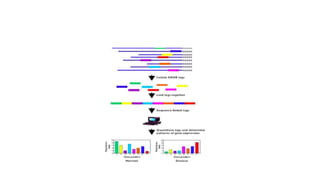
• A technique used to produce a snapshot of the messenger RNA
population in a sample of interest in the form of small tags that
corresponds to fragments of those transcripts, developed by Dr.
Victor Velculescu at the oncology Center of John Hopkins University
and published in 1995.
• Although SAGE was originally conceived for use in cancer studies, it
has been successfully used to describe the transcriptome of other
diseases and in a wide variety of organisms.
Proteomics Techniques
• Molecular techniques
• Separation techniques
• Protein identification techniques
• Protein structure techniques
Separation techniques
• 1D Slab Gel Electrophoresis
• 2D Gel Electrophoresis (SDS-PAGE/IEF)
• Capillary Electrophoresis
• Chromatography (HPLC, SEC,IEC,RP,Affinity,etc.)
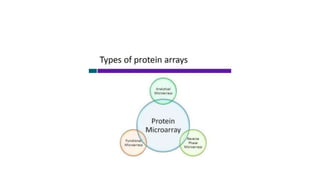
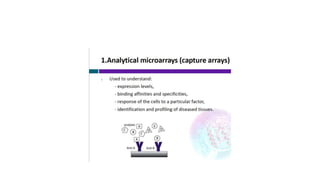
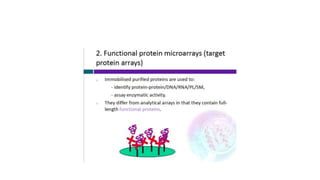
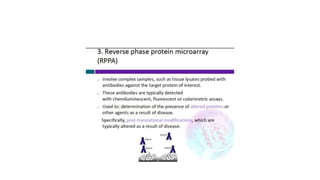
• Protein Chips (Protein microarray)
Protein array (protein chip)
• They are modeled after DNA microarrays, in 2000 at Harvard University.
• The success of DNA microarrays in large-scale genomic experiments
inspired researchers to develop similar technology to enable large-scale,
high-throughput proteomics experiments.
• Protein chips enable researchers to quickly and easily survey the entire
proteome of a cell within an organism.
• Applications include:
• Identifying biomarkers for diseases
• Investigating protein-protein interactions
• Testing for the presence of a protein (i.e. Ab) in a sample.
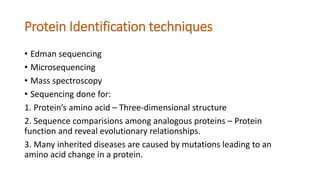
Protein Identification techniques
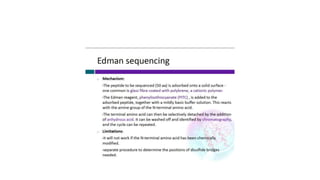
• Edman sequencing
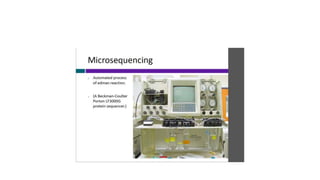
• Microsequencing
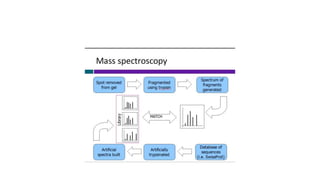
• Mass spectroscopy
• Sequencing done for:
1. Protein’s amino acid – Three-dimensional structure
2. Sequence comparisions among analogous proteins – Protein
function and reveal evolutionary relationships.
3. Many inherited diseases are caused by mutations leading to an
amino acid change in a protein.
Proteomics
Proteomics
Proteomics
Proteomics
Proteomics
Proteomics
Proteomics
Proteomics
Proteomics
Proteomics

Proteomics

  • 1.
    Proteomics – Toolsand Techniques Presented By: Dr. Shikha Thakur Assistant Professor Thakur College of Science and Commerce
  • 2.
    Introduction • Proteomics isthe study of the complete set of proteins expressed in an organism or under a particular condition. In other words Proteomics can be defined as the qualitative and quantitative comparision of proteomes under different conditions to further unravel biological processes. • The number of proteins expressed from DNA changes constantly as a result of altering conditions like eating, during sleep, as the result of an infection or other disease. Proteomics aim to understand the protein expression in response to such conditions.
  • 3.
    • Proteomics isa new fundamental concept called proteome (PROTE in complement to a genome) has recently emerged that should drastically help phenomics to unravel biochemical and physiological mechanisms of complex multivariate diseases at the functional molecular level.
  • 4.
  • 5.
    • Proteomics investigateson a large-scale the proteins expressed in a given organism or biological system. A top-down proteomic approach aims to identify characteristics of whole proteins, while bottom-up proteomics— also known as shotgun proteomics—uses a high throughput workflow to analyze complex mixtures containing hundreds to thousands of unique proteins. • Large amounts of proteomic data is increasingly being produced, often as a complement to genomic results. As proteins are the functional macromolecules directly driving cellular activity and physiology, proteomics offers significant biological insights not readily addressed by genomics and transcriptomics. These include studies in post-translational protein modifications, spatial and temporal protein localization, the biochemistry of metabolic pathways, protein interactions, and more.
  • 6.
    Tools in Proteomics •Cell lysis and extraction • Cell Fractionation • Protein concentration and Quantification • Protein digestion • Peptide cleanup and Mass spectometry
  • 7.
    Cell Lysis andExtraction • Cell lysis that precedes protein extraction can occur mechanically, through homogenizers or sonicators , or chemical solubilization via detergents and lysis buffers. While mechanical disruption offers an advantage of maintaining a relatively native chemical environment, reagents-based lysis via detergents or lysis buffers are generally more accommodating to smaller sample volumes and higher throughput processing. Ready-to-use protein extraction kits can offer a rapid, straightforward solution for lysing cells and subsequent protein collection.
  • 8.
    Cell Fractionation • Dependingon the aim of the study, complex samples, such as whole tissue and cell extracts, may require additional fractionation . This step can ensure enrichment of proteins enriched in subcellular locations, such as membrane proteins or nuclear proteins . Highly abundant proteins can also limit peptide identification during LC-MS analysis. • Further fractionation, through the use of centrifugation, chromatography or protein concentration kits , can help to account for the variations in protein amounts and to effectively capture lower abundance proteins.
  • 9.
    Protein Concentration andQuantification • Protocols leading up to protein digestion often specify a certain amount of necessary sample protein. Protein concentration kits are available when working with dilute or low-abundance protein samples. Such kits may serve to further cleanup the sample by desalting or buffer exchange. For protein quantification, a variety of protein assay kits may be used, but be careful to consider any detergent or buffer compatibilities.
  • 10.
    Protein Digestion • Togenerate peptides for mass spectrometric analysis, in-solution or in-gel digestion are the two common strategies. • With in-solution digestion, proteins can be denatured, digested, alkylated and reduced in a single tube, making this option ideal for less complex, detergent-sensitive, or low-volume samples. With in-gel digestion, protein electrophoresis (typically SDS-PAGE) is used to first separate and denature proteins, which are then digested while embedded in a gel slice. Gel-based digestion is widely used in LC- MS/MS analyses of complex samples. The choice of protease may vary depending on the nature of sample proteins, trypsin being the most common.
  • 11.
    Peptide Cleanup andMass Spectrometry • As detergents and other contaminants obscure mass spectrometry readings, peptides must be cleaned prior to analysis. The C18 reverse phase is the most commonly used liquid chromatography stationary phase resin for cleanup and can come in column, cartridge, or pipette tip formats. MALDI “Matrix Assisted Laser Desorption/Ionization." and ESI “Electro Spray ionization” are the two choice ionization methods leading up to MS and MS/MS analysis, with LC-ESI-MS/MS systems being favoured for complex samples. Mass spectrometry services that specialize in proteomic analyses are also available.
  • 12.
    Proteomics Techniques • Moleculartechniques • Separation techniques • Protein identification techniques • Protein Structure techniques
  • 13.
    Molecular techniques • DNAMicroarrays or Gene Chips • Differential Display • Northern/Southern Blotting • RNAi (small RNA interference) • Serial Analysis of Gene Expression (SAGE) • Yeast two-hybrid analysis
  • 14.
    SAGE • A techniqueused to produce a snapshot of the messenger RNA population in a sample of interest in the form of small tags that corresponds to fragments of those transcripts, developed by Dr. Victor Velculescu at the oncology Center of John Hopkins University and published in 1995. • Although SAGE was originally conceived for use in cancer studies, it has been successfully used to describe the transcriptome of other diseases and in a wide variety of organisms.
  • 18.
    Proteomics Techniques • Moleculartechniques • Separation techniques • Protein identification techniques • Protein structure techniques
  • 19.
    Separation techniques • 1DSlab Gel Electrophoresis • 2D Gel Electrophoresis (SDS-PAGE/IEF) • Capillary Electrophoresis • Chromatography (HPLC, SEC,IEC,RP,Affinity,etc.) • Protein Chips (Protein microarray)
  • 20.
    Protein array (proteinchip) • They are modeled after DNA microarrays, in 2000 at Harvard University. • The success of DNA microarrays in large-scale genomic experiments inspired researchers to develop similar technology to enable large-scale, high-throughput proteomics experiments. • Protein chips enable researchers to quickly and easily survey the entire proteome of a cell within an organism. • Applications include: • Identifying biomarkers for diseases • Investigating protein-protein interactions • Testing for the presence of a protein (i.e. Ab) in a sample.
  • 25.
    Protein Identification techniques •Edman sequencing • Microsequencing • Mass spectroscopy • Sequencing done for: 1. Protein’s amino acid – Three-dimensional structure 2. Sequence comparisions among analogous proteins – Protein function and reveal evolutionary relationships. 3. Many inherited diseases are caused by mutations leading to an amino acid change in a protein.