Introduction
to
Problem Analysis
Dr. Elijah Ezendu
FIMC, FCCM, FIIAN, FBDI, FAAFM, FSSM, MIMIS, MIAP, MITD, ACIArb, ACIPM,
PhD, DocM, MBA, CWM, CBDA, CMA, MPM, PME, CSOL, CCIP, CMC, CMgr
Learning Objectives
At the end of the course, participants should be
able to do the following:
• Identify importance of problem analysis
• Identify workable model for problem analysis
• Apply multiple techniques of problem analysis in
ascertainment of key causes
• Use problem analysis to increase effectiveness of
managerial capacity
Problem Analysis is used to find the cause of a
positive or negative deviation. When people,
machinery, systems, or processes are not
performing as expected, Problem Analysis
points to the relevant information and leads
the way to the root cause. The process is used
to gather and analyze just the information
needed to find and correct the true cause of a
problem, making it particularly effective in
today’s data-rich environment. This promotes
rapid and accurate issue resolution.
Source: Kepner-Tregoe
“Problem analysis can be defined as dissecting
and thoroughly studying a problem with the
objective to understand how the problem
emerged and how it grew to its current
proportions.”
- Coert Visser
“It is the theory through which we observe a
situation that decides what we can observe.”
- Einstein
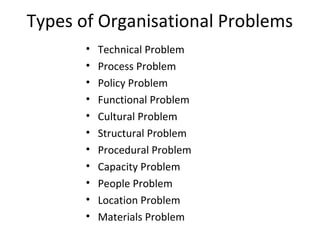
Types of Organisational Problems
• Technical Problem
• Process Problem
• Policy Problem
• Functional Problem
• Cultural Problem
• Structural Problem
• Procedural Problem
• Capacity Problem
• People Problem
• Location Problem
• Materials Problem
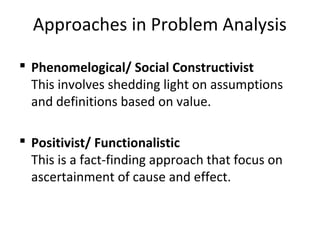
Approaches in Problem Analysis
 Phenomelogical/ Social Constructivist
This involves shedding light on assumptions
and definitions based on value.
 Positivist/ Functionalistic
This is a fact-finding approach that focus on
ascertainment of cause and effect.
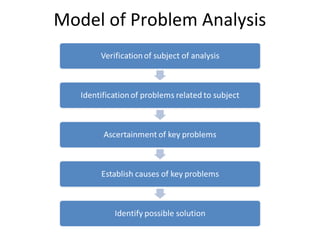
Model of Problem Analysis
Verifying Subject of Analysis
This should be performed by engaging the
stakeholders by means of the following:
• Interview
• Meeting
• Observation
Identification of Problems
Related to Subject
• Brainstorming
• Lateral thinking
• Mind mapping
• Structured inquisition
Major Techniques of Problem Analysis
Force Field Analysis
Fishbone Analysis
Cause and Effect Trail
Critical Incidence Analysis
Five Whys
Interrelationship Digraph
Force Field Analysis
Developed by Kurt Lewin.
It’s based on the concept of dynamic balance of
helping (driving) and hindering (restraining)
forces, emphasizing that problem will only
occur when there’s imbalance between them.
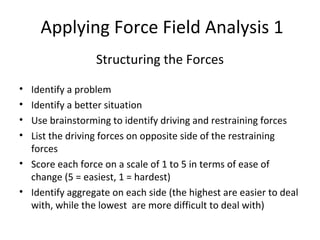
Applying Force Field Analysis 1
Structuring the Forces
• Identify a problem
• Identify a better situation
• Use brainstorming to identify driving and restraining forces
• List the driving forces on opposite side of the restraining
forces
• Score each force on a scale of 1 to 5 in terms of ease of
change (5 = easiest, 1 = hardest)
• Identify aggregate on each side (the highest are easier to deal
with, while the lowest are more difficult to deal with)
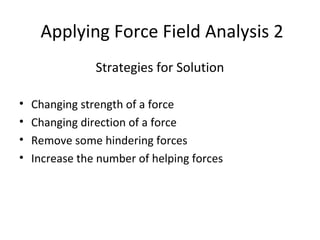
Applying Force Field Analysis 2
Strategies for Solution
• Changing strength of a force
• Changing direction of a force
• Remove some hindering forces
• Increase the number of helping forces
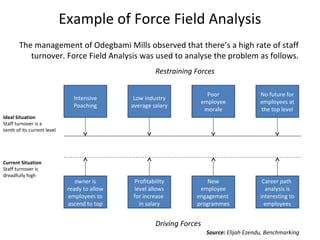
Example of Force Field Analysis
The management of Odegbami Mills observed that there’s a high rate of staff
turnover. Force Field Analysis was used to analyse the problem as follows.
Intensive
Poaching
Restraining Forces
Driving Forces
Low industry
average salary
Poor
employee
morale
No future for
employees at
the top level
owner is
ready to allow
employees to
ascend to top
Profitability
level allows
for increase
in salary
New
employee
engagement
programmes
Career path
analysis is
interesting to
employees
Ideal Situation
Staff turnover is a
tenth of its current level
Current Situation
Staff turnover is
dreadfully high
Source: Elijah Ezendu, Benchmarking
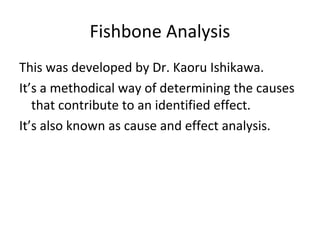
Fishbone Analysis
This was developed by Dr. Kaoru Ishikawa.
It’s a methodical way of determining the causes
that contribute to an identified effect.
It’s also known as cause and effect analysis.
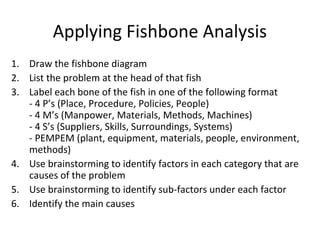
Applying Fishbone Analysis
1. Draw the fishbone diagram
2. List the problem at the head of that fish
3. Label each bone of the fish in one of the following format
- 4 P’s (Place, Procedure, Policies, People)
- 4 M’s (Manpower, Materials, Methods, Machines)
- 4 S’s (Suppliers, Skills, Surroundings, Systems)
- PEMPEM (plant, equipment, materials, people, environment,
methods)
4. Use brainstorming to identify factors in each category that are
causes of the problem
5. Use brainstorming to identify sub-factors under each factor
6. Identify the main causes
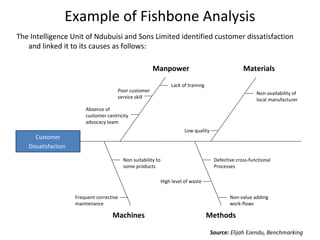
Example of Fishbone Analysis
The Intelligence Unit of Ndubuisi and Sons Limited identified customer dissatisfaction
and linked it to its causes as follows:
Customer
Dissatisfaction
Manpower Materials
Machines Methods
Poor customer
service skill
Lack of training
Absence of
customer-centricity
advocacy team
Low quality
Non-availability of
local manufacturer
Frequent corrective
maintenance
Non suitability to
some products
Defective cross-functional
Processes
High level of waste
Non-value adding
work-flows
Source: Elijah Ezendu, Benchmarking
Cause and Effect Trail
This is a diagram that shows the interrelated
causes of a problem and enables the
identification of the key cause.
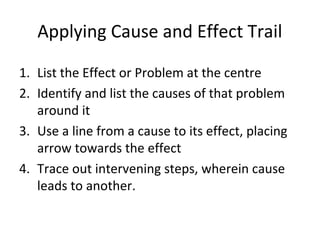
Applying Cause and Effect Trail
1. List the Effect or Problem at the centre
2. Identify and list the causes of that problem
around it
3. Use a line from a cause to its effect, placing
arrow towards the effect
4. Trace out intervening steps, wherein cause
leads to another.
Example of Cause and Effect Trail
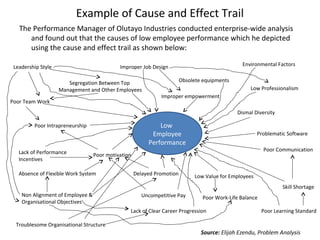
The Performance Manager of Olutayo Industries conducted enterprise-wide analysis
and found out that the causes of low employee performance which he depicted
using the cause and effect trail as shown below:
Low
Employee
Performance
Uncompetitive Pay
Lack of Performance
Incentives
Absence of Flexible Work System
Poor Team Work
Problematic Software
Skill Shortage
Poor Communication
Non Alignment of Employee &
Organisational Objectives
Improper Job Design
Poor Learning StandardLack of Clear Career Progression
Delayed Promotion
Environmental Factors
Dismal Diversity
Leadership Style
Poor Work-Life Balance
Low Professionalism
Low Value for Employees
Poor Intrapreneurship
Troublesome Organisational Structure
Poor motivation
Improper empowerment
Segregation Between Top
Management and Other Employees
Obsolete equipments
Source: Elijah Ezendu, Problem Analysis
Critical Incidence Analysis
This is a method of problem analysis through
identification of the total activities of a
problem by engagement of people from
various parts of a firm’s value chain.
Applying Critical Incidence Analysis
• Identify complete activity of a problem
• Appoint participants from various areas of the firm’s value
chain
• Place them in three or four groups
• Let each group state the key points about each process step,
noting the good and bad occurrences
• Then transfer the statement of each group to another, for
identification of log jams
• Collect the remarks of each group and compile to obtain the
final report of log jams.
• Identified log jams can be subjected to further analysis using
Five whys, Fishbone Analysis or Cause and Effect Trail
Five Whys
This problem analysis technique was developed
by Sakichi Toyoda for probing further and
further into an identified problem, so as to
trace the line of causality through diverse
levels of effects to the key cause.
Applying Five Whys
• Identify the problem
• Tender the first why
• Tender the second why, probing into the first
why
• Tender the third why, probing into the second
why
• Tender the fourth why, probing into the third
why
• Tender the fifth why, probing into the fourth why
• Ascertain the key cause
Interrelationship Digraph
This technique is used for tracing the
interrelated factors in complex problems, with
the aim of proving the relationships between
those factors.
Applying Interrelationship Digraph
• Identify the problem
• Place the problem at the centre
• Identify and list the causes of that problem around it
• Use a line from a cause to its effect, placing arrow towards
the effect
• Count the number of arrows heading into and out of each
factor
• Score each factor based on number of arrows heading
out/number of arrows heading into it
• The factor with the highest number of arrows heading out is
the key cause factor
Uses of Problem Analysis
Performance Reengineering
Decision-Making
Operation Management
Benchmarking
Value Based Management
Competitive Intelligence
Case Study
The management of John Codeliza International
observed discrepancies in employee morale
within the past 3 years. Due to its knack to
remain at the top of competitive web in
Nigeria, it demanded a repositioning of
employee morale to be in convergence with
the corporate brand profile. As a result, you
were required to conduct a wide spectrum
problem analysis in order to identify all the
key causes of the dip in employee morale.
Dr Elijah Ezendu is Award-Winning Business Expert & Certified Management Consultant with expertise
in Interim Management, Strategy, Competitive Intelligence, Transformation, Restructuring, Turnaround
Management, Business Development, Marketing, Project & Cost Management, Leadership, HR, CSR, e-
Business & Software Architecture. He had functioned as Founder, Initiative for Sustainable Business
Equity; Chairman of Board, Charisma Broadcast Film Academy; Group Chief Operating Officer, Idova
Group; CEO, Rubiini (UAE); Special Advisor, RTEAN; Director, MMNA Investments; Chair, Int’l Board of
GCC Business Council (UAE); Senior Partner, Shevach Consulting; Chairman (Certification & Training),
Coordinator (Board of Fellows), Lead Assessor & Governing Council Member, Institute of Management
Consultants, Nigeria; Lead Resource, Centre for Competitive Intelligence Development; Lead
Consultant/ Partner, JK Michaels; Turnaround Project Director, Consolidated Business Holdings Limited;
Technical Director, Gestalt; Chief Operating Officer, Rohan Group; Executive Director (Various Roles),
Fortuna, Gambia & Malta; Chief Advisor/ Partner, D & E; Vice Chairman of Board, Refined Shipping;
Director of Programmes & Governing Council Member, Institute of Business Development, Nigeria;
Member of TDD Committee, International Association of Software Architects, USA; Member of Strategic
Planning and Implementation Committee, Chartered Institute of Personnel Management of Nigeria;
Country Manager (Nigeria) & Adjunct Faculty (MBA Programme), Regent Business School, South Africa;
Adjunct Faculty (MBA Programme), Ladoke Akintola University of Technology; Editor-in-Chief, Cost
Management Journal; Council Member, Institute of Internal Auditors of Nigeria; Member, Board of
Directors (Several Organizations). He holds Doctoral Degree in Management, Master of Business
Administration and Fellow of Professional Institutes in North America, UK & Nigeria. He is Innovator of
Corporate Investment Structure Based on Financials and Intangibles, for valuation highlighting
intangible contributions of host communities and ecological environment: A model celebrated globally
as remedy for unmitigated depreciation of ecological capital and developmental deprivation of host
communities. He had served as Examiner to Professional Institutes and Universities. He had been a
member of Guild of Soundtrack Producers of Nigeria. He's an author and extensively featured speaker.
Thank You

Introduction To Problem Analysis

  • 1.
    Introduction to Problem Analysis Dr. ElijahEzendu FIMC, FCCM, FIIAN, FBDI, FAAFM, FSSM, MIMIS, MIAP, MITD, ACIArb, ACIPM, PhD, DocM, MBA, CWM, CBDA, CMA, MPM, PME, CSOL, CCIP, CMC, CMgr
  • 2.
    Learning Objectives At theend of the course, participants should be able to do the following: • Identify importance of problem analysis • Identify workable model for problem analysis • Apply multiple techniques of problem analysis in ascertainment of key causes • Use problem analysis to increase effectiveness of managerial capacity
  • 3.
    Problem Analysis isused to find the cause of a positive or negative deviation. When people, machinery, systems, or processes are not performing as expected, Problem Analysis points to the relevant information and leads the way to the root cause. The process is used to gather and analyze just the information needed to find and correct the true cause of a problem, making it particularly effective in today’s data-rich environment. This promotes rapid and accurate issue resolution. Source: Kepner-Tregoe
  • 4.
    “Problem analysis canbe defined as dissecting and thoroughly studying a problem with the objective to understand how the problem emerged and how it grew to its current proportions.” - Coert Visser
  • 5.
    “It is thetheory through which we observe a situation that decides what we can observe.” - Einstein
  • 6.
    Types of OrganisationalProblems • Technical Problem • Process Problem • Policy Problem • Functional Problem • Cultural Problem • Structural Problem • Procedural Problem • Capacity Problem • People Problem • Location Problem • Materials Problem
  • 7.
    Approaches in ProblemAnalysis  Phenomelogical/ Social Constructivist This involves shedding light on assumptions and definitions based on value.  Positivist/ Functionalistic This is a fact-finding approach that focus on ascertainment of cause and effect.
  • 8.
  • 9.
    Verifying Subject ofAnalysis This should be performed by engaging the stakeholders by means of the following: • Interview • Meeting • Observation
  • 10.
    Identification of Problems Relatedto Subject • Brainstorming • Lateral thinking • Mind mapping • Structured inquisition
  • 11.
    Major Techniques ofProblem Analysis Force Field Analysis Fishbone Analysis Cause and Effect Trail Critical Incidence Analysis Five Whys Interrelationship Digraph
  • 12.
    Force Field Analysis Developedby Kurt Lewin. It’s based on the concept of dynamic balance of helping (driving) and hindering (restraining) forces, emphasizing that problem will only occur when there’s imbalance between them.
  • 13.
    Applying Force FieldAnalysis 1 Structuring the Forces • Identify a problem • Identify a better situation • Use brainstorming to identify driving and restraining forces • List the driving forces on opposite side of the restraining forces • Score each force on a scale of 1 to 5 in terms of ease of change (5 = easiest, 1 = hardest) • Identify aggregate on each side (the highest are easier to deal with, while the lowest are more difficult to deal with)
  • 14.
    Applying Force FieldAnalysis 2 Strategies for Solution • Changing strength of a force • Changing direction of a force • Remove some hindering forces • Increase the number of helping forces
  • 15.
    Example of ForceField Analysis The management of Odegbami Mills observed that there’s a high rate of staff turnover. Force Field Analysis was used to analyse the problem as follows. Intensive Poaching Restraining Forces Driving Forces Low industry average salary Poor employee morale No future for employees at the top level owner is ready to allow employees to ascend to top Profitability level allows for increase in salary New employee engagement programmes Career path analysis is interesting to employees Ideal Situation Staff turnover is a tenth of its current level Current Situation Staff turnover is dreadfully high Source: Elijah Ezendu, Benchmarking
  • 16.
    Fishbone Analysis This wasdeveloped by Dr. Kaoru Ishikawa. It’s a methodical way of determining the causes that contribute to an identified effect. It’s also known as cause and effect analysis.
  • 17.
    Applying Fishbone Analysis 1.Draw the fishbone diagram 2. List the problem at the head of that fish 3. Label each bone of the fish in one of the following format - 4 P’s (Place, Procedure, Policies, People) - 4 M’s (Manpower, Materials, Methods, Machines) - 4 S’s (Suppliers, Skills, Surroundings, Systems) - PEMPEM (plant, equipment, materials, people, environment, methods) 4. Use brainstorming to identify factors in each category that are causes of the problem 5. Use brainstorming to identify sub-factors under each factor 6. Identify the main causes
  • 18.
    Example of FishboneAnalysis The Intelligence Unit of Ndubuisi and Sons Limited identified customer dissatisfaction and linked it to its causes as follows: Customer Dissatisfaction Manpower Materials Machines Methods Poor customer service skill Lack of training Absence of customer-centricity advocacy team Low quality Non-availability of local manufacturer Frequent corrective maintenance Non suitability to some products Defective cross-functional Processes High level of waste Non-value adding work-flows Source: Elijah Ezendu, Benchmarking
  • 19.
    Cause and EffectTrail This is a diagram that shows the interrelated causes of a problem and enables the identification of the key cause.
  • 20.
    Applying Cause andEffect Trail 1. List the Effect or Problem at the centre 2. Identify and list the causes of that problem around it 3. Use a line from a cause to its effect, placing arrow towards the effect 4. Trace out intervening steps, wherein cause leads to another.
  • 21.
    Example of Causeand Effect Trail The Performance Manager of Olutayo Industries conducted enterprise-wide analysis and found out that the causes of low employee performance which he depicted using the cause and effect trail as shown below: Low Employee Performance Uncompetitive Pay Lack of Performance Incentives Absence of Flexible Work System Poor Team Work Problematic Software Skill Shortage Poor Communication Non Alignment of Employee & Organisational Objectives Improper Job Design Poor Learning StandardLack of Clear Career Progression Delayed Promotion Environmental Factors Dismal Diversity Leadership Style Poor Work-Life Balance Low Professionalism Low Value for Employees Poor Intrapreneurship Troublesome Organisational Structure Poor motivation Improper empowerment Segregation Between Top Management and Other Employees Obsolete equipments Source: Elijah Ezendu, Problem Analysis
  • 22.
    Critical Incidence Analysis Thisis a method of problem analysis through identification of the total activities of a problem by engagement of people from various parts of a firm’s value chain.
  • 23.
    Applying Critical IncidenceAnalysis • Identify complete activity of a problem • Appoint participants from various areas of the firm’s value chain • Place them in three or four groups • Let each group state the key points about each process step, noting the good and bad occurrences • Then transfer the statement of each group to another, for identification of log jams • Collect the remarks of each group and compile to obtain the final report of log jams. • Identified log jams can be subjected to further analysis using Five whys, Fishbone Analysis or Cause and Effect Trail
  • 24.
    Five Whys This problemanalysis technique was developed by Sakichi Toyoda for probing further and further into an identified problem, so as to trace the line of causality through diverse levels of effects to the key cause.
  • 25.
    Applying Five Whys •Identify the problem • Tender the first why • Tender the second why, probing into the first why • Tender the third why, probing into the second why • Tender the fourth why, probing into the third why • Tender the fifth why, probing into the fourth why • Ascertain the key cause
  • 26.
    Interrelationship Digraph This techniqueis used for tracing the interrelated factors in complex problems, with the aim of proving the relationships between those factors.
  • 27.
    Applying Interrelationship Digraph •Identify the problem • Place the problem at the centre • Identify and list the causes of that problem around it • Use a line from a cause to its effect, placing arrow towards the effect • Count the number of arrows heading into and out of each factor • Score each factor based on number of arrows heading out/number of arrows heading into it • The factor with the highest number of arrows heading out is the key cause factor
  • 28.
    Uses of ProblemAnalysis Performance Reengineering Decision-Making Operation Management Benchmarking Value Based Management Competitive Intelligence
  • 29.
    Case Study The managementof John Codeliza International observed discrepancies in employee morale within the past 3 years. Due to its knack to remain at the top of competitive web in Nigeria, it demanded a repositioning of employee morale to be in convergence with the corporate brand profile. As a result, you were required to conduct a wide spectrum problem analysis in order to identify all the key causes of the dip in employee morale.
  • 30.
    Dr Elijah Ezenduis Award-Winning Business Expert & Certified Management Consultant with expertise in Interim Management, Strategy, Competitive Intelligence, Transformation, Restructuring, Turnaround Management, Business Development, Marketing, Project & Cost Management, Leadership, HR, CSR, e- Business & Software Architecture. He had functioned as Founder, Initiative for Sustainable Business Equity; Chairman of Board, Charisma Broadcast Film Academy; Group Chief Operating Officer, Idova Group; CEO, Rubiini (UAE); Special Advisor, RTEAN; Director, MMNA Investments; Chair, Int’l Board of GCC Business Council (UAE); Senior Partner, Shevach Consulting; Chairman (Certification & Training), Coordinator (Board of Fellows), Lead Assessor & Governing Council Member, Institute of Management Consultants, Nigeria; Lead Resource, Centre for Competitive Intelligence Development; Lead Consultant/ Partner, JK Michaels; Turnaround Project Director, Consolidated Business Holdings Limited; Technical Director, Gestalt; Chief Operating Officer, Rohan Group; Executive Director (Various Roles), Fortuna, Gambia & Malta; Chief Advisor/ Partner, D & E; Vice Chairman of Board, Refined Shipping; Director of Programmes & Governing Council Member, Institute of Business Development, Nigeria; Member of TDD Committee, International Association of Software Architects, USA; Member of Strategic Planning and Implementation Committee, Chartered Institute of Personnel Management of Nigeria; Country Manager (Nigeria) & Adjunct Faculty (MBA Programme), Regent Business School, South Africa; Adjunct Faculty (MBA Programme), Ladoke Akintola University of Technology; Editor-in-Chief, Cost Management Journal; Council Member, Institute of Internal Auditors of Nigeria; Member, Board of Directors (Several Organizations). He holds Doctoral Degree in Management, Master of Business Administration and Fellow of Professional Institutes in North America, UK & Nigeria. He is Innovator of Corporate Investment Structure Based on Financials and Intangibles, for valuation highlighting intangible contributions of host communities and ecological environment: A model celebrated globally as remedy for unmitigated depreciation of ecological capital and developmental deprivation of host communities. He had served as Examiner to Professional Institutes and Universities. He had been a member of Guild of Soundtrack Producers of Nigeria. He's an author and extensively featured speaker.
  • 31.