Project Risk
Management
+
Risk analysis is a systematic process to estimate the
level of risk for identified and approved risks. This
involves estimating the probability of occurrence
and consequence of occurrence and converting the
results to a corresponding risk.
The approach used depends upon the data available
and requirements levied on the project level.
Risk analyses are often based on detailed information
that may come from a variety of techniques, including
but not limited to:
Analysis of plans and related documents
Experience and interviewing
Relevant lessons-learned studies
Results from tests
…cont’d
There are two methods of risk analysis
Qualitative approach and
Quantitative approaches
Qualitative approach use the probability of occurrence and
consequence of occurrence scales together with a risk mapping
matrix to convert the values to risk levels.
When a qualitative risk analysis is performed, risk ratings can
be used as an indication of the potential importance of risks on
the program and often expressed as low, medium, and high (or
possibly low, medium low, medium, medium high, and high).
Quantitative approaches use the technique such as expected
value ,decision tree analysis, payoff matrices, and modeling
and simulation.
Project problems can be reduced as much
as 90% by using risk analysis
Positives:
More info available during planning
Improved probability of success/optimum
project
Negatives:
Project cut due to risk level
Risks have been thoroughly examined and included in project
plans, resulting in risk reduction. Information about possible risks
is available throughout the project, resulting in a better decision-
making process
Project objectives might be affected by certain risks, allowing the
objectives to be improved
Many of the project weaknesses have been identified in advance
and are incorporated into the project plan.
Decrease the number of changes made to the project plan during
project execution, resulting in higher chances of project success
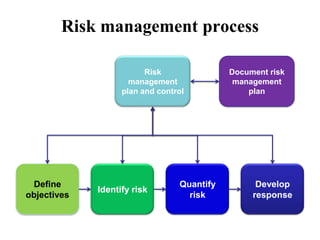
Risk Management Process
Risk
management
plan and control
Document risk
management
plan
Define
objectives
Identify risk
Quantify
risk
Develop
response
Benefits of Risk Assessment
 Protects project investments
 Proactive management – early warning
 Achieve project objectives
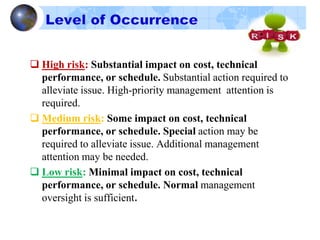
 High Risk: Substantial impact on cost, technical
performance, or schedule. Substantial action required to
alleviate issue. High-priority management attention is
required.
 Medium Risk: Some impact on cost, technical
performance, or schedule. Special action may be required
to alleviate issue. Additional management attention may be
needed.
 Low Risk: Minimal impact on cost, technical
performance, or schedule. Normal management oversight
is sufficient.
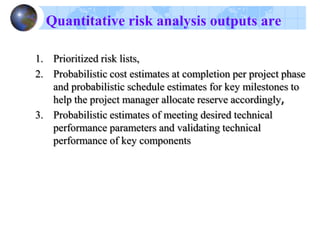
Quantitative risk analysis outputs are
1. Prioritized risk lists,
2. Probabilistic cost estimates at completion per project phase
and probabilistic schedule estimates for key milestones to
help the project manager allocate reserve accordingly,
3. Probabilistic estimates of meeting desired technical
performance parameters and validating technical
performance of key components
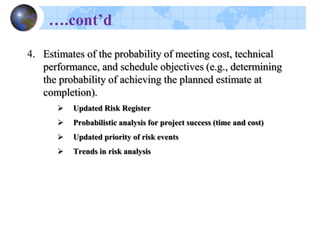
4. Estimates of the probability of meeting cost, technical
performance, and schedule objectives (e.g., determining the
probability of achieving the planned estimate at completion)
 Updated Risk Register
 Probabilistic analysis for project success (time and cost)
 Updated priority of risk events
 Trends in risk analysis
….cont’d
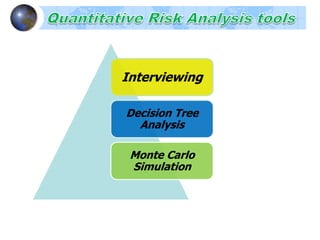
Interviewing
Decision Tree
Analysis
Monte Carlo
Simulation
The Monte Carlo process is an attempt to create a series of
probability distributions for potential risks, randomly sample the
distributions, and transform the numbers into useful information
that reflects quantification of the associated cost, technical
performance or schedule risks.
 Monte Carlo simulations used to
Estimate risk in the design of service centers;
Measure time to complete key milestones in a project;
Estimate the cost of developing, fabricating, & maintaining
an item.
Uses of Monte Carlo simulation
 A common method/tool to determine whether a risk
is considered low, moderate, or high by combining
the two dimensions of a risk:
 its probability of occurrence, and
 its impact on objectives if it occurs.
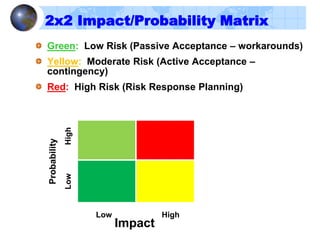
2x2 Impact/Probability Matrix
Green: Low Risk (Passive Acceptance – workarounds)
Yellow: Moderate Risk (Active Acceptance –
contingency)
Red: High Risk (Risk Response Planning)
Impact
Probability
HighLow
Low High
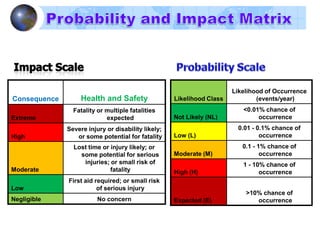
Likelihood Class
Likelihood of Occurrence
(events/year)
Not Likely (NL)
<0.01% chance of
occurrence
Low (L)
0.01 - 0.1% chance of
occurrence
Moderate (M)
0.1 - 1% chance of
occurrence
High (H)
1 - 10% chance of
occurrence
Expected (E)
>10% chance of
occurrence
Consequen
ce Health and Safety
Extreme
Fatality or multiple fatalities
expected
High
Severe injury or disability likely;
or some potential for fatality
Moderate
Lost time or injury likely; or
some potential for serious
injuries; or small risk of
fatality
Low
First aid required; or small risk
of serious injury
Negligible No concern
 The process of numerically analyzing the
effect of identified risks on the project’s
objectives In particular, the project schedule
and the project costs.
 Quantify possible outcomes for the project
 Assess probability of achieving specific project
objectives
 Identify risks requiring most attention
 Identify realistic and achievable cost, schedule,
or scope targets, given project risks
 Determine best management decision when
conditions or outcomes are uncertain
 Risks during the Project/idea Initiation phase:
–Unavailable subject matter experts
–Poor definition of problem or project
–No feasibility study
–No or unclear objectives
Taking….cont’d
 Risks during the Project Planning phase:
No risk management plan
Spotty planning
Underdeveloped requirements and
specifications
Unclear statement of work
No management or stakeholder support
Poor role definition
Inexperienced team
Lack of skills
 Risks during the Project Execution phase
 Changes in schedule
 No control systems in place
 Unskilled labour
 Material availability or poor quality material
 Unreliable suppliers
 Unexpected price increase (not budget for it)
 Strikes
 Weather
 Regulatory requirements
….cont’d
Risks during the Project Close-out /
termination phase:
Unacceptable to customer
Poor quality product/project
Budget problems
Penalties to be paid for exceeding the time
parameter of the project
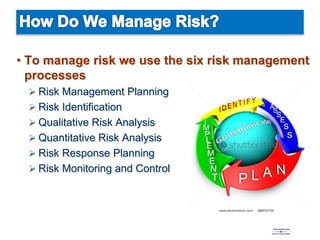
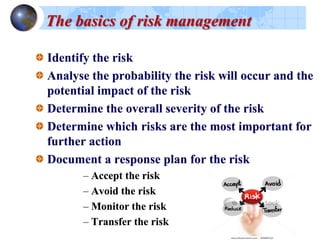
The basics of risk management
Identify the risk
Analyse the probability the risk will occur and the
potential impact of the risk
Determine the overall severity of the risk
Determine which risks are the most important for
further action
Document a response plan for the risk
– Accept the risk
– Avoid the risk
– Monitor the risk
– Transfer the risk
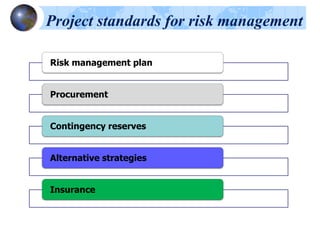
Project standards for risk management
Risk Management Plan
Procurement
Contingency Reserves
Alternative Strategies
Insurance
Management Reserves
◦ Created for unpredictable risks
Contingency Reserves
◦ Created for predictable risks
 Approaches used for developing contingency allowances:
Budgeting a standard allowance for contingencies and applying it to
all projects.
Identifying a percentage of additional cost or time needed, based on
past experience.
Pinpointing the most likely risks for a project, assessing the
probability that they will occur, identifying the possible
consequences, and then allotting contingencies based on these
results.
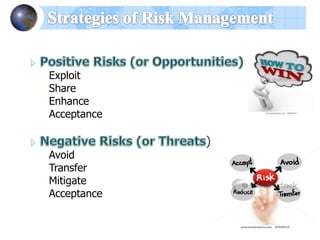
◦ Exploit
◦ Share
◦ Enhance
◦ Acceptance
)
◦ Avoid
◦ Transfer
◦ Mitigate
◦ Acceptance
Questions the project team should
ask when determining a risk:-
Why should the risk be accepted?
What are the potential benefits?
Are the potential benefits worth the
risk?
What are the potential losses?
What is the possibility of failure?

Project Risk Management

  • 1.
  • 2.
    + Risk analysis isa systematic process to estimate the level of risk for identified and approved risks. This involves estimating the probability of occurrence and consequence of occurrence and converting the results to a corresponding risk. The approach used depends upon the data available and requirements levied on the project level.
  • 3.
    Risk analyses areoften based on detailed information that may come from a variety of techniques, including but not limited to: Analysis of plans and related documents Experience and interviewing Relevant lessons-learned studies Results from tests
  • 4.
    …cont’d There are twomethods of risk analysis Qualitative approach and Quantitative approaches Qualitative approach use the probability of occurrence and consequence of occurrence scales together with a risk mapping matrix to convert the values to risk levels. When a qualitative risk analysis is performed, risk ratings can be used as an indication of the potential importance of risks on the program and often expressed as low, medium, and high (or possibly low, medium low, medium, medium high, and high). Quantitative approaches use the technique such as expected value ,decision tree analysis, payoff matrices, and modeling and simulation.
  • 5.
    Project problems canbe reduced as much as 90% by using risk analysis Positives: More info available during planning Improved probability of success/optimum project Negatives: Project cut due to risk level
  • 6.
    Risks have beenthoroughly examined and included in project plans, resulting in risk reduction. Information about possible risks is available throughout the project, resulting in a better decision- making process Project objectives might be affected by certain risks, allowing the objectives to be improved Many of the project weaknesses have been identified in advance and are incorporated into the project plan. Decrease the number of changes made to the project plan during project execution, resulting in higher chances of project success
  • 7.
    Risk Management Process Risk management planand control Document risk management plan Define objectives Identify risk Quantify risk Develop response
  • 8.
    Benefits of RiskAssessment  Protects project investments  Proactive management – early warning  Achieve project objectives
  • 9.
     High Risk:Substantial impact on cost, technical performance, or schedule. Substantial action required to alleviate issue. High-priority management attention is required.  Medium Risk: Some impact on cost, technical performance, or schedule. Special action may be required to alleviate issue. Additional management attention may be needed.  Low Risk: Minimal impact on cost, technical performance, or schedule. Normal management oversight is sufficient.
  • 10.
    Quantitative risk analysisoutputs are 1. Prioritized risk lists, 2. Probabilistic cost estimates at completion per project phase and probabilistic schedule estimates for key milestones to help the project manager allocate reserve accordingly, 3. Probabilistic estimates of meeting desired technical performance parameters and validating technical performance of key components
  • 11.
    4. Estimates ofthe probability of meeting cost, technical performance, and schedule objectives (e.g., determining the probability of achieving the planned estimate at completion)  Updated Risk Register  Probabilistic analysis for project success (time and cost)  Updated priority of risk events  Trends in risk analysis ….cont’d
  • 12.
  • 13.
    The Monte Carloprocess is an attempt to create a series of probability distributions for potential risks, randomly sample the distributions, and transform the numbers into useful information that reflects quantification of the associated cost, technical performance or schedule risks.
  • 15.
     Monte Carlosimulations used to Estimate risk in the design of service centers; Measure time to complete key milestones in a project; Estimate the cost of developing, fabricating, & maintaining an item. Uses of Monte Carlo simulation
  • 16.
     A commonmethod/tool to determine whether a risk is considered low, moderate, or high by combining the two dimensions of a risk:  its probability of occurrence, and  its impact on objectives if it occurs.
  • 17.
    2x2 Impact/Probability Matrix Green:Low Risk (Passive Acceptance – workarounds) Yellow: Moderate Risk (Active Acceptance – contingency) Red: High Risk (Risk Response Planning) Impact Probability HighLow Low High
  • 18.
    Likelihood Class Likelihood ofOccurrence (events/year) Not Likely (NL) <0.01% chance of occurrence Low (L) 0.01 - 0.1% chance of occurrence Moderate (M) 0.1 - 1% chance of occurrence High (H) 1 - 10% chance of occurrence Expected (E) >10% chance of occurrence Consequen ce Health and Safety Extreme Fatality or multiple fatalities expected High Severe injury or disability likely; or some potential for fatality Moderate Lost time or injury likely; or some potential for serious injuries; or small risk of fatality Low First aid required; or small risk of serious injury Negligible No concern
  • 19.
     The processof numerically analyzing the effect of identified risks on the project’s objectives In particular, the project schedule and the project costs.
  • 20.
     Quantify possibleoutcomes for the project  Assess probability of achieving specific project objectives  Identify risks requiring most attention  Identify realistic and achievable cost, schedule, or scope targets, given project risks  Determine best management decision when conditions or outcomes are uncertain
  • 21.
     Risks duringthe Project/idea Initiation phase: –Unavailable subject matter experts –Poor definition of problem or project –No feasibility study –No or unclear objectives
  • 22.
    Taking….cont’d  Risks duringthe Project Planning phase: No risk management plan Spotty planning Underdeveloped requirements and specifications Unclear statement of work No management or stakeholder support Poor role definition Inexperienced team Lack of skills
  • 23.
     Risks duringthe Project Execution phase  Changes in schedule  No control systems in place  Unskilled labour  Material availability or poor quality material  Unreliable suppliers  Unexpected price increase (not budget for it)  Strikes  Weather  Regulatory requirements
  • 24.
    ….cont’d Risks during theProject Close-out / termination phase: Unacceptable to customer Poor quality product/project Budget problems Penalties to be paid for exceeding the time parameter of the project
  • 25.
    The basics ofrisk management Identify the risk Analyse the probability the risk will occur and the potential impact of the risk Determine the overall severity of the risk Determine which risks are the most important for further action Document a response plan for the risk – Accept the risk – Avoid the risk – Monitor the risk – Transfer the risk
  • 26.
    Project standards forrisk management Risk Management Plan Procurement Contingency Reserves Alternative Strategies Insurance
  • 27.
    Management Reserves ◦ Createdfor unpredictable risks Contingency Reserves ◦ Created for predictable risks  Approaches used for developing contingency allowances: Budgeting a standard allowance for contingencies and applying it to all projects. Identifying a percentage of additional cost or time needed, based on past experience. Pinpointing the most likely risks for a project, assessing the probability that they will occur, identifying the possible consequences, and then allotting contingencies based on these results.
  • 28.
    ◦ Exploit ◦ Share ◦Enhance ◦ Acceptance ) ◦ Avoid ◦ Transfer ◦ Mitigate ◦ Acceptance
  • 29.
    Questions the projectteam should ask when determining a risk:- Why should the risk be accepted? What are the potential benefits? Are the potential benefits worth the risk? What are the potential losses? What is the possibility of failure?