Pareto analysis

      Submitted to
   Prof. Garima Gupta


                        By:
                        Amey P.Shetti
                        G06172
                        NICMAR-GOA
History


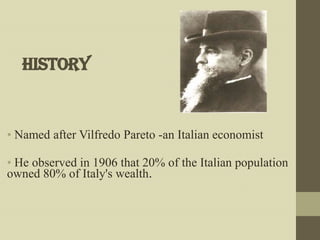
• Named after Vilfredo Pareto -an Italian economist

• He observed in 1906 that 20% of the Italian population
owned 80% of Italy's wealth.
What is it?
• One of the 7 tools of Quality Management

• Statistical technique in decision making for
  selection of limited tasks which have significant
  overall impact
Pareto Principle
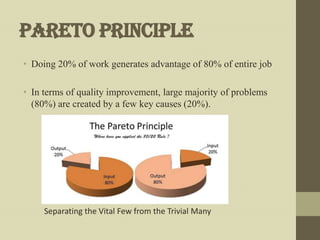
• Doing 20% of work generates advantage of 80% of entire job

• In terms of quality improvement, large majority of problems
  (80%) are created by a few key causes (20%).


     Separating the Vital Few from the Trivial Many
“pareto Chart”

• A Pareto Chart is a series of bars whose heights reflect
the frequency or impact of problems.

• The bars are arranged in descending order of height
from left to right.

•Bars on left are relatively more important than the bars
on the right

•Separates the vital from the trivial
how is “pareto Chart” ConstruCted ?

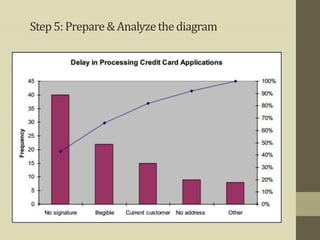
For example, if a business was investigating the delay
associated with processing credit card applications, the
data could be grouped into the following categories:
no signature, residential address not valid, non-legible
handwriting, already a customer, and other.
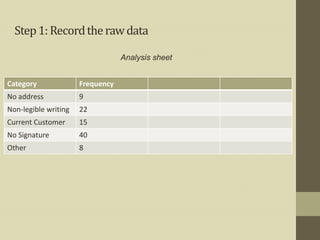
Step 1: Record the raw data

                                  Analysis sheet


Category              Frequency
No address            9
Non-legible writing   22
Current Customer      15
No Signature          40
Other                 8
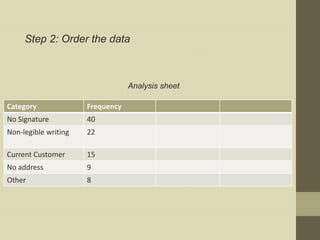
Step 2: Order the data


                                  Analysis sheet

Category              Frequency
No Signature          40
Non-legible writing   22

Current Customer      15
No address            9
Other                 8
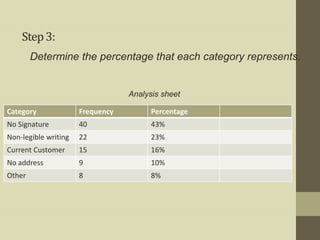
Step 3:
        Determine the percentage that each category represents.


                                  Analysis sheet

Category              Frequency         Percentage
No Signature          40                43%
Non-legible writing   22                23%
Current Customer      15                16%
No address            9                 10%
Other                 8                 8%
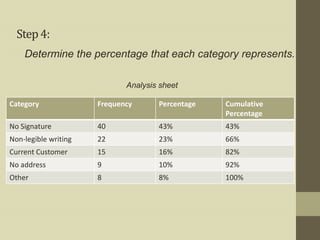
Step 4:
    Determine the percentage that each category represents.

                             Analysis sheet

Category              Frequency      Percentage   Cumulative
                                                  Percentage
No Signature          40             43%          43%
Non-legible writing   22             23%          66%
Current Customer      15             16%          82%
No address            9              10%          92%
Other                 8              8%           100%
Step 5: Prepare & Analyze the diagram
the Pareto Principle in Work-Life


• Problem Solving
• To-Do List of the day
• Passion
• Relationship
• Cut the Clutter
Problem Solving

• Pareto Analysis can really help in identifying the
  most critical problem to solve as well as the level
  of criticality.

• Identify and list problems and their causes.
To-Do List of the day

• Estimate a value % in terms of goal achievement or
  satisfaction against each of your tasks for the day –
  email, customer calls, reports, specific tasks.

• What 20% of the tasks listed contribute to 80% of the
  goals you seek to achieve?

• Concentrate on these tasks first in your most
  productive period of the day.
Passion
• certain “activities” account for the greatest amount of
  happiness and satisfaction. These activities are the ones that
  we feel most passionately about.

• Once you have identified your passions, be very careful of
  the time spent on those 80% activities that produce little
  satisfaction for you.

• No one really benefits if you are not happy or passionate
  about what you are doing.

• Apply Pareto to not only find your passions but also pursue
  them by comparing the results against the efforts you need to
  put in.
Relationships
• 20% of the people you know give you 80% of
your joy and support.

• Observe your friends, office colleagues and social
circle.

•Compare that to the amount of stress or joy you are
getting in return.
Cut the Clutter

• Most people only use 20% of what they own on a regular basis.

• A good part of the other 80% is things we used in the past or we
think we may use in the future.

• This basically means that about 80% of our possessions just sit
around every day, doing nothing more than gathering dust or
occupying space.

• Take a look at your desk, cupboard, files on your computer – if
you have not used something in the past year, it is highly unlikely
you will ever use it. Lighten your load – throw, delete, donate that
80%.
Conclusion
• Breaks a big problem down into smaller pieces

• Identifies the most significant factors

• Shows where to focus efforts & allows better use of limited
resources.

• Helps to separate the few major problems from the many
possible problems.
Pareto Analysis

Pareto Analysis

  • 1.
    Pareto analysis Submitted to Prof. Garima Gupta By: Amey P.Shetti G06172 NICMAR-GOA
  • 2.
    History • Named afterVilfredo Pareto -an Italian economist • He observed in 1906 that 20% of the Italian population owned 80% of Italy's wealth.
  • 3.
    What is it? •One of the 7 tools of Quality Management • Statistical technique in decision making for selection of limited tasks which have significant overall impact
  • 4.
    Pareto Principle • Doing20% of work generates advantage of 80% of entire job • In terms of quality improvement, large majority of problems (80%) are created by a few key causes (20%). Separating the Vital Few from the Trivial Many
  • 5.
    “pareto Chart” • APareto Chart is a series of bars whose heights reflect the frequency or impact of problems. • The bars are arranged in descending order of height from left to right. •Bars on left are relatively more important than the bars on the right •Separates the vital from the trivial
  • 7.
    how is “paretoChart” ConstruCted ? For example, if a business was investigating the delay associated with processing credit card applications, the data could be grouped into the following categories: no signature, residential address not valid, non-legible handwriting, already a customer, and other.
  • 8.
    Step 1: Recordthe raw data Analysis sheet Category Frequency No address 9 Non-legible writing 22 Current Customer 15 No Signature 40 Other 8
  • 9.
    Step 2: Orderthe data Analysis sheet Category Frequency No Signature 40 Non-legible writing 22 Current Customer 15 No address 9 Other 8
  • 10.
    Step 3: Determine the percentage that each category represents. Analysis sheet Category Frequency Percentage No Signature 40 43% Non-legible writing 22 23% Current Customer 15 16% No address 9 10% Other 8 8%
  • 11.
    Step 4: Determine the percentage that each category represents. Analysis sheet Category Frequency Percentage Cumulative Percentage No Signature 40 43% 43% Non-legible writing 22 23% 66% Current Customer 15 16% 82% No address 9 10% 92% Other 8 8% 100%
  • 12.
    Step 5: Prepare& Analyze the diagram
  • 13.
    the Pareto Principlein Work-Life • Problem Solving • To-Do List of the day • Passion • Relationship • Cut the Clutter
  • 14.
    Problem Solving • ParetoAnalysis can really help in identifying the most critical problem to solve as well as the level of criticality. • Identify and list problems and their causes.
  • 15.
    To-Do List ofthe day • Estimate a value % in terms of goal achievement or satisfaction against each of your tasks for the day – email, customer calls, reports, specific tasks. • What 20% of the tasks listed contribute to 80% of the goals you seek to achieve? • Concentrate on these tasks first in your most productive period of the day.
  • 16.
    Passion • certain “activities”account for the greatest amount of happiness and satisfaction. These activities are the ones that we feel most passionately about. • Once you have identified your passions, be very careful of the time spent on those 80% activities that produce little satisfaction for you. • No one really benefits if you are not happy or passionate about what you are doing. • Apply Pareto to not only find your passions but also pursue them by comparing the results against the efforts you need to put in.
  • 17.
    Relationships • 20% ofthe people you know give you 80% of your joy and support. • Observe your friends, office colleagues and social circle. •Compare that to the amount of stress or joy you are getting in return.
  • 18.
    Cut the Clutter •Most people only use 20% of what they own on a regular basis. • A good part of the other 80% is things we used in the past or we think we may use in the future. • This basically means that about 80% of our possessions just sit around every day, doing nothing more than gathering dust or occupying space. • Take a look at your desk, cupboard, files on your computer – if you have not used something in the past year, it is highly unlikely you will ever use it. Lighten your load – throw, delete, donate that 80%.
  • 19.
    Conclusion • Breaks abig problem down into smaller pieces • Identifies the most significant factors • Shows where to focus efforts & allows better use of limited resources. • Helps to separate the few major problems from the many possible problems.