Results-Based ManagementPatrick GrémilletBratislava Regional Center Management Practice2011
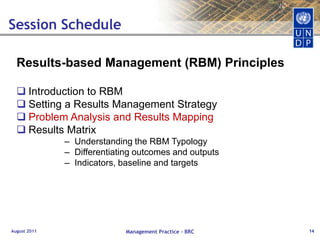
Session ScheduleResults-based Management (RBM) PrinciplesIntroduction to RBMSetting a Results Management StrategyProblem Analysis and Results MappingUNDP planning instrumentsResults Matrix Understanding the RBM TypologyDifferentiating outcomes and outputsIndicators, baseline and targetsAugust 2011Management Practice - BRC2
What is a Result ?August 2011Management Practice - BRC3Results are changes in a state or condition that derive from a cause-and-effect relationship. There are three types of such changes (intended or unintended, positive and/or negative) that can be set in motion by a development intervention – outputs, outcomes and impacts.- UNDG agreed RBM terminology
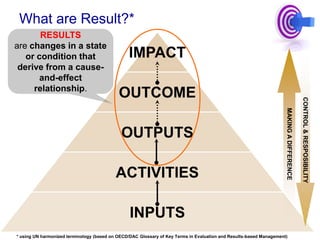
What are Result?*RESULTSare changes in a state or condition that derive from a cause-and-effect relationship.CONTROL & RESPOSIBILITYMAKING A DIFFERENCE* using UN harmonized terminology (based on OECD/DAC Glossary of Key Terms in Evaluation and Results-based Management)
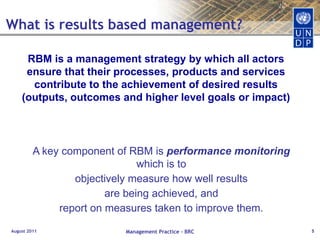
August 2011Management Practice - BRC5What is results based management?RBM is a management strategy by which all actors ensure that their processes, products and services contribute to the achievement of desired results (outputs, outcomes and higher level goals or impact) 	A key component of RBM is performancemonitoring which is toobjectively measure how well resultsare being achieved, andreport on measures taken to improve them.
Why RBM?Stated rationale/intended gains: Improved focus on results instead of activitiesImproved transparencyImproved accountabilityImproved measurement of programme achievements (performance rather than utilization)Enhanced strategic focusIndustry standardTo get more funds!!       			August 2011Management Practice - BRC6
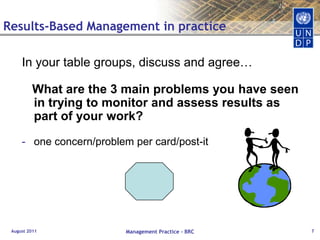
Results-Based Management in practice In your table groups, discuss and agree…    What are the 3 main problems you have seen in trying to monitor and assess results as part of your work?one concern/problem per card/post-itAugust 2011Management Practice - BRC7
General problems when applying RBM?Difficult to apply Difficult to learnDifficult to integrateDifficult to revise (... or reluctance to revise? )Difficult to measureDifficult to ‘attribute’ (at outcome level, the UN is accountable but not fully responsible)August 2011Management Practice - BRC8
Common elements of RBMProblem analysis to understand causesStakeholder analysisStructuring of programmes around a chain of desired results - addressing causesCausality in the chain of results (if… then logic)Use of ‘change language’ (future conditional)Reliance on indicators to measure performanceCosting of results rather than isolated activity budgetingAugust 2011Management Practice - BRC9
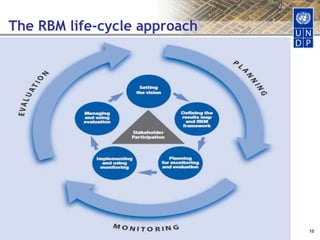
The RBM life-cycle approachAugust 2011Management Practice - BRC10
Session ScheduleAugust 2011Management Practice - BRC11Results-based Management (RBM) PrinciplesIntroduction to RBM
Setting a Results Management Strategy
Problem Analysis and Results Mapping
Results Matrix
Understanding the RBM Typology
Differentiating outcomes and outputs
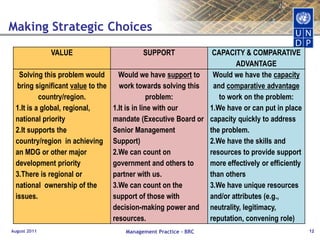
Indicators, baseline and targetsMaking Strategic ChoicesAugust 2011Management Practice - BRC12
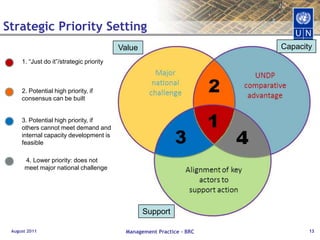
Strategic Priority SettingAugust 2011Management Practice - BRC13CapacityValue1. “Just do it”/strategic priorityMajor national challengeUNDP comparative advantage2. Potential high priority, if consensus can be built3. Potential high priority, if others cannot meet demand and internal capacity development is feasible  4. Lower priority: does not meet major national challengeAlignment of key actors to support actionSupport
Session ScheduleAugust 2011Management Practice - BRC14Results-based Management (RBM) PrinciplesIntroduction to RBM
Setting a Results Management Strategy
Problem Analysis and Results Mapping
Results Matrix
Understanding the RBM Typology
Differentiating outcomes and outputs
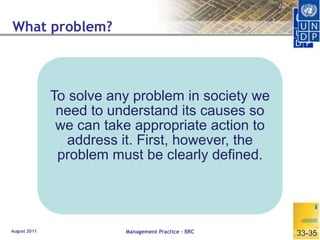
Indicators, baseline and targetsWhat problem?August 2011Management Practice - BRC1533-35
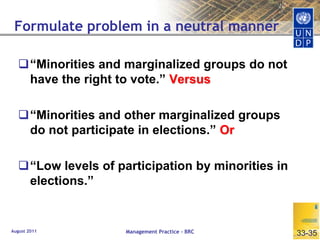
Formulate problem in a neutral manner“Minorities and marginalized groups do not have the right to vote.” Versus“Minorities and other marginalized groups do not participate in elections.” Or “Low levels of participation by minorities in elections.”August 2011Management Practice - BRC1633-35
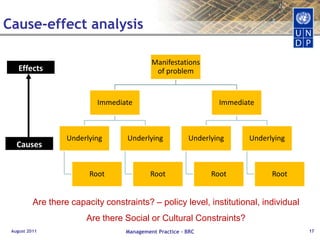
Cause-effect analysisAugust 2011Management Practice - BRC17EffectsCausesAre there capacity constraints? – policy level, institutional, individualAre there Social or Cultural Constraints?
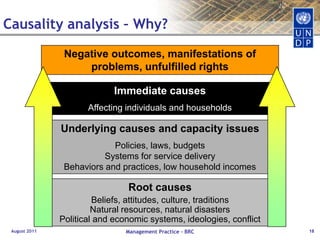
Causality analysis – Why?Negative outcomes, manifestations of problems, unfulfilled rightsImmediate causesAffecting individuals and householdsUnderlying causesand capacity issuesPolicies, laws, budgetsSystems for service deliveryBehaviors and practices, low household incomesRoot causesBeliefs, attitudes, culture, traditionsNatural resources, natural disastersPolitical and economic systems, ideologies, conflictAugust 2011Management Practice - BRC18
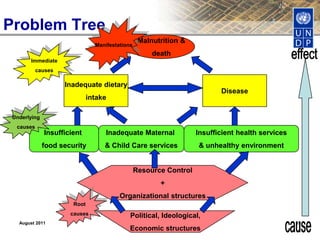
Problem TreeAugust 2011Management Practice - BRC19ManifestationsMalnutrition &deathImmediatecauseseffectInadequate dietaryintakeDiseaseUnderlyingcausesInsufficient food securityInadequate Maternal & Child Care servicesInsufficient health services& unhealthy environmentResource Control+Organizational structuresRootcausesPolitical, Ideological,Economic structurescause
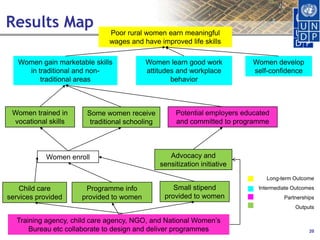
Results MapAugust 2011Management Practice - BRC20Poor rural women earn meaningful wages and have improved life skillsWomen gain marketable skills in traditional and non-traditional areasWomen learn good work attitudes and workplace behaviorWomen develop self-confidencePotential employers educated and committed to programmeWomen trained in vocational skillsSome women receive  traditional schoolingAdvocacy and sensitization initiativeWomen enrollLong-term OutcomeIntermediate OutcomesPartnershipsOutputsSmall stipend provided to womenChild care services providedProgramme info  provided to womenTraining agency, child care agency, NGO, and National Women’s Bureau etc collaborate to design and deliver programmes
Session ScheduleResults-based Management (RBM)Introduction to RBMKey PrinciplesRBM Life cycleUNDP planning instrumentsResults Matrix Understanding the RBM TypologyDifferentiating outcomes and outputsIndicators, baseline and targetsAugust 2011Management Practice - BRC21
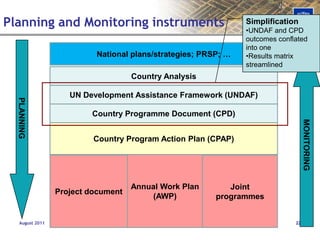
Planning and Monitoring instrumentsAugust 2011Management Practice - BRC22SimplificationUNDAF and CPD outcomes conflated into one
Results matrix streamlinedPLANNINGMONITORINGNational plans/strategies; PRSP; …Country AnalysisUN Development Assistance Framework (UNDAF)Country Programme Document (CPD)Country Program Action Plan (CPAP)Annual Work Plan (AWP)JointprogrammesProjectdocument
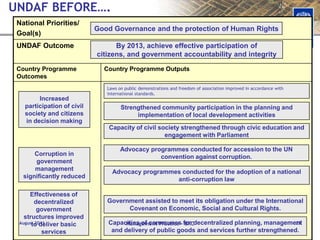
UNDAF BEFORE….Good Governance and the protection of Human RightsBy 2013, achieve effective participation of citizens, and government accountability and integrityLaws on public demonstrations and freedom of association improved in accordance with international standards.Increased participation of civil society and citizens in decision makingStrengthened community participation in the planning and implementation of local development activitiesCapacity of civil society strengthened through civic education and engagement with ParliamentAdvocacy programmes conducted for accession to the UN convention against corruption.Corruption in government management significantly reduced Advocacy programmes conducted for the adoption of a national anti-corruption law Effectiveness of decentralized government structures improved to deliver basic servicesGovernment assisted to meet its obligation under the International Covenant on Economic, Social and Cultural Rights.Capacities of communes for decentralized planning, management and delivery of public goods and services further strengthened.August 2011Management Practice - BRC23
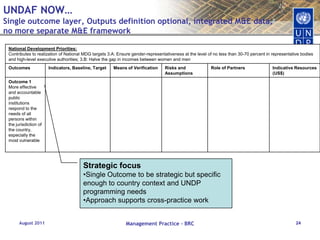
UNDAF NOW…Single outcome layer, Outputs definition optional, integrated M&E data, no more separate M&E frameworkAugust 2011Management Practice - BRC24Strategic focusSingle Outcome to be strategic but specific enough to country context and UNDP programming needs
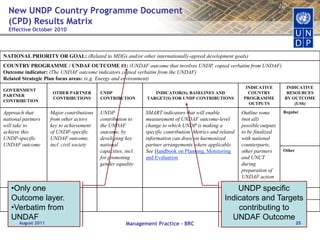
Approach supports cross-practice workNew UNDP Country Programme Document(CPD) Results MatrixEffective October 2010UNDP specific Indicators and Targets contributing to UNDAF OutcomeOnly one Outcome layer.
Verbatim from UNDAFAugust 2011Management Practice - BRC25
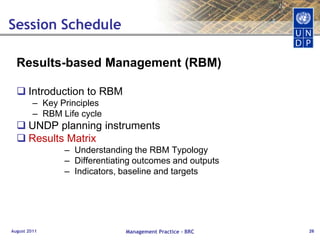
Session ScheduleResults-based Management (RBM)Introduction to RBMKey PrinciplesRBM Life cycleUNDP planning instrumentsResults Matrix Understanding the RBM TypologyDifferentiating outcomes and outputsIndicators, baseline and targetsAugust 2011Management Practice - BRC26
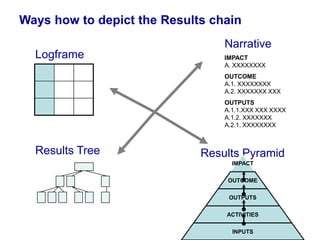
Ways how to depict the Results chainNarrativeIMPACTA. XXXXXXXXOUTCOMEA.1. XXXXXXXXA.2. XXXXXXX XXXOUTPUTSA.1.1.XXX XXX XXXXA.1.2. XXXXXXXA.2.1. XXXXXXXXLogframeResults TreeResults Pyramid
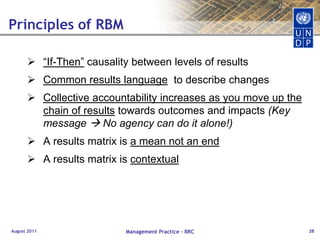
Principles of RBM“If-Then” causality between levels of results
Common results language  to describe changes
Collective accountability increases as you move up the chain of results towards outcomes and impacts (Key message  No agency can do it alone!)
A results matrix is a mean not an end
A results matrix is contextual August 2011Management Practice - BRC28
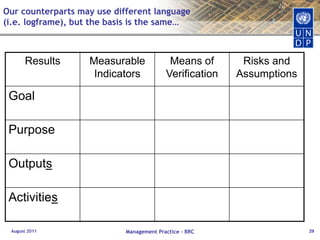
August 2011Management Practice - BRC29Our counterparts may use different language (i.e. logframe), but the basis is the same…
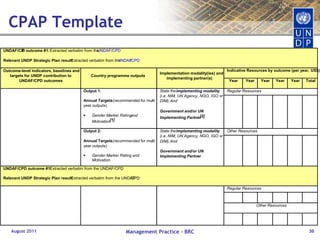
CPAP TemplateAugust 2011Management Practice - BRC30UNDAF/CPD outcome #1:Extracted verbatim from the UNDAF/CPDRelevant UNDP Strategic Plan result: Extracted verbatim from the UNDAF/CPDIndicative Resources by outcome (per year, US$)Outcome-level indicators, baselines and Implementation modality(ies) and targets for UNDP contribution to Country programme outputsimplementing partner(s)UNDAF/CPD outcomesYearYearYearYearYearTotalOutput 1:State the implementing modalityRegular Resources(i.e. NIM, UN Agency, NGO, IGO or Annual Targets(recommended for multi-DIM);Andyear outputs)Government and/or UN ·Gender Marker Rating and [2]Implementing Partner[1]MotivationOutput 2:State the implementing modalityOther Resources(i.e. NIM, UN Agency, NGO, IGO or Annual Targets (recommended for multi-DIM);Andyear outputs)Government and/or UN ·Gender Marker Rating and Implementing PartnerMotivationUNDAF/CPD outcome #1:Extracted verbatim from the UNDAF/CPDRelevant UNDP Strategic Plan result: Extracted verbatim from the UNDAF/CPDRegular ResourcesOther Resources[1]Gender Rating:3-Gender equality is a principal objective of the output; 2-Gender equality is a significant objective of the output; 1-Outputs that will contribute in some way to gender equality but not significantly; 0-Outputs that are not expected to contribute noticeably to gender equality.Include a one sentence motivation as to the reason for the chosen rating.[2]State also IGO Implementing Partners who have already signed SBEAA with UNDP. Other IGOs and NGOs will not be mentioned here in CPAP. They would be selected through a competitive process later.
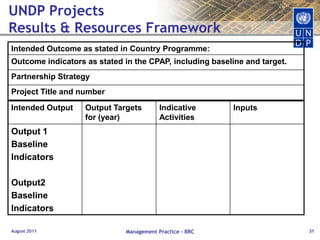
 August 2011Management Practice - BRC31UNDP ProjectsResults & Resources Framework 
A few caveatsThe results matrix is a storylineIt is a description of a programme or project strategy Shows the intended  paths we think are required to achieve desired resultsThe storyline comprises results, indicators & targets and assumptions & risksAugust 2011Management Practice - BRC32
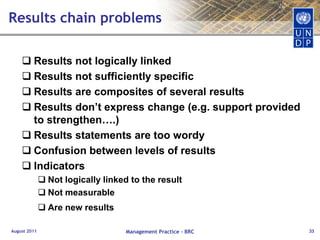
Results chain problemsResults not logically linkedResults not sufficiently specificResults are composites of several results Results don’t express change (e.g. support provided to strengthen….)Results statements are too wordyConfusion between levels of results Indicators Not logically linked to the result
Not measurable
Are new resultsAugust 2011Management Practice - BRC33
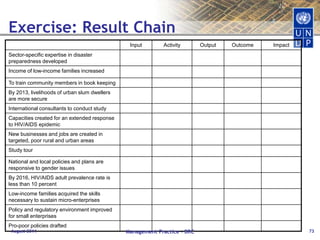
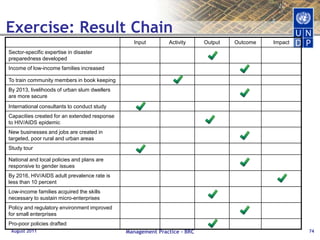
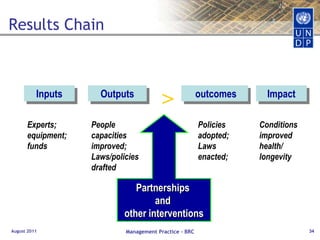
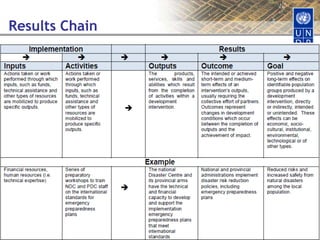
Results ChainAugust 2011Management Practice - BRC34InputsOutputsoutcomesImpact>Experts; equipment; fundsPeople capacities improved; Laws/policies draftedPolicies adopted; Laws enacted;Conditions improved health/ longevityPartnerships and other interventions
Results ChainAugust 2011Management Practice - BRC35
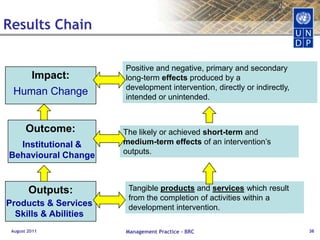
Results ChainAugust 2011Management Practice - BRC36Positive and negative, primary and secondarylong-term effects produced by adevelopment intervention, directly or indirectly,intended or unintended.Impact:Human ChangeOutcome: The likely or achieved short-term andmedium-term effects of an intervention’soutputs. Institutional & Behavioural ChangeOutputs:Tangible products and services which result from the completion of activities within a development intervention. Products & ServicesSkills & Abilities
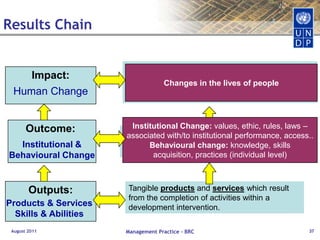
Results ChainAugust 2011Management Practice - BRC37Positive and negative, primary and secondarylong-term effects produced by adevelopment intervention, directly or indirectly,intended or unintended.Changes in the lives of peopleImpact:Human ChangeInstitutional Change: values, ethic, rules, laws – associated with/to institutional performance, access..Behavioural change: knowledge, skills acquisition, practices (individual level)Outcome: The likely or achieved short-term andmedium-term effects of an intervention’soutputs. Institutional & Behavioural ChangeOutputs:Tangible products and services which result from the completion of activities within a development intervention. Products & ServicesSkills & Abilities
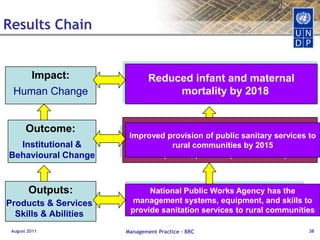
Results ChainAugust 2011Management Practice - BRC38Positive and negative, primary and secondarylong-term effects produced by adevelopment intervention, directly or indirectly,intended or unintended.Changes in the lives of peopleReduced infant and maternal mortality by 2018Impact:Human ChangeInstitutional Change: values, ethic, rules, laws – associated with/to institutional performance, access..Behavioural change: knowledge, skills acquisition, practices (individual level)Outcome: Improved provision of public sanitary services to rural communities by 2015The likely or achieved short-term andmedium-term effects of an intervention’soutputs. Institutional & Behavioural ChangeOutputs:Tangible products and services which result from the completion of activities within a development intervention. National Public Works Agency has the management systems, equipment, and skills to provide sanitation services to rural communitiesProducts & ServicesSkills & Abilities
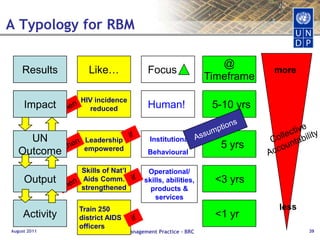
August 2011Management Practice - BRC39ResultsLike…  Focus      @Timeframe      more   5-10 yrs      ImpactImpactImpactthenCollective Accountabilityif      5 yrs      UNOutcomeUNOutcomeUNOutcomethen    <3 yrs      OutputOutputOutputifthenless    <1 yr      ActivityActivityActivityifA Typology for RBMHIV incidence reduced  Human!      AssumptionsLeadership empoweredInstitutional/ BehaviouralSkills of Nat’l Aids Comm. strengthenedOperational/ skills, abilities, products & servicesTrain 250 district AIDS officers
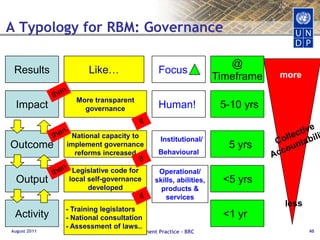
August 2011Management Practice - BRC40moreCollective AccountabilitylessA Typology for RBM: GovernanceResultsLike…Focus@TimeframethenImpactMore transparent governance5-10 yrs        Human!      ifthenOutcomeNational capacity to implement governance reforms increased5 yrs      Institutional/ BehaviouralifthenOutputLegislative code for local self-governance developed    <5 yrs      Operational/ skills, abilities, products & servicesifActivity- Training legislators - National consultation- Assessment of laws..    <1 yr
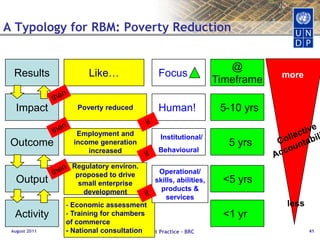
August 2011Management Practice - BRC41moreCollective AccountabilitylessA Typology for RBM: Poverty Reduction ResultsLike…Focus@TimeframethenImpactPoverty reduced5-10 yrs        Human!      ifthenOutcomeEmployment and income generation increasedInstitutional/ Behavioural5 yrsifRegulatory environ. proposed to drive small enterprise development thenOutput    <5 yrs      Operational/ skills, abilities, products & servicesif Economic assessment
 Training for chambers of commerce - National consultationActivity    <1 yr
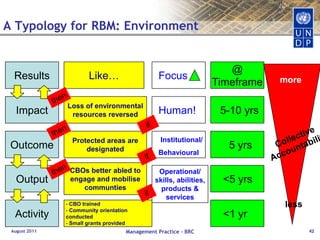
August 2011Management Practice - BRC42moreCollective AccountabilitylessA Typology for RBM: EnvironmentResultsLike…Focus@TimeframethenImpactLoss of environmental resources reversed5-10 yrs        Human!      ifthenOutcomeProtected areas are designatedInstitutional/ Behavioural5 yrsifCBOs better abled to engage and mobilise communtiesthenOutput    <5 yrs      Operational/ skills, abilities, products & servicesifActivity CBO trained
 Community orientation conducted
 Small grants provided    <1 yr
OutcomesLet’s look at some examples…
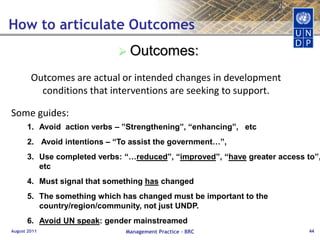
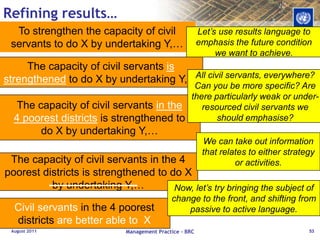
How to articulate OutcomesAugust 2011Management Practice - BRC44Outcomes:Outcomes are actual or intended changes in development conditions that interventions are seeking to support. Some guides: Avoid  action verbs – ”Strengthening”, “enhancing”,   etc Avoid intentions – “To assist the government…”, Use completed verbs: “…reduced”, “improved”, “have greater access to”, etcMust signal that something has changed The something which has changed must be important to the country/region/community, not just UNDP.Avoid UN speak: gender mainstreamed
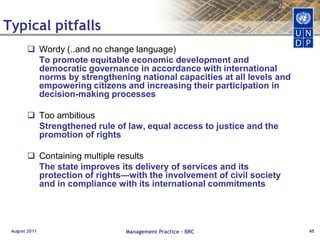
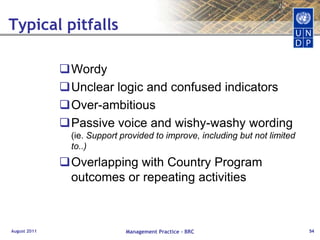
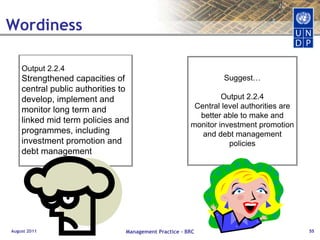
Typical pitfallsWordy (..and no change language)	To promote equitable economic development and democratic governance in accordance with international norms by strengthening national capacities at all levels and empowering citizens and increasing their participation in decision-making processesToo ambitious	Strengthened rule of law, equal access to justice and the promotion of rightsContaining multiple results	The state improves its delivery of services and its protection of rights—with the involvement of civil society and in compliance with its international commitmentsAugust 2011Management Practice - BRC45
Typical pitfallsWishy-washy (ie. Support provided to improve..)Support to institutional capacity building for improved governanceSo general, they could mean anything	To promote sustainable development and increase capacity at municipal levelOverlapping with National goals/ MDGs (impacts) 	Substantially reduce the level of poverty and income inequality in accordance with the MDGs and PRSPConfusing means and ends	Strengthen the protection of natural resources through the creation of an enabling environment that promotes sound resources managementAugust 2011Management Practice - BRC46
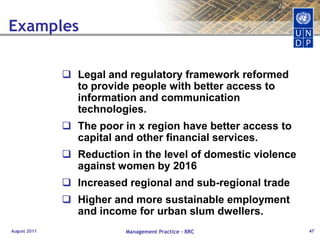
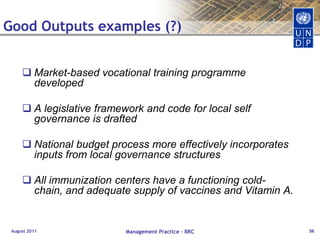
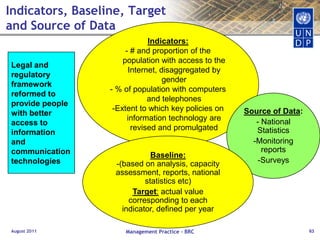
ExamplesLegal and regulatory framework reformed to provide people with better access to information and communication technologies.  The poor in x region have better access to capital and other financial services.Reduction in the level of domestic violence against women by 2016Increased regional and sub-regional trade Higher and more sustainable employment and income for urban slum dwellers.August 2011Management Practice - BRC47
ExamplesBy the end of 2010, user-friendly and sustainable health care and nutrition services are provided in compliance with international standards at national and sub-national levels.Increased access to and completion of basic education, especially for girls.By 2012, increased and more equitable access to and utilization of quality, integrated and sustainable basic services by the poor and vulnerable.August 2011Management Practice - BRC48
OutputsTangible, deliverable, promises
Outputs: Definition & key featuresOutputs are deliverables/end-project resultsOperational changes: new skills or abilities, the availability of new products and services
Must be achieved within the project period
Managers have a high degree of control If the result is mostly beyond the control or influence of the programme or project, it cannot be an outputFailure to deliver is failure of the project
3 to 6 outputs per agency outcome

Results-Based Management in UNDP

  • 1.
    Results-Based ManagementPatrick GrémilletBratislavaRegional Center Management Practice2011
  • 2.
    Session ScheduleResults-based Management(RBM) PrinciplesIntroduction to RBMSetting a Results Management StrategyProblem Analysis and Results MappingUNDP planning instrumentsResults Matrix Understanding the RBM TypologyDifferentiating outcomes and outputsIndicators, baseline and targetsAugust 2011Management Practice - BRC2
  • 3.
    What is aResult ?August 2011Management Practice - BRC3Results are changes in a state or condition that derive from a cause-and-effect relationship. There are three types of such changes (intended or unintended, positive and/or negative) that can be set in motion by a development intervention – outputs, outcomes and impacts.- UNDG agreed RBM terminology
  • 4.
    What are Result?*RESULTSarechanges in a state or condition that derive from a cause-and-effect relationship.CONTROL & RESPOSIBILITYMAKING A DIFFERENCE* using UN harmonized terminology (based on OECD/DAC Glossary of Key Terms in Evaluation and Results-based Management)
  • 5.
    August 2011Management Practice- BRC5What is results based management?RBM is a management strategy by which all actors ensure that their processes, products and services contribute to the achievement of desired results (outputs, outcomes and higher level goals or impact) A key component of RBM is performancemonitoring which is toobjectively measure how well resultsare being achieved, andreport on measures taken to improve them.
  • 6.
    Why RBM?Stated rationale/intendedgains: Improved focus on results instead of activitiesImproved transparencyImproved accountabilityImproved measurement of programme achievements (performance rather than utilization)Enhanced strategic focusIndustry standardTo get more funds!! August 2011Management Practice - BRC6
  • 7.
    Results-Based Management inpractice In your table groups, discuss and agree… What are the 3 main problems you have seen in trying to monitor and assess results as part of your work?one concern/problem per card/post-itAugust 2011Management Practice - BRC7
  • 8.
    General problems whenapplying RBM?Difficult to apply Difficult to learnDifficult to integrateDifficult to revise (... or reluctance to revise? )Difficult to measureDifficult to ‘attribute’ (at outcome level, the UN is accountable but not fully responsible)August 2011Management Practice - BRC8
  • 9.
    Common elements ofRBMProblem analysis to understand causesStakeholder analysisStructuring of programmes around a chain of desired results - addressing causesCausality in the chain of results (if… then logic)Use of ‘change language’ (future conditional)Reliance on indicators to measure performanceCosting of results rather than isolated activity budgetingAugust 2011Management Practice - BRC9
  • 10.
    The RBM life-cycleapproachAugust 2011Management Practice - BRC10
  • 11.
    Session ScheduleAugust 2011ManagementPractice - BRC11Results-based Management (RBM) PrinciplesIntroduction to RBM
  • 12.
    Setting a ResultsManagement Strategy
  • 13.
    Problem Analysis andResults Mapping
  • 14.
  • 15.
  • 16.
  • 17.
    Indicators, baseline andtargetsMaking Strategic ChoicesAugust 2011Management Practice - BRC12
  • 18.
    Strategic Priority SettingAugust2011Management Practice - BRC13CapacityValue1. “Just do it”/strategic priorityMajor national challengeUNDP comparative advantage2. Potential high priority, if consensus can be built3. Potential high priority, if others cannot meet demand and internal capacity development is feasible 4. Lower priority: does not meet major national challengeAlignment of key actors to support actionSupport
  • 19.
    Session ScheduleAugust 2011ManagementPractice - BRC14Results-based Management (RBM) PrinciplesIntroduction to RBM
  • 20.
    Setting a ResultsManagement Strategy
  • 21.
    Problem Analysis andResults Mapping
  • 22.
  • 23.
  • 24.
  • 25.
    Indicators, baseline andtargetsWhat problem?August 2011Management Practice - BRC1533-35
  • 26.
    Formulate problem ina neutral manner“Minorities and marginalized groups do not have the right to vote.” Versus“Minorities and other marginalized groups do not participate in elections.” Or “Low levels of participation by minorities in elections.”August 2011Management Practice - BRC1633-35
  • 27.
    Cause-effect analysisAugust 2011ManagementPractice - BRC17EffectsCausesAre there capacity constraints? – policy level, institutional, individualAre there Social or Cultural Constraints?
  • 28.
    Causality analysis –Why?Negative outcomes, manifestations of problems, unfulfilled rightsImmediate causesAffecting individuals and householdsUnderlying causesand capacity issuesPolicies, laws, budgetsSystems for service deliveryBehaviors and practices, low household incomesRoot causesBeliefs, attitudes, culture, traditionsNatural resources, natural disastersPolitical and economic systems, ideologies, conflictAugust 2011Management Practice - BRC18
  • 29.
    Problem TreeAugust 2011ManagementPractice - BRC19ManifestationsMalnutrition &deathImmediatecauseseffectInadequate dietaryintakeDiseaseUnderlyingcausesInsufficient food securityInadequate Maternal & Child Care servicesInsufficient health services& unhealthy environmentResource Control+Organizational structuresRootcausesPolitical, Ideological,Economic structurescause
  • 30.
    Results MapAugust 2011ManagementPractice - BRC20Poor rural women earn meaningful wages and have improved life skillsWomen gain marketable skills in traditional and non-traditional areasWomen learn good work attitudes and workplace behaviorWomen develop self-confidencePotential employers educated and committed to programmeWomen trained in vocational skillsSome women receive traditional schoolingAdvocacy and sensitization initiativeWomen enrollLong-term OutcomeIntermediate OutcomesPartnershipsOutputsSmall stipend provided to womenChild care services providedProgramme info provided to womenTraining agency, child care agency, NGO, and National Women’s Bureau etc collaborate to design and deliver programmes
  • 31.
    Session ScheduleResults-based Management(RBM)Introduction to RBMKey PrinciplesRBM Life cycleUNDP planning instrumentsResults Matrix Understanding the RBM TypologyDifferentiating outcomes and outputsIndicators, baseline and targetsAugust 2011Management Practice - BRC21
  • 32.
    Planning and MonitoringinstrumentsAugust 2011Management Practice - BRC22SimplificationUNDAF and CPD outcomes conflated into one
  • 33.
    Results matrix streamlinedPLANNINGMONITORINGNationalplans/strategies; PRSP; …Country AnalysisUN Development Assistance Framework (UNDAF)Country Programme Document (CPD)Country Program Action Plan (CPAP)Annual Work Plan (AWP)JointprogrammesProjectdocument
  • 34.
    UNDAF BEFORE….Good Governanceand the protection of Human RightsBy 2013, achieve effective participation of citizens, and government accountability and integrityLaws on public demonstrations and freedom of association improved in accordance with international standards.Increased participation of civil society and citizens in decision makingStrengthened community participation in the planning and implementation of local development activitiesCapacity of civil society strengthened through civic education and engagement with ParliamentAdvocacy programmes conducted for accession to the UN convention against corruption.Corruption in government management significantly reduced Advocacy programmes conducted for the adoption of a national anti-corruption law Effectiveness of decentralized government structures improved to deliver basic servicesGovernment assisted to meet its obligation under the International Covenant on Economic, Social and Cultural Rights.Capacities of communes for decentralized planning, management and delivery of public goods and services further strengthened.August 2011Management Practice - BRC23
  • 35.
    UNDAF NOW…Single outcomelayer, Outputs definition optional, integrated M&E data, no more separate M&E frameworkAugust 2011Management Practice - BRC24Strategic focusSingle Outcome to be strategic but specific enough to country context and UNDP programming needs
  • 36.
    Approach supports cross-practiceworkNew UNDP Country Programme Document(CPD) Results MatrixEffective October 2010UNDP specific Indicators and Targets contributing to UNDAF OutcomeOnly one Outcome layer.
  • 37.
    Verbatim from UNDAFAugust2011Management Practice - BRC25
  • 38.
    Session ScheduleResults-based Management(RBM)Introduction to RBMKey PrinciplesRBM Life cycleUNDP planning instrumentsResults Matrix Understanding the RBM TypologyDifferentiating outcomes and outputsIndicators, baseline and targetsAugust 2011Management Practice - BRC26
  • 39.
    Ways how todepict the Results chainNarrativeIMPACTA. XXXXXXXXOUTCOMEA.1. XXXXXXXXA.2. XXXXXXX XXXOUTPUTSA.1.1.XXX XXX XXXXA.1.2. XXXXXXXA.2.1. XXXXXXXXLogframeResults TreeResults Pyramid
  • 40.
    Principles of RBM“If-Then”causality between levels of results
  • 41.
    Common results language to describe changes
  • 42.
    Collective accountability increasesas you move up the chain of results towards outcomes and impacts (Key message  No agency can do it alone!)
  • 43.
    A results matrixis a mean not an end
  • 44.
    A results matrixis contextual August 2011Management Practice - BRC28
  • 45.
    August 2011Management Practice- BRC29Our counterparts may use different language (i.e. logframe), but the basis is the same…
  • 46.
    CPAP TemplateAugust 2011ManagementPractice - BRC30UNDAF/CPD outcome #1:Extracted verbatim from the UNDAF/CPDRelevant UNDP Strategic Plan result: Extracted verbatim from the UNDAF/CPDIndicative Resources by outcome (per year, US$)Outcome-level indicators, baselines and Implementation modality(ies) and targets for UNDP contribution to Country programme outputsimplementing partner(s)UNDAF/CPD outcomesYearYearYearYearYearTotalOutput 1:State the implementing modalityRegular Resources(i.e. NIM, UN Agency, NGO, IGO or Annual Targets(recommended for multi-DIM);Andyear outputs)Government and/or UN ·Gender Marker Rating and [2]Implementing Partner[1]MotivationOutput 2:State the implementing modalityOther Resources(i.e. NIM, UN Agency, NGO, IGO or Annual Targets (recommended for multi-DIM);Andyear outputs)Government and/or UN ·Gender Marker Rating and Implementing PartnerMotivationUNDAF/CPD outcome #1:Extracted verbatim from the UNDAF/CPDRelevant UNDP Strategic Plan result: Extracted verbatim from the UNDAF/CPDRegular ResourcesOther Resources[1]Gender Rating:3-Gender equality is a principal objective of the output; 2-Gender equality is a significant objective of the output; 1-Outputs that will contribute in some way to gender equality but not significantly; 0-Outputs that are not expected to contribute noticeably to gender equality.Include a one sentence motivation as to the reason for the chosen rating.[2]State also IGO Implementing Partners who have already signed SBEAA with UNDP. Other IGOs and NGOs will not be mentioned here in CPAP. They would be selected through a competitive process later.
  • 47.
     August 2011Management Practice- BRC31UNDP ProjectsResults & Resources Framework 
  • 48.
    A few caveatsTheresults matrix is a storylineIt is a description of a programme or project strategy Shows the intended paths we think are required to achieve desired resultsThe storyline comprises results, indicators & targets and assumptions & risksAugust 2011Management Practice - BRC32
  • 49.
    Results chain problemsResultsnot logically linkedResults not sufficiently specificResults are composites of several results Results don’t express change (e.g. support provided to strengthen….)Results statements are too wordyConfusion between levels of results Indicators Not logically linked to the result
  • 50.
  • 51.
    Are new resultsAugust2011Management Practice - BRC33
  • 52.
    Results ChainAugust 2011ManagementPractice - BRC34InputsOutputsoutcomesImpact>Experts; equipment; fundsPeople capacities improved; Laws/policies draftedPolicies adopted; Laws enacted;Conditions improved health/ longevityPartnerships and other interventions
  • 53.
  • 54.
    Results ChainAugust 2011ManagementPractice - BRC36Positive and negative, primary and secondarylong-term effects produced by adevelopment intervention, directly or indirectly,intended or unintended.Impact:Human ChangeOutcome: The likely or achieved short-term andmedium-term effects of an intervention’soutputs. Institutional & Behavioural ChangeOutputs:Tangible products and services which result from the completion of activities within a development intervention. Products & ServicesSkills & Abilities
  • 55.
    Results ChainAugust 2011ManagementPractice - BRC37Positive and negative, primary and secondarylong-term effects produced by adevelopment intervention, directly or indirectly,intended or unintended.Changes in the lives of peopleImpact:Human ChangeInstitutional Change: values, ethic, rules, laws – associated with/to institutional performance, access..Behavioural change: knowledge, skills acquisition, practices (individual level)Outcome: The likely or achieved short-term andmedium-term effects of an intervention’soutputs. Institutional & Behavioural ChangeOutputs:Tangible products and services which result from the completion of activities within a development intervention. Products & ServicesSkills & Abilities
  • 56.
    Results ChainAugust 2011ManagementPractice - BRC38Positive and negative, primary and secondarylong-term effects produced by adevelopment intervention, directly or indirectly,intended or unintended.Changes in the lives of peopleReduced infant and maternal mortality by 2018Impact:Human ChangeInstitutional Change: values, ethic, rules, laws – associated with/to institutional performance, access..Behavioural change: knowledge, skills acquisition, practices (individual level)Outcome: Improved provision of public sanitary services to rural communities by 2015The likely or achieved short-term andmedium-term effects of an intervention’soutputs. Institutional & Behavioural ChangeOutputs:Tangible products and services which result from the completion of activities within a development intervention. National Public Works Agency has the management systems, equipment, and skills to provide sanitation services to rural communitiesProducts & ServicesSkills & Abilities
  • 57.
    August 2011Management Practice- BRC39ResultsLike… Focus @Timeframe more 5-10 yrs ImpactImpactImpactthenCollective Accountabilityif 5 yrs UNOutcomeUNOutcomeUNOutcomethen <3 yrs OutputOutputOutputifthenless <1 yr ActivityActivityActivityifA Typology for RBMHIV incidence reduced Human! AssumptionsLeadership empoweredInstitutional/ BehaviouralSkills of Nat’l Aids Comm. strengthenedOperational/ skills, abilities, products & servicesTrain 250 district AIDS officers
  • 58.
    August 2011Management Practice- BRC40moreCollective AccountabilitylessA Typology for RBM: GovernanceResultsLike…Focus@TimeframethenImpactMore transparent governance5-10 yrs Human! ifthenOutcomeNational capacity to implement governance reforms increased5 yrs Institutional/ BehaviouralifthenOutputLegislative code for local self-governance developed <5 yrs Operational/ skills, abilities, products & servicesifActivity- Training legislators - National consultation- Assessment of laws.. <1 yr
  • 59.
    August 2011Management Practice- BRC41moreCollective AccountabilitylessA Typology for RBM: Poverty Reduction ResultsLike…Focus@TimeframethenImpactPoverty reduced5-10 yrs Human! ifthenOutcomeEmployment and income generation increasedInstitutional/ Behavioural5 yrsifRegulatory environ. proposed to drive small enterprise development thenOutput <5 yrs Operational/ skills, abilities, products & servicesif Economic assessment
  • 60.
    Training forchambers of commerce - National consultationActivity <1 yr
  • 61.
    August 2011Management Practice- BRC42moreCollective AccountabilitylessA Typology for RBM: EnvironmentResultsLike…Focus@TimeframethenImpactLoss of environmental resources reversed5-10 yrs Human! ifthenOutcomeProtected areas are designatedInstitutional/ Behavioural5 yrsifCBOs better abled to engage and mobilise communtiesthenOutput <5 yrs Operational/ skills, abilities, products & servicesifActivity CBO trained
  • 62.
  • 63.
    Small grantsprovided <1 yr
  • 64.
    OutcomesLet’s look atsome examples…
  • 65.
    How to articulateOutcomesAugust 2011Management Practice - BRC44Outcomes:Outcomes are actual or intended changes in development conditions that interventions are seeking to support. Some guides: Avoid action verbs – ”Strengthening”, “enhancing”, etc Avoid intentions – “To assist the government…”, Use completed verbs: “…reduced”, “improved”, “have greater access to”, etcMust signal that something has changed The something which has changed must be important to the country/region/community, not just UNDP.Avoid UN speak: gender mainstreamed
  • 66.
    Typical pitfallsWordy (..andno change language) To promote equitable economic development and democratic governance in accordance with international norms by strengthening national capacities at all levels and empowering citizens and increasing their participation in decision-making processesToo ambitious Strengthened rule of law, equal access to justice and the promotion of rightsContaining multiple results The state improves its delivery of services and its protection of rights—with the involvement of civil society and in compliance with its international commitmentsAugust 2011Management Practice - BRC45
  • 67.
    Typical pitfallsWishy-washy (ie.Support provided to improve..)Support to institutional capacity building for improved governanceSo general, they could mean anything To promote sustainable development and increase capacity at municipal levelOverlapping with National goals/ MDGs (impacts) Substantially reduce the level of poverty and income inequality in accordance with the MDGs and PRSPConfusing means and ends Strengthen the protection of natural resources through the creation of an enabling environment that promotes sound resources managementAugust 2011Management Practice - BRC46
  • 68.
    ExamplesLegal and regulatoryframework reformed to provide people with better access to information and communication technologies. The poor in x region have better access to capital and other financial services.Reduction in the level of domestic violence against women by 2016Increased regional and sub-regional trade Higher and more sustainable employment and income for urban slum dwellers.August 2011Management Practice - BRC47
  • 69.
    ExamplesBy the endof 2010, user-friendly and sustainable health care and nutrition services are provided in compliance with international standards at national and sub-national levels.Increased access to and completion of basic education, especially for girls.By 2012, increased and more equitable access to and utilization of quality, integrated and sustainable basic services by the poor and vulnerable.August 2011Management Practice - BRC48
  • 70.
  • 71.
    Outputs: Definition &key featuresOutputs are deliverables/end-project resultsOperational changes: new skills or abilities, the availability of new products and services
  • 72.
    Must be achievedwithin the project period
  • 73.
    Managers have ahigh degree of control If the result is mostly beyond the control or influence of the programme or project, it cannot be an outputFailure to deliver is failure of the project
  • 74.
    3 to 6outputs per agency outcome

Editor's Notes

  • #13 Which issues, or which causes should we choose to work on?
  • #14 Area 1 is sometimes referred to as the “Nike” or “Just do it” area.In area 3, care should be taken not to readily go into that area before doing a thorough review of whether another agency (UN, CSO, etc) can provide the support required. UNDP should operate in this zone only as a last resort, as it is outside of our mandate and comparative advantage.Question: The EU is sending a electoral observation mission to x country, to observe their national elections. They wish to negotiate with UNDP an arrangement for UNDP to contract their field personnel, and handle all logistics arrangements. The EU will do the recruitment and will supervise the staff. Which area (1,2,3 or 4) would this project fit in?
  • #16 Discussion of examples of poor problem definition. Relationship to country analytical processes
  • #17 Crucial to ensure that problems are not defined to fit the interest or capacity of an agency. Sometimes problems can be defined with the solutions in mind – e.g. first example above where someone may think that giving minorities the right to vote will solve the problem. If the problem was formulated in one of the other 2 ways, then the right to vote could be seen as one constraint. There could be others, including social norms, lack of access roads, etc.
  • #18 In looking at causes, dig deeper into the issues to see what is the source of the problem.Are there policy impediments? Are institutions in place? Are they set up or structured properly? Do they collaborate effectively? Do they have the capacity? Are there social or cultural norms and practices that are creating impediments?
  • #21 Before we decide on what to fund, we should have a clear understanding of our strengths, weaknesses and comparative advantagesBased on that, we define a clear vision of what needs to happen and what must in place for the goal to be achieved.We must be aware of what others will need to do to complement our efforts to achieve the goal.In most cases, a single project by one agency will not be adequate to achieve the goal: partnerships and collaboration will be critical.
  • #23 Simplified results matrix: conflate the two outcome levels into one, with emphasis on strategic but specific enough to country context. Number of priorities &amp; outcomes are optional.
  • #45 Refer to pages 56 and 57 of HandbookPublic sector investment programme makes provision for substantial increase in the real allocation to gender equality and women’s empowerment. National budget allocation procedures and processes require gender analysis of all investment decisions.