


MDF Tool: Problem Tree Analysis


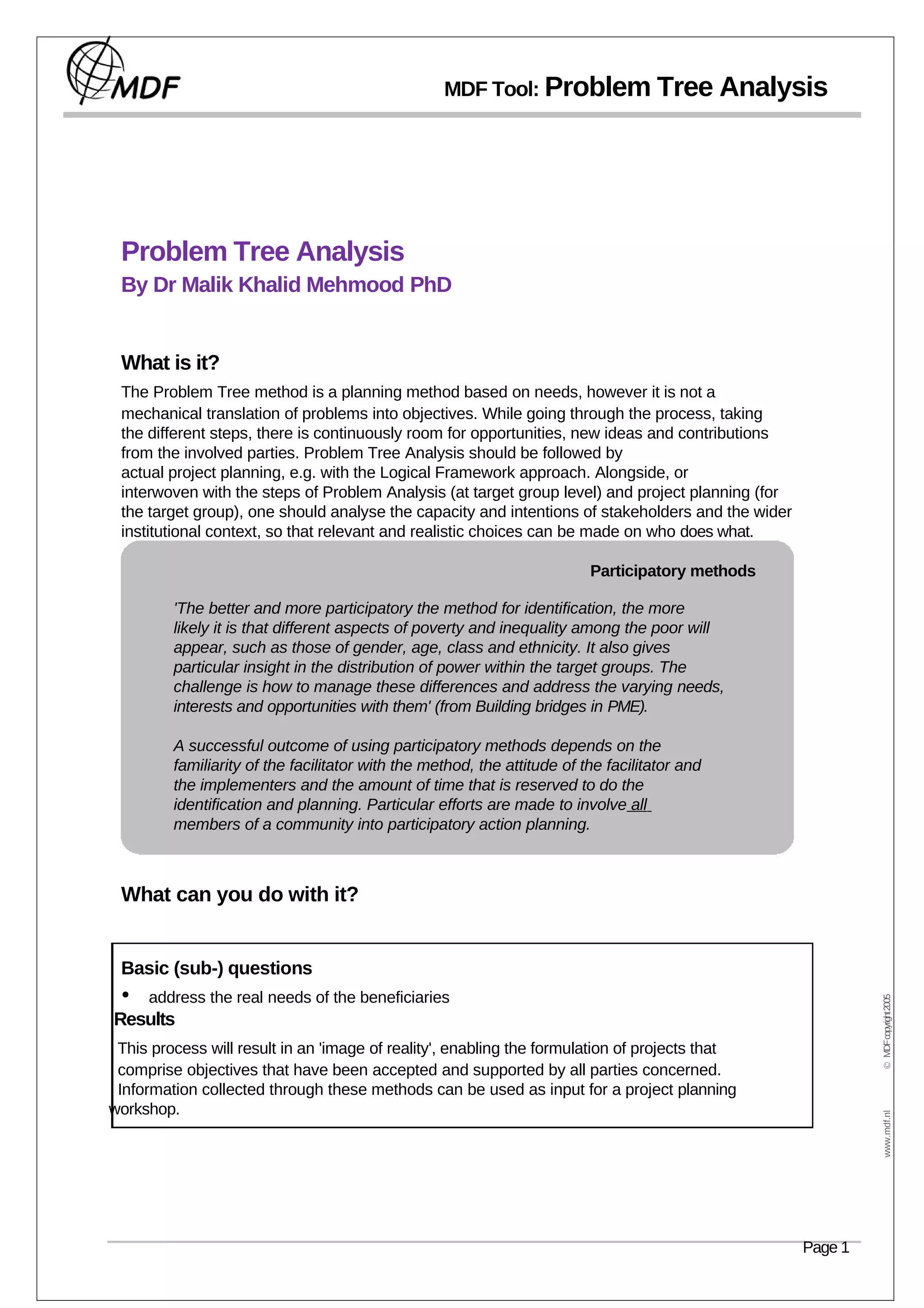
 Problem Tree Analysis
 By Dr Malik Khalid Mehmood PhD


 What is it?
 The Problem Tree method is a planning method based on needs, however it is not a
 mechanical translation of problems into objectives. While going through the process, taking
 the different steps, there is continuously room for opportunities, new ideas and contributions
 from the involved parties. Problem Tree Analysis should be followed by
 actual project planning, e.g. with the Logical Framework approach. Alongside, or
 interwoven with the steps of Problem Analysis (at target group level) and project planning (for
 the target group), one should analyse the capacity and intentions of stakeholders and the wider
 institutional context, so that relevant and realistic choices can be made on who does what.

                                                                          Participatory methods

         'The better and more participatory the method for identification, the more
         likely it is that different aspects of poverty and inequality among the poor will
         appear, such as those of gender, age, class and ethnicity. It also gives
         particular insight in the distribution of power within the target groups. The
         challenge is how to manage these differences and address the varying needs,
         interests and opportunities with them' (from Building bridges in PME).

         A successful outcome of using participatory methods depends on the
         familiarity of the facilitator with the method, the attitude of the facilitator and
         the implementers and the amount of time that is reserved to do the
         identification and planning. Particular efforts are made to involve all
         members of a community into participatory action planning.


 What can you do with it?


 Basic (sub-) questions
 •   address the real needs of the beneficiaries
                                                                                                            © MDF copyright 2005


Results
 This process will result in an 'image of reality', enabling the formulation of projects that
 comprise objectives that have been accepted and supported by all parties concerned.
 Information collected through these methods can be used as input for a project planning
workshop.
                                                                                                             www.mdf.nl


                                                                                                   Page 1
MDF Tool: Problem Tree Analysis


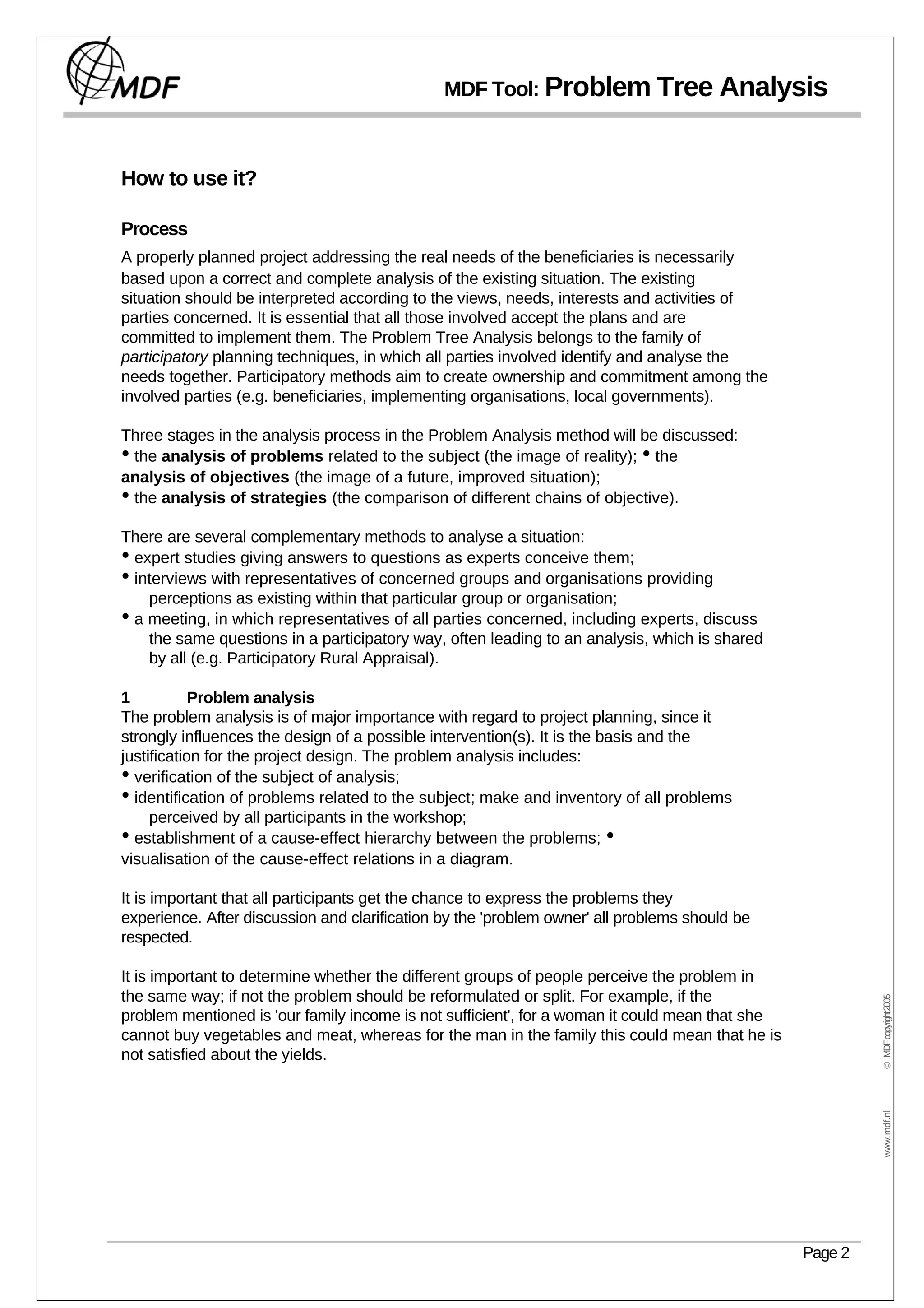
How to use it?

Process
A properly planned project addressing the real needs of the beneficiaries is necessarily
based upon a correct and complete analysis of the existing situation. The existing
situation should be interpreted according to the views, needs, interests and activities of
parties concerned. It is essential that all those involved accept the plans and are
committed to implement them. The Problem Tree Analysis belongs to the family of
participatory planning techniques, in which all parties involved identify and analyse the
needs together. Participatory methods aim to create ownership and commitment among the
involved parties (e.g. beneficiaries, implementing organisations, local governments).

Three stages in the analysis process in the Problem Analysis method will be discussed:
• the analysis of problems related to the subject (the image of reality); • the
analysis of objectives (the image of a future, improved situation);
• the analysis of strategies (the comparison of different chains of objective).
There are several complementary methods to analyse a situation:
• expert studies giving answers to questions as experts conceive them;
• interviews with representatives of concerned groups and organisations providing
    perceptions as existing within that particular group or organisation;
• a meeting, in which representatives of all parties concerned, including experts, discuss
    the same questions in a participatory way, often leading to an analysis, which is shared
    by all (e.g. Participatory Rural Appraisal).

1           Problem analysis
The problem analysis is of major importance with regard to project planning, since it
strongly influences the design of a possible intervention(s). It is the basis and the
justification for the project design. The problem analysis includes:
• verification of the subject of analysis;
• identification of problems related to the subject; make and inventory of all problems
     perceived by all participants in the workshop;
• establishment of a cause-effect hierarchy between the problems; •
visualisation of the cause-effect relations in a diagram.

It is important that all participants get the chance to express the problems they
experience. After discussion and clarification by the 'problem owner' all problems should be
respected.

It is important to determine whether the different groups of people perceive the problem in
the same way; if not the problem should be reformulated or split. For example, if the
                                                                                                          © MDF copyright 2005


problem mentioned is 'our family income is not sufficient', for a woman it could mean that she
cannot buy vegetables and meat, whereas for the man in the family this could mean that he is
not satisfied about the yields.
                                                                                                           www.mdf.nl


                                                                                                 Page 2
MDF Tool: Problem Tree Analysis


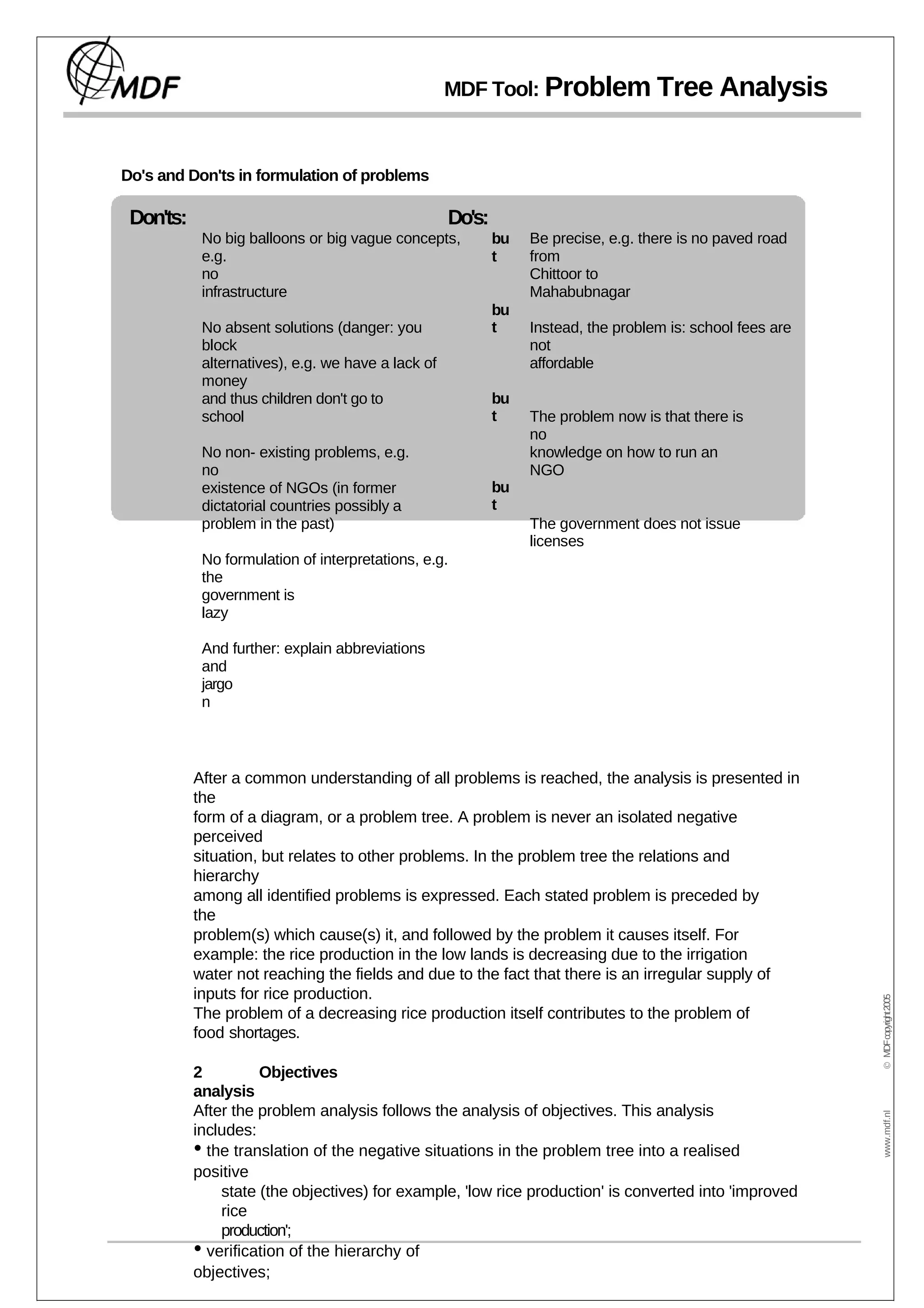
Do's and Don'ts in formulation of problems

 Don'ts:                                            Do's:
            No big balloons or big vague concepts,          bu   Be precise, e.g. there is no paved road
            e.g.                                            t    from
            no                                                   Chittoor to
            infrastructure                                       Mahabubnagar
                                                            bu
            No absent solutions (danger: you                t    Instead, the problem is: school fees are
            block                                                not
            alternatives), e.g. we have a lack of                affordable
            money
            and thus children don't go to                   bu
            school                                          t    The problem now is that there is
                                                                 no
            No non- existing problems, e.g.                      knowledge on how to run an
            no                                                   NGO
            existence of NGOs (in former                    bu
            dictatorial countries possibly a                t
            problem in the past)                                 The government does not issue
                                                                 licenses
            No formulation of interpretations, e.g.
            the
            government is
            lazy

            And further: explain abbreviations
            and
            jargo
            n


           After a common understanding of all problems is reached, the analysis is presented in
           the
           form of a diagram, or a problem tree. A problem is never an isolated negative
           perceived
           situation, but relates to other problems. In the problem tree the relations and
           hierarchy
           among all identified problems is expressed. Each stated problem is preceded by
           the
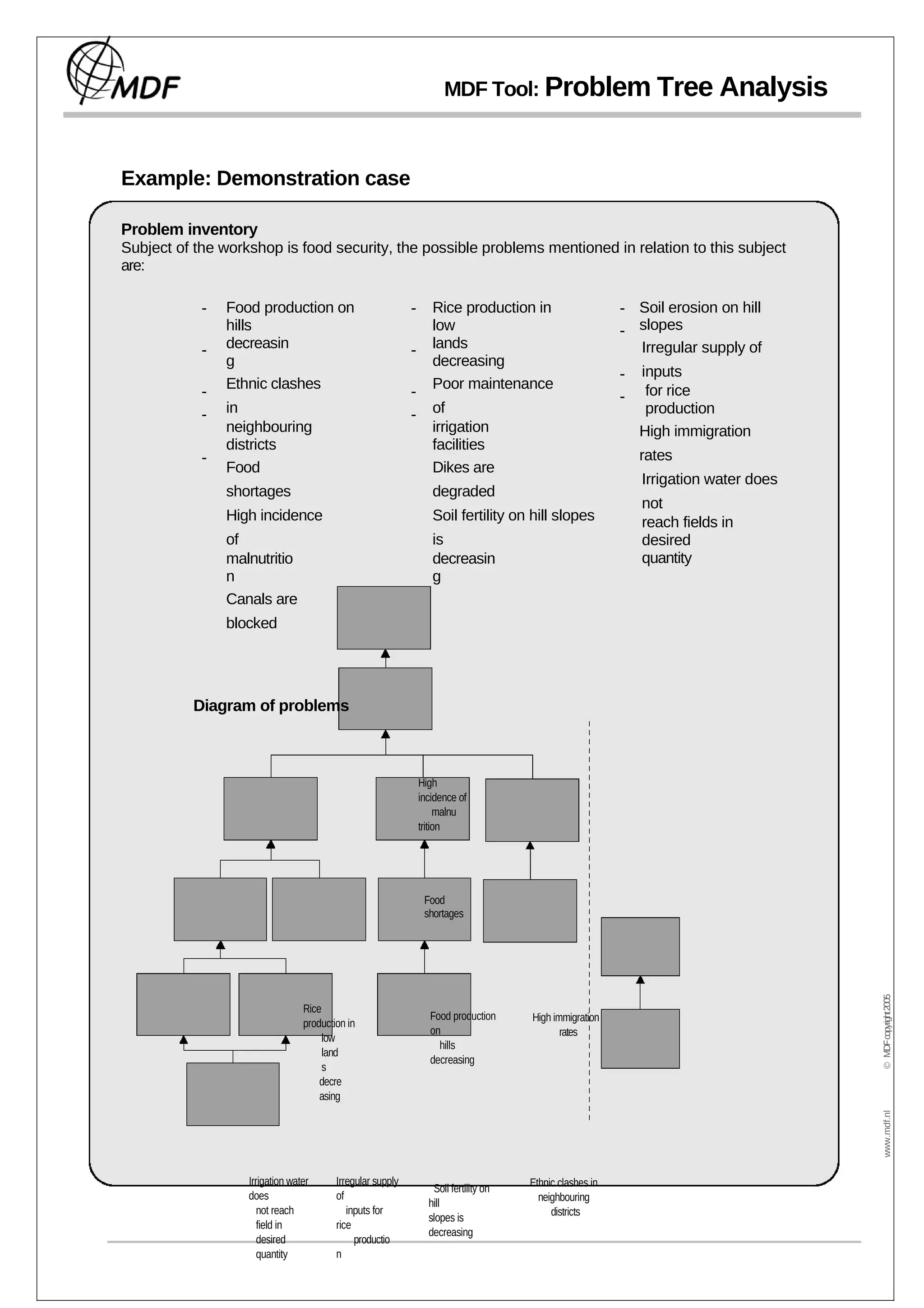
           problem(s) which cause(s) it, and followed by the problem it causes itself. For
           example: the rice production in the low lands is decreasing due to the irrigation
           water not reaching the fields and due to the fact that there is an irregular supply of
           inputs for rice production.
                                                                                                            © MDF copyright 2005


           The problem of a decreasing rice production itself contributes to the problem of
           food shortages.

           2         Objectives
           analysis
           After the problem analysis follows the analysis of objectives. This analysis
                                                                                                             www.mdf.nl


           includes:
           • the translation of the negative situations in the problem tree into a realised
           positive
               state (the objectives) for example, 'low rice production' is converted into 'improved
               rice
               production';
           • verification of the hierarchy of
           objectives;
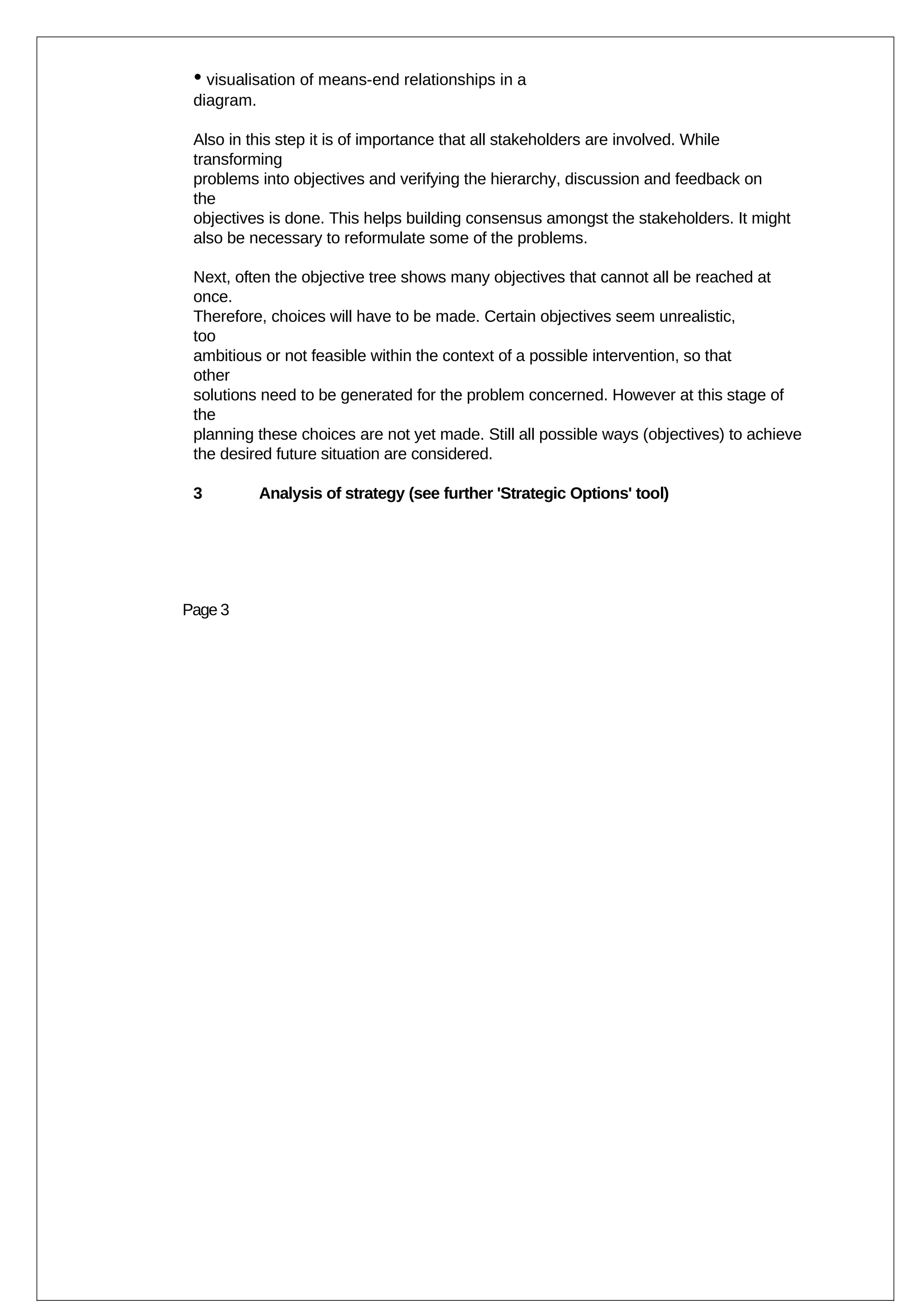
• visualisation of means-end relationships in a
 diagram.

 Also in this step it is of importance that all stakeholders are involved. While
 transforming
 problems into objectives and verifying the hierarchy, discussion and feedback on
 the
 objectives is done. This helps building consensus amongst the stakeholders. It might
 also be necessary to reformulate some of the problems.

 Next, often the objective tree shows many objectives that cannot all be reached at
 once.
 Therefore, choices will have to be made. Certain objectives seem unrealistic,
 too
 ambitious or not feasible within the context of a possible intervention, so that
 other
 solutions need to be generated for the problem concerned. However at this stage of
 the
 planning these choices are not yet made. Still all possible ways (objectives) to achieve
 the desired future situation are considered.

 3          Analysis of strategy (see further 'Strategic Options' tool)


Page 3
MDF Tool: Problem Tree Analysis


After having formulated the desired future situation the selection of possible interventions
starts. To analyse the strategies for implementation the following steps are taken:
• identification of the different possible groups of objectives contributing to a higher
    objective (clustering);
• choice of a strategy for the intervention, choosing the scope of the project (scoping).
In the process of clustering and scoping it is important to realise that the aim is to
contribute the maximum possible to an overall objective, keeping in mind the priorities of
the beneficiaries, and the limitations and possibilities of the implementing organisation.

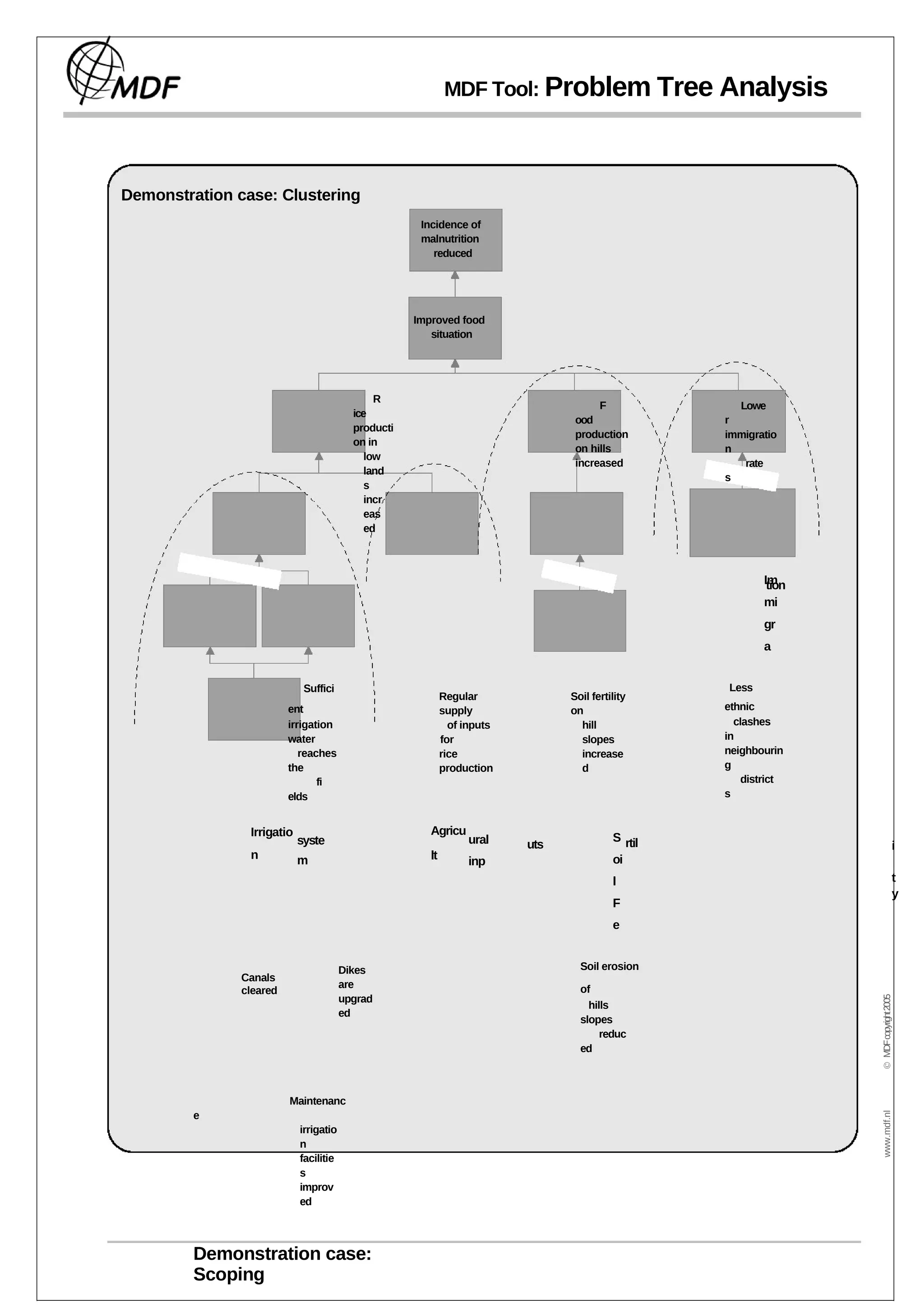
In the diagram of objectives, the different objectives sharing the same nature can be
considered to be clusters. The clustering should be based on common sense and should be of
practical value in the planning stage. The clusters should be neither too broadly nor
too narrowly defined. It concerns the identification and selection of potential alternative
strategies towards realising all or some of the objectives. Clusters are made based on
similarity of possible future activities, region or required expertise.

In the demonstration case these clusters are irrigation system, agricultural inputs, soil
fertility and immigration. For each of these clusters a different type of expertise is needed.

Out of the clusters, one (and often more) will be chosen and used as the strategy to
achieve a future desired situation: the aims of the intervention. This is called scoping, or
choosing a strategy. Based on a number of criteria, the most relevant and feasible
strategy is selected. Unrealistic objectives should be excluded and objectives that
certainly should be included should be prioritised. The criteria have to be chosen and
agreed upon by all stakeholders. Examples of possible criteria:

-   priorities of beneficiaries                   -   donor policy
-   expertise and experience of                   -   fit with mandate of government
    implementing organisation                         authorities, sectoral policies
-   duration of implementation                    -   contributions of different stakeholders
-   urgency                                       -   available human resources, institutions
-   contribution to overall objectives            -   available budget
-   inter-linkages between clusters               -   shift in power relations
-   positive/negative side-effects                -   gender and social diversity aspects
-   sustainability                                -   likelihood of success
-   fit with mandate of implementing
    organisation

Groundwork
Preparatory phase
1          Define the subject
                                                                                                          © MDF copyright 2005


The first thing to do is to define the subject based on which the exercise will be done. The
subject is the framework for the discussion; no more and no less. The relevance of the
subject is to be discussed with the stakeholders (social actors that have a relation to the
subject). As soon as stakeholders are identified and invited to participate, the subject is
checked and a consensus on it should be reached. The subject needs to be understood by all
                                                                                                           www.mdf.nl


parties. Care should be taken that the formulation as such does not unintentionally exclude
certain (target) groups.

2        Stakeholder analysis (see also the 'Stakeholder analysis' tool)


                                                                                                 Page 4
MDF Tool: Problem Tree Analysis


It is important that all stakeholders get a chance to express their experiences and ideas
for the (new) project. Ideas from all different perspectives should be respected and used.
Not only individuals can be stakeholders, also organisations that have a social relation the
subject need to be involved. The active participation of old and young women and men,
married people, single headed households, landless, higher class and lower class, etc.
means that a representative group out of the beneficiaries is taking part in the process of project
development and implementation.

Depending on the setting, the following actors may be involved in the preparatory and
analysis phases:
• local communities, the 'problem owners'
• donor organisation
• implementing or grassroot organisations, NGOs
• local government officials
• facilitator who will do the moderation of the workshop

Follow up
Planning should continue with:

•   Developing the logical framework (in 'Logical Framework' tool)
•   Assessing and documenting assumptions and risks (in 'Assumptions' tool)
•   Defining targets, benchmarks and (in 'Indicators' tool)
•   Operational planning: Budgeting (no tool)
•   Operational planning: Who does what (in 'Participation matrix' tool)


Requirements and limitations
All stakeholders should participate in the scoping. This way, their commitment can be
obtained and, very important, their understanding for the choices made. Scoping is about
assessing with whom you are suited to do what, and what can better be left (to others). This is
why you may integrate some institutional and organisational analysis tools at this stage. They
give you an overview of current capacities and aspirations, so you consider both your own
capacity and those of others in deciding what you will define as within or outside the scope of
your project.
                                                                                                               © MDF copyright 2005
                                                                                                                www.mdf.nl


                                                                                                      Page 5
MDF Tool: Problem Tree Analysis


Example: Demonstration case

Problem inventory
Subject of the workshop is food security, the possible problems mentioned in relation to this subject
are:

            -   Food production on                          -      Rice production in                      - Soil erosion on hill
                hills                                              low                                     - slopes
            -   decreasin                                   -      lands                                     Irregular supply of
                g                                                  decreasing
                                                                                                           -   inputs
            -   Ethnic clashes                              -      Poor maintenance                             for rice
                                                                                                           -
            -   in                                          -      of                                           production
                neighbouring                                       irrigation                                  High immigration
                districts                                          facilities
            -                                                                                                  rates
                Food                                               Dikes are
                                                                                                               Irrigation water does
                shortages                                          degraded
                                                                                                               not
                High incidence                                     Soil fertility on hill slopes               reach fields in
                of                                                 is                                          desired
                malnutritio                                        decreasin                                   quantity
                n                                                  g
                Canals are
                blocked


          Diagram of problems


                                                                High
                                                                incidence of
                                                                     malnu
                                                                trition


                                                                 Food
                                                                 shortages
                                                                                                                                       © MDF copyright 2005


                                 Rice
                                                                  Food production      High immigration
                                 production in
                                                                  on                          rates
                                     low
                                                                    hills
                                     land
                                                                  decreasing
                                     s
                                     decre
                                     asing
                                                                                                                                        www.mdf.nl


                   Irrigation water      Irregular supply                              Ethnic clashes in
                                                                   Soil fertility on
                   does                  of                                              neighbouring
                                                                  hill
                      not reach             inputs for                                      districts
                                                                  slopes is
                      field in           rice
                                                                  decreasing
                      desired                 productio
                      quantity           n
Canals are                                              Effe
    blocked
                                                            ct

                                          Soil erosion on
                              Dikes are
                                          hill
                              degraded
                                                 slo
                                          pes
                                                            C
                                                            a
                                                            u
                                                            s
                                                            e


                  Poor
                 maintenance
                 system for
                 irrigation
                         faciliti
                 es


Page 6
MDF Tool: Problem Tree Analysis


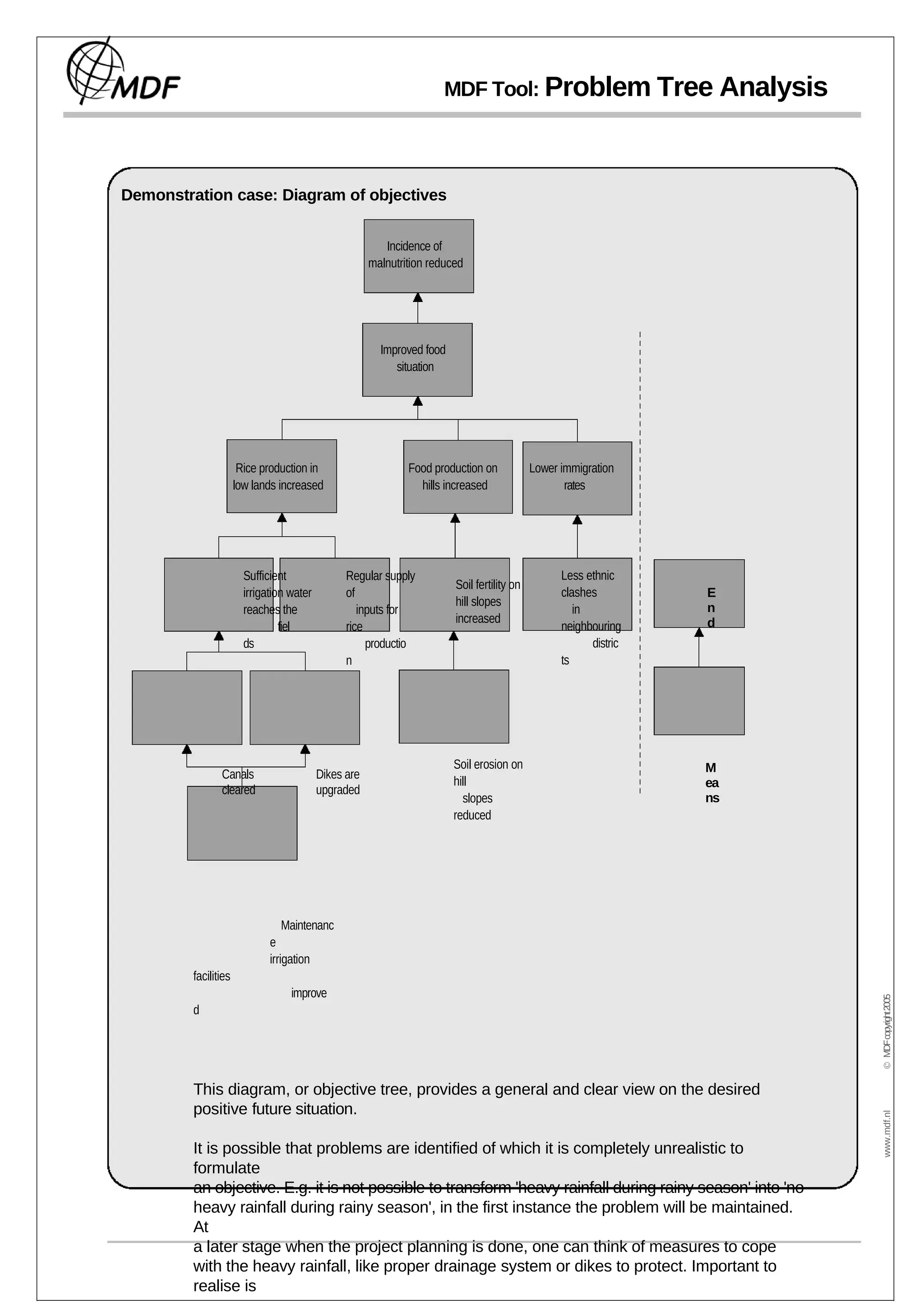
Demonstration case: Diagram of objectives


                                                          Incidence of
                                                       malnutrition reduced


                                                         Improved food
                                                            situation


                       Rice production in                      Food production on            Lower immigration
                      low lands increased                        hills increased                    rates


                        Sufficient               Regular supply                                    Less ethnic
                                                                         Soil fertility on
                        irrigation water         of                                                clashes         E
                                                                         hill slopes                               n
                        reaches the                 inputs for                                        in
                                                                         increased                                 d
                                 fiel            rice                                              neighbouring
                        ds                            productio                                          distric
                                                 n                                                 ts


                                                                         Soil erosion on                           M
                Canals                     Dikes are
                                                                         hill                                      ea
                cleared                    upgraded
                                                                           slopes                                  ns
                                                                         reduced


                                  Maintenanc
                              e
                              irrigation
         facilities
                                   improve
                                                                                                                        © MDF copyright 2005


         d


         This diagram, or objective tree, provides a general and clear view on the desired
         positive future situation.
                                                                                                                         www.mdf.nl


         It is possible that problems are identified of which it is completely unrealistic to
         formulate
         an objective. E.g. it is not possible to transform 'heavy rainfall during rainy season' into 'no
         heavy rainfall during rainy season', in the first instance the problem will be maintained.
         At
         a later stage when the project planning is done, one can think of measures to cope
         with the heavy rainfall, like proper drainage system or dikes to protect. Important to
         realise is
that while transforming problems into objectives one should remain realistic
 (is it feasible?).


Page 7
MDF Tool: Problem Tree Analysis


Demonstration case: Clustering
                                                      Incidence of
                                                      malnutrition
                                                         reduced


                                                     Improved food
                                                        situation


                                              R
                                                                                       F              Lowe
                                          ice
                                                                                  ood               r
                                          producti
                                                                                  production        immigratio
                                          on in
                                                                                  on hills          n
                                            low
                                                                                  increased            rate
                                            land
                                                                                                    s
                                            s
                                            incr
                                            eas
                                            ed


                                                                                                            Im
                                                                                                             tion
                                                                                                            mi
                                                                                                            gr
                                                                                                            a


                             Suffici                                                                Less
                                                             Regular             Soil fertility
                         ent                                 supply              on                 ethnic
                         irrigation                            of inputs           hill               clashes
                         water                               for                   slopes           in
                            reaches                          rice                  increase         neighbourin
                         the                                 production            d                g
                                fi                                                                      district
                         elds                                                                       s


                Irrigatio                               Agricu
                            syste                                 ural                     S rtil
                                                                           uts                                                        i
                n           m                           lt                                 oi
                                                                  inp
                                                                                           l                                          t
                                                                                                                                      y
                                                                                           F
                                                                                           e


                                        Dikes                                      Soil erosion
               Canals
                                        are                                        of
               cleared
                                        upgrad
                                                                                                                    © MDF copyright 2005


                                                                                     hills
                                        ed
                                                                                   slopes
                                                                                        reduc
                                                                                   ed


                         Maintenanc
         e
                                                                                                                     www.mdf.nl


                            irrigatio
                            n
                            facilitie
                            s
                            improv
                            ed


         Demonstration case:
         Scoping
Using different criteria in selecting one or more clusters the following decisions
 were
 taken:
 - Irrigation system: the beneficiaries indicate that this is a cluster that requires
 urgent
     intervention. Working on irrigation issues suits the policy of both the local
     government
     and the implementing agency. Besides the implementing organization has a
     vast experience in similar projects.
 -   Agricultural inputs: in the workshop it was indicated that the suppliers of
 agricultural
     inputs intend to have a more regular supply, especially when the farmers are
     willing to
     pay a little more. When there will be sufficient water, the production will increase
     and thus the farmers will have more income to invest in agricultural inputs.
 -   Soil fertility: working on soil fertility issues requires a special expertise and it is
 known
    that the local government and the agricultural university run a successful project
    on soil fertility management.
 -   Immigration: this is probably the most sensitive and difficult cluster to deal with.
 The
       beneficiaries and the implementing organisation do not see any chance for them to
       try
       and work on this issue. It is typically a task for the politicians and the
       government.


Page 8
MDF Tool: Problem Tree Analysis


    Therefore this is not taken up in the implementation of the new project. It's simply not feasible.

Conclusion: the project will focus on the irrigation system cluster.


                                                                                                                  © MDF copyright 2005
                                                                                                                   www.mdf.nl


                                                                                                         Page 9
MDF Tool: Problem Tree Analysis


Steps in the analysis and planning process at target group level
The below overview gives the steps that have to be taken to complete a planning process.
The different steps serve as the basis for the subsequent chapters in this tool, as well as the
'Logical Framework' and 'Assumptions' tool.


Preparatory phase

0. Define the subject
Define the subject of the OOPP workshop

0. Stakeholder analysis
Analysis the parties that have an interest in the subject


Analysis phase

          1 Problem analysis
          . Check the subject with the
          • stakeholders
          • Make an inventory of all perceived
          • problems
          • Check whether these problems are commonly
            understood
            Build the problem tree (cause-effect
            relations)

          2. Objectives analysis
          • Convert the problem tree into an objective
          tree
          • Check consistency of means-end relations, if necessary reformulate
          objectives

          3. Analysis of strategy
          • Divide the objective tree into clusters
          (clustering)
          • Select the clusters which will be included in the intervention
          (scoping)
          At this stage also use institutional analysis
                                                                                                  © MDF copyright 2005


          tools
                                                                                                   www.mdf.nl
Page 1

Understanding logframe ___problem_tree_analysis_____by_dr_malik_khalid_mehmood_ph_d

  • 1.
    MDF Tool: ProblemTree Analysis Problem Tree Analysis By Dr Malik Khalid Mehmood PhD What is it? The Problem Tree method is a planning method based on needs, however it is not a mechanical translation of problems into objectives. While going through the process, taking the different steps, there is continuously room for opportunities, new ideas and contributions from the involved parties. Problem Tree Analysis should be followed by actual project planning, e.g. with the Logical Framework approach. Alongside, or interwoven with the steps of Problem Analysis (at target group level) and project planning (for the target group), one should analyse the capacity and intentions of stakeholders and the wider institutional context, so that relevant and realistic choices can be made on who does what. Participatory methods 'The better and more participatory the method for identification, the more likely it is that different aspects of poverty and inequality among the poor will appear, such as those of gender, age, class and ethnicity. It also gives particular insight in the distribution of power within the target groups. The challenge is how to manage these differences and address the varying needs, interests and opportunities with them' (from Building bridges in PME). A successful outcome of using participatory methods depends on the familiarity of the facilitator with the method, the attitude of the facilitator and the implementers and the amount of time that is reserved to do the identification and planning. Particular efforts are made to involve all members of a community into participatory action planning. What can you do with it? Basic (sub-) questions • address the real needs of the beneficiaries © MDF copyright 2005 Results This process will result in an 'image of reality', enabling the formulation of projects that comprise objectives that have been accepted and supported by all parties concerned. Information collected through these methods can be used as input for a project planning workshop. www.mdf.nl Page 1
  • 2.
    MDF Tool: ProblemTree Analysis How to use it? Process A properly planned project addressing the real needs of the beneficiaries is necessarily based upon a correct and complete analysis of the existing situation. The existing situation should be interpreted according to the views, needs, interests and activities of parties concerned. It is essential that all those involved accept the plans and are committed to implement them. The Problem Tree Analysis belongs to the family of participatory planning techniques, in which all parties involved identify and analyse the needs together. Participatory methods aim to create ownership and commitment among the involved parties (e.g. beneficiaries, implementing organisations, local governments). Three stages in the analysis process in the Problem Analysis method will be discussed: • the analysis of problems related to the subject (the image of reality); • the analysis of objectives (the image of a future, improved situation); • the analysis of strategies (the comparison of different chains of objective). There are several complementary methods to analyse a situation: • expert studies giving answers to questions as experts conceive them; • interviews with representatives of concerned groups and organisations providing perceptions as existing within that particular group or organisation; • a meeting, in which representatives of all parties concerned, including experts, discuss the same questions in a participatory way, often leading to an analysis, which is shared by all (e.g. Participatory Rural Appraisal). 1 Problem analysis The problem analysis is of major importance with regard to project planning, since it strongly influences the design of a possible intervention(s). It is the basis and the justification for the project design. The problem analysis includes: • verification of the subject of analysis; • identification of problems related to the subject; make and inventory of all problems perceived by all participants in the workshop; • establishment of a cause-effect hierarchy between the problems; • visualisation of the cause-effect relations in a diagram. It is important that all participants get the chance to express the problems they experience. After discussion and clarification by the 'problem owner' all problems should be respected. It is important to determine whether the different groups of people perceive the problem in the same way; if not the problem should be reformulated or split. For example, if the © MDF copyright 2005 problem mentioned is 'our family income is not sufficient', for a woman it could mean that she cannot buy vegetables and meat, whereas for the man in the family this could mean that he is not satisfied about the yields. www.mdf.nl Page 2
  • 3.
    MDF Tool: ProblemTree Analysis Do's and Don'ts in formulation of problems Don'ts: Do's: No big balloons or big vague concepts, bu Be precise, e.g. there is no paved road e.g. t from no Chittoor to infrastructure Mahabubnagar bu No absent solutions (danger: you t Instead, the problem is: school fees are block not alternatives), e.g. we have a lack of affordable money and thus children don't go to bu school t The problem now is that there is no No non- existing problems, e.g. knowledge on how to run an no NGO existence of NGOs (in former bu dictatorial countries possibly a t problem in the past) The government does not issue licenses No formulation of interpretations, e.g. the government is lazy And further: explain abbreviations and jargo n After a common understanding of all problems is reached, the analysis is presented in the form of a diagram, or a problem tree. A problem is never an isolated negative perceived situation, but relates to other problems. In the problem tree the relations and hierarchy among all identified problems is expressed. Each stated problem is preceded by the problem(s) which cause(s) it, and followed by the problem it causes itself. For example: the rice production in the low lands is decreasing due to the irrigation water not reaching the fields and due to the fact that there is an irregular supply of inputs for rice production. © MDF copyright 2005 The problem of a decreasing rice production itself contributes to the problem of food shortages. 2 Objectives analysis After the problem analysis follows the analysis of objectives. This analysis www.mdf.nl includes: • the translation of the negative situations in the problem tree into a realised positive state (the objectives) for example, 'low rice production' is converted into 'improved rice production'; • verification of the hierarchy of objectives;
  • 4.
    • visualisation ofmeans-end relationships in a diagram. Also in this step it is of importance that all stakeholders are involved. While transforming problems into objectives and verifying the hierarchy, discussion and feedback on the objectives is done. This helps building consensus amongst the stakeholders. It might also be necessary to reformulate some of the problems. Next, often the objective tree shows many objectives that cannot all be reached at once. Therefore, choices will have to be made. Certain objectives seem unrealistic, too ambitious or not feasible within the context of a possible intervention, so that other solutions need to be generated for the problem concerned. However at this stage of the planning these choices are not yet made. Still all possible ways (objectives) to achieve the desired future situation are considered. 3 Analysis of strategy (see further 'Strategic Options' tool) Page 3
  • 5.
    MDF Tool: ProblemTree Analysis After having formulated the desired future situation the selection of possible interventions starts. To analyse the strategies for implementation the following steps are taken: • identification of the different possible groups of objectives contributing to a higher objective (clustering); • choice of a strategy for the intervention, choosing the scope of the project (scoping). In the process of clustering and scoping it is important to realise that the aim is to contribute the maximum possible to an overall objective, keeping in mind the priorities of the beneficiaries, and the limitations and possibilities of the implementing organisation. In the diagram of objectives, the different objectives sharing the same nature can be considered to be clusters. The clustering should be based on common sense and should be of practical value in the planning stage. The clusters should be neither too broadly nor too narrowly defined. It concerns the identification and selection of potential alternative strategies towards realising all or some of the objectives. Clusters are made based on similarity of possible future activities, region or required expertise. In the demonstration case these clusters are irrigation system, agricultural inputs, soil fertility and immigration. For each of these clusters a different type of expertise is needed. Out of the clusters, one (and often more) will be chosen and used as the strategy to achieve a future desired situation: the aims of the intervention. This is called scoping, or choosing a strategy. Based on a number of criteria, the most relevant and feasible strategy is selected. Unrealistic objectives should be excluded and objectives that certainly should be included should be prioritised. The criteria have to be chosen and agreed upon by all stakeholders. Examples of possible criteria: - priorities of beneficiaries - donor policy - expertise and experience of - fit with mandate of government implementing organisation authorities, sectoral policies - duration of implementation - contributions of different stakeholders - urgency - available human resources, institutions - contribution to overall objectives - available budget - inter-linkages between clusters - shift in power relations - positive/negative side-effects - gender and social diversity aspects - sustainability - likelihood of success - fit with mandate of implementing organisation Groundwork Preparatory phase 1 Define the subject © MDF copyright 2005 The first thing to do is to define the subject based on which the exercise will be done. The subject is the framework for the discussion; no more and no less. The relevance of the subject is to be discussed with the stakeholders (social actors that have a relation to the subject). As soon as stakeholders are identified and invited to participate, the subject is checked and a consensus on it should be reached. The subject needs to be understood by all www.mdf.nl parties. Care should be taken that the formulation as such does not unintentionally exclude certain (target) groups. 2 Stakeholder analysis (see also the 'Stakeholder analysis' tool) Page 4
  • 6.
    MDF Tool: ProblemTree Analysis It is important that all stakeholders get a chance to express their experiences and ideas for the (new) project. Ideas from all different perspectives should be respected and used. Not only individuals can be stakeholders, also organisations that have a social relation the subject need to be involved. The active participation of old and young women and men, married people, single headed households, landless, higher class and lower class, etc. means that a representative group out of the beneficiaries is taking part in the process of project development and implementation. Depending on the setting, the following actors may be involved in the preparatory and analysis phases: • local communities, the 'problem owners' • donor organisation • implementing or grassroot organisations, NGOs • local government officials • facilitator who will do the moderation of the workshop Follow up Planning should continue with: • Developing the logical framework (in 'Logical Framework' tool) • Assessing and documenting assumptions and risks (in 'Assumptions' tool) • Defining targets, benchmarks and (in 'Indicators' tool) • Operational planning: Budgeting (no tool) • Operational planning: Who does what (in 'Participation matrix' tool) Requirements and limitations All stakeholders should participate in the scoping. This way, their commitment can be obtained and, very important, their understanding for the choices made. Scoping is about assessing with whom you are suited to do what, and what can better be left (to others). This is why you may integrate some institutional and organisational analysis tools at this stage. They give you an overview of current capacities and aspirations, so you consider both your own capacity and those of others in deciding what you will define as within or outside the scope of your project. © MDF copyright 2005 www.mdf.nl Page 5
  • 7.
    MDF Tool: ProblemTree Analysis Example: Demonstration case Problem inventory Subject of the workshop is food security, the possible problems mentioned in relation to this subject are: - Food production on - Rice production in - Soil erosion on hill hills low - slopes - decreasin - lands Irregular supply of g decreasing - inputs - Ethnic clashes - Poor maintenance for rice - - in - of production neighbouring irrigation High immigration districts facilities - rates Food Dikes are Irrigation water does shortages degraded not High incidence Soil fertility on hill slopes reach fields in of is desired malnutritio decreasin quantity n g Canals are blocked Diagram of problems High incidence of malnu trition Food shortages © MDF copyright 2005 Rice Food production High immigration production in on rates low hills land decreasing s decre asing www.mdf.nl Irrigation water Irregular supply Ethnic clashes in Soil fertility on does of neighbouring hill not reach inputs for districts slopes is field in rice decreasing desired productio quantity n
  • 8.
    Canals are Effe blocked ct Soil erosion on Dikes are hill degraded slo pes C a u s e Poor maintenance system for irrigation faciliti es Page 6
  • 9.
    MDF Tool: ProblemTree Analysis Demonstration case: Diagram of objectives Incidence of malnutrition reduced Improved food situation Rice production in Food production on Lower immigration low lands increased hills increased rates Sufficient Regular supply Less ethnic Soil fertility on irrigation water of clashes E hill slopes n reaches the inputs for in increased d fiel rice neighbouring ds productio distric n ts Soil erosion on M Canals Dikes are hill ea cleared upgraded slopes ns reduced Maintenanc e irrigation facilities improve © MDF copyright 2005 d This diagram, or objective tree, provides a general and clear view on the desired positive future situation. www.mdf.nl It is possible that problems are identified of which it is completely unrealistic to formulate an objective. E.g. it is not possible to transform 'heavy rainfall during rainy season' into 'no heavy rainfall during rainy season', in the first instance the problem will be maintained. At a later stage when the project planning is done, one can think of measures to cope with the heavy rainfall, like proper drainage system or dikes to protect. Important to realise is
  • 10.
    that while transformingproblems into objectives one should remain realistic (is it feasible?). Page 7
  • 11.
    MDF Tool: ProblemTree Analysis Demonstration case: Clustering Incidence of malnutrition reduced Improved food situation R F Lowe ice ood r producti production immigratio on in on hills n low increased rate land s s incr eas ed Im tion mi gr a Suffici Less Regular Soil fertility ent supply on ethnic irrigation of inputs hill clashes water for slopes in reaches rice increase neighbourin the production d g fi district elds s Irrigatio Agricu syste ural S rtil uts i n m lt oi inp l t y F e Dikes Soil erosion Canals are of cleared upgrad © MDF copyright 2005 hills ed slopes reduc ed Maintenanc e www.mdf.nl irrigatio n facilitie s improv ed Demonstration case: Scoping
  • 12.
    Using different criteriain selecting one or more clusters the following decisions were taken: - Irrigation system: the beneficiaries indicate that this is a cluster that requires urgent intervention. Working on irrigation issues suits the policy of both the local government and the implementing agency. Besides the implementing organization has a vast experience in similar projects. - Agricultural inputs: in the workshop it was indicated that the suppliers of agricultural inputs intend to have a more regular supply, especially when the farmers are willing to pay a little more. When there will be sufficient water, the production will increase and thus the farmers will have more income to invest in agricultural inputs. - Soil fertility: working on soil fertility issues requires a special expertise and it is known that the local government and the agricultural university run a successful project on soil fertility management. - Immigration: this is probably the most sensitive and difficult cluster to deal with. The beneficiaries and the implementing organisation do not see any chance for them to try and work on this issue. It is typically a task for the politicians and the government. Page 8
  • 13.
    MDF Tool: ProblemTree Analysis Therefore this is not taken up in the implementation of the new project. It's simply not feasible. Conclusion: the project will focus on the irrigation system cluster. © MDF copyright 2005 www.mdf.nl Page 9
  • 14.
    MDF Tool: ProblemTree Analysis Steps in the analysis and planning process at target group level The below overview gives the steps that have to be taken to complete a planning process. The different steps serve as the basis for the subsequent chapters in this tool, as well as the 'Logical Framework' and 'Assumptions' tool. Preparatory phase 0. Define the subject Define the subject of the OOPP workshop 0. Stakeholder analysis Analysis the parties that have an interest in the subject Analysis phase 1 Problem analysis . Check the subject with the • stakeholders • Make an inventory of all perceived • problems • Check whether these problems are commonly understood Build the problem tree (cause-effect relations) 2. Objectives analysis • Convert the problem tree into an objective tree • Check consistency of means-end relations, if necessary reformulate objectives 3. Analysis of strategy • Divide the objective tree into clusters (clustering) • Select the clusters which will be included in the intervention (scoping) At this stage also use institutional analysis © MDF copyright 2005 tools www.mdf.nl
  • 15.