
Problem Solving
A Systematic Approach For Solving Problems
By – Yugi Reddy
Welcome
IS Development
Problem Management
training
Agenda
 Training Objective
 Foundation Concepts
 Common Mistakes In Problem Solving
 The Problem Solving Process
 Problem Solving Exercises
 End Note
Problem Solving
Objectives Of This Training
Purpose
 As a result of experiences associated with often lengthened, erratic or
delayed identification, acknowledgement, recovery and resultant
indeterminate root cause on technical issues we experience within IS, the
need to improve problem management process has become urgent.
– The cost and organizational risk of any unnecessary delay in the
delivery of business critical applications for revenue generation is
significant.
– Another area of opportunity is in increased efficiency of the application
resources when addressing systems availability. We often have 5 to 7
or more IS resources working for days/weeks on problems that are
less than well identified or defined.
The goal of this training is to establish a standard process
for both production and in-flight projects that ensures
that problems are resolved in an efficient and effective
manner while minimizing the business impact and
likelihood of recurrence.
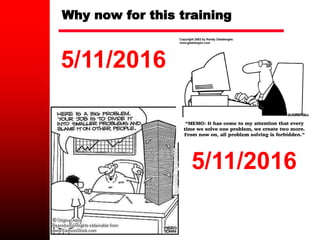
Why now for this training
5/11/2016
5/11/2016
Problem Solving
Introduction And Foundation Concepts
A moment on definitions
 Problem Management processes should have both reactive and proactive
aspects.
– The reactive aspects focuses on solving problems in response to one or more incidents
having occurred.
– Proactive Problem Management focuses on identifying and solving known errors before
incidents occur in the first place.
 Problem management requires accurate and comprehensive recording of
incidents in order to identify effectively and efficiently the cause of the incidents
and any trends.
– Problems are logged as incidents of various kinds like SCR’s in Team Track or as
Defects in HPQC
In terms of formal ITIL definition:
 A Problem is an unknown condition often identified as a result of either a single
significant error or multiple incidents that exhibit common symptoms.
 Problem Management is the process used to determine the root cause and
initiate action(s) to remove the error.
Incident vs. Problem
 Problems tend to focus more on detection of underlying causes of an
incident and their subsequent resolution and prevention. Investigation of
underlying problem can require some time and can often delay
restoration of service, causing downtime but preventing recurrence.
 Incident management is focused mainly on the restoration of service to
Customers as quickly as possible, often through a work-around rather
than through determination of a permanent resolution
Often both are required of us…identifying quick-fixes to restore service, as
well as continue on with prevention activities.
Problems are logged as incidents of various kinds like SCR’s in Team
Track or as Defects in HPQC
Roles
Processes tend to span functions within the organization. It is important to define the
responsibilities associated with the activities in the process that have to be performed. To
remain flexible, we’re using the concept of roles.
 Problem manager (on Projects it is PM, in Production it’s Kathy McClure)
 The problem manager has the responsibility for all problem management activities and has
the following specific responsibilities:
– Developing and maintaining process
– Producing management information
– Managing problem support staff
 Problem support
– Reactive:
• Identifying and Investigating problems, identifying root causes
• Raising and Logging Change Controls
• Monitoring progress on the resolution of known errors
• Advising and implementing the best available work-around
– Proactive:
• Identifying trends and potentially problematic sources
• Raising and Logging preventative Change Controls
• Advising and implementing the best possible long-term solution
• Preventing the replication of problems across multiple systems
Problem Solving
Common Mistakes In Problem Solving
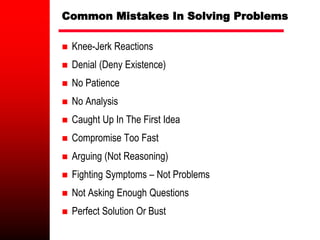
Common Mistakes In Solving Problems
 Knee-Jerk Reactions
 Denial (Deny Existence)
 No Patience
 No Analysis
 Caught Up In The First Idea
 Compromise Too Fast
 Arguing (Not Reasoning)
 Fighting Symptoms – Not Problems
 Not Asking Enough Questions
 Perfect Solution Or Bust
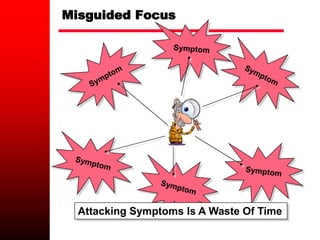
Misguided Focus
Attacking Symptoms Is A Waste Of Time
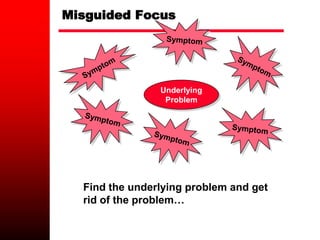
Misguided Focus
Underlying
Problem
Find the underlying problem and get
rid of the problem…
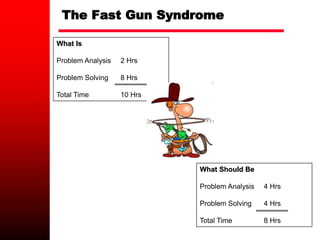
The Fast Gun Syndrome
What Is
Problem Analysis 2 Hrs
Problem Solving 8 Hrs
Total Time 10 Hrs
What Should Be
Problem Analysis 4 Hrs
Problem Solving 4 Hrs
Total Time 8 Hrs
Problem Solving
The Problem Solving Process
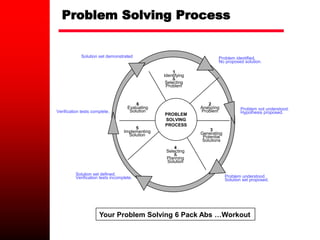
Problem Solving Process
PROBLEM
SOLVING
PROCESS
1
Identifying
&
Selecting
Problem
4
Selecting
&
Planning
Solution
3
Generating
Potential
Solutions
2
Analyzing
Problem
6
Evaluating
Solution
5
Implementing
Solution
Problem identified.
No proposed solution.
Problem not understood.
Hypothesis proposed.
Problem understood.
Solution set proposed.
Solution set defined.
Verification tests incomplete.
Verification tests complete.
Solution set demonstrated
Your Problem Solving 6 Pack Abs …Workout
Identifying The Problem
 Identify the problem area
 Define the problem statement
 Refine the problem statement
 Measure the problem (if possible)
 Collect as much information on the problem statement (and
only the problem statement – do not go astray) as possible
 Ensure that the team is on the same page as far as the
problem statement is concerned
Step – 1
Identifying The Problem
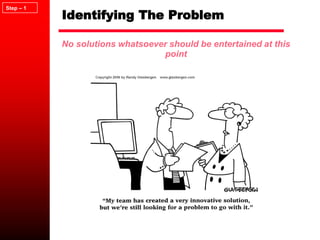
No solutions whatsoever should be entertained at this
point
Step – 1
Analyzing The Problem
 The most important step
 Use Tools like WBS or Fishbone Diagram
 Document assumptions and challenge them
 Document constraints
 Break down the problem into smaller sub-parts
 Ask searching questions – Follow the “5 Whys”
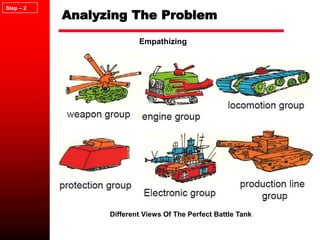
 Understanding Different Views Of The Same Problem –
Empathy
Step – 2
Analyzing The Problem
Step – 2
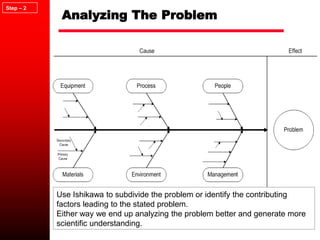
Use Ishikawa to subdivide the problem or identify the contributing
factors leading to the stated problem.
Either way we end up analyzing the problem better and generate more
scientific understanding.
Analyzing The Problem
Tips For Challenging Assumptions
 Recognize that you and everyone else have ingrained assumptions
about every situation.
 Ask plenty of basic questions in order to discover and challenge those
assumptions.
 Pretend you are a complete outsider and ask questions like ‘Why do we
do it this way at all?’
 Reduce a situation to its simplest components in order to take it out of
your environment.
 Restate a problem in different terms.
 Consider what the experts and professionals advise and then consider
doing the opposite.
Step – 2
Analyzing The Problem
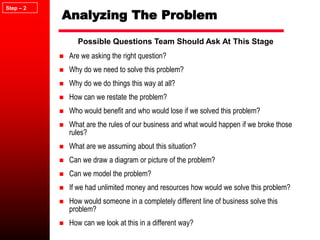
 Are we asking the right question?
 Why do we need to solve this problem?
 Why do we do things this way at all?
 How can we restate the problem?
 Who would benefit and who would lose if we solved this problem?
 What are the rules of our business and what would happen if we broke those
rules?
 What are we assuming about this situation?
 Can we draw a diagram or picture of the problem?
 Can we model the problem?
 If we had unlimited money and resources how would we solve this problem?
 How would someone in a completely different line of business solve this
problem?
 How can we look at this in a different way?
Step – 2
Possible Questions Team Should Ask At This Stage
Analyzing The Problem
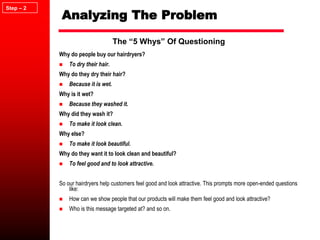
Why do people buy our hairdryers?
 To dry their hair.
Why do they dry their hair?
 Because it is wet.
Why is it wet?
 Because they washed it.
Why did they wash it?
 To make it look clean.
Why else?
 To make it look beautiful.
Why do they want it to look clean and beautiful?
 To feel good and to look attractive.
So our hairdryers help customers feel good and look attractive. This prompts more open-ended questions
like:
 How can we show people that our products will make them feel good and look attractive?
 Who is this message targeted at? and so on.
Step – 2
The “5 Whys” Of Questioning
Analyzing The Problem
Step – 2
Empathizing
Different Views Of The Perfect Battle Tank
Generating Potential Solutions
 Before doing this, remember that there should be multiple
solutions – This mindset is very important
 First find the perfect solution and also the resources, cost
and time it would take to implement this perfect solution.
 Now identify other “Less – Than – Perfect’ solutions and
also document their tradeoffs.
 Rank the tradeoffs in order of your organizations priority
 Adopt tools like Brainstorming or Mind Mapping
Step – 3
Generating Potential Solutions
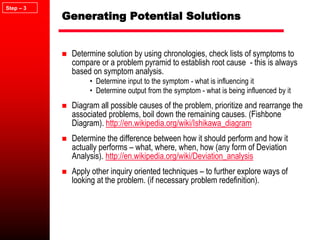
 Determine solution by using chronologies, check lists of symptoms to
compare or a problem pyramid to establish root cause - this is always
based on symptom analysis.
• Determine input to the symptom - what is influencing it
• Determine output from the symptom - what is being influenced by it
 Diagram all possible causes of the problem, prioritize and rearrange the
associated problems, boil down the remaining causes. (Fishbone
Diagram). http://en.wikipedia.org/wiki/Ishikawa_diagram
 Determine the difference between how it should perform and how it
actually performs – what, where, when, how (any form of Deviation
Analysis). http://en.wikipedia.org/wiki/Deviation_analysis
 Apply other inquiry oriented techniques – to further explore ways of
looking at the problem. (if necessary problem redefinition).
Step – 3
Selecting And Planning Solutions
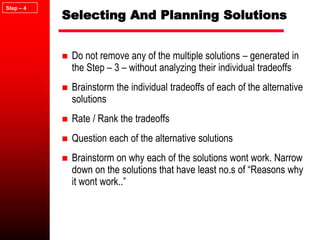
 Do not remove any of the multiple solutions – generated in
the Step – 3 – without analyzing their individual tradeoffs
 Brainstorm the individual tradeoffs of each of the alternative
solutions
 Rate / Rank the tradeoffs
 Question each of the alternative solutions
 Brainstorm on why each of the solutions wont work. Narrow
down on the solutions that have least no.s of “Reasons why
it wont work..”
Step – 4
Selecting And Planning Solutions
Step – 4
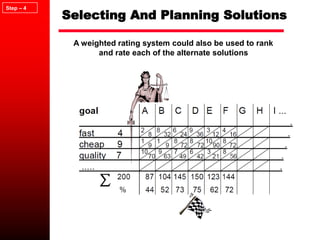
A weighted rating system could also be used to rank
and rate each of the alternate solutions
Implementing Solution
 Communicate the “Selected Solution” to every key person
 Communicate all aspects of the selected solutions
 Decide on “Piloting” Vs “Main-Stream” implementation of the
solution
 Assess impact of any change that has to be made based on
the solution implementation
 Be very “Critical” of the solution under implementation
 Verify if the solution actually solved the problem or not.
 Verify if the solution solved the problem in all circumstances
or only in some. Document your findings on this and
communicate to all the parties involved.
Step – 5
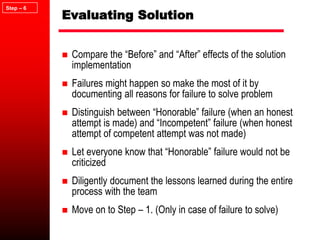
Evaluating Solution
 Compare the “Before” and “After” effects of the solution
implementation
 Failures might happen so make the most of it by
documenting all reasons for failure to solve problem
 Distinguish between “Honorable” failure (when an honest
attempt is made) and “Incompetent” failure (when honest
attempt of competent attempt was not made)
 Let everyone know that “Honorable” failure would not be
criticized
 Diligently document the lessons learned during the entire
process with the team
 Move on to Step – 1. (Only in case of failure to solve)
Step – 6
Problem Solving
Some Exercises
Exercise – 1 The Athens Vandals
 Just like any other historical place the authorities in Athens
were very concerned that tourists sometimes hacked pieces
from the ancient columns of the Parthenon building.
 The practice is illegal but some people were determined to
take away souvenirs.
 There are several souvenir shops but hardly anyone buys
from it as tourists feel that they are not “Original”
memorabilia and keep hacking away at the pillars and
monuments to get hold of some “Original” souvenir.
 How would you solve this problem.
 Please use the six step method (as far as possible) for
documenting and solving the problem
Exercise – 2 The Athens Vandals
 A schoolteacher knew that the school superintendent would
visit the next day.
 The superintendent would ask questions such as spellings
or mental arithmetic of the class, and the teacher would
choose a pupil to answer.
 The teacher wanted to give the best impression of the
school.
 What instructions did she give the children in order to create
the best impression and maximize the chances that the right
answer was given to each question?
Final Note

Problem Management - Systematic Approach

  • 1.
    Problem Solving A SystematicApproach For Solving Problems By – Yugi Reddy
  • 2.
  • 3.
  • 4.
    Agenda  Training Objective Foundation Concepts  Common Mistakes In Problem Solving  The Problem Solving Process  Problem Solving Exercises  End Note
  • 5.
  • 6.
    Purpose  As aresult of experiences associated with often lengthened, erratic or delayed identification, acknowledgement, recovery and resultant indeterminate root cause on technical issues we experience within IS, the need to improve problem management process has become urgent. – The cost and organizational risk of any unnecessary delay in the delivery of business critical applications for revenue generation is significant. – Another area of opportunity is in increased efficiency of the application resources when addressing systems availability. We often have 5 to 7 or more IS resources working for days/weeks on problems that are less than well identified or defined. The goal of this training is to establish a standard process for both production and in-flight projects that ensures that problems are resolved in an efficient and effective manner while minimizing the business impact and likelihood of recurrence.
  • 7.
    Why now forthis training 5/11/2016 5/11/2016
  • 8.
  • 9.
    A moment ondefinitions  Problem Management processes should have both reactive and proactive aspects. – The reactive aspects focuses on solving problems in response to one or more incidents having occurred. – Proactive Problem Management focuses on identifying and solving known errors before incidents occur in the first place.  Problem management requires accurate and comprehensive recording of incidents in order to identify effectively and efficiently the cause of the incidents and any trends. – Problems are logged as incidents of various kinds like SCR’s in Team Track or as Defects in HPQC In terms of formal ITIL definition:  A Problem is an unknown condition often identified as a result of either a single significant error or multiple incidents that exhibit common symptoms.  Problem Management is the process used to determine the root cause and initiate action(s) to remove the error.
  • 10.
    Incident vs. Problem Problems tend to focus more on detection of underlying causes of an incident and their subsequent resolution and prevention. Investigation of underlying problem can require some time and can often delay restoration of service, causing downtime but preventing recurrence.  Incident management is focused mainly on the restoration of service to Customers as quickly as possible, often through a work-around rather than through determination of a permanent resolution Often both are required of us…identifying quick-fixes to restore service, as well as continue on with prevention activities. Problems are logged as incidents of various kinds like SCR’s in Team Track or as Defects in HPQC
  • 11.
    Roles Processes tend tospan functions within the organization. It is important to define the responsibilities associated with the activities in the process that have to be performed. To remain flexible, we’re using the concept of roles.  Problem manager (on Projects it is PM, in Production it’s Kathy McClure)  The problem manager has the responsibility for all problem management activities and has the following specific responsibilities: – Developing and maintaining process – Producing management information – Managing problem support staff  Problem support – Reactive: • Identifying and Investigating problems, identifying root causes • Raising and Logging Change Controls • Monitoring progress on the resolution of known errors • Advising and implementing the best available work-around – Proactive: • Identifying trends and potentially problematic sources • Raising and Logging preventative Change Controls • Advising and implementing the best possible long-term solution • Preventing the replication of problems across multiple systems
  • 12.
  • 13.
    Common Mistakes InSolving Problems  Knee-Jerk Reactions  Denial (Deny Existence)  No Patience  No Analysis  Caught Up In The First Idea  Compromise Too Fast  Arguing (Not Reasoning)  Fighting Symptoms – Not Problems  Not Asking Enough Questions  Perfect Solution Or Bust
  • 14.
  • 15.
    Misguided Focus Underlying Problem Find theunderlying problem and get rid of the problem…
  • 16.
    The Fast GunSyndrome What Is Problem Analysis 2 Hrs Problem Solving 8 Hrs Total Time 10 Hrs What Should Be Problem Analysis 4 Hrs Problem Solving 4 Hrs Total Time 8 Hrs
  • 17.
  • 18.
    Problem Solving Process PROBLEM SOLVING PROCESS 1 Identifying & Selecting Problem 4 Selecting & Planning Solution 3 Generating Potential Solutions 2 Analyzing Problem 6 Evaluating Solution 5 Implementing Solution Problemidentified. No proposed solution. Problem not understood. Hypothesis proposed. Problem understood. Solution set proposed. Solution set defined. Verification tests incomplete. Verification tests complete. Solution set demonstrated Your Problem Solving 6 Pack Abs …Workout
  • 19.
    Identifying The Problem Identify the problem area  Define the problem statement  Refine the problem statement  Measure the problem (if possible)  Collect as much information on the problem statement (and only the problem statement – do not go astray) as possible  Ensure that the team is on the same page as far as the problem statement is concerned Step – 1
  • 20.
    Identifying The Problem Nosolutions whatsoever should be entertained at this point Step – 1
  • 21.
    Analyzing The Problem The most important step  Use Tools like WBS or Fishbone Diagram  Document assumptions and challenge them  Document constraints  Break down the problem into smaller sub-parts  Ask searching questions – Follow the “5 Whys”  Understanding Different Views Of The Same Problem – Empathy Step – 2
  • 22.
    Analyzing The Problem Step– 2 Use Ishikawa to subdivide the problem or identify the contributing factors leading to the stated problem. Either way we end up analyzing the problem better and generate more scientific understanding.
  • 23.
    Analyzing The Problem TipsFor Challenging Assumptions  Recognize that you and everyone else have ingrained assumptions about every situation.  Ask plenty of basic questions in order to discover and challenge those assumptions.  Pretend you are a complete outsider and ask questions like ‘Why do we do it this way at all?’  Reduce a situation to its simplest components in order to take it out of your environment.  Restate a problem in different terms.  Consider what the experts and professionals advise and then consider doing the opposite. Step – 2
  • 24.
    Analyzing The Problem Are we asking the right question?  Why do we need to solve this problem?  Why do we do things this way at all?  How can we restate the problem?  Who would benefit and who would lose if we solved this problem?  What are the rules of our business and what would happen if we broke those rules?  What are we assuming about this situation?  Can we draw a diagram or picture of the problem?  Can we model the problem?  If we had unlimited money and resources how would we solve this problem?  How would someone in a completely different line of business solve this problem?  How can we look at this in a different way? Step – 2 Possible Questions Team Should Ask At This Stage
  • 25.
    Analyzing The Problem Whydo people buy our hairdryers?  To dry their hair. Why do they dry their hair?  Because it is wet. Why is it wet?  Because they washed it. Why did they wash it?  To make it look clean. Why else?  To make it look beautiful. Why do they want it to look clean and beautiful?  To feel good and to look attractive. So our hairdryers help customers feel good and look attractive. This prompts more open-ended questions like:  How can we show people that our products will make them feel good and look attractive?  Who is this message targeted at? and so on. Step – 2 The “5 Whys” Of Questioning
  • 26.
    Analyzing The Problem Step– 2 Empathizing Different Views Of The Perfect Battle Tank
  • 27.
    Generating Potential Solutions Before doing this, remember that there should be multiple solutions – This mindset is very important  First find the perfect solution and also the resources, cost and time it would take to implement this perfect solution.  Now identify other “Less – Than – Perfect’ solutions and also document their tradeoffs.  Rank the tradeoffs in order of your organizations priority  Adopt tools like Brainstorming or Mind Mapping Step – 3
  • 28.
    Generating Potential Solutions Determine solution by using chronologies, check lists of symptoms to compare or a problem pyramid to establish root cause - this is always based on symptom analysis. • Determine input to the symptom - what is influencing it • Determine output from the symptom - what is being influenced by it  Diagram all possible causes of the problem, prioritize and rearrange the associated problems, boil down the remaining causes. (Fishbone Diagram). http://en.wikipedia.org/wiki/Ishikawa_diagram  Determine the difference between how it should perform and how it actually performs – what, where, when, how (any form of Deviation Analysis). http://en.wikipedia.org/wiki/Deviation_analysis  Apply other inquiry oriented techniques – to further explore ways of looking at the problem. (if necessary problem redefinition). Step – 3
  • 29.
    Selecting And PlanningSolutions  Do not remove any of the multiple solutions – generated in the Step – 3 – without analyzing their individual tradeoffs  Brainstorm the individual tradeoffs of each of the alternative solutions  Rate / Rank the tradeoffs  Question each of the alternative solutions  Brainstorm on why each of the solutions wont work. Narrow down on the solutions that have least no.s of “Reasons why it wont work..” Step – 4
  • 30.
    Selecting And PlanningSolutions Step – 4 A weighted rating system could also be used to rank and rate each of the alternate solutions
  • 31.
    Implementing Solution  Communicatethe “Selected Solution” to every key person  Communicate all aspects of the selected solutions  Decide on “Piloting” Vs “Main-Stream” implementation of the solution  Assess impact of any change that has to be made based on the solution implementation  Be very “Critical” of the solution under implementation  Verify if the solution actually solved the problem or not.  Verify if the solution solved the problem in all circumstances or only in some. Document your findings on this and communicate to all the parties involved. Step – 5
  • 32.
    Evaluating Solution  Comparethe “Before” and “After” effects of the solution implementation  Failures might happen so make the most of it by documenting all reasons for failure to solve problem  Distinguish between “Honorable” failure (when an honest attempt is made) and “Incompetent” failure (when honest attempt of competent attempt was not made)  Let everyone know that “Honorable” failure would not be criticized  Diligently document the lessons learned during the entire process with the team  Move on to Step – 1. (Only in case of failure to solve) Step – 6
  • 33.
  • 34.
    Exercise – 1The Athens Vandals  Just like any other historical place the authorities in Athens were very concerned that tourists sometimes hacked pieces from the ancient columns of the Parthenon building.  The practice is illegal but some people were determined to take away souvenirs.  There are several souvenir shops but hardly anyone buys from it as tourists feel that they are not “Original” memorabilia and keep hacking away at the pillars and monuments to get hold of some “Original” souvenir.  How would you solve this problem.  Please use the six step method (as far as possible) for documenting and solving the problem
  • 35.
    Exercise – 2The Athens Vandals  A schoolteacher knew that the school superintendent would visit the next day.  The superintendent would ask questions such as spellings or mental arithmetic of the class, and the teacher would choose a pupil to answer.  The teacher wanted to give the best impression of the school.  What instructions did she give the children in order to create the best impression and maximize the chances that the right answer was given to each question?
  • 36.

Editor's Notes

  • #35 Trainer Notes: - Top solutions should be: - Best: Make marble pieces using the same kind of marble as the Parthenon and strew around the historical places. Tourists who like to have “original” memorabilia would think that something original is just lying around and would pick it up thus not finding a reason to hack the monuments and pillars. This is a solution that has been in use in Athens for the last 15 yrs or so and there has not been a single case of hacking or piercing the pillars or monuments since this time. Second Best: Make free souveniers shop available in the premises of the historical location thus allowing tourists not to hack the pillars and monuments. However this still does not solve the problem of “Original” souvenir
  • #36 Instructor Notes: Before the inspector arrived the teacher instructed the pupils always to raise their left hands if they did not know the answer or were unsure. If they were sure they knew the answer they should raise their right hand. The teacher chooses a different pupil every time, but always one who had raised his or her right hand. The Superintendent was duly impressed. (From Sloane and MacHale, 1993.)