INTRODUCTION
TO
NANOBIOTECHNOLOGY
JOSEPH ASAMOAH-ASARE
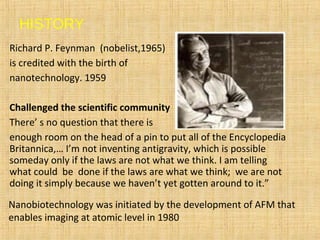
Richard P. Feynman (nobelist,1965)
is credited with the birth of
nanotechnology. 1959
Challenged the scientific community
There’ s no question that there is
enough room on the head of a pin to put all of the Encyclopedia
Britannica,… I’m not inventing antigravity, which is possible
someday only if the laws are not what we think. I am telling
what could be done if the laws are what we think; we are not
doing it simply because we haven’t yet gotten around to it.”
HISTORY
Nanobiotechnology was initiated by the development of AFM that
enables imaging at atomic level in 1980
Nano:
• The word nano is from the Greek word ‘Nanos’
meaning Dwarf. It is a prefix used to describe "one
billionth" of something, or 0.000000001.
• The word nano is from the Greek word ‘Nanos’
meaning Dwarf. It is a prefix used to describe "one
billionth" of something, or 0.000000001.
A prefix that means very,
very, small.
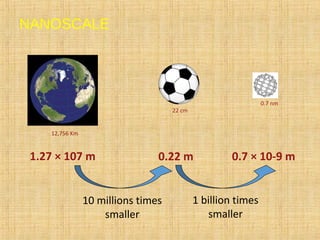
NANOSCALE
1.27 × 10⁷ m 0.22 m
0.7 nm
22 cm
12,756 Km
0.7 × 10⁻⁹ m
10 millions times
smaller
1 billion times
smaller
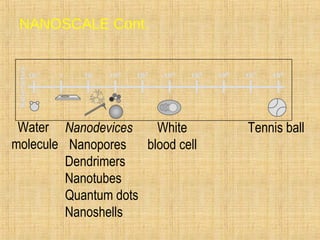
NANOSCALE Cont.
Water
molecule
Nanodevices
Nanopores
Dendrimers
Nanotubes
Quantum dots
Nanoshells
White
blood cell
Tennis ball
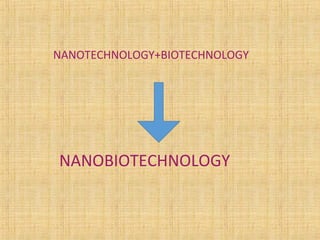
NANOTECHNOLOGY+BIOTECHNOLOGY
NANOBIOTECHNOLOGY
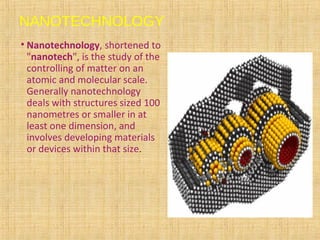
NANOTECHNOLOGY
• Nanotechnology, shortened to
"nanotech", is the study of the
controlling of matter on an
atomic and molecular scale.
Generally nanotechnology
deals with structures sized 100
nanometres or smaller in at
least one dimension, and
involves developing materials
or devices within that size.
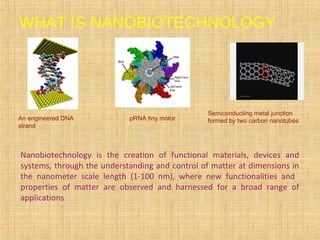
WHAT IS NANOBIOTECHNOLOGY
An engineered DNA
strand
pRNA tiny motor
Semiconducting metal junction
formed by two carbon nanotubes
Nanobiotechnology is the creation of functional materials, devices and
systems, through the understanding and control of matter at dimensions in
the nanometer scale length (1-100 nm), where new functionalities and
properties of matter are observed and harnessed for a broad range of
applications
NANOFABRICATION
•Bottom up approach
o molecular systems
o biomolecules
•Top down approach
oUV lithography
oIonic gelation
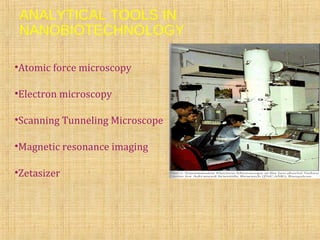
•Atomic force microscopy
•Electron microscopy
•Scanning Tunneling Microscope
•Magnetic resonance imaging
•Zetasizer
ANALYTICAL TOOLS IN
NANOBIOTECHNOLOGY
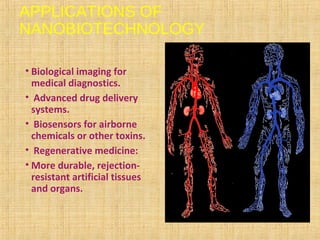
APPLICATIONS OF
NANOBIOTECHNOLOGY
• Biological imaging for
medical diagnostics.
• Advanced drug delivery
systems.
• Biosensors for airborne
chemicals or other toxins.
• Regenerative medicine:
• More durable, rejection-
resistant artificial tissues
and organs.
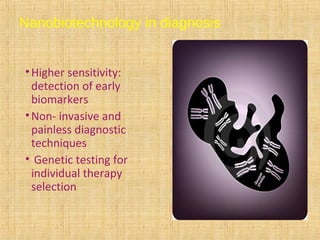
Nanobiotechnology in diagnosis
•Higher sensitivity:
detection of early
biomarkers
•Non- invasive and
painless diagnostic
techniques
• Genetic testing for
individual therapy
selection
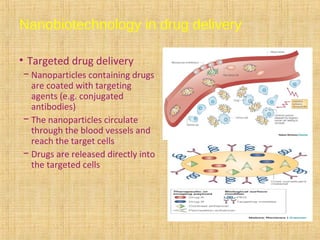
• Targeted drug delivery
− Nanoparticles containing drugs
are coated with targeting
agents (e.g. conjugated
antibodies)
− The nanoparticles circulate
through the blood vessels and
reach the target cells
− Drugs are released directly into
the targeted cells
Nanobiotechnology in drug delivery
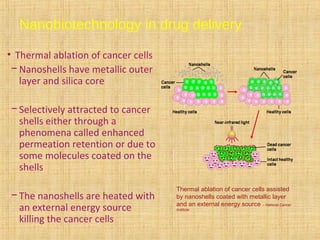
• Thermal ablation of cancer cells
− Nanoshells have metallic outer
layer and silica core
− Selectively attracted to cancer
shells either through a
phenomena called enhanced
permeation retention or due to
some molecules coated on the
shells
− The nanoshells are heated with
an external energy source
killing the cancer cells
Thermal ablation of cancer cells assisted
by nanoshells coated with metallic layer
and an external energy source – National Cancer
Institute
Nanobiotechnology in drug delivery
FUTURE GOALS AND CONCERNS OF
NANOBIOTECHNOLOGY
•Nanobiotechnology may be able to create many new materials
and devices with a vast range of applications, such as in
medicine, biomaterials and energy production.
•Nanobiotechnology raises many of the same issues as with any
introduction of new technology, including concerns about the
toxicity and environmental impact of nanomaterials, and their
potential effects on global economics.
THANK YOU

Introduction to nanobiotechnology

  • 1.
  • 2.
    Richard P. Feynman(nobelist,1965) is credited with the birth of nanotechnology. 1959 Challenged the scientific community There’ s no question that there is enough room on the head of a pin to put all of the Encyclopedia Britannica,… I’m not inventing antigravity, which is possible someday only if the laws are not what we think. I am telling what could be done if the laws are what we think; we are not doing it simply because we haven’t yet gotten around to it.” HISTORY Nanobiotechnology was initiated by the development of AFM that enables imaging at atomic level in 1980
  • 3.
    Nano: • The wordnano is from the Greek word ‘Nanos’ meaning Dwarf. It is a prefix used to describe "one billionth" of something, or 0.000000001. • The word nano is from the Greek word ‘Nanos’ meaning Dwarf. It is a prefix used to describe "one billionth" of something, or 0.000000001. A prefix that means very, very, small.
  • 4.
    NANOSCALE 1.27 × 10⁷m 0.22 m 0.7 nm 22 cm 12,756 Km 0.7 × 10⁻⁹ m 10 millions times smaller 1 billion times smaller
  • 5.
  • 6.
  • 7.
    NANOTECHNOLOGY • Nanotechnology, shortenedto "nanotech", is the study of the controlling of matter on an atomic and molecular scale. Generally nanotechnology deals with structures sized 100 nanometres or smaller in at least one dimension, and involves developing materials or devices within that size.
  • 8.
    WHAT IS NANOBIOTECHNOLOGY Anengineered DNA strand pRNA tiny motor Semiconducting metal junction formed by two carbon nanotubes Nanobiotechnology is the creation of functional materials, devices and systems, through the understanding and control of matter at dimensions in the nanometer scale length (1-100 nm), where new functionalities and properties of matter are observed and harnessed for a broad range of applications
  • 9.
    NANOFABRICATION •Bottom up approach omolecular systems o biomolecules •Top down approach oUV lithography oIonic gelation
  • 10.
    •Atomic force microscopy •Electronmicroscopy •Scanning Tunneling Microscope •Magnetic resonance imaging •Zetasizer ANALYTICAL TOOLS IN NANOBIOTECHNOLOGY
  • 11.
    APPLICATIONS OF NANOBIOTECHNOLOGY • Biologicalimaging for medical diagnostics. • Advanced drug delivery systems. • Biosensors for airborne chemicals or other toxins. • Regenerative medicine: • More durable, rejection- resistant artificial tissues and organs.
  • 12.
    Nanobiotechnology in diagnosis •Highersensitivity: detection of early biomarkers •Non- invasive and painless diagnostic techniques • Genetic testing for individual therapy selection
  • 13.
    • Targeted drugdelivery − Nanoparticles containing drugs are coated with targeting agents (e.g. conjugated antibodies) − The nanoparticles circulate through the blood vessels and reach the target cells − Drugs are released directly into the targeted cells Nanobiotechnology in drug delivery
  • 14.
    • Thermal ablationof cancer cells − Nanoshells have metallic outer layer and silica core − Selectively attracted to cancer shells either through a phenomena called enhanced permeation retention or due to some molecules coated on the shells − The nanoshells are heated with an external energy source killing the cancer cells Thermal ablation of cancer cells assisted by nanoshells coated with metallic layer and an external energy source – National Cancer Institute Nanobiotechnology in drug delivery
  • 15.
    FUTURE GOALS ANDCONCERNS OF NANOBIOTECHNOLOGY •Nanobiotechnology may be able to create many new materials and devices with a vast range of applications, such as in medicine, biomaterials and energy production. •Nanobiotechnology raises many of the same issues as with any introduction of new technology, including concerns about the toxicity and environmental impact of nanomaterials, and their potential effects on global economics.
  • 16.