Nanobiosensors
tion
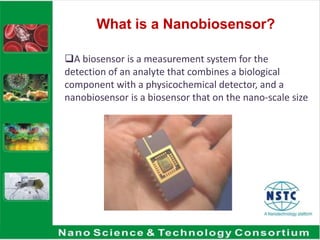
A biosensor is a measurement system for the
detection of an analyte that combines a biological
component with a physicochemical detector, and a
nanobiosensor is a biosensor that on the nano-scale size
What is a Nanobiosensor?
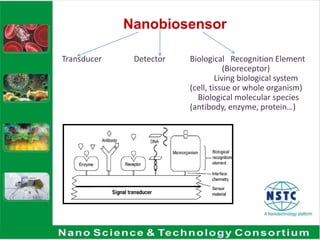
Nanobiosensor
Transducer Detector Biological Recognition Element
(Bioreceptor)
Living biological system
(cell, tissue or whole organism)
Biological molecular species
(antibody, enzyme, protein…)
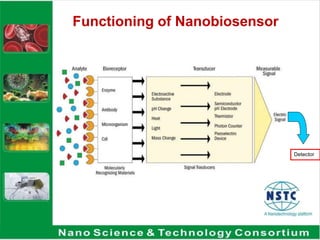
Functioning of Nanobiosensor
Detector
TYPES OF BIOSENSORS
Optical Biosensors
 Electrical Biosensors
 Electrochemical Biosensors
 Nanotube Based Biosensors
 Nanowire Biosensors
 Viral Nanosensors
 Nanoshell Biosensors
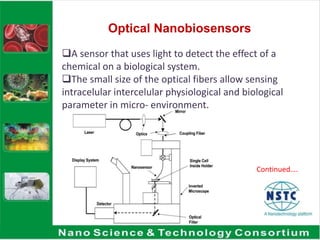
Optical Nanobiosensors
A sensor that uses light to detect the effect of a
chemical on a biological system.
The small size of the optical fibers allow sensing
intracelular intercelular physiological and biological
parameter in micro- environment.
Continued….
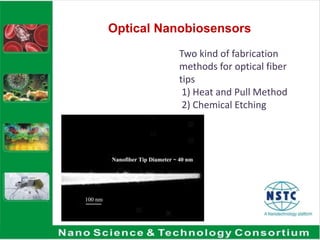
Optical Nanobiosensors
Two kind of fabrication
methods for optical fiber
tips
1) Heat and Pull Method
2) Chemical Etching
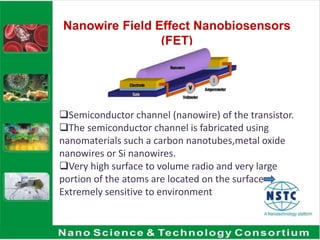
Nanowire Field Effect Nanobiosensors
(FET)
Semiconductor channel (nanowire) of the transistor.
The semiconductor channel is fabricated using
nanomaterials such a carbon nanotubes,metal oxide
nanowires or Si nanowires.
Very high surface to volume radio and very large
portion of the atoms are located on the surface
Extremely sensitive to environment
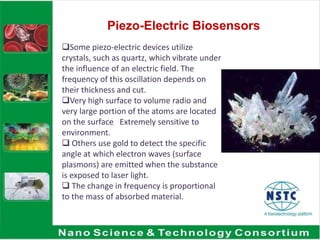
Piezo-Electric Biosensors
Some piezo-electric devices utilize
crystals, such as quartz, which vibrate under
the influence of an electric field. The
frequency of this oscillation depends on
their thickness and cut.
Very high surface to volume radio and
very large portion of the atoms are located
on the surface Extremely sensitive to
environment.
 Others use gold to detect the specific
angle at which electron waves (surface
plasmons) are emitted when the substance
is exposed to laser light.
 The change in frequency is proportional
to the mass of absorbed material.
Electrochemical Biosensors
Amperometric for applied current: Movement of
e- in redox reactions detected when a potential is
applied between two electrodes.
Potentiometric for voltage: Change in distribution
of charge is detected using ion-selective electrodes,
such as pH-meters.
Conductimetric for impedance
Applications of Nanobiosensors
Biological Applications
 DNA Sensors: Genetic monitoring, disease
 Immunosensors: HIV, Hepatitis,other viral diseas,
drug testing, environmental monitoring…
 Cell-based Sensors: functional sensors, drug testing…
 Point-of-care sensors: blood, urine, electrolytes,
gases, steroids, drugs, hormones, proteins, other…
 Bacteria Sensors (E-coli, streptococcus, other): food
industry, medicine, environmental, other.
 Enzyme sensors: diabetics, drug testing, other.
Environmental Applications
 Detection of environmental pollution and toxicity
 Agricultural monitoring
 Ground water screening
 Ocean monitoring
Future Applications of Nanobiosensors
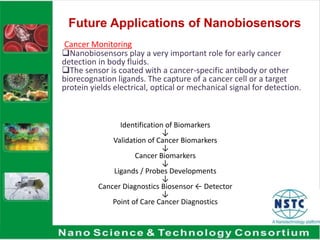
Cancer Monitoring
Nanobiosensors play a very important role for early cancer
detection in body fluids.
The sensor is coated with a cancer-specific antibody or other
biorecognation ligands. The capture of a cancer cell or a target
protein yields electrical, optical or mechanical signal for detection.
Identification of Biomarkers
↓
Validation of Cancer Biomarkers
↓
Cancer Biomarkers
↓
Ligands / Probes Developments
↓
Cancer Diagnostics Biosensor ← Detector
↓
Point of Care Cancer Diagnostics

Nanobiosensors

  • 1.
  • 2.
    tion A biosensor isa measurement system for the detection of an analyte that combines a biological component with a physicochemical detector, and a nanobiosensor is a biosensor that on the nano-scale size What is a Nanobiosensor?
  • 3.
    Nanobiosensor Transducer Detector BiologicalRecognition Element (Bioreceptor) Living biological system (cell, tissue or whole organism) Biological molecular species (antibody, enzyme, protein…)
  • 4.
  • 5.
    TYPES OF BIOSENSORS OpticalBiosensors  Electrical Biosensors  Electrochemical Biosensors  Nanotube Based Biosensors  Nanowire Biosensors  Viral Nanosensors  Nanoshell Biosensors
  • 6.
    Optical Nanobiosensors A sensorthat uses light to detect the effect of a chemical on a biological system. The small size of the optical fibers allow sensing intracelular intercelular physiological and biological parameter in micro- environment. Continued….
  • 7.
    Optical Nanobiosensors Two kindof fabrication methods for optical fiber tips 1) Heat and Pull Method 2) Chemical Etching
  • 8.
    Nanowire Field EffectNanobiosensors (FET) Semiconductor channel (nanowire) of the transistor. The semiconductor channel is fabricated using nanomaterials such a carbon nanotubes,metal oxide nanowires or Si nanowires. Very high surface to volume radio and very large portion of the atoms are located on the surface Extremely sensitive to environment
  • 9.
    Piezo-Electric Biosensors Some piezo-electricdevices utilize crystals, such as quartz, which vibrate under the influence of an electric field. The frequency of this oscillation depends on their thickness and cut. Very high surface to volume radio and very large portion of the atoms are located on the surface Extremely sensitive to environment.  Others use gold to detect the specific angle at which electron waves (surface plasmons) are emitted when the substance is exposed to laser light.  The change in frequency is proportional to the mass of absorbed material.
  • 10.
    Electrochemical Biosensors Amperometric forapplied current: Movement of e- in redox reactions detected when a potential is applied between two electrodes. Potentiometric for voltage: Change in distribution of charge is detected using ion-selective electrodes, such as pH-meters. Conductimetric for impedance
  • 11.
    Applications of Nanobiosensors BiologicalApplications  DNA Sensors: Genetic monitoring, disease  Immunosensors: HIV, Hepatitis,other viral diseas, drug testing, environmental monitoring…  Cell-based Sensors: functional sensors, drug testing…  Point-of-care sensors: blood, urine, electrolytes, gases, steroids, drugs, hormones, proteins, other…  Bacteria Sensors (E-coli, streptococcus, other): food industry, medicine, environmental, other.  Enzyme sensors: diabetics, drug testing, other. Environmental Applications  Detection of environmental pollution and toxicity  Agricultural monitoring  Ground water screening  Ocean monitoring
  • 12.
    Future Applications ofNanobiosensors Cancer Monitoring Nanobiosensors play a very important role for early cancer detection in body fluids. The sensor is coated with a cancer-specific antibody or other biorecognation ligands. The capture of a cancer cell or a target protein yields electrical, optical or mechanical signal for detection. Identification of Biomarkers ↓ Validation of Cancer Biomarkers ↓ Cancer Biomarkers ↓ Ligands / Probes Developments ↓ Cancer Diagnostics Biosensor ← Detector ↓ Point of Care Cancer Diagnostics