Today’s hot issues in: 
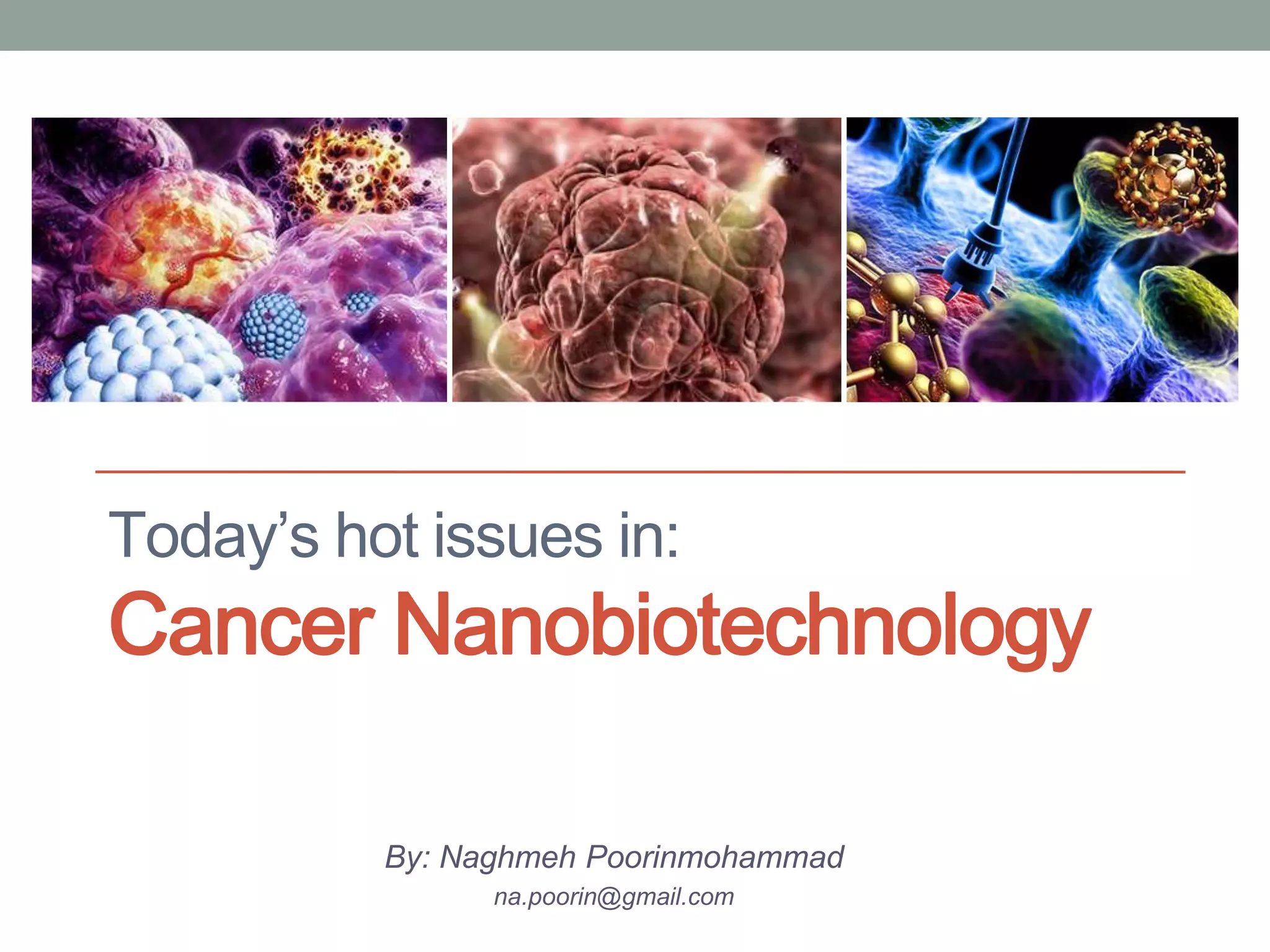
Cancer Nanobiotechnology 
By: Naghmeh Poorinmohammad 
na.poorin@gmail.com
Outline 
• Why nanotechnology is promising in cancer control? 
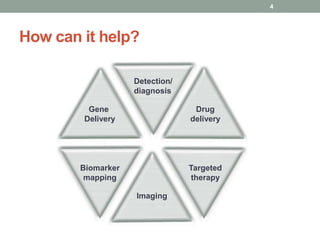
• How can it help? 
• “Today” what does nanotechnology do to amaze us? 
• Bright points aside/ Dark points aside... 
• Biotechnologists! Any ideas? 
• References 
2
3 
Why Nanotechnology is promising in cancer 
control? 
1. Limitations of Macromedicine: 
• Microscopic residual 
• Functional damage to organs 
• Resistance in cancer cells 
• Side effects of therapies 
2. Novelty of “nano” and its uncovered potentials 
• It is promising in other fields 
• It has shown unique properties 
ATTENTION: We now know some nano limitations also!
How can it help? 
Detection/ 
diagnosis 
Drug 
delivery 
Targeted 
therapy 
Imaging 
Gene 
Delivery 
Biomarker 
mapping 
4
Today what does nanotechnology do 
to amaze us?! 
1. Nanotheranostics 
2. Fighting with Cancer Stem Cells 
3. Novel nanodevices 
5
Today what does 
nanotechnology 
do to amaze us?! 
1. Nanotheranostics 
2. Fighting with 
Cancer Stem 
Cells 
3. Novel 
nanodevices 
6
Today what does 
nanotechnology 
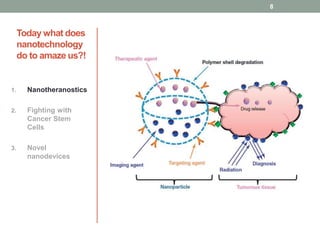
do to amaze us?! • Therapeutics + Diagnostics 
• Application of nanotechnology in preparation of 
dual-purpose nanomaterials used for 
simultaneous diagnosis and therapy. 
• A combined technique will result in an 
improved disease management, reduced risks 
and reduced cost. 
• Suitable theranostic approaches are expected 
for all diseases, especially cancer, in the future, 
although this will take some time. 
1. Nanotheranostics 
2. Fighting with 
Cancer Stem 
Cells 
3. Novel 
nanodevices 
7
Today what does 
nanotechnology 
do to amaze us?! 
1. Nanotheranostics 
2. Fighting with 
Cancer Stem 
Cells 
3. Novel 
nanodevices 
8
Today what does 
nanotechnology 
do to amaze us?! 
1. Nanotheranostics 
2. Fighting with 
Cancer Stem 
Cells 
3. Novel 
nanodevices 
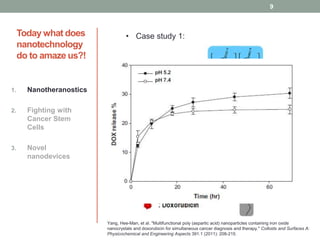
• Case study 1: 
9 
Yang, Hee-Man, et al. "Multifunctional poly (aspartic acid) nanoparticles containing iron oxide 
nanocrystals and doxorubicin for simultaneous cancer diagnosis and therapy." Colloids and Surfaces A: 
Physicochemical and Engineering Aspects 391.1 (2011): 208-215.
Today what does 
nanotechnology 
do to amaze us?! 
1. Nanotheranostics 
2. Fighting with 
Cancer Stem 
Cells 
3. Novel 
nanodevices 
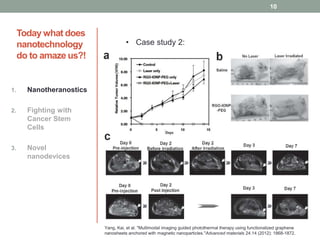
• Case study 2: 
10 
Yang, Kai, et al. "Multimodal imaging guided photothermal therapy using functionalized graphene 
nanosheets anchored with magnetic nanoparticles."Advanced materials 24.14 (2012): 1868-1872.
Today what does 
nanotechnology 
do to amaze us?! 
1. Nanotheranostics 
2. Fighting with 
Cancer Stem 
Cells 
3. Novel 
nanodevices 
11 
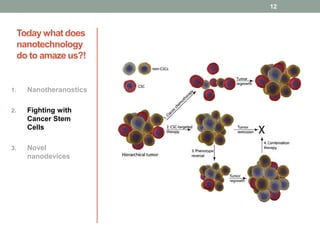
• CSCs are functionally and phenotypically distinct 
from other tumor cells. 
• Nanotechnology for the targeting of CSCs can 
provide us with a solution to cure cancer before a 
tumor forms 
• curcumin shows anti-CSC activity, but its efficacy 
is limited by its poor bioavailability. Compared with 
free curcumin, curcumin-loaded nanomedicine 
showed enhanced stability, bioavailability and 
antitumor effects (Mimeault and Batra 2011) 
• SWNTs conjugated with CD133 antibodies 
developed by Wang et al. and many other such 
studies.
Today what does 
nanotechnology 
do to amaze us?! 
1. Nanotheranostics 
2. Fighting with 
Cancer Stem 
Cells 
3. Novel 
nanodevices 
12
Today what does 
nanotechnology 
do to amaze us?! 
1. Nanotheranostics 
2. Fighting with 
Cancer Stem 
Cells 
3. Novel 
nanodevices 
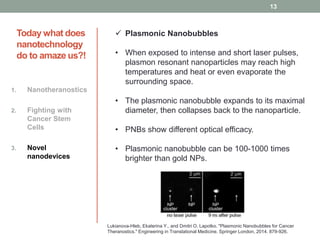
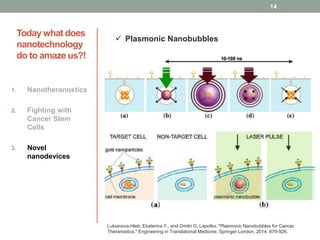
 Plasmonic Nanobubbles 
• When exposed to intense and short laser pulses, 
plasmon resonant nanoparticles may reach high 
temperatures and heat or even evaporate the 
surrounding space. 
• The plasmonic nanobubble expands to its maximal 
diameter, then collapses back to the nanoparticle. 
• PNBs show different optical efficacy. 
• Plasmonic nanobubble can be 100-1000 times 
brighter than gold NPs. 
13 
Lukianova-Hleb, Ekaterina Y., and Dmitri O. Lapotko. "Plasmonic Nanobubbles for Cancer 
Theranostics." Engineering in Translational Medicine. Springer London, 2014. 879-926.
Today what does 
nanotechnology 
do to amaze us?! 
1. Nanotheranostics 
2. Fighting with 
Cancer Stem 
Cells 
3. Novel 
nanodevices 
 Plasmonic Nanobubbles 
14 
Lukianova-Hleb, Ekaterina Y., and Dmitri O. Lapotko. "Plasmonic Nanobubbles for Cancer 
Theranostics." Engineering in Translational Medicine. Springer London, 2014. 879-926.
Bright points aside/ Dark points aside... 
• Toxicity/Biocompatibility studies 
Should be further investigated 
• Costs 
Sometimes high 
• Research output 
Let’s see in the next slides... 
15
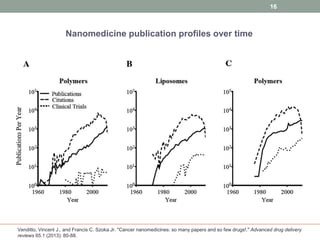
Nanomedicine publication profiles over time 
16 
Venditto, Vincent J., and Francis C. Szoka Jr. "Cancer nanomedicines: so many papers and so few drugs!." Advanced drug delivery 
reviews 65.1 (2013): 80-88.
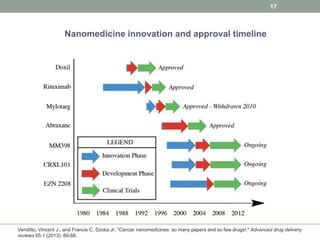
Nanomedicine innovation and approval timeline 
17 
Venditto, Vincent J., and Francis C. Szoka Jr. "Cancer nanomedicines: so many papers and so few drugs!." Advanced drug delivery 
reviews 65.1 (2013): 80-88.
BIOTECHNOLOGISTS! 
Any Ideas? 
18
References to Dig Deeper 
• Venditto, Vincent J., and Francis C. Szoka Jr. "Cancer nanomedicines: so many papers 
and so few drugs!." Advanced drug delivery reviews 65.1 (2013): 80-88. 
• Ahmed, Naveed, Hatem Fessi, and Abdelhamid Elaissari. "Theranostic applications of 
nanoparticles in cancer." Drug Discovery Today 17.17 (2012): 928-934. 
• Lukianova-Hleb, Ekaterina Y., and Dmitri O. Lapotko. "Plasmonic Nanobubbles for 
Cancer Theranostics." Engineering in Translational Medicine. Springer London, 2014. 
879-926. 
• Janát-Amsbury, Margit M., and You Han Bae. "Nanotechnology in Cancer." Handbook 
of Anticancer Pharmacokinetics and Pharmacodynamics. Springer New York, 2014. 
703-730. 
• Sanna, Vanna, Nicolino Pala, and Mario Sechi. "Targeted therapy using 
nanotechnology: focus on cancer." International journal of nanomedicine 9 (2014): 467. 
18 
19
THANK YOU 
20

Cancer Nanobiotechnology

  • 1.
    Today’s hot issuesin: Cancer Nanobiotechnology By: Naghmeh Poorinmohammad na.poorin@gmail.com
  • 2.
    Outline • Whynanotechnology is promising in cancer control? • How can it help? • “Today” what does nanotechnology do to amaze us? • Bright points aside/ Dark points aside... • Biotechnologists! Any ideas? • References 2
  • 3.
    3 Why Nanotechnologyis promising in cancer control? 1. Limitations of Macromedicine: • Microscopic residual • Functional damage to organs • Resistance in cancer cells • Side effects of therapies 2. Novelty of “nano” and its uncovered potentials • It is promising in other fields • It has shown unique properties ATTENTION: We now know some nano limitations also!
  • 4.
    How can ithelp? Detection/ diagnosis Drug delivery Targeted therapy Imaging Gene Delivery Biomarker mapping 4
  • 5.
    Today what doesnanotechnology do to amaze us?! 1. Nanotheranostics 2. Fighting with Cancer Stem Cells 3. Novel nanodevices 5
  • 6.
    Today what does nanotechnology do to amaze us?! 1. Nanotheranostics 2. Fighting with Cancer Stem Cells 3. Novel nanodevices 6
  • 7.
    Today what does nanotechnology do to amaze us?! • Therapeutics + Diagnostics • Application of nanotechnology in preparation of dual-purpose nanomaterials used for simultaneous diagnosis and therapy. • A combined technique will result in an improved disease management, reduced risks and reduced cost. • Suitable theranostic approaches are expected for all diseases, especially cancer, in the future, although this will take some time. 1. Nanotheranostics 2. Fighting with Cancer Stem Cells 3. Novel nanodevices 7
  • 8.
    Today what does nanotechnology do to amaze us?! 1. Nanotheranostics 2. Fighting with Cancer Stem Cells 3. Novel nanodevices 8
  • 9.
    Today what does nanotechnology do to amaze us?! 1. Nanotheranostics 2. Fighting with Cancer Stem Cells 3. Novel nanodevices • Case study 1: 9 Yang, Hee-Man, et al. "Multifunctional poly (aspartic acid) nanoparticles containing iron oxide nanocrystals and doxorubicin for simultaneous cancer diagnosis and therapy." Colloids and Surfaces A: Physicochemical and Engineering Aspects 391.1 (2011): 208-215.
  • 10.
    Today what does nanotechnology do to amaze us?! 1. Nanotheranostics 2. Fighting with Cancer Stem Cells 3. Novel nanodevices • Case study 2: 10 Yang, Kai, et al. "Multimodal imaging guided photothermal therapy using functionalized graphene nanosheets anchored with magnetic nanoparticles."Advanced materials 24.14 (2012): 1868-1872.
  • 11.
    Today what does nanotechnology do to amaze us?! 1. Nanotheranostics 2. Fighting with Cancer Stem Cells 3. Novel nanodevices 11 • CSCs are functionally and phenotypically distinct from other tumor cells. • Nanotechnology for the targeting of CSCs can provide us with a solution to cure cancer before a tumor forms • curcumin shows anti-CSC activity, but its efficacy is limited by its poor bioavailability. Compared with free curcumin, curcumin-loaded nanomedicine showed enhanced stability, bioavailability and antitumor effects (Mimeault and Batra 2011) • SWNTs conjugated with CD133 antibodies developed by Wang et al. and many other such studies.
  • 12.
    Today what does nanotechnology do to amaze us?! 1. Nanotheranostics 2. Fighting with Cancer Stem Cells 3. Novel nanodevices 12
  • 13.
    Today what does nanotechnology do to amaze us?! 1. Nanotheranostics 2. Fighting with Cancer Stem Cells 3. Novel nanodevices  Plasmonic Nanobubbles • When exposed to intense and short laser pulses, plasmon resonant nanoparticles may reach high temperatures and heat or even evaporate the surrounding space. • The plasmonic nanobubble expands to its maximal diameter, then collapses back to the nanoparticle. • PNBs show different optical efficacy. • Plasmonic nanobubble can be 100-1000 times brighter than gold NPs. 13 Lukianova-Hleb, Ekaterina Y., and Dmitri O. Lapotko. "Plasmonic Nanobubbles for Cancer Theranostics." Engineering in Translational Medicine. Springer London, 2014. 879-926.
  • 14.
    Today what does nanotechnology do to amaze us?! 1. Nanotheranostics 2. Fighting with Cancer Stem Cells 3. Novel nanodevices  Plasmonic Nanobubbles 14 Lukianova-Hleb, Ekaterina Y., and Dmitri O. Lapotko. "Plasmonic Nanobubbles for Cancer Theranostics." Engineering in Translational Medicine. Springer London, 2014. 879-926.
  • 15.
    Bright points aside/Dark points aside... • Toxicity/Biocompatibility studies Should be further investigated • Costs Sometimes high • Research output Let’s see in the next slides... 15
  • 16.
    Nanomedicine publication profilesover time 16 Venditto, Vincent J., and Francis C. Szoka Jr. "Cancer nanomedicines: so many papers and so few drugs!." Advanced drug delivery reviews 65.1 (2013): 80-88.
  • 17.
    Nanomedicine innovation andapproval timeline 17 Venditto, Vincent J., and Francis C. Szoka Jr. "Cancer nanomedicines: so many papers and so few drugs!." Advanced drug delivery reviews 65.1 (2013): 80-88.
  • 18.
  • 19.
    References to DigDeeper • Venditto, Vincent J., and Francis C. Szoka Jr. "Cancer nanomedicines: so many papers and so few drugs!." Advanced drug delivery reviews 65.1 (2013): 80-88. • Ahmed, Naveed, Hatem Fessi, and Abdelhamid Elaissari. "Theranostic applications of nanoparticles in cancer." Drug Discovery Today 17.17 (2012): 928-934. • Lukianova-Hleb, Ekaterina Y., and Dmitri O. Lapotko. "Plasmonic Nanobubbles for Cancer Theranostics." Engineering in Translational Medicine. Springer London, 2014. 879-926. • Janát-Amsbury, Margit M., and You Han Bae. "Nanotechnology in Cancer." Handbook of Anticancer Pharmacokinetics and Pharmacodynamics. Springer New York, 2014. 703-730. • Sanna, Vanna, Nicolino Pala, and Mario Sechi. "Targeted therapy using nanotechnology: focus on cancer." International journal of nanomedicine 9 (2014): 467. 18 19
  • 20.

Editor's Notes

  • #4 (1) Incomplete resection of tumors results in microscopic residual disease [1–5]. (2) Resection of tumors intertwined with functionally or cosmetically important organs causes functional and cosmetic damage [6–9]. (3) Residual cancer cells often become highly resistant to chemotherapy and radiotherapy, rendering these interventions ineffective and greatly increasing the risk of local regional recurrence [10, 11]. (4) High doses of drugs and radiation induce severe nonspecific toxicities, further complicating treatment [5].
  • #8 This knowledge includes understanding of molecular mechanisms, diagnostic strategies, therapeutic efficiency, the toxicity and side-effects of materials and nanoparticle preparation techniques for the dual purpose of diagnosis and therapy
  • #9 This knowledge includes understanding of molecular mechanisms, diagnostic strategies, therapeutic efficiency, the toxicity and side-effects of materials and nanoparticle preparation techniques for the dual purpose of diagnosis and therapy
  • #10 Yang, Hee-Man, et al. "Multifunctional poly (aspartic acid) nanoparticles containing iron oxide nanocrystals and doxorubicin for simultaneous cancer diagnosis and therapy." Colloids and Surfaces A: Physicochemical and Engineering Aspects 391.1 (2011): 208-215. prepared by Yang et al. [64] illustrate theranostic applications. In this study, poly(aspartic acid) was used as a carrier for drug delivery because it is biodegradable. IONPs synthesised by a thermal decomposition method were loaded on poly(- aspartic acid) nanoparticles via an emulsion method, whereas DOX was incorporated into multifunctional nanoparticles via solvent diffusion. IONPs were used for the enhancement of T2 contrast, whereas DOX was loaded for cancer therapeutic applications. They showed that DOX was released successfully from nanoparticles and an MRI study was done using IONPs as the contrast agent for diagnosis purposes.
  • #11  The nanocomposite was prepared and functionalised with a biocompatible polymer (PEG). This functionalisation was done to reduce the toxic effects of graphene. With imaging guidance they were able to design a photothermal study for the treatment of the tumour and obtained results using ultra-efficient tumour ablation. Different doses were tested and no side-effect regarding in vivo or in vitro toxicity was observed, hence providing another probe for in vivo multimodel tumour imaging and imaging-guided PTT. Photothermal therapy (PTT) employs photo-absorbing agents to generate heat from optical energy, leading to the ‘burning’ of cancer cells. gold-based nanomaterials, [ 1 ] carbon nanotubes [ 2 , 3 ] and graphene, [ 4 , 5 ] all with strong optical absorbance in the NIR tissue transparency window, have been proposed as photothermal agents for PTT treatment of cancer. Although a number of studies have uncovered that pristine graphene and graphene oxide (GO) could induce toxicity in biological systems, results from our and many other groups have also suggested that wellfunctionalized nanoscale GO with biocompatible coatings are not obviously toxic in vitro to cells and in vivo to animals. [ 11 , 12 ] As a typical nanocomposite material, the GO–iron oxide nanoparticle (GO–IONP) composite has attracted substantial attention in biomedicine, for potential use as the contrast agent for cell labeling in magnetic resonance (MR) imaging, [ 14 ] as well as a nanocarrier for intracellular drug delivery. [ 15 ] However, in most previous reports, little attention has been paid to the surface chemistry (e.g., biocompatible coatings) of graphene-based nanocomposites used in biomedicine. Possibly as a result, graphene-based nanocomposites have not yet been explored for in-vivo applications in animal experiments to our best knowledge. In this work, we designed a novel probe based on reduced graphene oxide (RGO)–iron oxide nanoparticle (IONP) nanocomposite, which was noncovalently functionalized with a biocompatible polymer, polyethylene glycol (PEG), for applications in multimodal imaging guided photothermal therapy of cancer. Utilizing the intrinsic high NIR optical absorbance and strong magnetic property of RGO–IONP–PEG, as well as external labels, in vivo triple modal fl uorescence, photoacoustic tomography (PAT), and magnetic resonance (MR) imaging of tumor-bearing mice was carried out, revealing high tumor uptake of our nanocomposite in a 4T1 murine breast tumor mouse model. Under the guidance of imaging, we designed an in-vivo photothermal therapy (PTT) study, and found that the tumors of mice treated with RGO–IONP–PEG were effectively ablated by irradiation with an 808 nm NIR laser at a low power density of 0.5 W cm − 2 . Our data greatly promise future explorations of graphene-base nanocomposites for cancer imaging and therapies.
  • #12 Molecular basis of CSCs must be fully described which is today progressing. After that, targeted drug delivery with high efficiency and good pharmacokinetics provided by nanotechnology will help us in fighting against CSCs.
  • #18 Venditto, Vincent J., and Francis C. Szoka Jr. "Cancer nanomedicines: so many papers and so few drugs!." Advanced drug delivery reviews 65.1 (2013): 80-88.