SALiS Project in the Institute of
 Educational Sciences (IES):
           experiences
              and
         implementation


       SALiS Final Conference
          Tibilisi, Georgia
        August, 28-31 , 2012
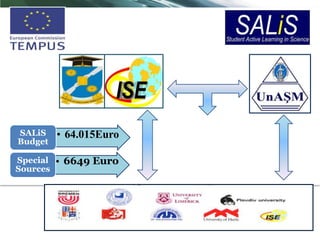
SALiS     • 64.015Euro
Budget

Special   • 6649 Euro
Sources
IES MAIN GOAL:


                     Promote and support contemporary scientific
                     education by developing scientific knowledge
                     competence of Science teachers from Moldova
                     through continuous education courses ; thus
                     contributing to effective implementation of
                     science in schools.

OBJECTIVES:
-develop conceptual framework /base in accordance to SAliS philosophy;
-develop teacher training theory and methodology through SALiS
(curricula, guides, etc.);
-provide conditions for scientific knowledge competence development within
teacher training course (equipping labs, staff training, etc.)
-ensure effective SALiS project implementation and continuity.
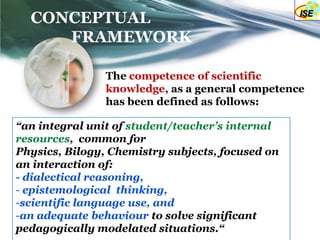
CONCEPTUAL
     FRAMEWORK

                The competence of scientific
                knowledge, as a general competence
                has been defined as follows:

“an integral unit of student/teacher’s internal
resources, common for
Physics, Bilogy, Chemistry subjects, focused on
an interaction of:
- dialectical reasoning,
- epistemological thinking,
-scientific language use, and
-an adequate behaviour to solve significant
pedagogically modelated situations.“
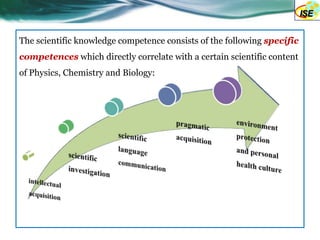
The scientific knowledge competence consists of the following specific
competences which directly correlate with a certain scientific content
of Physics, Chemistry and Biology:
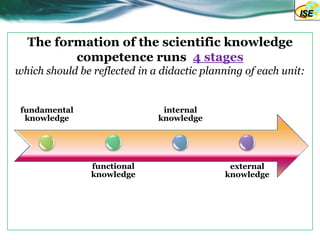
The formation of the scientific knowledge
         competence runs 4 stages
which should be reflected in a didactic planning of each unit:


 fundamental                   internal
  knowledge                   knowledge


                functional                   external
                knowledge                   knowledge
Scientific Knowledge
   Competence Development:

                         For a student/teacher to form the competence of scientific
                         knowledge as a final acquisition it is necessary:


- To master a set of fundamental knowledge depending on the problem to be solved;
- To develop skills of applying this knowledge in concrete situations for a better
scientific understanding ; this way achieving their functionality;
- To resolve different problem-solving situations; thus constructing their own
functional image of the knowledge;
  - To solve the significant daily problems in different contexts , by applying their
final acquision behaviour/attitudes; meaning competences.


the students/teachers’ scientific education developed through the competence
of scientific knowledge should be based on a methodological support and
       reasoning through observation, experiment and deduction.
Developed Teacher Training
Theory and Methodology
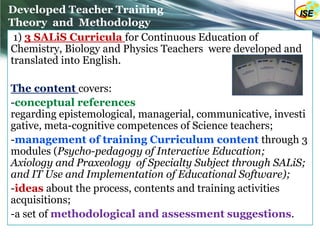
 1) 3 SALiS Curricula for Continuous Education of
Chemistry, Biology and Physics Teachers were developed and
translated into English.

The content covers:
-conceptual references
regarding epistemological, managerial, communicative, investi
gative, meta-cognitive competences of Science teachers;
-management of training Curriculum content through 3
modules (Psycho-pedagogy of Interactive Education;
Axiology and Praxeology of Specialty Subject through SALiS;
and IT Use and Implementation of Educational Software);
-ideas about the process, contents and training activities
acquisitions;
-a set of methodological and assessment suggestions.
Developed Teacher Training Theory and
                Methodology
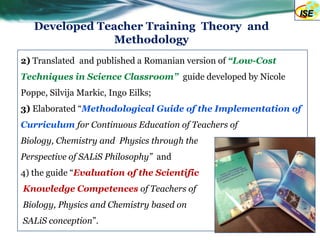
2) Translated and published a Romanian version of “Low-Cost
Techniques in Science Classroom” guide developed by Nicole
Poppe, Silvija Markic, Ingo Eilks;
3) Elaborated “Methodological Guide of the Implementation of
Curriculum for Continuous Education of Teachers of
Biology, Chemistry and Physics through the
Perspective of SALiS Philosophy” and
4) the guide “Evaluation of the Scientific
Knowledge Competences of Teachers of
Biology, Physics and Chemistry based on
SALiS conception”.
Developed Teacher
Training Theory and Methodology
         These documents will serve as a methodological support in
 teaching SALiS philosophy during Science teachers’ trainings as it
 argues conceptual dimensions of continuous development of the
 didactic staff from the perspective of SALiS concept and
 methodology of scientific knowledge competence development.

 They reflect:
  -the notion of teachers’ scientific knowledge competence;
 -the specific of teachers’ training curriculum;
 - the process of school curricula modernization; methodology of
 forming scientific knowledge competence;
 -active didactic strategies and technologies based on constructivist
 teaching-instruction process;
 -low-cost equipment in experimental research;
 -procedure of evaluating students/teachers’ scientific knowledge;
 -unit/lesson planning; and the interdisciplinary aspect in teaching.
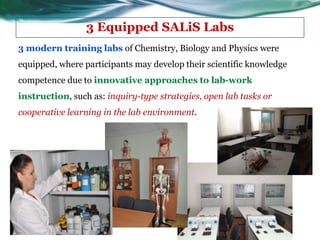
3 Equipped SALiS Labs
3 modern training labs of Chemistry, Biology and Physics were
equipped, where participants may develop their scientific knowledge
competence due to innovative approaches to lab-work
instruction, such as: inquiry-type strategies, open lab tasks or
cooperative learning in the lab environment.
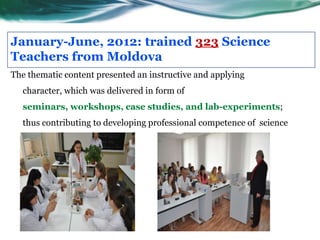
January-June, 2012: trained 323 Science
Teachers from Moldova
The thematic content presented an instructive and applying
  character, which was delivered in form of
  seminars, workshops, case studies, and lab-experiments;
  thus contributing to developing professional competence of science
  specialists from the country.
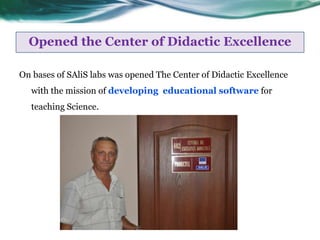
Opened the Center of Didactic Excellence

On bases of SAliS labs was opened The Center of Didactic Excellence
  with the mission of developing educational software for
  teaching Science.
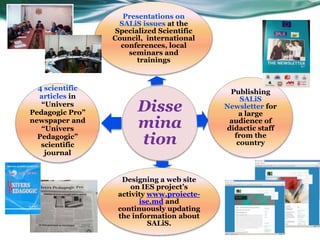
Presentations on
                   SALiS issues at the
                  Specialized Scientific
                 Council, international
                   conferences, local
                     seminars and
                        trainings


  4 scientific
                                            Publishing
  articles in                                  SALiS
   “Univers
Pedagogic Pro”          Disse              Newsletter for
                                               a large
newspaper and
   “Univers             mina                audience of
                                           didactic staff
  Pedagogic”
   scientific           tion                 from the
                                              country
    journal


                   Designing a web site
                      on IES project’s
                  activity www.proiecte-
                        ise.md and
                  continuously updating
                  the information about
                           SALiS.
Perspective view…


  Implementation
                         Providing all Science
  in mass of SALiS
                            teachers from
philosophy through
                        the country with the set
  teacher training
                          of methodological
      courses
                        guides developed within
(~700 Science teacher
                             SALiS project
      per year)
Thank You for Inspiration,
        Support
          and
    Collaboration!!!

     To Be Continued…

IES SALiS presentation at Final Conference, Tibilisi, August 27-31, 2012

  • 1.
    SALiS Project inthe Institute of Educational Sciences (IES): experiences and implementation SALiS Final Conference Tibilisi, Georgia August, 28-31 , 2012
  • 2.
    SALiS • 64.015Euro Budget Special • 6649 Euro Sources
  • 3.
    IES MAIN GOAL: Promote and support contemporary scientific education by developing scientific knowledge competence of Science teachers from Moldova through continuous education courses ; thus contributing to effective implementation of science in schools. OBJECTIVES: -develop conceptual framework /base in accordance to SAliS philosophy; -develop teacher training theory and methodology through SALiS (curricula, guides, etc.); -provide conditions for scientific knowledge competence development within teacher training course (equipping labs, staff training, etc.) -ensure effective SALiS project implementation and continuity.
  • 4.
    CONCEPTUAL FRAMEWORK The competence of scientific knowledge, as a general competence has been defined as follows: “an integral unit of student/teacher’s internal resources, common for Physics, Bilogy, Chemistry subjects, focused on an interaction of: - dialectical reasoning, - epistemological thinking, -scientific language use, and -an adequate behaviour to solve significant pedagogically modelated situations.“
  • 5.
    The scientific knowledgecompetence consists of the following specific competences which directly correlate with a certain scientific content of Physics, Chemistry and Biology:
  • 6.
    The formation ofthe scientific knowledge competence runs 4 stages which should be reflected in a didactic planning of each unit: fundamental internal knowledge knowledge functional external knowledge knowledge
  • 7.
    Scientific Knowledge Competence Development: For a student/teacher to form the competence of scientific knowledge as a final acquisition it is necessary: - To master a set of fundamental knowledge depending on the problem to be solved; - To develop skills of applying this knowledge in concrete situations for a better scientific understanding ; this way achieving their functionality; - To resolve different problem-solving situations; thus constructing their own functional image of the knowledge; - To solve the significant daily problems in different contexts , by applying their final acquision behaviour/attitudes; meaning competences. the students/teachers’ scientific education developed through the competence of scientific knowledge should be based on a methodological support and reasoning through observation, experiment and deduction.
  • 8.
    Developed Teacher Training Theoryand Methodology 1) 3 SALiS Curricula for Continuous Education of Chemistry, Biology and Physics Teachers were developed and translated into English. The content covers: -conceptual references regarding epistemological, managerial, communicative, investi gative, meta-cognitive competences of Science teachers; -management of training Curriculum content through 3 modules (Psycho-pedagogy of Interactive Education; Axiology and Praxeology of Specialty Subject through SALiS; and IT Use and Implementation of Educational Software); -ideas about the process, contents and training activities acquisitions; -a set of methodological and assessment suggestions.
  • 9.
    Developed Teacher TrainingTheory and Methodology 2) Translated and published a Romanian version of “Low-Cost Techniques in Science Classroom” guide developed by Nicole Poppe, Silvija Markic, Ingo Eilks; 3) Elaborated “Methodological Guide of the Implementation of Curriculum for Continuous Education of Teachers of Biology, Chemistry and Physics through the Perspective of SALiS Philosophy” and 4) the guide “Evaluation of the Scientific Knowledge Competences of Teachers of Biology, Physics and Chemistry based on SALiS conception”.
  • 10.
    Developed Teacher Training Theoryand Methodology These documents will serve as a methodological support in teaching SALiS philosophy during Science teachers’ trainings as it argues conceptual dimensions of continuous development of the didactic staff from the perspective of SALiS concept and methodology of scientific knowledge competence development. They reflect: -the notion of teachers’ scientific knowledge competence; -the specific of teachers’ training curriculum; - the process of school curricula modernization; methodology of forming scientific knowledge competence; -active didactic strategies and technologies based on constructivist teaching-instruction process; -low-cost equipment in experimental research; -procedure of evaluating students/teachers’ scientific knowledge; -unit/lesson planning; and the interdisciplinary aspect in teaching.
  • 11.
    3 Equipped SALiSLabs 3 modern training labs of Chemistry, Biology and Physics were equipped, where participants may develop their scientific knowledge competence due to innovative approaches to lab-work instruction, such as: inquiry-type strategies, open lab tasks or cooperative learning in the lab environment.
  • 12.
    January-June, 2012: trained323 Science Teachers from Moldova The thematic content presented an instructive and applying character, which was delivered in form of seminars, workshops, case studies, and lab-experiments; thus contributing to developing professional competence of science specialists from the country.
  • 13.
    Opened the Centerof Didactic Excellence On bases of SAliS labs was opened The Center of Didactic Excellence with the mission of developing educational software for teaching Science.
  • 14.
    Presentations on SALiS issues at the Specialized Scientific Council, international conferences, local seminars and trainings 4 scientific Publishing articles in SALiS “Univers Pedagogic Pro” Disse Newsletter for a large newspaper and “Univers mina audience of didactic staff Pedagogic” scientific tion from the country journal Designing a web site on IES project’s activity www.proiecte- ise.md and continuously updating the information about SALiS.
  • 15.
    Perspective view… Implementation Providing all Science in mass of SALiS teachers from philosophy through the country with the set teacher training of methodological courses guides developed within (~700 Science teacher SALiS project per year)
  • 16.
    Thank You forInspiration, Support and Collaboration!!! To Be Continued…

Editor's Notes

  • #2 Acest șablon se poate utiliza ca fișier de pornire pentru a furniza actualizări pentru proiect jaloane.SecțiuniClic cu butonul din dreapta pe un diapozitiv pentru a adăuga secțiuni. Secțiunile vă ajută să organizați diapozitivele sau să facilitați colaborarea între mai mulți autori.NoteUtilizați secțiunea Note pentru a livra note sau pentru a furniza detalii suplimentare pentru public. Vizualizați aceste note în Vizualizare prezentare în timpul prezentării. Luați în considerare dimensiunea fontului (importantă pentru accesibilitate, vizibilitate, înregistrare video și producția online)Culori coordonate Acordați atenție specială graficelor, diagramelor și casetelor text.Aveți în vedere că participanții vor imprima în alb-negru sau tonuri de gri. Efectuați un test de imprimare pentru a vă asigura că acele culori funcționează atunci când imprimați doar alb-negru și tonuri de gri.Ilustrații, tabele și graficePăstrați un aspect simplu: dacă este posibil, utilizați stiluri și culori consistente, care nu distrag atenția.Etichetați toate graficele și tabelele.
  • #6 Diapozitivele următoare se afișează mai multe exemple de cronologii utilizând elemente grafice SmartArt.Includeți o cronologie a proiectului, marcând clar jaloanele, datele importante, și evidențiați stadiul actual al proiectului.
  • #8 Se pregătesc diapozitive pentru anexă în evenimentul care are nevoie de mai multe detalii sau diapozitive suplimentare. De asemenea, anexa este utilă dacă prezentarea este distribuită ulterior.
  • #12 * Dacă vreun aceste probleme au provocat o întârziere în program sau trebuie să fie discutate mai amplu; detaliile în diapozitivul următor.
  • #13 Diapozitivul se dublează după cum este necesar dacă există mai multe probleme.Acesta și diapozitivele înrudite se poate muta la anexă sau se poate ascunde, dacă este necesar.
  • #15 Ce sunt dependențele acest lucru afectează cronologia, costurile și rezultatul acestui proiect?