NANO-TECHNOLOGY
BY: ABDUL REHMAN
DEFINATION:
• Nanotechnology is science, engineering, and technology conducted at
the nanoscale, which is about 1 to 100 nanometers.
• Nanoscience and nanotechnology are the study and application of
extremely small things and can be used across all the other science
fields, such as chemistry, biology, physics, materials science, and
engineering.
• The science of manipulating materials on an atomic or molecular scale
especially to build microscopic devices (such as robots).
CONTINUE…
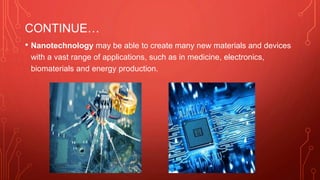
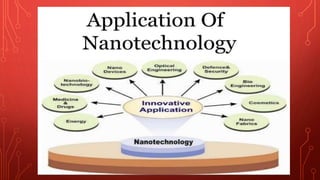
• Nanotechnology may be able to create many new materials and devices
with a vast range of applications, such as in medicine, electronics,
biomaterials and energy production.
FUNDAMENTAL CONCEPT IN
NANOTECHNOLOGY
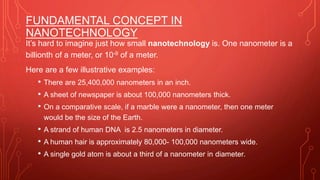
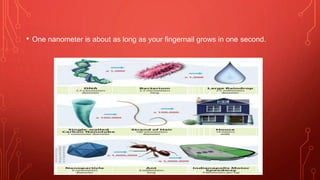
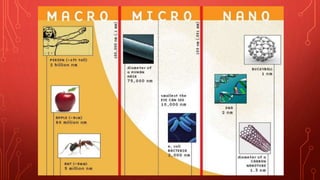
It’s hard to imagine just how small nanotechnology is. One nanometer is a
billionth of a meter, or 10-9 of a meter.
Here are a few illustrative examples:
• There are 25,400,000 nanometers in an inch.
• A sheet of newspaper is about 100,000 nanometers thick.
• On a comparative scale, if a marble were a nanometer, then one meter
would be the size of the Earth.
• A strand of human DNA is 2.5 nanometers in diameter.
• A human hair is approximately 80,000- 100,000 nanometers wide.
• A single gold atom is about a third of a nanometer in diameter.
• One nanometer is about as long as your fingernail grows in one second.
HISTORY:
• The ideas and concepts behind nanoscience and nanotechnology
started with a talk entitled “There’s Plenty of Room at the Bottom” by
physicist Richard Feynman at an American Physical Society meeting
at the California Institute of Technology (CalTech) on December 29,
1959.
• In this talk Feynman described a process in which scientists would be
able to manipulate and control individual atoms and molecules.
• Over a decade later, in his explorations of ultraprecision machining,
Professor Norio Taniguchi coined the term nanotechnology.
• Invention of the scanning tunneling microscope in 1981 and the
discovery of fullerene(C60) in1985 lead to the emergence of
nanotechnology.
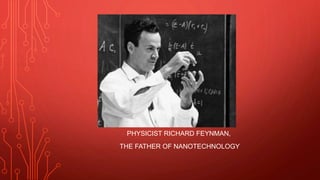
PHYSICIST RICHARD FEYNMAN,
THE FATHER OF NANOTECHNOLOGY
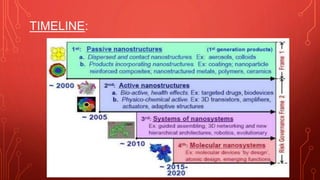
TIMELINE:
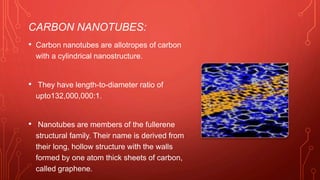
CARBON NANOTUBES:
• Carbon nanotubes are allotropes of carbon
with a cylindrical nanostructure.
• They have length-to-diameter ratio of
upto132,000,000:1.
• Nanotubes are members of the fullerene
structural family. Their name is derived from
their long, hollow structure with the walls
formed by one atom thick sheets of carbon,
called graphene.
Application:
• Highest strength to weight ratio, helps in creating light weight
spacecrafts.
• Easily penetrate membranes such as cell walls. Helps in cancer
treatment.
• Making the component of bicycle.
• For Manufacturing the light weight boats.
• Replacing transistors from the silicon chips as they are small and
emits less heat.
• In electric cables and wires
• In solar cells
• In fabrics
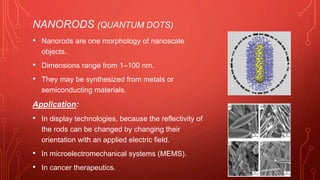
NANORODS (QUANTUM DOTS)
• Nanorods are one morphology of nanoscale
objects.
• Dimensions range from 1–100 nm.
• They may be synthesized from metals or
semiconducting materials.
Application:
• In display technologies, because the reflectivity of
the rods can be changed by changing their
orientation with an applied electric field.
• In microelectromechanical systems (MEMS).
• In cancer therapeutics.
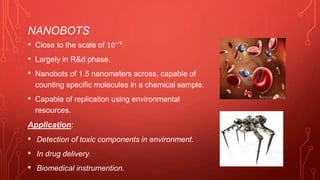
NANOBOTS
• Close to the scale of 10−9
• Largely in R&d phase.
• Nanobots of 1.5 nanometers across, capable of
counting specific molecules in a chemical sample.
• Capable of replication using environmental
resources.
Application:
• Detection of toxic components in environment.
• In drug delivery.
• Biomedical instrumention.
APPLICATION OF
NANOTECHNOLOGY
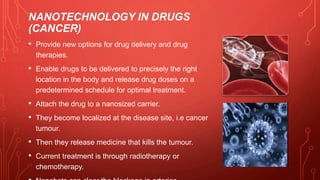
NANOTECHNOLOGY IN DRUGS
(CANCER)
• Provide new options for drug delivery and drug
therapies.
• Enable drugs to be delivered to precisely the right
location in the body and release drug doses on a
predetermined schedule for optimal treatment.
• Attach the drug to a nanosized carrier.
• They become localized at the disease site, i.e cancer
tumour.
• Then they release medicine that kills the tumour.
• Current treatment is through radiotherapy or
chemotherapy.
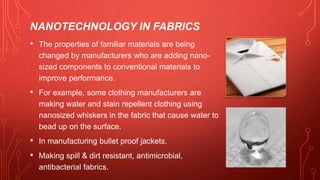
NANOTECHNOLOGY IN FABRICS
• The properties of familiar materials are being
changed by manufacturers who are adding nano-
sized components to conventional materials to
improve performance.
• For example, some clothing manufacturers are
making water and stain repellent clothing using
nanosized whiskers in the fabric that cause water to
bead up on the surface.
• In manufacturing bullet proof jackets.
• Making spill & dirt resistant, antimicrobial,
antibacterial fabrics.
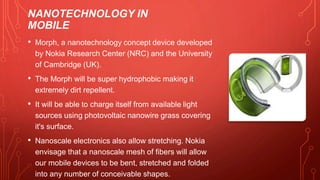
NANOTECHNOLOGY IN
MOBILE
• Morph, a nanotechnology concept device developed
by Nokia Research Center (NRC) and the University
of Cambridge (UK).
• The Morph will be super hydrophobic making it
extremely dirt repellent.
• It will be able to charge itself from available light
sources using photovoltaic nanowire grass covering
it's surface.
• Nanoscale electronics also allow stretching. Nokia
envisage that a nanoscale mesh of fibers will allow
our mobile devices to be bent, stretched and folded
into any number of conceivable shapes.
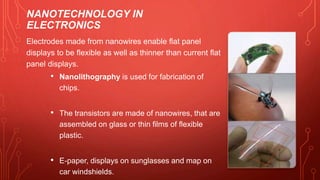
NANOTECHNOLOGY IN
ELECTRONICS
Electrodes made from nanowires enable flat panel
displays to be flexible as well as thinner than current flat
panel displays.
• Nanolithography is used for fabrication of
chips.
• The transistors are made of nanowires, that are
assembled on glass or thin films of flexible
plastic.
• E-paper, displays on sunglasses and map on
car windshields.
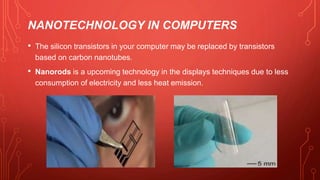
NANOTECHNOLOGY IN COMPUTERS
• The silicon transistors in your computer may be replaced by transistors
based on carbon nanotubes.
• Nanorods is a upcoming technology in the displays techniques due to less
consumption of electricity and less heat emission.
Nanotechnology may make it possible to manufacture lighter, stronger, and
programmable materials that:
• require less energy to produce than conventional material
• and that promise greater fuel efficiency in land transportation, ships,
aircraft, and space vehicles.
The future of nanotechnology could very well include the use of
nanorobotics.
These nanorobots have the potential to take on human tasks as well as
tasks that humans could never complete.
There would be an entire nano surgical field to help cure everything from
natural aging to diabetes to bone spurs.
PITFALLS OF NANOTECHNOLOGY
• Nano-particles can get into the body through the skin, lungs and
digestive system, thus creating free radicals that can cause cell
damage.
• Once nano-particles are in the bloodstream, they will be able to cross
the blood-brain barrier.
• The most dangerous Nano-application use for military purposes is the
Nano-bomb that contain engineered self multiplying deadly viruses that
can continue to wipe out a community, country or even a civilization.
"The Next Big Thing Is Really
Small”
ANY
QUESTION…???
Nano Technology

Nano Technology

  • 2.
  • 3.
    DEFINATION: • Nanotechnology isscience, engineering, and technology conducted at the nanoscale, which is about 1 to 100 nanometers. • Nanoscience and nanotechnology are the study and application of extremely small things and can be used across all the other science fields, such as chemistry, biology, physics, materials science, and engineering. • The science of manipulating materials on an atomic or molecular scale especially to build microscopic devices (such as robots).
  • 4.
    CONTINUE… • Nanotechnology maybe able to create many new materials and devices with a vast range of applications, such as in medicine, electronics, biomaterials and energy production.
  • 5.
    FUNDAMENTAL CONCEPT IN NANOTECHNOLOGY It’shard to imagine just how small nanotechnology is. One nanometer is a billionth of a meter, or 10-9 of a meter. Here are a few illustrative examples: • There are 25,400,000 nanometers in an inch. • A sheet of newspaper is about 100,000 nanometers thick. • On a comparative scale, if a marble were a nanometer, then one meter would be the size of the Earth. • A strand of human DNA is 2.5 nanometers in diameter. • A human hair is approximately 80,000- 100,000 nanometers wide. • A single gold atom is about a third of a nanometer in diameter.
  • 6.
    • One nanometeris about as long as your fingernail grows in one second.
  • 7.
    HISTORY: • The ideasand concepts behind nanoscience and nanotechnology started with a talk entitled “There’s Plenty of Room at the Bottom” by physicist Richard Feynman at an American Physical Society meeting at the California Institute of Technology (CalTech) on December 29, 1959. • In this talk Feynman described a process in which scientists would be able to manipulate and control individual atoms and molecules. • Over a decade later, in his explorations of ultraprecision machining, Professor Norio Taniguchi coined the term nanotechnology. • Invention of the scanning tunneling microscope in 1981 and the discovery of fullerene(C60) in1985 lead to the emergence of nanotechnology.
  • 8.
    PHYSICIST RICHARD FEYNMAN, THEFATHER OF NANOTECHNOLOGY
  • 10.
  • 11.
    CARBON NANOTUBES: • Carbonnanotubes are allotropes of carbon with a cylindrical nanostructure. • They have length-to-diameter ratio of upto132,000,000:1. • Nanotubes are members of the fullerene structural family. Their name is derived from their long, hollow structure with the walls formed by one atom thick sheets of carbon, called graphene.
  • 12.
    Application: • Highest strengthto weight ratio, helps in creating light weight spacecrafts. • Easily penetrate membranes such as cell walls. Helps in cancer treatment. • Making the component of bicycle. • For Manufacturing the light weight boats. • Replacing transistors from the silicon chips as they are small and emits less heat. • In electric cables and wires • In solar cells • In fabrics
  • 13.
    NANORODS (QUANTUM DOTS) •Nanorods are one morphology of nanoscale objects. • Dimensions range from 1–100 nm. • They may be synthesized from metals or semiconducting materials. Application: • In display technologies, because the reflectivity of the rods can be changed by changing their orientation with an applied electric field. • In microelectromechanical systems (MEMS). • In cancer therapeutics.
  • 14.
    NANOBOTS • Close tothe scale of 10−9 • Largely in R&d phase. • Nanobots of 1.5 nanometers across, capable of counting specific molecules in a chemical sample. • Capable of replication using environmental resources. Application: • Detection of toxic components in environment. • In drug delivery. • Biomedical instrumention.
  • 15.
  • 17.
    NANOTECHNOLOGY IN DRUGS (CANCER) •Provide new options for drug delivery and drug therapies. • Enable drugs to be delivered to precisely the right location in the body and release drug doses on a predetermined schedule for optimal treatment. • Attach the drug to a nanosized carrier. • They become localized at the disease site, i.e cancer tumour. • Then they release medicine that kills the tumour. • Current treatment is through radiotherapy or chemotherapy.
  • 18.
    NANOTECHNOLOGY IN FABRICS •The properties of familiar materials are being changed by manufacturers who are adding nano- sized components to conventional materials to improve performance. • For example, some clothing manufacturers are making water and stain repellent clothing using nanosized whiskers in the fabric that cause water to bead up on the surface. • In manufacturing bullet proof jackets. • Making spill & dirt resistant, antimicrobial, antibacterial fabrics.
  • 19.
    NANOTECHNOLOGY IN MOBILE • Morph,a nanotechnology concept device developed by Nokia Research Center (NRC) and the University of Cambridge (UK). • The Morph will be super hydrophobic making it extremely dirt repellent. • It will be able to charge itself from available light sources using photovoltaic nanowire grass covering it's surface. • Nanoscale electronics also allow stretching. Nokia envisage that a nanoscale mesh of fibers will allow our mobile devices to be bent, stretched and folded into any number of conceivable shapes.
  • 20.
    NANOTECHNOLOGY IN ELECTRONICS Electrodes madefrom nanowires enable flat panel displays to be flexible as well as thinner than current flat panel displays. • Nanolithography is used for fabrication of chips. • The transistors are made of nanowires, that are assembled on glass or thin films of flexible plastic. • E-paper, displays on sunglasses and map on car windshields.
  • 21.
    NANOTECHNOLOGY IN COMPUTERS •The silicon transistors in your computer may be replaced by transistors based on carbon nanotubes. • Nanorods is a upcoming technology in the displays techniques due to less consumption of electricity and less heat emission.
  • 22.
    Nanotechnology may makeit possible to manufacture lighter, stronger, and programmable materials that: • require less energy to produce than conventional material • and that promise greater fuel efficiency in land transportation, ships, aircraft, and space vehicles. The future of nanotechnology could very well include the use of nanorobotics. These nanorobots have the potential to take on human tasks as well as tasks that humans could never complete. There would be an entire nano surgical field to help cure everything from natural aging to diabetes to bone spurs.
  • 23.
    PITFALLS OF NANOTECHNOLOGY •Nano-particles can get into the body through the skin, lungs and digestive system, thus creating free radicals that can cause cell damage. • Once nano-particles are in the bloodstream, they will be able to cross the blood-brain barrier. • The most dangerous Nano-application use for military purposes is the Nano-bomb that contain engineered self multiplying deadly viruses that can continue to wipe out a community, country or even a civilization.
  • 24.
    "The Next BigThing Is Really Small”
  • 25.